

 |
市場調查報告書
商品編碼
2071287
炊具市場機會、成長要素、產業趨勢分析及 2026-2035 年預測。Cookware Market Opportunity, Growth Drivers, Industry Trend Analysis, and Forecast 2026 - 2035 |
||||||

預計到 2025 年,全球炊具市場價值將達到 375 億美元,年複合成長率為 4.1%,到 2035 年將達到 565 億美元。
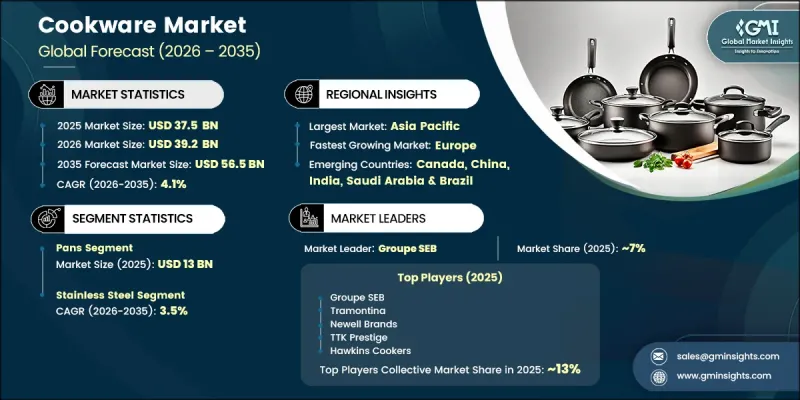
市場成長是由一系列長期行業趨勢共同驅動的,包括新興經濟體加速的城市化進程、餐飲服務業需求的成長,以及受監管標準演變推動的對新型廚具材料的偏好轉變。隨著消費者和企業客戶越來越傾向於選擇被認為更安全、更耐用的材料,廚具產業的產品組合正在發生顯著變化。成長的主要驅動力是發展中地區消費的擴張和對高階廚具產品需求的上升,而成熟市場由於家庭擁有率高、人口成長放緩,預計將保持相對穩定的需求模式。多個地區餐飲服務基礎設施的擴張正在創造對商用廚具解決方案的強勁需求。同時,消費者對廚具材料和表面塗層的認知度不斷提高,也促進了廚具的更換需求。因此,不銹鋼、鑄鐵、陶瓷塗層材料和碳鋼製成的廚具正被更廣泛地接受。監管政策的進步進一步強化了這一趨勢,將材料偏好轉化為推動市場持續成長的動力,並縮短了某些廚具類別的更換週期。
| 市場範圍 | |
|---|---|
| 開始年份 | 2025 |
| 預測期 | 2026-2035 |
| 上市時的市場規模 | 375億美元 |
| 預測金額 | 565億美元 |
| 複合年成長率 | 4.1% |
預計到2025年,煎鍋市場規模將達到130億美元,市佔率將維持在34.7%。此類別涵蓋了各種材質、尺寸和價格範圍的炊具,適用於住宅和商用。這些產品的多功能性和日常實用性正在推動主要區域市場需求的持續成長。炊具材料方面的監管趨勢也促進了替換需求的增加,隨著現有產品逐步被新產品取代,預計在整個預測期內,煎鍋銷售量更換持續成長。
預計到2025年,北美廚具市場規模將達74億美元。全部區域的需求持續受到消費者對高品質廚具的需求、對耐用材料的日益偏好以及不斷成長的更換需求的驅動。高級產品類別體現了消費者對經久耐用廚具的投資意願,在該地區的產生收入中繼續發揮著尤為重要的作用。
目錄
第1章:調查方法和範圍
第2章執行摘要
第3章 行業洞察
- 產業生態系分析
- 供應商情況
- 利潤率
- 每個階段增加的價值
- 影響價值鏈的因素
- 影響產業的因素
- 促進因素
- 全球食品服務與飯店餐飲業擴張
- 新興市場的都市化與家庭形成
- 健康環保材料和塗層的改進正在加速產品更換週期。
- 線上零售的興起和數位優先品牌的湧現
- 產業潛在風險與挑戰
- 不銹鋼和鋁等原料價格的波動
- 市場分散且價格競爭激烈
- 西歐和北美成熟市場的飽和
- 機會
- 對高品質、無毒烹飪用具的需求
- 專用和多功能烹飪用具
- 促進因素
- 成長潛力分析
- 未來市場趨勢
- 技術與創新展望
- 最新科技趨勢
- 新興技術
- 監理情勢
- 標準和合規要求
- 區域監理框架
- 認證標準
- 貿易數據分析
- 進出口量及進口額趨勢
- 主要貿易路線及關稅的影響
- 價格分析
- 對過去價格趨勢的分析
- 按業務類型(高階/低階/大眾市場)分類的定價策略
- 人工智慧和生成式人工智慧對市場的影響
- 利用人工智慧改造現有經營模式
- 按細分市場分類的生成式人工智慧用例和部署藍圖
- 風險、限制和監管考量
- 波特的分析
- PESTLE分析
- 消費者購買行為分析
- 人口趨勢
- 影響購買決策的因素
- 消費者產品採納
- 首選分銷管道
第4章 競爭情勢
- 介紹
- 企業市佔率分析
- 按地區
- 企業矩陣分析
- 主要市場公司的競爭分析
- 競爭定位矩陣
- 主要進展
- 併購
- 夥伴關係和聯盟
- 新產品發布
- 業務拓展計劃
第5章 市場估算與預測:依產品類型分類,2022-2035年
- Pans
- 煎鍋和長柄平鍋
- 煎鍋
- 平底鍋
- 烤麵包
- 烤盤和煎鍋
- 鍋
- 荷蘭烤鍋和燉鍋
- 湯鍋和燉鍋
- 胸罩
- 油炸鍋
- 烘焙用品
- 蛋糕模具和鬆餅模具
- 烤盤和烤架
- 麵包條模具
- 活底模具與特殊烘焙模具
- 壓力鍋
- 爐灶式壓力鍋
- 多功能壓力鍋系統
- 廚房用品及配件
- 傳統圓底炒鍋
- 平底、適用於電磁爐的炒鍋
- 民族和地區特色烹飪用具
- 其他
第6章 市場估計與預測:依材料分類,2022-2035年
- 不銹鋼
- 鋁和陽極氧化鋁
- 鑄鐵和搪瓷鑄鐵
- 碳鋼
- 陶瓷玻璃
- 其他
第7章 市場估算與預測:依塗層類型分類,2022-2035年
- 聚四氟乙烯/鐵氟龍塗層
- 陶瓷塗層
- 硬質陽極處理
- 搪瓷塗層
- 先進混合塗層
第8章 市場估計與預測:依價格分類,2022-2035年
- 低的
- 中等的
- 高的
第9章 市場估價與預測:依最終用戶分類,2022-2035年
- 住宅
- 商業
- HoReCa
- 麵包店
- 餐飲服務
- 其他
第10章 市場估價與預測:依通路分類,2022-2035年
- 線上
- 電子商務網站
- 公司網站
- 離線
- 專賣店
- 大型零售商店
- 其他
第11章 市場估價與預測:按地區分類,2022-2035年
- 北美洲
- 美國
- 加拿大
- 歐洲
- 德國
- 英國
- 法國
- 義大利
- 西班牙
- 亞太地區
- 中國
- 印度
- 日本
- 韓國
- 澳洲
- 印尼
- 馬來西亞
- 拉丁美洲
- 巴西
- 墨西哥
- 阿根廷
- 中東和非洲
- 沙烏地阿拉伯
- UAE
- 南非
第12章:公司簡介
- All-Clad
- BERNDES Kuchen
- Calphalon
- Coleman
- Cuisinart
- GoodCook
- GreenPan
- Groupe SEB
- Hawkins Cookers
- Heritage Steel
- Meyer Corporation
- NuWave
- Tramontina
- TTK Prestige
- Zwilling
The Global Cookware Market was valued at USD 37.5 billion in 2025 and is estimated to grow at a CAGR of 4.1% to reach USD 56.5 billion by 2035.
Market growth is supported by a combination of long-term industry trends, including accelerating urban development across emerging economies, increasing demand from the hospitality and foodservice industry, and the ongoing transition toward alternative cookware materials driven by evolving regulatory standards. The cookware industry is experiencing a notable shift in product composition as consumers and commercial buyers increasingly favor materials perceived as safer and more durable. Growth is expected to be fueled primarily by rising consumption across developing regions and increasing demand for premium cookware products, while mature markets continue to demonstrate relatively stable demand patterns due to already high household ownership rates and slower population growth. Expanding foodservice infrastructure across multiple regions is creating strong demand for professional-grade cookware solutions. At the same time, growing awareness regarding cookware materials and surface coatings is encouraging replacement purchases among consumers. As a result, cookware made from stainless steel, cast iron, ceramic-coated materials, and carbon steel is gaining broader acceptance. Regulatory developments are further strengthening this trend, transforming material preferences into a sustained market growth driver and contributing to shorter replacement cycles for certain cookware categories.
| Market Scope | |
|---|---|
| Start Year | 2025 |
| Forecast Year | 2026-2035 |
| Start Value | $37.5 Billion |
| Forecast Value | $56.5 Billion |
| CAGR | 4.1% |
The pans segment accounted for USD 13 billion in 2025, holding 34.7% share. This category includes a wide variety of cookware products designed for both residential and commercial applications, available in multiple materials, sizes, and price ranges. Demand continues to expand across major regional markets due to the versatility and everyday utility of these products. Regulatory developments related to cookware materials are also contributing to increased replacement demand, creating sustained volume growth opportunities throughout the forecast period as existing products are gradually replaced with newer alternatives.
North America Cookware Market reached USD 7.4 billion in 2025. Demand across the region continues to be supported by consumer interest in high-quality cookware, growing preference for durable materials, and ongoing replacement purchasing activity. Premium product categories remain particularly important to regional revenue generation, reflecting consumers' willingness to invest in long-lasting kitchen equipment.
Key companies operating in the global cookware market include Groupe SEB, Tramontina, Newell Brands, Meyer Corporation, Le Creuset, Zwilling J.A. Henckels, Lodge Cast Iron, Fissler, TTK Prestige, and Hawkins Cookers. Leading cookware manufacturers are strengthening their market position through a combination of product innovation, premiumization, and portfolio diversification. Companies are investing heavily in research and development to introduce advanced cookware materials, improved durability, enhanced heat distribution, and safer cooking surfaces that align with evolving consumer preferences and regulatory requirements. Many industry participants are expanding their direct-to-consumer channels and digital commerce capabilities to improve customer engagement and increase brand visibility. Strategic partnerships with retailers, foodservice operators, and distribution networks are helping manufacturers broaden market reach and improve product accessibility. Businesses are also focusing on sustainability initiatives, including environmentally responsible manufacturing processes and recyclable materials.
Table of Contents
Chapter 1 Methodology & Scope
- 1.1 Market scope and definition
- 1.2 Research design
- 1.2.1 Research approach
- 1.2.2 Data collection methods
- 1.3 Data mining sources
- 1.3.1 Global
- 1.3.2 Regional/Country
- 1.4 Base estimates and calculations
- 1.4.1 Base year calculation
- 1.4.2 Key trends for market estimation
- 1.5 Primary research and validation
- 1.5.1 Primary sources
- 1.6 Forecast model
- 1.7 Research assumptions and limitations
Chapter 2 Executive Summary
- 2.1 Industry 360° synopsis
- 2.2 Key market trends
- 2.2.1 Regional
- 2.2.2 Product type
- 2.2.3 Material
- 2.2.4 Coating type
- 2.2.5 Price
- 2.2.6 End use
- 2.2.7 Distribution channel
Chapter 3 Industry Insights
- 3.1 Industry ecosystem analysis
- 3.1.1 Supplier landscape
- 3.1.2 Profit margin
- 3.1.3 Value addition at each stage
- 3.1.4 Factor affecting the value chain
- 3.2 Industry impact forces
- 3.2.1 Growth drivers
- 3.2.1.1 Rising global foodservice and HoReCa expansion
- 3.2.1.2 Urbanization and household formation in emerging markets
- 3.2.1.3 Health-conscious material and coating upgrades driving replacement cycles
- 3.2.1.4 Online retail penetration and digital-first brand emergence
- 3.2.2 Industry pitfalls & challenges
- 3.2.2.1 Raw material price volatility for stainless steel and aluminum
- 3.2.2.2 Market fragmentation and intense price competition
- 3.2.2.3 Mature market saturation in Western Europe and North America
- 3.2.3 Opportunities
- 3.2.3.1 Premium & non-toxic cookware demand
- 3.2.3.2 Specialty & multi-functional cookware
- 3.2.1 Growth drivers
- 3.3 Growth potential analysis
- 3.4 Future market trends
- 3.5 Technology and innovation landscape
- 3.5.1 Current technological trends
- 3.5.2 Emerging technologies
- 3.6 Regulatory landscape
- 3.6.1 Standards and compliance requirements
- 3.6.2 Regional regulatory frameworks
- 3.6.3 Certification standards
- 3.7 Trade data analysis (HS Code 732393)
- 3.7.1 Import/export volume & value trends
- 3.7.2 Key trade corridors & tariff impact
- 3.8 Pricing analysis
- 3.8.1 Historical price trend analysis (driven by primary research)
- 3.8.2 Pricing strategy by player type (premium / value / mass market)
- 3.9 Impact of AI & generative AI on the market
- 3.9.1 AI-driven disruption of existing business models
- 3.9.2 GenAI use cases & adoption roadmap by segment
- 3.9.3 Risks, limitations & regulatory considerations
- 3.10 Porter's analysis
- 3.11 PESTEL analysis
- 3.12 Consumer buying behavior analysis
- 3.12.1 Demographic trends
- 3.12.2 Factors affecting buying decisions
- 3.12.3 Consumer product adoption
- 3.12.4 Preferred distribution channel
Chapter 4 Competitive Landscape, 2025
- 4.1 Introduction
- 4.2 Company market share analysis
- 4.2.1 By Region
- 4.2.1.1 North America
- 4.2.1.2 Europe
- 4.2.1.3 Asia Pacific
- 4.2.1.4 Latin America
- 4.2.1.5 Middle East & Africa
- 4.2.1 By Region
- 4.3 Company matrix analysis
- 4.4 Competitive analysis of major market players
- 4.5 Competitive positioning matrix
- 4.6 Key developments
- 4.6.1 Mergers & acquisitions
- 4.6.2 Partnerships & collaborations
- 4.6.3 New product launches
- 4.6.4 Expansion plans
Chapter 5 Market Estimates & Forecast, By Product Type, 2022 - 2035, (USD Billion) (Million Units)
- 5.1 Key trends
- 5.2 Pans
- 5.2.1 Fry pans & skillets
- 5.2.2 Saute pans
- 5.2.3 Saucepans
- 5.2.4 Roasting pans
- 5.2.5 Grill pans & griddles
- 5.3 Pots
- 5.3.1 Dutch ovens & cocottes
- 5.3.2 Stock pots & sauce pots
- 5.3.3 Braziers
- 5.3.4 Fryer pots
- 5.4 Bakeware
- 5.4.1 Cake pans & muffin pans
- 5.4.2 Sheet pans & roasting trays
- 5.4.3 Bread & loaf pans
- 5.4.4 Springform & specialty baking molds
- 5.5 Pressure cookers
- 5.5.1 Stovetop pressure cookers
- 5.5.2 Multi-function pressure cooker systems
- 5.6 Kitchen tools & accessories
- 5.6.1 Traditional round-bottom woks
- 5.6.2 Flat-bottom & induction-ready woks
- 5.6.3 Ethnic & regional specialty cookware
- 5.7 Other
Chapter 6 Market Estimates & Forecast, By Material, 2022 - 2035, (USD Billion) (Million Units)
- 6.1 Key trends
- 6.2 Stainless steel
- 6.3 Aluminum & anodized aluminum
- 6.4 Cast iron & enamelled cast iron
- 6.5 Carbon steel
- 6.6 Ceramic & glass
- 6.7 Others
Chapter 7 Market Estimates & Forecast, By Coating Type, 2022 - 2035, (USD Billion) (Million Units)
- 7.1 Key trends
- 7.2 PTFE / Teflon coated
- 7.3 Ceramic coated
- 7.4 Hard-anodized
- 7.5 Enamel coated
- 7.6 Advanced & hybrid coatings
Chapter 8 Market Estimates & Forecast, By Price, 2022 - 2035, (USD Billion) (Million Units)
- 8.1 Key trends
- 8.2 Low
- 8.3 Medium
- 8.4 High
Chapter 9 Market Estimates & Forecast, By End User, 2022 - 2035, (USD Billion) (Million Units)
- 9.1 Key trends
- 9.2 Residential
- 9.3 Commercial
- 9.3.1 HoReCa
- 9.3.2 Bakery
- 9.3.3 Catering services
- 9.3.4 Others
Chapter 10 Market Estimates & Forecast, By Distribution Channel, 2022 - 2035, (USD Billion) (Million Units)
- 10.1 Key trends
- 10.2 Online
- 10.2.1 E-commerce sites
- 10.2.2 Company websites
- 10.3 Offline
- 10.3.1 Specialty stores
- 10.3.2 Mega retail stores
- 10.3.3 Others
Chapter 11 Market Estimates & Forecast, By Region, 2022 - 2035, (USD Billion) (Million Units)
- 11.1 Key trends
- 11.2 North America
- 11.2.1 U.S.
- 11.2.2 Canada
- 11.3 Europe
- 11.3.1 Germany
- 11.3.2 UK
- 11.3.3 France
- 11.3.4 Italy
- 11.3.5 Spain
- 11.4 Asia Pacific
- 11.4.1 China
- 11.4.2 India
- 11.4.3 Japan
- 11.4.4 South Korea
- 11.4.5 Australia
- 11.4.6 Indonesia
- 11.4.7 Malaysia
- 11.5 Latin America
- 11.5.1 Brazil
- 11.5.2 Mexico
- 11.5.3 Argentina
- 11.6 MEA
- 11.6.1 Saudi Arabia
- 11.6.2 UAE
- 11.6.3 South Africa
Chapter 12 Company Profiles
- 12.1 All-Clad
- 12.2 BERNDES Kuchen
- 12.3 Calphalon
- 12.4 Coleman
- 12.5 Cuisinart
- 12.6 GoodCook
- 12.7 GreenPan
- 12.8 Groupe SEB
- 12.9 Hawkins Cookers
- 12.10 Heritage Steel
- 12.11 Meyer Corporation
- 12.12 NuWave
- 12.13 Tramontina
- 12.14 TTK Prestige
- 12.15 Zwilling

 炊具市場-2026-2032年全球市場預測
 永續炊具市場:商業機會、成長要素、產業趨勢分析及2026-2035年預測不鏽鋼炊具市場:2026-2032年全球市場預測(依產品類型、材質等級、表面處理、銷售管道和最終用戶分類)
 2026-2030年全球炊具市場
 全球炊具市場規模、佔有率、趨勢和成長分析報告(2026-2034年)
 日本廚具市場規模、佔有率、趨勢及預測(按類型、產品類型、材質、應用、通路及地區分類),2026-2034年
 一次性炊具市場-全球產業規模、佔有率、趨勢、機會和預測:按材料類型、應用、分銷管道、地區和競爭格局分類,2021-2031年炊具市場-全球產業規模、佔有率、趨勢、機會及預測(依材料、應用、通路、地區及競爭格局分類,2021-2031年)
 炊具市場規模、佔有率和成長分析(按類型、產品類型、材質、應用、通路和地區分類)-2026-2033年產業預測高階炊具市場機會、成長動力、產業趨勢分析及 2025 - 2034 年預測