


 |
市場調查報告書
商品編碼
2071273
電刺激設備市場:商業機會、成長要素、產業趨勢分析及2026-2035年預測Electrical Stimulators Market Opportunity, Growth Drivers, Industry Trend Analysis, and Forecast 2026 - 2035 |
||||||

全球電刺激設備市場預計到 2025 年將價值 69 億美元,預計到 2035 年將以 7.3% 的複合年成長率成長至 141 億美元。
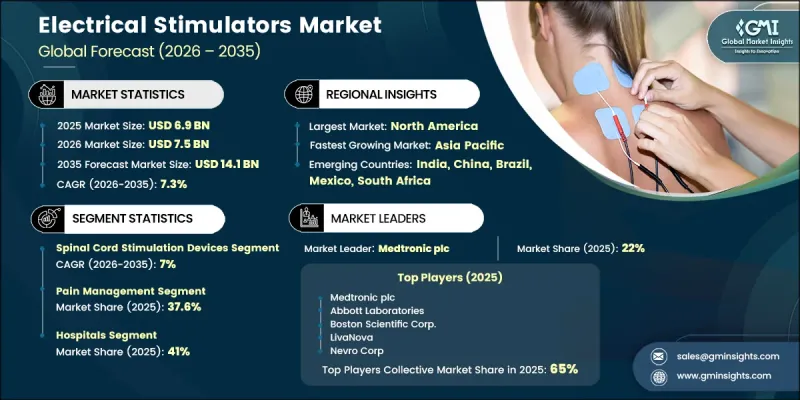
市場成長的促進因素包括神經系統疾病盛行率的上升、人們對非侵入性和非藥物治療方法的日益青睞、刺激技術的不斷進步,以及這些設備在復健和物理治療中日益廣泛的應用。持續創新仍然是關鍵的成長要素,現代設備提供更高的精度、更緊湊的設計以及可根據患者個體需求量身定做的可程式設計功能,從而帶來更好的治療效果。無線連接、可充電植入系統、封閉回路型回饋機制和人工智慧 (AI) 整合等技術進步顯著提高了設備效率和患者體驗。穿戴式和家用刺激器的出現進一步拓展了其在傳統臨床環境之外的應用,從而推動了市場的長期成長。
| 市場範圍 | |
|---|---|
| 開始年份 | 2025 |
| 預測期 | 2026-2035 |
| 初始市場規模 | 69億美元 |
| 預計金額 | 141億美元 |
| 複合年成長率 | 7.3% |
電刺激設備是一種治療性醫療設備,它透過向神經、肌肉或特定腦區傳送可控的電脈衝,來促進功能恢復、緩解疼痛或輔助復健。這些脈衝模擬了人體自然的電訊號傳導過程,進而改善生理功能並加速復原。
預計到2025年,脊髓刺激設備市佔率將達到41.7%,到2035年將達到57億美元,複合年成長率(CAGR)為7%。該細分市場保持領先地位,尤其是在傳統治療方法效果不佳的慢性疼痛治療領域,主導應用日益廣泛。這些植入式系統透過傳輸電訊號阻斷疼痛傳導路徑發揮作用。慢性疾病的日益普遍以及人們對微創療法的偏好不斷增強,正在加速該細分市場的需求成長。先進的電源系統、無線控制和增強的刺激功能等技術進步,進一步推動了該細分市場的普及和治療效果的提升。
預計到2025年,醫院市場將佔全球市場佔有率的41%,並在2026年至2035年間達到57億美元。由於醫院擁有先進的基礎設施和訓練有素的醫護人員,因此仍然是主要的終端用戶場所。電刺激設備在這些機構中被應用於多種治療領域,包括疼痛管理、神經系統疾病治療和術後復健。龐大的患者群體和獲得專業治療方案的機會持續推動對植入式和非侵入式設備的需求。此外,醫院在推廣新興技術方面發揮著至關重要的作用,這支撐著整個市場的發展。
到2025年,北美電刺激設備市佔率將達到38.5%。該地區是一個高度發展的市場,擁有完善的醫療保健體系和先進醫療技術的快速應用。慢性病和神經系統疾病患者數量的不斷成長,推動了對神經調控療法的需求。有利的保險報銷政策和監管支持,進一步加速了植入式和非侵入式刺激解決方案在全部區域的應用。
目錄
第1章:調查方法
第2章執行摘要
第3章 行業洞察
- 產業生態系分析
- 影響產業的因素
- 促進因素
- 神經退化性疾病盛行率增加
- 電刺激設備的技術進步
- 對非侵入性和無藥物治療方法的需求日益成長
- 在復健和物理治療領域不斷拓展應用。
- 產業潛在風險與挑戰
- 對刺激器實施嚴格的監管流程
- 植入式刺激器的初始成本高昂,且手術過程也較為複雜。
- 市場機遇
- 與數位健康和遠端醫療平台整合
- 家庭和遠端醫療解決方案的開發
- 促進因素
- 成長潛力分析
- 監理情勢
- 技術展望
- 最新科技趨勢
- 新興技術
- 未來市場趨勢
- 波特的分析
- PESTLE分析
- 價格趨勢分析
- 創業場景
- 人工智慧和生成式人工智慧對市場的影響
- 投資與資金籌措分析
- 差距分析
第4章 競爭情勢
- 介紹
- 企業矩陣分析
- 企業市佔率分析
- 世界
- 北美洲
- 歐洲
- 亞太地區
- 競爭定位矩陣
- 主要市場公司的競爭分析
- 主要進展
- 併購
- 夥伴關係和聯盟
- 新產品發布
- 業務拓展計劃
第5章 市場估算與預測:依產品類型分類,2022-2035年
- 經皮神經電刺激(TENS)裝置
- 神經肌肉電刺激設備(NMES)
- 深部腦部刺激器
- 脊髓刺激設備
- 薦椎神經刺激(SNS)裝置
- 迷走神經刺激(VNS)裝置
- 其他產品
第6章 市場估計與預測:依應用領域分類,2022-2035年
- 疼痛管理
- 肌肉骨骼疾病的治療
- 神經系統疾病和運動障礙的管理
- 尿失禁及骨盆底健康管理
- 代謝和胃腸道管理
- 美麗
- 其他用途
第7章 市場估計與預測:依最終用途分類,2022-2035年
- 醫院
- 門診手術中心(ASC)
- 物理治療和復健中心
- 居家醫療
- 其他最終用戶
第8章 市場估計與預測:依地區分類,2022-2035年
- 北美洲
- 美國
- 加拿大
- 歐洲
- 德國
- 英國
- 法國
- 西班牙
- 義大利
- 荷蘭
- 亞太地區
- 中國
- 日本
- 印度
- 澳洲
- 韓國
- 拉丁美洲
- 巴西
- 墨西哥
- 阿根廷
- 中東和非洲
- 南非
- 沙烏地阿拉伯
- UAE
第9章:公司簡介
- Abbott Laboratories
- BIOTRONIK
- Boston Scientific Corp.
- BTL Corporate
- DJO Global
- electroCore
- HASOMED
- LivaNova plc
- Mainstay Medical
- Medtronic plc
- Nalu Medical
- Nevro Corp
- Omron Healthcare
- Zynex Medical
The Global Electrical Stimulators Market was valued at USD 6.9 billion in 2025 and is estimated to grow at a CAGR of 7.3% to reach USD 14.1 billion by 2035.
Market growth is driven by the rising incidence of neurological conditions, increasing preference for non-invasive and drug-free treatment approaches, ongoing advancements in stimulation technologies, and the expanding role of these devices in rehabilitation and physiotherapy applications. Continuous innovation remains a key growth driver, with modern devices offering enhanced precision, compact designs, and programmable features tailored to individual patient needs, leading to improved therapeutic outcomes. Advancements such as wireless connectivity, rechargeable implant systems, closed-loop feedback mechanisms, and integration of artificial intelligence are significantly improving device efficiency and patient experience. The emergence of wearable and home-based stimulators is further broadening accessibility beyond traditional clinical environments, strengthening long-term market expansion.
| Market Scope | |
|---|---|
| Start Year | 2025 |
| Forecast Year | 2026-2035 |
| Start Value | $6.9 Billion |
| Forecast Value | $14.1 Billion |
| CAGR | 7.3% |
Electrical stimulators are therapeutic medical devices that deliver controlled electrical impulses to nerves, muscles, or targeted brain regions to restore function, alleviate pain, or aid in rehabilitation. These impulses replicate the body's natural electrical signaling processes to support improved physiological performance and recovery outcomes.
The spinal cord stimulation devices segment accounted for 41.7% share in 2025 and is projected to reach USD 5.7 billion by 2035, growing at a CAGR of 7%. This segment maintains its leading position due to increasing adoption for chronic pain management, particularly in cases where conventional treatments are less effective. These implantable systems function by transmitting electrical signals that disrupt pain transmission pathways. Rising cases of chronic conditions and growing preference for minimally invasive therapies are accelerating segment demand. Technological enhancements, including advanced power systems, wireless control, and improved stimulation capabilities, are further strengthening adoption and treatment outcomes.
The hospitals segment held a 41% share in 2025 and is expected to reach USD 5.7 billion during 2026- 2035. Hospitals remain the primary end-use setting due to the availability of advanced infrastructure and trained healthcare professionals. These facilities utilize electrical stimulators across multiple therapeutic areas, including pain management, neurological care, and post-procedure recovery. High patient volumes and access to specialized treatment solutions continue to drive demand for both implantable and non-invasive devices. Additionally, hospitals play a critical role in adopting emerging technologies, which supports overall market development.
North America Electrical Stimulators Market accounted for 38.5% share in 2025. The region represents a highly developed market supported by strong healthcare systems and rapid integration of advanced medical technologies. A growing patient population affected by chronic conditions and neurological disorders is driving demand for neuromodulation therapies. Favorable reimbursement policies and regulatory support are further encouraging the adoption of both implantable and non-invasive stimulation solutions across the region.
Major players operating in the global electrical stimulators industry include Abbott Laboratories, Medtronic plc, Boston Scientific Corp., LivaNova plc, BIOTRONIK, Nevro Corp, electroCore, DJO Global, Omron Healthcare, Zynex Medical, BTL Corporate, HASOMED, Mainstay Medical, and Nalu Medical. Companies in the electrical stimulators market are focusing on innovation-driven growth strategies to strengthen their competitive position. Manufacturers are investing in research and development to introduce advanced technologies such as AI-enabled stimulation systems, wireless devices, and personalized therapy solutions. Strategic collaborations with healthcare providers and research institutions are supporting product development and clinical validation. Firms are expanding their product portfolios to address a wider range of medical conditions and patient needs. Increasing emphasis on minimally invasive and home-use devices is improving accessibility and patient compliance.
Table of Contents
Chapter 1 Research Methodology
- 1.1 Research approach
- 1.2 Quality commitments
- 1.2.1 GMI AI policy & data integrity commitment
- 1.2.1.1 Source consistency protocol
- 1.2.1 GMI AI policy & data integrity commitment
- 1.3 Research trail & confidence scoring
- 1.3.1 Research trail components
- 1.3.2 Scoring components
- 1.4 Data collection
- 1.4.1 Partial list of primary sources
- 1.5 Data mining sources
- 1.5.1 Paid sources
- 1.5.1.1 Sources, by region
- 1.5.1 Paid sources
- 1.6 Base estimates and calculations
- 1.6.1 Base year calculation for any one approach
- 1.7 Forecast model
- 1.7.1 Quantified market impact analysis
- 1.7.1.1 Mathematical impact of growth parameters on forecast
- 1.7.1 Quantified market impact analysis
- 1.8 Research transparency addendum
- 1.8.1 Source attribution framework
- 1.8.2 Quality assurance metrics
- 1.8.3 Our commitment to trust
Chapter 2 Executive Summary
- 2.1 Industry 3600 synopsis
- 2.2 Key market trends
- 2.2.1 Regional trends
- 2.2.2 Product type trends
- 2.2.3 Application trends
- 2.2.4 End use trends
- 2.3 CXO perspectives: Strategic imperatives
Chapter 3 Industry Insights
- 3.1 Industry ecosystem analysis
- 3.2 Industry impact forces
- 3.2.1 Growth drivers
- 3.2.1.1 Increasing prevalence of neuro-degenerative disorder
- 3.2.1.2 Technological advancements in electrical stimulators
- 3.2.1.3 Growing demand for non-invasive and drug-free therapies
- 3.2.1.4 Expanding applications in rehabilitation and physiotherapy
- 3.2.2 Industry pitfalls and challenges
- 3.2.2.1 Stringent regulatory process for stimulation devices
- 3.2.2.2 High upfront cost of implantable stimulators and associated procedure complexity
- 3.2.3 Market opportunities
- 3.2.3.1 Integration with digital health and telemedicine platforms
- 3.2.3.2 Development of home-based and remote therapy solutions
- 3.2.1 Growth drivers
- 3.3 Growth potential analysis
- 3.4 Regulatory landscape (Driven by primary research)
- 3.4.1 North America
- 3.4.2 Europe
- 3.4.3 Asia Pacific
- 3.4.4 Latin America
- 3.4.5 MEA
- 3.5 Technology landscape
- 3.5.1 Current technological trends
- 3.5.2 Emerging technologies
- 3.6 Future market trends (Driven by primary research)
- 3.7 Porter's analysis
- 3.8 PESTEL analysis
- 3.9 Pricing trend analysis (Driven by primary research)
- 3.10 Start-up scenarios (Driven by primary research)
- 3.11 Impact of AI and Generative AI on the market
- 3.12 Investment and funding analysis
- 3.13 Gap analysis
Chapter 4 Competitive Landscape, 2025
- 4.1 Introduction
- 4.2 Company matrix analysis
- 4.3 Company market share analysis (Driven by primary research)
- 4.3.1 Global
- 4.3.2 North America
- 4.3.3 Europe
- 4.3.4 Asia Pacific
- 4.4 Competitive positioning matrix
- 4.5 Competitive analysis of major market players
- 4.6 Key developments
- 4.6.1 Mergers & acquisitions
- 4.6.2 Partnerships & collaborations
- 4.6.3 New product launches
- 4.6.4 Expansion plans
Chapter 5 Market Estimates and Forecast, By Product Type, 2022 - 2035 ($ Mn)
- 5.1 Key trends
- 5.2 Transcutaneous electrical nerve stimulation (TENS) devices
- 5.3 Neuromuscular electric stimulator (NMES)
- 5.4 Deep brain stimulation devices
- 5.5 Spinal cord stimulation devices
- 5.6 Sacral nerve stimulation (SNS) devices
- 5.7 Vagus nerve stimulation (VNS) devices
- 5.8 Other products
Chapter 6 Market Estimates and Forecast, By Application, 2022 - 2035 ($ Mn)
- 6.1 Key trends
- 6.2 Pain management
- 6.3 Musculoskeletal disorder management
- 6.4 Neurological and movement disorder management
- 6.5 Incontinence and pelvic health management
- 6.6 Metabolism and GIT management
- 6.7 Aesthetics
- 6.8 Other applications
Chapter 7 Market Estimates and Forecast, By End Use, 2022 - 2035 ($ Mn)
- 7.1 Key trends
- 7.2 Hospitals
- 7.3 Ambulatory surgical centers (ASCs)
- 7.4 Physiotherapy and rehabilitation centers
- 7.5 Home care settings
- 7.6 Other end users
Chapter 8 Market Estimates and Forecast, By Region, 2022 - 2035 ($ Mn)
- 8.1 Key trends
- 8.2 North America
- 8.2.1 U.S.
- 8.2.2 Canada
- 8.3 Europe
- 8.3.1 Germany
- 8.3.2 UK
- 8.3.3 France
- 8.3.4 Spain
- 8.3.5 Italy
- 8.3.6 Netherlands
- 8.4 Asia Pacific
- 8.4.1 China
- 8.4.2 Japan
- 8.4.3 India
- 8.4.4 Australia
- 8.4.5 South Korea
- 8.5 Latin America
- 8.5.1 Brazil
- 8.5.2 Mexico
- 8.5.3 Argentina
- 8.6 Middle East and Africa
- 8.6.1 South Africa
- 8.6.2 Saudi Arabia
- 8.6.3 UAE
Chapter 9 Company Profiles
- 9.1 Abbott Laboratories
- 9.2 BIOTRONIK
- 9.3 Boston Scientific Corp.
- 9.4 BTL Corporate
- 9.5 DJO Global
- 9.6 electroCore
- 9.7 HASOMED
- 9.8 LivaNova plc
- 9.9 Mainstay Medical
- 9.10 Medtronic plc
- 9.11 Nalu Medical
- 9.12 Nevro Corp
- 9.13 Omron Healthcare
- 9.14 Zynex Medical

 經顱磁刺激系統市場-2026-2032年全球市場預測
 全球電刺激設備市場規模、佔有率、趨勢和成長分析報告(2026-2034)
 經顱磁刺激設備市場:按類型、應用、頻率、最終用戶和地區分類經顱磁刺激設備全球市場規模、佔有率、趨勢和成長分析報告(2026-2034)經顱直流電刺激裝置市場按產品類型、分銷管道、應用和最終用戶分類,全球預測(2026-2032)
 2026年全球攜帶式經顱刺激市場報告2026年全球經顱磁刺激市場報告
 經顱磁刺激系統市場-全球產業規模、佔有率、趨勢、機會及預測,依類型、應用、年齡層、地區及競爭格局分類,2020-2030年預測
 全球經顱磁刺激系統市場:市場規模、佔有率和趨勢分析(按類型、應用、年齡層和地區分類),細分市場預測(2025-2033 年)
 全球神經肌肉電刺激設備市場