


 |
市場調查報告書
商品編碼
2071242
重型設備遠端資訊處理市場機會、成長要素、產業趨勢分析及2026-2035年預測Heavy Equipment Telematics Market Opportunity, Growth Drivers, Industry Trend Analysis, and Forecast 2026 - 2035 |
||||||

全球重型設備遠端資訊處理市場預計到 2025 年將達到 28 億美元,並以 12.4% 的複合年成長率成長,到 2035 年將達到 90 億美元。
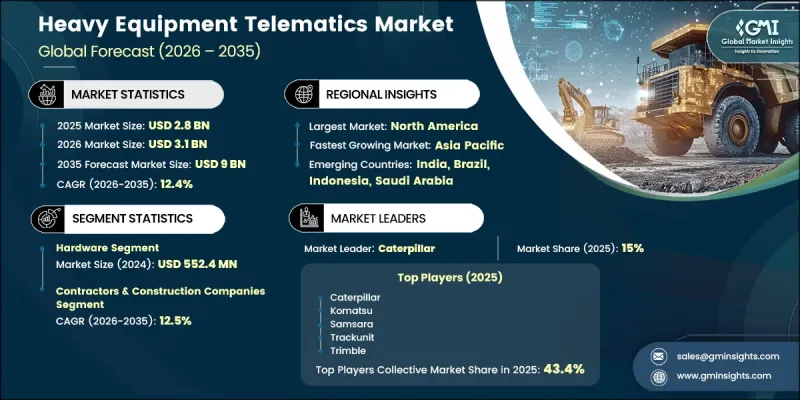
市場擴張的驅動力來自互聯設備技術的日益普及、法律規範的加強以及建築、採礦、基礎設施和工業等行業對即時車隊資訊日益成長的需求。企業越來越依賴遠端資訊處理平台來提高資產運轉率、最佳化設備效能、減少停機時間並支援預測性維護策略。隨著多個地區大規模基礎設施投資的持續推進,設備運作狀態的可視性不再是競爭優勢,而是必需品。排放氣體監測、營運報告和職場安全方面的監管要求也在加速遠端資訊處理解決方案的普及。互聯系統提供自動化資料收集、位置追蹤、運作監控和操作員績效分析,幫助企業簡化合規流程並提高營運效率。此外,對職場安全、設備管理責任和數位化車輛管理的日益重視也進一步推動了對先進遠端資訊處理技術的需求。隨著企業努力在提高生產力的同時降低營運成本,遠端資訊處理解決方案正成為全球重型設備車隊管理策略中日益重要的組成部分。
| 市場範圍 | |
|---|---|
| 開始年份 | 2025 |
| 預測期 | 2026-2035 |
| 上市時的市場規模 | 28億美元 |
| 預測金額 | 90億美元 |
| 複合年成長率 | 12.4% |
預計到2035年,硬體產業將以9.8%的複合年成長率成長。硬體解決方案包括遠端資訊處理控制單元、位置追蹤設備、車載診斷系統、通訊閘道、資產監控設備以及專為嚴苛工業環境設計的連網感測器技術。儘管該行業在實現互聯互通方面繼續發揮著至關重要的作用,但由於遠端資訊處理功能擴大直接整合到新型設備平台中,其成長速度相對放緩。隨著互聯功能成為新製造機械的標配,市場收入正逐漸轉向基於軟體的解決方案和訂閱服務。
預計到2035年,承包商細分市場將以12.5%的複合年成長率成長,與整體市場成長率基本一致。承包商是遠端資訊處理解決方案最廣泛的基本客群,涵蓋基礎設施開發、商業建築、住宅專案和專業工業服務等領域的機構。對車輛可視性、專案效率、設備追蹤和資源最佳化的日益成長的需求,持續推動該領域對遠端資訊處理技術的積極應用。
2025年,北美重型設備遠端資訊處理市場佔有率將達到37.8%。該地區的市場主導得益於重型設備車隊的廣泛數位化、雲端車隊管理平台的高滲透率,以及針對營運績效、排放氣體管理和職場安全的既定監管要求。此外,該地區成熟的技術生態系統和對互聯設備解決方案的大力投資也為其發展提供了助力,這些因素持續推動遠端資訊處理技術在建築、採礦、物流和工業領域的應用。
目錄
第1章:調查方法
第2章執行摘要
第3章 行業洞察
- 產業生態系分析
- 供應商情況
- 利潤率
- 成本結構
- 每個階段增加的價值
- 影響價值鏈的因素
- 中斷
- 影響產業的因素
- 促進因素
- 排放監測和安全合規方面的監管要求
- 對提高營運效率和最佳化資產利用率的需求日益成長。
- OEM整合智慧系統與工廠出貨時裝載遠端資訊處理系統
- 設備租賃模式的擴展需要車隊追蹤
- 產業潛在風險與挑戰
- 小規模承包商面臨前期實施成本高、投資報酬率不確定性等問題。
- 與缺乏診斷功能的傳統設備整合面臨的挑戰
- 市場機遇
- 人工智慧驅動的預測性維護加值服務
- Telematics-as-a-Service
- 在危險環境中與自主設備整合和遠端操作
- 促進因素
- 技術與創新展望
- 最新科技趨勢
- 新興技術
- 成長潛力分析
- 價格分析
- 對過去價格趨勢的分析
- 依球員類型分類的定價策略(高級球員、超值球員、成本加成球員)
- 監理情勢
- 北美洲
- 美國職業安全與健康管理局安全標準
- 美國 - FCC 設備認證
- 加拿大 - ISED 無線標準規格 (RSS)
- 歐洲
- 歐盟一般資料保護規則(GDPR)
- 歐盟機械法規 (EU) 2023/1230
- 亞太地區
- 中國工信部型式認可
- 日本 - 無線電法認證(MIC)
- LATAM
- 巴西 - ANATEL 認證
- 墨西哥 - IFT 型式認可
- 中東和非洲
- 阿拉伯聯合大公國TDRA認證
- 沙烏地阿拉伯 - CST 型式認可
- 北美洲
- 波特的分析
- PESTLE分析
- 成本細分分析
- 專利分析
- 人工智慧和生成式人工智慧對市場的影響
- 利用人工智慧改造現有經營模式
- 按細分市場分類的生成式人工智慧用例和部署藍圖
- 風險、限制和監管考量
- 網路安全與功能安全分析
- 基礎架構和部署狀態
- 基礎設施投資的可擴展性限制和趨勢
- 通訊覆蓋範圍差異(行動電話與衛星通訊)
- 工廠出貨時裝載率與售後市場安裝率的比較。
- 預測假設和情境分析
- 基本案例:驅動複合年成長率的關鍵宏觀經濟與產業變量
- 樂觀情境:宏觀經濟與產業的順風
- 悲觀情景:宏觀經濟放緩或產業逆風
第4章 競爭情勢
- 介紹
- 企業市佔率分析
- 北美洲
- 歐洲
- 亞太地區
- LATAM
- 中東和非洲
- 主要市場公司的競爭分析
- 競爭定位矩陣
- 主要進展
- 併購
- 夥伴關係和聯盟
- 新產品發布
- 業務拓展計劃及資金籌措
- 按公司規模進行基準測試
- 排名分類標準與遴選標準
- 按銷售額、地區和創新能力分類的層級定位矩陣。
第5章 市場估算與預測:依產品類型分類,2022-2035年
- 硬體
- 車載資訊控制單元(TCU)
- GPS接收器
- 感應器
- 整個單元
- 連接模組
- 軟體
- 車隊管理平台
- 數據分析與報告撰寫
- 其他
- 服務
- 專業服務
- 安裝與整合
- 維護和支援
- 諮詢和培訓
- 託管服務
- 專業服務
第6章 市場估計與預測:依應用領域分類,2022-2035年
- 車輛管理和性能報告
- 導航和資產追蹤
- 燃料管理
- 設備維護和診斷
- 車輛安全與合規性
- 其他
第7章 市場估計與預測:依性別分類的互聯互通情況,2022-2035年
- 細胞
- 3G/4G LTE
- 5G
- 衛星通訊
第8章 市場估算與預測:依設備類別分類,2022-2035年
- 土木工程施工機械
- 物料輸送設備
- 道路施工設備
- 運輸設備
- 林業設備
- 其他
第9章 市場估價與預測:依銷售管道分類,2022-2035年
- 原廠/工廠出貨時裝載
- 售後市場
第10章 市場估價與預測:依最終用途分類,2022-2035年
- 租賃公司
- 承包商和建設公司
- 礦業公司
- 農業和林業公司
- 政府/地方政府
- 其他
第11章 市場估價與預測:按地區分類,2022-2035年
- 北美洲
- 美國
- 加拿大
- 歐洲
- 德國
- 英國
- 法國
- 義大利
- 西班牙
- 俄羅斯
- 波蘭
- 挪威
- 亞太地區
- 中國
- 印度
- 日本
- 澳洲
- 印尼
- 韓國
- 泰國
- 越南
- 拉丁美洲
- 巴西
- 墨西哥
- 阿根廷
- 中東和非洲
- 南非
- 沙烏地阿拉伯
- UAE
第12章:公司簡介
- 世界公司
- Samsara
- Trimble
- Geotab
- Caterpillar
- Komatsu
- Deere & Company
- ORBCOMM
- Topcon
- CalAmp
- Volvo Construction Equipment
- CNH Industrial
- Liebherr
- Hitachi Construction Machinery
- 當地公司
- Trackunit
- JC Bamford
- Actia
- DSA Daten-und Systemtechnik
- MiX Telematics
- 新興企業
- Machinemax
- DPL Telematics
The Global Heavy Equipment Telematics Market was valued at USD 2.8 billion in 2025 and is estimated to grow at a CAGR of 12.4% to reach USD 9 billion by 2035.
Market expansion is fueled by the growing adoption of connected equipment technologies, increasing regulatory oversight, and rising demand for real-time fleet intelligence across construction, mining, infrastructure, and industrial operations. Businesses are increasingly relying on telematics platforms to improve asset utilization, optimize equipment performance, reduce downtime, and support predictive maintenance strategies. As large-scale infrastructure investments continue across multiple regions, visibility into equipment operations has become an essential requirement rather than a competitive advantage. Regulatory requirements related to emissions monitoring, operational reporting, and workplace safety are also accelerating the deployment of telematics solutions. Connected systems provide automated data collection, location tracking, utilization monitoring, and operator performance insights, helping organizations streamline compliance processes and improve operational efficiency. In addition, growing emphasis on workplace safety, equipment accountability, and digital fleet management is strengthening demand for advanced telematics technologies. As organizations seek to improve productivity while reducing operating costs, telematics solutions are becoming an increasingly important component of heavy equipment fleet management strategies worldwide.
| Market Scope | |
|---|---|
| Start Year | 2025 |
| Forecast Year | 2026-2035 |
| Start Value | $2.8 Billion |
| Forecast Value | $9 Billion |
| CAGR | 12.4% |
The hardware segment is projected to grow at a CAGR of 9.8% through 2035. Hardware solutions include telematics control units, location tracking devices, onboard diagnostic systems, communication gateways, asset monitoring equipment, and connected sensor technologies designed to operate in demanding industrial environments. While the segment continues to play a critical role in enabling connectivity, its growth rate is comparatively moderate due to the increasing integration of telematics functionality directly into new equipment platforms. As connected capabilities become standard features in newly manufactured machinery, market revenue is gradually shifting toward software-based solutions and subscription-driven service offerings.
The contractor segment is expected to grow at a CAGR of 12.5% through 2035, closely aligned with overall market growth. Contractors constitute the broadest customer base for telematics solutions, encompassing organizations involved in infrastructure development, commercial construction, residential projects, and specialized industrial services. The increasing need for fleet visibility, project efficiency, equipment tracking, and resource optimization continues to support strong adoption of telematics technologies across this segment.
North America Heavy Equipment Telematics Market held a 37.8% share in 2025. Market leadership is supported by widespread digitalization across heavy equipment fleets, high adoption of cloud-based fleet management platforms, and well-established regulatory requirements related to operational performance, emissions management, and workplace safety. The region also benefits from a mature technology ecosystem and strong investment in connected equipment solutions, which continue to drive telematics deployment across construction, mining, logistics, and industrial sectors.
Major companies operating in the global heavy equipment telematics market include Caterpillar, Komatsu, Trackunit, Trimble, Samsara, John Deere, Volvo Construction Equipment, ORBCOMM, Topcon, CalAmp, CNH Industrial, Liebherr, Hitachi Construction Machinery, J C Bamford (JCB), Actia, DSA Daten- und Systemtechnik, MiX Telematics, Machinemax, and DPL Telematics. Companies operating in the heavy equipment telematics market are adopting a range of strategies to strengthen their market position and expand their customer base. Key initiatives include investing in advanced telematics platforms that incorporate artificial intelligence, predictive analytics, remote diagnostics, and real-time fleet monitoring capabilities. Market participants are increasingly focusing on software innovation and subscription-based business models to generate recurring revenue streams and improve customer retention. Strategic partnerships with equipment manufacturers, fleet operators, and technology providers are helping companies enhance solution interoperability and accelerate market penetration. Investments in cloud-based platforms, IoT connectivity, and data analytics are enabling businesses to deliver more comprehensive fleet management solutions.
Table of Contents
Chapter 1 Methodology
- 1.1 Research approach
- 1.2 Quality Commitments
- 1.2.1 GMI AI policy & data integrity commitment
- 1.3 Research Trail & Confidence Scoring
- 1.3.1 Research Trail Components
- 1.3.2 Scoring Components
- 1.4 Data Collection
- 1.5 Data mining sources
- 1.5.1 Paid sources
- 1.6 Base estimates and calculations
- 1.6.1 Base year calculation
- 1.7 Forecast model
- 1.7.1 Quantified market impact analysis
- 1.8 Research transparency addendum
- 1.8.1 Source attribution framework
- 1.8.2 Quality assurance metrics
- 1.8.3 Our commitment to trust
Chapter 2 Executive Summary
- 2.1 Industry 360° synopsis
- 2.2 Key market trends
- 2.2.1 Regional
- 2.2.2 Offering
- 2.2.3 Application
- 2.2.4 Connectivity
- 2.2.5 Equipment Category
- 2.2.6 Sales Channel
- 2.2.7 End Use
- 2.3 TAM analysis, 2026-2035
- 2.4 CXO perspectives: Strategic imperatives
Chapter 3 Industry Insights
- 3.1 Industry ecosystem analysis
- 3.1.1 Supplier landscape
- 3.1.2 Profit margin
- 3.1.3 Cost structure
- 3.1.4 Value addition at each stage
- 3.1.5 Factor affecting the value chain
- 3.1.6 Disruptions
- 3.2 Industry impact forces
- 3.2.1 Growth drivers
- 3.2.1.1 Regulatory Mandates for Emissions Monitoring & Safety Compliance
- 3.2.1.2 Rising Demand for Operational Efficiency & Asset Utilization Optimization
- 3.2.1.3 OEM Integration of Smart Systems & Factory-Installed Telematics
- 3.2.1.4 Growth in Equipment Rental & Leasing Models Requiring Fleet Tracking
- 3.2.2 Industry pitfalls and challenges
- 3.2.2.1 High Upfront Deployment Costs & ROI Uncertainty for Small Contractors
- 3.2.2.2 Integration Challenges with Legacy Equipment Lacking Diagnostic Capabilities
- 3.2.3 Market opportunities
- 3.2.3.1 AI-Based Predictive Maintenance Premium Services
- 3.2.3.2 Telematics-as-a-Service
- 3.2.3.3 Integration with Autonomous Equipment & Remote Operation in Hazardous Environments
- 3.2.1 Growth drivers
- 3.3 Technology and innovation landscape
- 3.3.1 Current technological trends
- 3.3.2 Emerging technologies
- 3.4 Growth potential analysis
- 3.5 Pricing Analysis (Driven by Primary Research)
- 3.5.1 Historical Price Trend Analysis
- 3.5.2 Pricing Strategy by Player Type (Premium / Value / Cost-plus)
- 3.6 Regulatory landscape
- 3.6.1 North America
- 3.6.1.1 US - OSHA Safety Standards
- 3.6.1.2 US - FCC Equipment Authorization
- 3.6.1.3 Canada - ISED Radio Standards Specifications (RSS)
- 3.6.2 Europe
- 3.6.2.1 EU - General Data Protection Regulation (GDPR)
- 3.6.2.2 EU - Machinery Regulation (EU) 2023/1230
- 3.6.3 Asia Pacific
- 3.6.3.1 China - MIIT Type Approval
- 3.6.3.2 Japan - Radio Law Certification (MIC)
- 3.6.4 LATAM
- 3.6.4.1 Brazil - ANATEL Certification
- 3.6.4.2 Mexico - IFT Homologation
- 3.6.5 MEA
- 3.6.5.1 UAE - TDRA Certification
- 3.6.5.2 Saudi Arabia - CST Type Approval
- 3.6.1 North America
- 3.7 Porter's analysis
- 3.8 PESTEL analysis
- 3.9 Cost breakdown analysis
- 3.10 Patent analysis (Driven by Primary Research)
- 3.11 Impact of AI & generative AI on the market
- 3.11.1 AI-driven disruption of existing business models
- 3.11.2 GenAI use cases & adoption roadmap by segment
- 3.11.3 Risks, limitations & regulatory considerations
- 3.12 Cybersecurity & Functional Safety Analysis
- 3.13 Infrastructure & Deployment Landscape
- 3.13.1 Scalability Constraints & Infrastructure Investment Trends
- 3.13.2 Connectivity Coverage Gaps (Cellular vs. Satellite)
- 3.13.3 OEM Factory-Install Rates vs. Aftermarket Retrofit Rates
- 3.14 Forecast assumptions & scenario analysis (Driven by Primary Research)
- 3.14.1 Base Case- Key Macro & Industry Variables Driving CAGR
- 3.14.2 Optimistic Scenarios- Favorable macro and industry tailwinds
- 3.14.3 Pessimistic Scenario - Macroeconomic slowdown or industry headwinds
Chapter 4 Competitive Landscape, 2025
- 4.1 Introduction
- 4.2 Company market share analysis
- 4.2.1 North America
- 4.2.2 Europe
- 4.2.3 Asia Pacific
- 4.2.4 LATAM
- 4.2.5 MEA
- 4.3 Competitive analysis of major market players
- 4.4 Competitive positioning matrix
- 4.5 Key developments
- 4.5.1 Mergers & acquisitions
- 4.5.2 Partnerships & collaborations
- 4.5.3 New product launches
- 4.5.4 Expansion plans and funding
- 4.6 Company tier benchmarking
- 4.6.1 Tier classification criteria & qualifying thresholds
- 4.6.2 Tier positioning matrix by revenue, geography & innovation
Chapter 5 Market Estimates and Forecast, By Offering, 2022 - 2035 ($ Mn)
- 5.1 Key trends
- 5.2 Hardware
- 5.2.1 Telematics Control Units (TCUs)
- 5.2.2 GPS Receivers
- 5.2.3 Sensors
- 5.2.4 Display Units
- 5.2.5 Connectivity Modules
- 5.3 Software
- 5.3.1 Fleet Management Platforms
- 5.3.2 Data Analytics & Reporting
- 5.3.3 Others
- 5.4 Services
- 5.4.1 Professional services
- 5.4.1.1 Installation & Integration
- 5.4.1.2 Maintenance & Support
- 5.4.1.3 Consulting & Training
- 5.4.2 Managed services
- 5.4.1 Professional services
Chapter 6 Market Estimates and Forecast, By Application, 2022 - 2035 ($ Mn)
- 6.1 Key trends
- 6.2 Fleet Management & Performance Reporting
- 6.3 Navigation & Asset Tracking
- 6.4 Fuel Management
- 6.5 Equipment Maintenance & Diagnostics
- 6.6 Fleet Safety & Compliance
- 6.7 Others
Chapter 7 Market Estimates and Forecast, By Connectivity, 2022 - 2035 ($ Mn)
- 7.1 Key trends
- 7.2 Cellular
- 7.2.1 3G/4G LTE
- 7.2.2 5G
- 7.3 Satellite
Chapter 8 Market Estimates and Forecast, By Equipment Category, 2022 - 2035 ($ Mn, Fleet Size)
- 8.1 Key trends
- 8.2 Earthmoving Equipment
- 8.3 Material Handling Equipment
- 8.4 Road Construction Equipment
- 8.5 Hauling Equipment
- 8.6 Forestry Equipment
- 8.7 Others
Chapter 9 Market Estimates and Forecast, By Sales Channel, 2022 - 2035 ($ Mn)
- 9.1 Key trends
- 9.2 OEM/factory-installed
- 9.3 Aftermarket
Chapter 10 Market Estimates and Forecast, By End Use, 2022 - 2035 ($ Mn)
- 10.1 Key trends
- 10.2 Rental & Leasing Companies
- 10.3 Contractors & Construction Companies
- 10.4 Mining Companies
- 10.5 Agriculture & Forestry Companies
- 10.6 Government & Municipal Agencies
- 10.7 Others
Chapter 11 Market Estimates & Forecast, By Region, 2022 - 2035 ($Mn, Fleet Size)
- 11.1 Key trends
- 11.2 North America
- 11.2.1 US
- 11.2.2 Canada
- 11.3 Europe
- 11.3.1 Germany
- 11.3.2 UK
- 11.3.3 France
- 11.3.4 Italy
- 11.3.5 Spain
- 11.3.6 Russia
- 11.3.7 Poland
- 11.3.8 Norway
- 11.4 Asia Pacific
- 11.4.1 China
- 11.4.2 India
- 11.4.3 Japan
- 11.4.4 Australia
- 11.4.5 Indonesia
- 11.4.6 South Korea
- 11.4.7 Thailand
- 11.4.8 Vietnam
- 11.5 Latin America
- 11.5.1 Brazil
- 11.5.2 Mexico
- 11.5.3 Argentina
- 11.6 MEA
- 11.6.1 South Africa
- 11.6.2 Saudi Arabia
- 11.6.3 UAE
Chapter 12 Company Profiles
- 12.1 Global players
- 12.1.1 Samsara
- 12.1.2 Trimble
- 12.1.3 Geotab
- 12.1.4 Caterpillar
- 12.1.5 Komatsu
- 12.1.6 Deere & Company
- 12.1.7 ORBCOMM
- 12.1.8 Topcon
- 12.1.9 CalAmp
- 12.1.10 Volvo Construction Equipment
- 12.1.11 CNH Industrial
- 12.1.12 Liebherr
- 12.1.13 Hitachi Construction Machinery
- 12.2 Regional players
- 12.2.1 Trackunit
- 12.2.2 J C Bamford
- 12.2.3 Actia
- 12.2.4 DSA Daten- und Systemtechnik
- 12.2.5 MiX Telematics
- 12.3 Emerging players
- 12.3.1 Machinemax
- 12.3.2 DPL Telematics


