

 |
市場調查報告書
商品編碼
2071228
新一代車載互聯解決方案市場:商業機會、成長要素、產業趨勢分析以及 2026-2035 年預測。Next-Generation Automotive Connectivity Solutions Market Opportunity, Growth Drivers, Industry Trend Analysis, and Forecast 2026 - 2035 |
||||||

預計到 2025 年,下一代汽車連網解決方案的全球市場價值將達到 315 億美元,並以 12.4% 的複合年成長率成長,到 2035 年將達到 986 億美元。
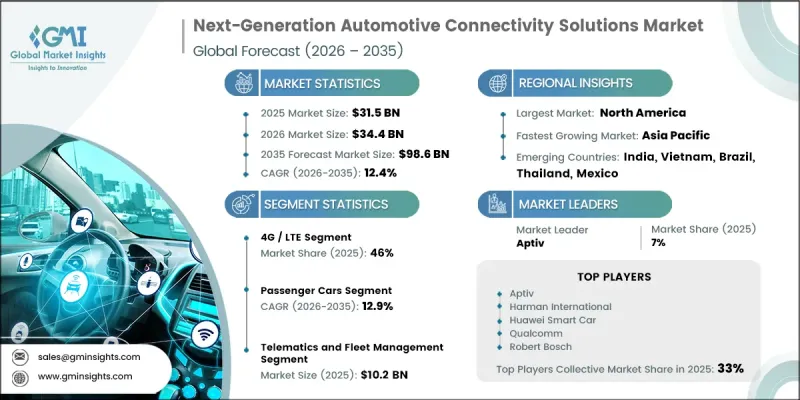
這項市場擴張的驅動力來自於聯網汽車技術的快速發展,包括5G連接、蜂窩車聯網(C-V2X)通訊、衛星輔助網路、邊緣運算能力以及軟體定義汽車平臺。隨著互聯出行生態系統的不斷成熟,商機已遠遠超越傳統的連接硬體。汽車製造商、半導體供應商、通訊業者、雲端技術公司和車隊技術供應商正日益專注於獲取透過車輛資訊服務、空中軟體更新、互聯資訊娛樂服務、高級安全功能和數位化車隊營運產生的長期收入來源。隨著車輛越來越依賴軟體,市場也不斷演變,這不僅為基於常規服務的經營模式創造了新的機遇,也加速了整個互聯出行領域的創新。
| 市場範圍 | |
|---|---|
| 開始年份 | 2025 |
| 預測期 | 2026-2035 |
| 上市時的市場規模 | 315億美元 |
| 預測金額 | 986億美元 |
| 複合年成長率 | 12.4% |
目前,4G/LTE技術的廣泛應用仍對該市場產生深遠的影響。穩定的網路可用性、具成本效益模組的推出以及可靠的性能,持續支撐著聯網汽車生態系統的廣泛部署。在新冠疫情期間,下一代車載互聯解決方案市場面臨挑戰與機會。初期,製造業停滯、供應鏈中斷、半導體短缺以及汽車產量下降等因素限制了市場成長,導致先進聯網汽車技術的應用速度放緩。儘管面臨這些不利因素,市場對互聯出行解決方案的長期需求依然強勁。 V2X(車聯網)通訊在協同智慧型運輸系統(ITS)的發展中繼續發揮著至關重要的作用,實現了車輛與周邊交通基礎設施之間的無縫互動。
預計到2025年,4G/LTE市佔率將達到46%,並在2026年至2035年間以10.7%的複合年成長率成長。 LTE技術的可靠性和經濟性是其持續普及的主要驅動力。 LTE-Advanced、LTE Cat-M1和NB-IoT解決方案憑藉其完善的基礎設施和有利的成本結構,在聯網汽車應用中廣泛部署。
預計到2025年,乘用車市佔率將達到67%。消費者對數位化增強駕駛體驗的強勁需求持續推動著該細分市場的成長。先進的互聯技術、嵌入式5G功能、空中下載(OTA)軟體推送、高級駕駛輔助系統(ADAS)、電動車(EV)最佳化功能、遠端車輛控制以及訂閱式數位服務的整合,正在加速汽車製造商和消費者對這些技術的接受度。
到2025年,美國新一代車載互聯解決方案市場規模將達到89億美元。政府大力推動互聯交通基礎建設,為美國市場成長提供了有力支撐。兩黨基礎設施法案提供的資金正在加速V2X技術的發展,而5.9 GHz頻段相關法規的明確化也增強了C-V2X通訊部署的前景。此外,車輛通訊框架和汽車網路安全標準的持續推進,也將持續協助美國聯網汽車生態系統的發展。
目錄
第1章:調查方法和範圍
第2章執行摘要
第3章 行業洞察
- 產業生態系分析
- 供應商情況
- 原物料供應商
- 零件供應商
- 技術實施公司
- 服務供應商
- 最終用途
- 成本結構
- 利潤率
- 每個階段增加的價值
- 垂直整合趨勢
- 顛覆者
- 供應商情況
- 影響因素
- 促進因素
- 擴大 5G 和 C-V2X 基礎設施的部署
- 對先進駕駛輔助系統和自動駕駛互聯功能的需求日益成長。
- 聯網汽車生態系的擴展
- 邊緣運算和人工智慧連接技術的廣泛應用。
- 產業潛在風險與挑戰
- 聯網汽車網路安全漏洞日益增多
- 基礎設施實施和整合成本高昂
- 市場機遇
- 向軟體定義和聯網汽車過渡
- 衛星和混合連接解決方案的整合正在推進。
- V2X(車聯網)通訊平台的發展
- 擴展互聯資訊娛樂和個人化出行服務
- 促進因素
- 成長潛力分析
- 價格分析
- 對過去價格趨勢的分析
- 依球員類型分類的定價策略(高級球員、超值球員、成本加成球員)
- 監理情勢
- 北美洲
- FCC 對 C-V2X 和 5G 汽車通訊的頻率分配
- 美國國家公路交通安全管理局的《汽車網路安全與聯網汽車安全指南》
- 歐洲
- 歐盟互聯自動駕駛(CAM)框架
- 智慧車輛系統通用安全法規 (GSR)
- 聯合國歐洲經濟委員會工作小組29 網路安全條例(R155)
- 聯合國歐洲經濟委員會軟體更新管理系統(SUMS)條例(R156)
- 亞太地區
- 中國智慧網聯汽車(ICV)發展策略
- 中國C-V2X和智慧高速公路計畫的實用化
- 日本互聯交通與智慧交通系統藍圖
- 韓國的5G-V2X和自動駕駛汽車政策框架
- 拉丁美洲
- 巴西互聯旅遊與智慧交通計劃
- 墨西哥擴大車用通訊系統和數位基礎設施的政策
- 中東和非洲
- 阿拉伯聯合大公國智慧運輸與自動駕駛交通戰略
- 沙烏地阿拉伯在智慧交通和智慧城市互聯方面的努力
- 北美洲
- 技術與創新展望
- 最新技術
- 新興技術
- 波特的分析
- PESTLE分析
- 專利分析
- 用例
- 人工智慧和生成式人工智慧對市場的影響
- 利用人工智慧改造現有經營模式
- 設計自動化最佳化
- 用於需求預測的供應鏈人工智慧
- 按細分市場分類的生成式人工智慧用例和部署藍圖
- 風險、限制和監管考量
- 預測假設和情境分析
- 基本案例:驅動複合年成長率的關鍵宏觀經濟與產業變量
- 樂觀情境:宏觀經濟與產業的順風
- 悲觀情景:宏觀經濟放緩或產業逆風
- 永續性和環境方面
- 永續計劃
- 減少廢棄物策略
- 生產中的能源效率
- 具有環保意識的舉措
- 考慮碳足跡
第4章 競爭情勢
- 介紹
- 企業市佔率分析
- 北美洲
- 歐洲
- 亞太地區
- 拉丁美洲
- 中東和非洲
- 競爭定位矩陣
- 戰略展望矩陣
- 主要進展
- 併購
- 夥伴關係和聯盟
- 新產品發布
- 業務拓展計劃及資金籌措
第5章 市場估算與預測:依連結架構分類,2022-2035年
- 嵌入式
- 融合的
- 繫繩
第6章 市場估算與預測:依通訊技術分類,2022-2035年
- 5G/C-V2X(Cellular Vehicle-to-Everything)
- 4G/LTE
- DSRC/Wi-Fi
- 藍牙/超寬頻 (UWB)
- 衛星通訊
第7章 市場估價與預測:依車輛類型分類,2022-2035年
- 搭乘用車
- SUV
- 轎車
- 掀背車
- 商用車輛
- 輕型商用車(LCV)
- 中型商用車(MCV)
- 重型商用車(HCV)
第8章 市場估計與預測:依促進因素分類,2022-2035年
- 內燃機車(ICE車輛)
- 電池式電動車(BEV)
- 插電式混合動力車(PHEV)
- 混合動力電動車(HEV)
第9章 市場估計與預測:依應用領域分類,2022-2035年
- ADAS和自動駕駛輔助
- 車載資訊系統與車隊管理
- 安全和緊急應變
- 遠端診斷和OTA更新
- V2X通訊
- 其他
第10章 市場估價與預測:依最終用途分類,2022-2035年
- OEM/一級供應商
- 車隊營運商
- 售後市場和服務供應商
第11章 市場估價與預測:按地區分類,2022-2035年
- 北美洲
- 美國
- 加拿大
- 歐洲
- 英國
- 德國
- 法國
- 義大利
- 西班牙
- 比利時
- 荷蘭
- 瑞典
- 俄羅斯
- 亞太地區
- 中國
- 印度
- 日本
- 澳洲
- 新加坡
- 韓國
- 越南
- 印尼
- 泰國
- 拉丁美洲
- 巴西
- 墨西哥
- 阿根廷
- 中東和非洲
- 南非
- 沙烏地阿拉伯
- UAE
- 土耳其
第12章:公司簡介
- 世界公司
- Aptiv
- Continental
- Denso
- Harman International
- NXP Semiconductors
- Qualcomm Technologies
- Robert Bosch
- TE Connectivity
- Texas Instruments
- Thales
- 當地公司
- BlackBerry
- Ericsson
- Geotab
- Huawei Technologies
- LG Electronics Vehicle Component Solutions
- Octo Group
- Sierra Wireless
- Verizon Connect
- 新興企業
- Mojio
- Molex
The Global Next-Generation Automotive Connectivity Solutions Market was valued at USD 31.5 billion in 2025 and is estimated to grow at a CAGR of 12.4% to reach USD 98.6 billion by 2035.
Industry expansion is driven by the rapid evolution of connected vehicle technologies, including 5G connectivity, cellular vehicle-to-everything (C-V2X) communications, satellite-supported networking, edge computing capabilities, and software-defined vehicle platforms. As connected mobility ecosystems continue to mature, revenue opportunities are extending far beyond traditional connectivity hardware. Automotive manufacturers, semiconductor suppliers, telecommunications providers, cloud technology companies, and fleet technology vendors are increasingly focused on capturing long-term revenue streams generated through vehicle data services, over-the-air software updates, connected infotainment offerings, advanced safety functionalities, and digital fleet operations. The market continues to evolve as vehicles become more software-centric, creating new opportunities for recurring service-based business models while accelerating innovation across the connected transportation landscape.
| Market Scope | |
|---|---|
| Start Year | 2025 |
| Forecast Year | 2026-2035 |
| Start Value | $31.5 Billion |
| Forecast Value | $98.6 Billion |
| CAGR | 12.4% |
The market currently remains heavily influenced by the widespread adoption of 4G/LTE technologies. Strong network availability, cost-efficient module deployment, and dependable performance continue to support extensive implementation across connected vehicle ecosystems. During the COVID-19 pandemic, the next-generation automotive connectivity solutions market experienced both challenges and opportunities. Initial market growth was constrained by manufacturing disruptions, supply chain disruptions, semiconductor shortages, and reduced vehicle output, thereby slowing the deployment of advanced connected vehicle technologies. Despite these setbacks, long-term demand for connected mobility solutions remained resilient. Vehicle-to-everything (V2X) communication continues to play a critical role in the development of cooperative intelligent transportation systems, enabling seamless interaction between vehicles and surrounding transportation infrastructure.
The 4G/LTE segment accounted for a 46% share in 2025 and is forecast to grow at a 10.7% CAGR from 2026 through 2035. Continued adoption is supported by the proven reliability and affordability of LTE-based technologies. LTE-Advanced, LTE Cat-M1, and NB-IoT solutions remain widely deployed across connected vehicle applications due to their established infrastructure and favorable cost structures.
The passenger cars segment held a 67% share in 2025. Strong demand for digitally enhanced driving experiences continues to support growth across this category. Increasing integration of advanced connectivity technologies, embedded 5G capabilities, over-the-air software delivery, advanced driver assistance systems, electric vehicle optimization functions, remote vehicle controls, and subscription-based digital services is accelerating adoption among passenger vehicle manufacturers and consumers.
United States Next-Generation Automotive Connectivity Solutions Market generated USD 8.9 billion in 2025. Market growth in the country is supported by government initiatives designed to advance connected transportation infrastructure. Funding allocations under the Bipartisan Infrastructure Law have encouraged the development of V2X technologies, while regulatory clarity surrounding the 5.9 GHz spectrum has strengthened the deployment outlook for C-V2X communications. Ongoing efforts related to vehicle communication frameworks and automotive cybersecurity standards continue to support the expansion of connected vehicle ecosystems throughout the U.S.
Major companies operating in the global next-generation automotive connectivity solutions market include Aptiv, Continental (ANS), Harman International, Huawei Smart Car, NXP Semiconductors, Qualcomm, Robert Bosch, TE Connectivity, Texas Instruments, and Thales. Companies operating in the next-generation automotive connectivity solutions market are focusing on several strategic initiatives to strengthen their competitive position and expand market share. Industry participants are investing heavily in research and development to accelerate innovation in 5G connectivity, C-V2X technologies, software-defined vehicle platforms, and advanced telematics systems. Strategic partnerships between automotive manufacturers, semiconductor companies, cloud service providers, and telecommunications operators are becoming increasingly common to build integrated connected mobility ecosystems. Many companies are also expanding their product portfolios through technology acquisitions and collaborative development agreements.
Table of Contents
Chapter 1 Methodology & Scope
- 1.1 Research approach
- 1.2 Quality Commitments
- 1.2.1 GMI AI policy & data integrity commitment
- 1.2.1.1 Source consistency protocol
- 1.2.1 GMI AI policy & data integrity commitment
- 1.3 Research Trail & Confidence Scoring
- 1.3.1 Research Trail Components
- 1.3.2 Scoring Components
- 1.4 Data Collection
- 1.4.1 Partial list of primary sources
- 1.5 Data mining sources
- 1.5.1 Paid sources
- 1.5.1.1 Sources, by region
- 1.5.1 Paid sources
- 1.6 Base estimates and calculations
- 1.6.1 Base year calculation
- 1.7 Forecast model
- 1.7.1 Quantified market impact analysis
- 1.7.1.1 Mathematical impact of growth parameters on forecast
- 1.7.1 Quantified market impact analysis
- 1.8 Research transparency addendum
- 1.8.1 Source attribution framework
- 1.8.2 Quality assurance metrics
- 1.8.3 Our commitment to trust
Chapter 2 Executive Summary
- 2.1 Industry 360° synopsis
- 2.2 Key market trends
- 2.2.1 Connectivity Architecture
- 2.2.2 Communication Technology
- 2.2.3 Vehicle
- 2.2.4 Propulsion
- 2.2.5 Application
- 2.2.6 End Use
- 2.3 TAM Analysis, 2026-2035
- 2.4 CXO perspectives: Strategic imperatives
Chapter 3 Industry Insights
- 3.1 Industry ecosystem analysis
- 3.1.1 Supplier landscape
- 3.1.1.1 Raw material suppliers
- 3.1.1.2 Component suppliers
- 3.1.1.3 Technology installers
- 3.1.1.4 Service providers
- 3.1.1.5 End Use
- 3.1.2 Cost structure
- 3.1.3 Profit margin
- 3.1.4 Value addition at each stage
- 3.1.5 Vertical integration trends
- 3.1.6 Disruptors
- 3.1.1 Supplier landscape
- 3.2 Impact forces
- 3.2.1 Growth drivers
- 3.2.1.1 Rising deployment of 5G & C-V2X infrastructure
- 3.2.1.2 Increasing demand for advanced driver assistance & autonomous connectivity
- 3.2.1.3 Expansion of connected vehicle ecosystems
- 3.2.1.4 Growing adoption of edge computing & ai-enabled connectivity
- 3.2.2 Industry pitfalls & challenges
- 3.2.2.1 Rising cybersecurity vulnerabilities in connected vehicles
- 3.2.2.2 High infrastructure deployment & integration costs
- 3.2.3 Market opportunities
- 3.2.3.1 Transition toward software-defined & connected vehicles
- 3.2.3.2 Rising integration of satellite & hybrid connectivity solutions
- 3.2.3.3 Growth of vehicle-to-everything (V2X) communication platforms
- 3.2.3.4 Expansion of connected infotainment & personalized mobility services
- 3.2.1 Growth drivers
- 3.3 Growth potential analysis
- 3.4 Pricing Analysis (Driven by Primary Research)
- 3.4.1 Historical Price Trend Analysis
- 3.4.2 Pricing Strategy by Player Type (Premium / Value / Cost-plus)
- 3.5 Regulatory landscape
- 3.5.1 North America
- 3.5.1.1 FCC Spectrum Allocation for C-V2X & 5G Automotive Communications
- 3.5.1.2 NHTSA Vehicle Cybersecurity & Connected Vehicle Safety Guidelines
- 3.5.2 Europe
- 3.5.2.1 EU Connected and Automated Mobility (CAM) Framework
- 3.5.2.2 General Safety Regulation (GSR) for Intelligent Vehicle Systems
- 3.5.2.3 UNECE WP.29 Cybersecurity Regulation (R155)
- 3.5.2.4 UNECE Software Update Management System (SUMS) Regulation (R156)
- 3.5.3 Asia-Pacific
- 3.5.3.1 China Intelligent Connected Vehicle (ICV) Development Strategy
- 3.5.3.2 China C-V2X Commercialization & Smart Highway Initiatives
- 3.5.3.3 Japan Connected Mobility & ITS Roadmap
- 3.5.3.4 South Korea 5G-V2X and Autonomous Vehicle Policy Framework
- 3.5.4 Latin America
- 3.5.4.1 Brazil Connected Mobility & Smart Transportation Programs
- 3.5.4.2 Mexico Automotive Telematics and Digital Infrastructure Expansion Policies
- 3.5.5 MEA
- 3.5.5.1 UAE Smart Mobility & Autonomous Transport Strategy
- 3.5.5.2 Saudi Arabia Intelligent Transportation & Smart City Connectivity Initiatives
- 3.5.1 North America
- 3.6 Technology and Innovation landscape
- 3.6.1 Current technologies
- 3.6.2 Emerging technologies
- 3.7 Porter's analysis
- 3.8 PESTEL analysis
- 3.9 Patent analysis (Driven by Primary Research)
- 3.10 Use cases
- 3.11 Impact of AI & generative AI on the market
- 3.11.1 AI-Driven Disruption of Existing Business Models
- 3.11.2 Automated design optimization
- 3.11.3 Supply chain AI for demand forecasting
- 3.11.4 GenAI use cases & adoption roadmap by segment
- 3.11.5 Risks, Limitations & Regulatory Considerations
- 3.12 Forecast assumptions & scenario analysis (Driven by Primary Research)
- 3.12.1 Base Case - key macro & industry variables driving CAGR
- 3.12.2 Optimistic Scenarios - Favorable Macro and Industry Tailwinds
- 3.12.3 Pessimistic Scenario - Macroeconomic slowdown or industry headwinds
- 3.13 Sustainability and environmental aspects
- 3.13.1 Sustainable practices
- 3.13.2 Waste reduction strategies
- 3.13.3 Energy efficiency in production
- 3.13.4 Eco-friendly Initiatives
- 3.13.5 Carbon footprint considerations
Chapter 4 Competitive Landscape, 2025
- 4.1 Introduction
- 4.2 Company market share analysis
- 4.2.1 North America
- 4.2.2 Europe
- 4.2.3 Asia-Pacific
- 4.2.4 Latin America
- 4.2.5 Middle East & Africa
- 4.3 Competitive positioning matrix
- 4.4 Strategic outlook matrix
- 4.5 Key developments
- 4.5.1 Mergers & acquisitions
- 4.5.2 Partnerships & collaborations
- 4.5.3 New product launches
- 4.5.4 Expansion plans and funding
Chapter 5 Market Estimates & Forecast, By Connectivity Architecture, 2022 - 2035 ($Mn)
- 5.1 Key trends
- 5.2 Embedded
- 5.3 Integrated
- 5.4 Tethered
Chapter 6 Market Estimates & Forecast, By Communication Technology, 2022 - 2035 ($Mn)
- 6.1 Key trends
- 6.2 5G / C-V2X (Cellular Vehicle-to-Everything)
- 6.3 4G / LTE
- 6.4 DSRC / Wi-Fi
- 6.5 Bluetooth / Ultra-Wideband (UWB)
- 6.6 Satellite Connectivity
Chapter 7 Market Estimates & Forecast, By Vehicle, 2022 - 2035 ($Mn)
- 7.1 Key trends
- 7.2 Passenger Cars
- 7.2.1 SUV
- 7.2.2 Sedan
- 7.2.3 Hatchback
- 7.3 Commercial Vehicle
- 7.3.1 Light Commercial Vehicle (LCV)
- 7.3.2 Medium Commercial Vehicle (MCV)
- 7.3.3 Heavy Commercial Vehicle (HCV)
Chapter 8 Market Estimates & Forecast, By Propulsion, 2022 - 2035 ($Mn)
- 8.1 Key trends
- 8.2 ICE Vehicles
- 8.3 Battery Electric Vehicles (BEV)
- 8.4 Plug-in Hybrid Electric Vehicles (PHEV)
- 8.5 Hybrid Electric Vehicles (HEV)
Chapter 9 Market Estimates & Forecast, By Application, 2022 - 2035 ($Mn)
- 9.1 ADAS & Autonomous Driving Support
- 9.2 Telematics & Fleet Management
- 9.3 Safety & Emergency Response
- 9.4 Remote Diagnostics & OTA Updates
- 9.5 V2X Communication
- 9.6 Others
Chapter 10 Market Estimates & Forecast, By End Use, 2022 - 2035 ($Mn)
- 10.1 OEM/Tier 1
- 10.2 Fleet Operators
- 10.3 Aftermarket & Service Providers
Chapter 11 Market Estimates & Forecast, By Region, 2022 - 2035 ($Mn)
- 11.1 North America
- 11.1.1 US
- 11.1.2 Canada
- 11.2 Europe
- 11.2.1 UK
- 11.2.2 Germany
- 11.2.3 France
- 11.2.4 Italy
- 11.2.5 Spain
- 11.2.6 Belgium
- 11.2.7 Netherlands
- 11.2.8 Sweden
- 11.2.9 Russia
- 11.3 Asia Pacific
- 11.3.1 China
- 11.3.2 India
- 11.3.3 Japan
- 11.3.4 Australia
- 11.3.5 Singapore
- 11.3.6 South Korea
- 11.3.7 Vietnam
- 11.3.8 Indonesia
- 11.3.9 Thailand
- 11.4 Latin America
- 11.4.1 Brazil
- 11.4.2 Mexico
- 11.4.3 Argentina
- 11.5 MEA
- 11.5.1 South Africa
- 11.5.2 Saudi Arabia
- 11.5.3 UAE
- 11.5.4 Turkey
Chapter 12 Company Profiles
- 12.1 Global players
- 12.1.1 Aptiv
- 12.1.2 Continental
- 12.1.3 Denso
- 12.1.4 Harman International
- 12.1.5 NXP Semiconductors
- 12.1.6 Qualcomm Technologies
- 12.1.7 Robert Bosch
- 12.1.8 TE Connectivity
- 12.1.9 Texas Instruments
- 12.1.10 Thales
- 12.2 Regional Players
- 12.2.1 BlackBerry
- 12.2.2 Ericsson
- 12.2.3 Geotab
- 12.2.4 Huawei Technologies
- 12.2.5 LG Electronics Vehicle Component Solutions
- 12.2.6 Octo Group
- 12.2.7 Sierra Wireless
- 12.2.8 Verizon Connect
- 12.3 Emerging players
- 12.3.1 Mojio
- 12.3.2 Molex

