


 |
市場調查報告書
商品編碼
2071204
蔬菜及特種作物種子市場機會、成長促進因素、產業趨勢分析及2026-2035年預測。Vegetable and Specialty Crop Seeds Market Opportunity, Growth Drivers, Industry Trend Analysis, and Forecast 2026 - 2035 |
||||||

全球蔬菜和特種作物種子市場預計到 2025 年將達到 81 億美元,年複合成長率為 6%,到 2035 年將達到 145 億美元。
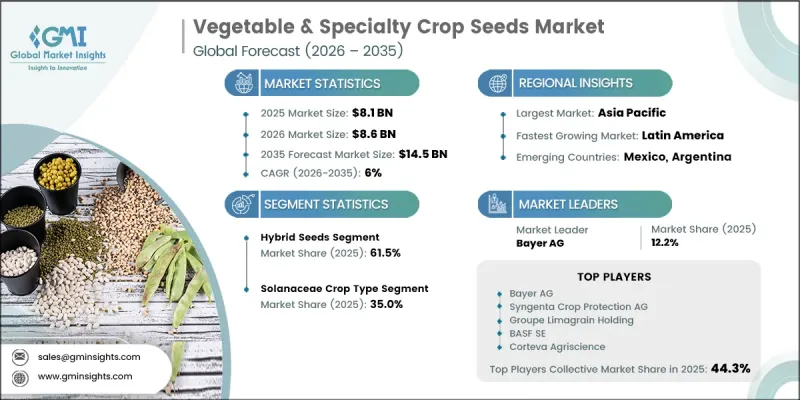
全球蔬菜和特種作物種子市場的成長主要受商業農業需求成長、保護措施不斷加強以及基因改造種子日益普及(旨在提高產量和作物性能)的推動。消費者對優質新鮮農產品的需求不斷成長,以及透過改良種苗提高農業生產力的持續努力,也促進了市場成長。植物育種技術的進步正在加速高性能種子品種的研發,使種子生產商能夠比傳統育種方法更有效率地將適應性更強、產量潛力更高、抗逆性更強的產品推向市場。政府在糧食安全、農業現代化和種子體系發展方面的舉措,進一步推動了向認證商業種子的過渡。此外,食品分銷網路的演變和消費模式的改變,也推動了對具有更佳採後特性、更穩定的產品質量和更強市場競爭力的作物品種的需求成長,從而為蔬菜和特種作物種子行業的長期發展創造了有利條件。
| 市場規模 | |
|---|---|
| 開始年份 | 2025 |
| 預測期 | 2026-2035 |
| 起始金額 | 81億美元 |
| 預測金額 | 145億美元 |
| 複合年成長率 | 6% |
預計到2025年,雜交種子市佔率將達到61.5%,並在2035年之前以6.5%的複合年成長率成長。由於雜交品種具有許多優勢,包括更高的產量、更均勻的作物生長以及更強的抗環境和生物挑戰能力,因此商業農戶持續青睞雜交品種。這些優勢有助於提高收成可靠性、降低生產風險並提升營運效率。雜交種子能夠在保證高產量的同時降低投入成本,這仍然是推動其在商業農業系統中廣泛應用的關鍵因素。
預計到2025年,茄科作物將佔全球市場佔有率的35%。該領域之所以保持強勁勢頭,是因為其在主糧生產和高階生鮮食品市場中佔據重要地位。對種子研發和育種計畫的大量投資持續推動著該作物領域的創新。
預計到2025年,北美蔬菜和特種作物種子市佔率將達到17%。該市場受益於高度商業化的蔬菜生產體係以及高價值作物領域對先進種子技術的積極應用。雜交種子的廣泛使用持續提升該地區農業的生產力和品質。此外,對可控環境農業和保護性栽培基礎設施的投資增加,也推動了對專為集約化生產系統開發的特殊種子品種的需求。這些趨勢進一步鞏固了北美在全球蔬菜和特種作物種子產業的地位。
目錄
第1章:調查方法和範圍
第2章執行摘要
第3章 行業洞察
- 產業生態系分析
- 供應商情況
- 利潤率
- 每個階段增加的價值
- 影響價值鏈的因素
- 中斷
- 影響產業的因素
- 成長促進因素
- 產業潛在風險與挑戰
- 市場機遇
- 成長潛力分析
- 監理情勢
- 波特的分析
- PESTLE分析
- 價格趨勢
- 按地區
- 按種子類型
- 未來市場趨勢
- 技術與創新展望
- 最新科技趨勢
- 新興技術
- 專利趨勢
- 貿易統計
- 主要進口國
- 主要出口國
- 永續性和環境方面
- 永續計劃
- 減少廢棄物策略
- 生產中的能源效率
- 具有環保意識的舉措
- 考慮碳足跡
第4章 競爭情勢
- 介紹
- 企業市佔率分析
- 按地區
- 北美洲
- 歐洲
- 亞太地區
- 拉丁美洲
- 中東和非洲
- 按地區
- 企業矩陣分析
- 主要市場公司的競爭分析
- 競爭定位矩陣
- 主要進展
- 併購
- 夥伴關係和聯盟
- 新產品發布
- 業務拓展計劃
第5章 市場估計與預測:依種子類型分類,2022-2035年
- 混合子
- 自然雜交品種(OPV)
- 有機種子
- 基因改造種子
第6章 市場估算與預測:依作物類型分類,2022-2035年
- 茄科
- 番茄種子
- 甜椒籽
- 茄子種子
- 辣椒籽
- 芸薹屬
- 高麗菜種子
- 花椰菜種子
- 綠色花椰菜
- 羽衣甘藍種子
- 抱子甘藍種子
- 球莖甘藍種子
- 綠葉蔬菜
- 生菜種子
- 菠菜籽
- 羽衣甘藍和微型菜苗蔬菜種子
- 芝麻菜種子
- 草本植物和芳香植物的種子
- 葫蘆科植物
- 黃瓜種子
- 瓜子
- 果汁汽水瓜籽
- 西葫蘆籽
- 南瓜籽
- 根莖類和球莖類蔬菜
- 洋蔥籽
- 紅蘿蔔種子
- 蘿蔔種子
- 甜菜根種子
- 芹菜籽
- 其他
第7章 市場估計與預測:依最終用戶分類,2022-2035年
- 商業生產者
- 家庭園藝愛好者
- 研究和教育機構
第8章 市場估計與預測:依地區分類,2022-2035年
- 北美洲
- 美國
- 加拿大
- 歐洲
- 德國
- 英國
- 法國
- 西班牙
- 義大利
- 其他歐洲國家
- 亞太地區
- 中國
- 印度
- 日本
- 澳洲
- 韓國
- 其他亞太國家
- 拉丁美洲
- 巴西
- 墨西哥
- 阿根廷
- 其他拉丁美洲國家
- 中東和非洲
- 沙烏地阿拉伯
- 南非
- UAE
- 其他中東和非洲國家
第9章:公司簡介
- Advanta Seeds
- American Takii, Inc.
- Axia Vegetable Seeds
- BASF SE
- Bayer AG
- Bejo Zaden
- Corteva Agriscience
- East-West Seed
- Enza Zaden
- Fedco Seeds
- Groupe Limagrain Holding
- Johnny's Selected Seeds
- Namdhari Seeds
- Rijk Zwaan
- Sakata Seed Corporation
- Syngenta Crop Protection AG
The Global Vegetable & Specialty Crop Seeds Market was valued at USD 8.1 billion in 2025 and is estimated to grow at a CAGR of 6% to reach USD 14.5 billion by 2035.
Growth in the global vegetable & specialty crop seeds market is supported by rising demand from commercial farming operations, expanding protected cultivation activities, and increasing adoption of genetically enhanced seed varieties designed to improve productivity and crop performance. The market is also benefiting from growing consumer demand for premium-quality fresh produce and ongoing efforts to strengthen agricultural productivity through improved planting materials. Advances in plant breeding technologies have accelerated the development of high-performance seed varieties, allowing seed producers to introduce products with improved adaptability, yield potential, and resilience more efficiently than traditional breeding methods. Government initiatives focused on food security, agricultural modernization, and seed system development are further encouraging the transition toward certified commercial seeds. Additionally, evolving food distribution networks and changing consumption patterns are increasing demand for crop varieties that offer improved post-harvest characteristics, enhanced product consistency, and greater marketability, creating favorable conditions for long-term expansion of the vegetable and specialty crop seeds industry.
| Market Scope | |
|---|---|
| Start Year | 2025 |
| Forecast Year | 2026-2035 |
| Start Value | $8.1 Billion |
| Forecast Value | $14.5 Billion |
| CAGR | 6% |
The hybrid seeds segment accounted for 61.5% share in 2025 and is projected to grow at a CAGR of 6.5% through 2035. Commercial growers continue to favor hybrid varieties because they provide superior productivity, greater crop uniformity, and enhanced resistance to environmental and biological challenges. These advantages contribute to more reliable harvest outcomes, lower production risks, and improved operational efficiency. The ability of hybrid seeds to support higher yields while reducing input-related costs remains a key factor driving widespread adoption across commercial cultivation systems.
The solanaceae crop category held a 35% share in 2025. This segment maintains a strong position due to its importance within both staple food production and premium fresh produce markets. Significant investments in seed development and breeding programs continue to support innovation within this crop category.
North America Vegetable & Specialty Crop Seeds Market held 17% share in 2025. The market benefits from highly commercialized vegetable production systems and strong adoption of advanced seed technologies across high-value crop segments. The widespread use of hybrid seeds continues to support productivity improvements and quality enhancements throughout the region's agricultural sector. Additionally, growing investments in controlled-environment agriculture and protected cultivation infrastructure are contributing to increased demand for specialized seed varieties developed specifically for intensive production systems. These trends continue to strengthen North America's position within the global vegetable and specialty crop seeds industry.
Major companies operating in the global vegetable & specialty crop seeds market include Advanta Seeds, American Takii, Inc., Axia Vegetable Seeds, BASF SE, Bayer AG, Bejo Zaden, Corteva Agriscience, East-West Seed, Enza Zaden, Fedco Seeds, Groupe Limagrain Holding, Johnny's Selected Seeds, Namdhari Seeds, Rijk Zwaan, Sakata Seed Corporation, and Syngenta Crop Protection AG. Companies participating in the vegetable & specialty crop seeds market are implementing several strategic initiatives to strengthen their competitive position and expand market presence. Research and development investments remain a primary focus, with seed producers working to develop high-yielding, climate-resilient, and disease-resistant varieties that meet evolving agricultural requirements. Product portfolio expansion through advanced breeding technologies and genetic improvement programs is helping companies address diverse grower needs across multiple regions. Strategic partnerships, distribution network enhancements, and geographic expansion initiatives are also being used to improve market penetration and customer access.
Table of Contents
Chapter 1 Methodology & Scope
- 1.1 Research approach
- 1.2 Quality Commitments
- 1.2.1 GMI AI policy & data integrity commitment
- 1.2.1.1 Source consistency protocol
- 1.2.1 GMI AI policy & data integrity commitment
- 1.3 Research Trail & Confidence Scoring
- 1.3.1 Research Trail Components
- 1.3.2 Scoring Components
- 1.4 Data Collection
- 1.4.1 Partial list of primary sources
- 1.5 Data mining sources
- 1.5.1 Paid sources
- 1.5.1.1 Sources, by region
- 1.5.1 Paid sources
- 1.6 Base estimates and calculations
- 1.6.1 Base year calculation for any one approach
- 1.7 Forecast model
- 1.7.1 Quantified market impact analysis
- 1.7.1.1 Mathematical impact of growth parameters on forecast
- 1.7.1 Quantified market impact analysis
- 1.8 Research transparency addendum
- 1.8.1 Source attribution framework
- 1.8.2 Quality assurance metrics
- 1.8.3 Our commitment to trust
Chapter 2 Executive Summary
- 2.1 Industry 360° synopsis
- 2.2 Key market trends
- 2.2.1 Regional
- 2.2.2 Seed type
- 2.2.3 Crop type
- 2.2.4 End user
- 2.3 TAM Analysis, 2026-2035
- 2.4 CXO perspectives: Strategic imperatives
Chapter 3 Industry Insights
- 3.1 Industry ecosystem analysis
- 3.1.1 Supplier landscape
- 3.1.2 Profit margin
- 3.1.3 Value addition at each stage
- 3.1.4 Factor affecting the value chain
- 3.1.5 Disruptions
- 3.2 Industry impact forces
- 3.2.1 Growth drivers
- 3.2.2 Industry pitfalls and challenges
- 3.2.3 Market opportunities
- 3.3 Growth potential analysis
- 3.4 Regulatory landscape
- 3.4.1 North America
- 3.4.2 Europe
- 3.4.3 Asia Pacific
- 3.4.4 Latin America
- 3.4.5 Middle East & Africa
- 3.5 Porter's analysis
- 3.6 PESTEL analysis
- 3.7 Price trends
- 3.7.1 By region
- 3.7.2 By seed type
- 3.8 Future market trends
- 3.9 Technology and Innovation landscape
- 3.9.1 Current technological trends
- 3.9.2 Emerging technologies
- 3.10 Patent Landscape
- 3.11 Trade statistics (HS code)
- 3.11.1 Major importing countries
- 3.11.2 Major exporting countries
- 3.12 Sustainability and environmental aspects
- 3.12.1 Sustainable practices
- 3.12.2 Waste reduction strategies
- 3.12.3 Energy efficiency in production
- 3.12.4 Eco-friendly initiatives
- 3.13 Carbon footprint consideration
Chapter 4 Competitive Landscape, 2025
- 4.1 Introduction
- 4.2 Company market share analysis
- 4.2.1 By region
- 4.2.1.1 North America
- 4.2.1.2 Europe
- 4.2.1.3 Asia Pacific
- 4.2.1.4 LATAM
- 4.2.1.5 MEA
- 4.2.1 By region
- 4.3 Company matrix analysis
- 4.4 Competitive analysis of major market players
- 4.5 Competitive positioning matrix
- 4.6 Key developments
- 4.6.1 Mergers & acquisitions
- 4.6.2 Partnerships & collaborations
- 4.6.3 New Product Launches
- 4.6.4 Expansion Plans
Chapter 5 Market Estimates and Forecast, By Seed Type, 2022-2035 (USD Billion) (Kilo Tons)
- 5.1 Key trends
- 5.2 Hybrid seeds
- 5.3 Open-pollinated varieties (OPV)
- 5.4 Organic seeds
- 5.5 Genetically modified (GM) seeds
Chapter 6 Market Estimates and Forecast, By Crop Type, 2022-2035 (USD Billion) (Kilo Tons)
- 6.1 Key trends
- 6.2 Solanaceae
- 6.2.1 Tomato seeds
- 6.2.2 Pepper seeds
- 6.2.3 Eggplant seeds
- 6.2.4 Chili seeds
- 6.3 Brassica
- 6.3.1 Cabbage seeds
- 6.3.2 Cauliflower seeds
- 6.3.3 Broccoli seeds
- 6.3.4 Kale seeds
- 6.3.5 Brussels sprouts seeds
- 6.3.6 Kohlrabi seeds
- 6.4 Leafy greens
- 6.4.1 Lettuce seeds
- 6.4.2 Spinach seeds
- 6.4.3 Kale & microgreens seeds
- 6.4.4 Arugula seeds
- 6.4.5 Herbs & aromatic plant seeds
- 6.5 Cucurbit
- 6.5.1 Cucumber seeds
- 6.5.2 Melon seeds
- 6.5.3 Squash seeds
- 6.5.4 Zucchini seeds
- 6.5.5 Pumpkin seeds
- 6.6 Root & bulb
- 6.6.1 Onion seeds
- 6.6.2 Carrot seeds
- 6.6.3 Radish seeds
- 6.6.4 Beetroot seeds
- 6.6.5 Celery seeds
- 6.7 Others
Chapter 7 Market Estimates and Forecast, By End User, 2022-2035 (USD Billion) (Kilo Tons)
- 7.1 Key trends
- 7.2 Commercial growers
- 7.3 Home gardeners
- 7.4 Research & educational institutions
Chapter 8 Market Estimates and Forecast, By Region, 2022-2035 (USD Billion) (Kilo Tons)
- 8.1 Key trends
- 8.2 North America
- 8.2.1 U.S.
- 8.2.2 Canada
- 8.3 Europe
- 8.3.1 Germany
- 8.3.2 UK
- 8.3.3 France
- 8.3.4 Spain
- 8.3.5 Italy
- 8.3.6 Rest of Europe
- 8.4 Asia Pacific
- 8.4.1 China
- 8.4.2 India
- 8.4.3 Japan
- 8.4.4 Australia
- 8.4.5 South Korea
- 8.4.6 Rest of Asia Pacific
- 8.5 Latin America
- 8.5.1 Brazil
- 8.5.2 Mexico
- 8.5.3 Argentina
- 8.5.4 Rest of Latin America
- 8.6 Middle East and Africa
- 8.6.1 Saudi Arabia
- 8.6.2 South Africa
- 8.6.3 UAE
- 8.6.4 Rest of Middle East and Africa
Chapter 9 Company Profiles
- 9.1 Advanta Seeds
- 9.2 American Takii, Inc.
- 9.3 Axia Vegetable Seeds
- 9.4 BASF SE
- 9.5 Bayer AG
- 9.6 Bejo Zaden
- 9.7 Corteva Agriscience
- 9.8 East-West Seed
- 9.9 Enza Zaden
- 9.10 Fedco Seeds
- 9.11 Groupe Limagrain Holding
- 9.12 Johnny's Selected Seeds
- 9.13 Namdhari Seeds
- 9.14 Rijk Zwaan
- 9.15 Sakata Seed Corporation
- 9.16 Syngenta Crop Protection AG

 根莖類和球莖類種子市場規模、佔有率和成長分析:按作物類型、種子類型、栽培方法、最終用戶、分銷管道和地區分類-2026-2033年產業預測
 茄子種子市場規模、佔有率和成長分析:按種子類型、栽培方法、品種、最終用戶、分銷管道和地區分類-產業預測,2026-2033年
 蔬菜種子市場分析及預測(至2035年):依類型、產品、服務、技術、應用、過程、最終用戶及解決方案分類
 茄子種子市場規模、佔有率和成長分析:按種子類型、產品形式、最終用戶、分銷管道和地區分類-2026-2033年產業預測
 蔬菜種子市場:按類型和地區分類
 蔬菜種子市場規模、佔有率、成長及全球產業分析:按類型、應用和地區分類,並預測至2026-2034年
 蔬菜種子市場-全球產業規模、佔有率、趨勢、機會、預測:按類型、地區和競爭格局分類,2021-2031年
 蔬菜種子市場規模、佔有率及成長分析(按蔬菜類型、栽培方法、種子處理、基因改造、應用和地區分類)-2026-2033年產業預測
 特種蔬菜種子市場機會、成長動力、產業趨勢分析及 2025 - 2034 年預測蔬菜種子市場機會、成長動力、產業趨勢分析及2025-2034年預測