


 |
市場調查報告書
商品編碼
2071185
用於病原體檢測的選擇性培養基市場:市場機會、成長要素、產業趨勢分析及2026-2035年預測Selective Culture Media for Pathogen Detection Market Opportunity, Growth Drivers, Industry Trend Analysis, and Forecast 2026 - 2035 |
||||||

2025年全球病原體檢測選擇性培養基市場價值為29億美元,預計2035年將以7.5%的複合年成長率成長至61億美元。
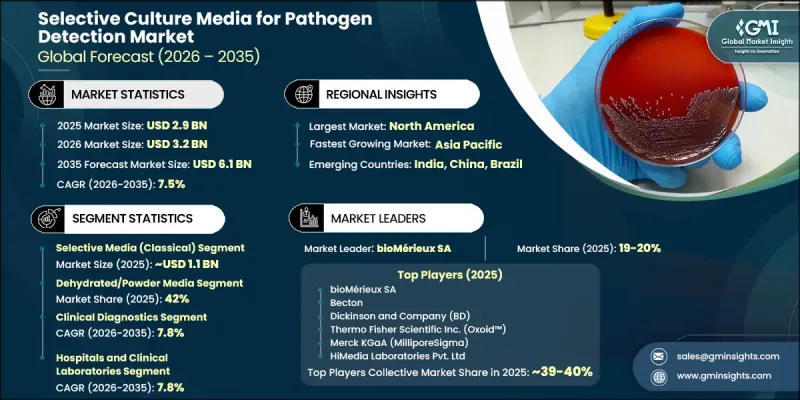
市場擴張反映了選擇性培養基在臨床診斷、藥品生產、食品安全檢測和環境監測等領域的關鍵作用。在這些領域,可靠的病原體檢測對於合規監管和公共衛生保護至關重要。對抗菌素抗藥性監測的日益重視推動了市場需求,使基於培養的病原體鑑定從一項常規檢測程序提升為疾病監測和感染控制計劃的戰略要素。同時,與傳統培養基相比,性能更優、平均售價更高的優質培養基正逐漸受到市場青睞,這對市場產生了積極影響。醫療保健、食品生產和製藥行業法律規範的加強持續推動對先進病原體檢測解決方案的持續需求。此外,新興經濟體不斷擴大的檢測基礎設施和對診斷能力的投資增加,也拓展了全球市場機會。這些長期的產業基本面支撐著穩定的成長前景,並進一步凸顯了選擇性培養基作為現代微生物檢測領域核心技術的重要性。
| 市場範圍 | |
|---|---|
| 開始年份 | 2025 |
| 預測期 | 2026-2035 |
| 初始市場規模 | 29億美元 |
| 預計金額 | 61億美元 |
| 複合年成長率 | 7.5% |
預計到2025年,顯色選擇性培養基將佔據28%的市場佔有率,並在2035年之前以9.8%的複合年成長率成長,成為市場中成長最快的產品類型之一。這一成長主要得益於抗菌藥物抗藥性監測計畫應用的增加、品質保證要求的提高以及先進微生物檢測方法的普及。顯色選擇性培養基透過可視化辨識機制提高目標微生物鑑定的準確性,加速檢查室病原體的初步檢測,並簡化檢測流程。提高檢查室效率和縮短檢測週轉時間的能力顯著促進了其在多個終端使用者領域的應用。隨著醫療系統和實驗室持續重視快速且準確的診斷結果,預計在整個預測期內,對顯色培養基的需求將保持強勁。
預計到2025年,臨床診斷業務將佔據43%的市場佔有率,複合年成長率(CAGR)為7.8%。該業務的主導地位得益於選擇性培養基在醫療檢查室常規微生物檢測中的關鍵作用。由於診斷機構需要這些產品作為既定檢測流程的一部分,因此需求極為穩定,不受整體醫療保健支出波動的影響,採購模式保持可預測性。抗菌素抗藥性監測力度的加大和疾病監測計畫的強化進一步提高了檢查室的使用率,從而推動了選擇性培養基消耗量的成長。對感染控制、疾病早期發現和診斷準確性的日益重視,也持續支撐著全球醫療機構對選擇性培養基的持續需求。
預計到2025年,北美病原體檢測選擇性培養基市場將佔據49%的市場佔有率,市場規模將達到14億美元。該地區的領先地位得益於其高度發展的檢查室基礎設施、微生物檢測技術的廣泛應用以及多個行業對病原體檢測的嚴格監管要求。對公共衛生計畫、食品安全監管和藥品品質保證的大力投入,持續推動對選擇性培養基產品的龐大需求。此外,先進的診斷能力、檢查室最佳實踐的廣泛應用以及不斷加強疾病監測系統的努力,也鞏固了該地區的市場主導地位。這些因素共同支撐著北美在全球市場的持續主導。
目錄
第1章:調查方法和範圍
第2章執行摘要
第3章 行業洞察
- 產業生態系分析
- 供應商情況
- 利潤率
- 每個階段增加的價值
- 影響價值鏈的因素
- 中斷
- 影響產業的因素
- 促進因素
- 產業潛在風險與挑戰
- 市場機遇
- 成長潛力分析
- 監理情勢
- 北美洲
- 歐洲
- 亞太地區
- 拉丁美洲
- 中東和非洲
- 波特的分析
- PESTLE分析
- 價格趨勢
- 按地區
- 依產品類型
- 未來市場趨勢
- 技術與創新展望
- 最新科技趨勢
- 新興技術
- 專利趨勢
- 貿易統計
- 主要進口國
- 主要出口國
- 永續性和環境方面
- 永續計劃
- 減少廢棄物策略
- 生產中的能源效率
- 具有環保意識的舉措
- 考慮碳足跡
第4章 競爭情勢
- 介紹
- 企業市佔率分析
- 按地區
- 北美洲
- 歐洲
- 亞太地區
- LATAM
- 中東和非洲
- 按地區
- 主要市場公司的競爭分析
- 競爭定位矩陣
- 主要進展
- 併購
- 夥伴關係和聯盟
- 新產品發布
- 業務拓展計劃
第5章 市場估算與預測:依產品類型分類,2022-2035年
- 選擇性培養基(常規型)
- 顯色選擇性培養基
- 選擇性和鑑別性培養基
- 專用選擇性介質(AMR檢測)
第6章 市場估算與預測:依產品形式分類,2022-2035年
- 脫水/粉末介質
- 即用型培養基(預製培養皿和培養瓶)
- 液體培養基(選擇性培養基)
- 半固體培養基
- 固體培養基(瓊脂基)
第7章 市場估算與預測:依病原體目標分類,2022-2035年
- 細菌病原體
- 真菌病原體
- 分枝桿菌
- 病毒病原體
- 其他(新出現的病原體)
第8章 市場估計與預測:依應用領域分類,2022-2035年
- 臨床診斷
- 食品和飲料安全檢測
- 藥品和生物製藥的生產
- 環境監測
- 學術和研究機構
- 其他(化妝品、獸用)
第9章 市場估價與預測:依最終用戶分類,2022-2035年
- 醫院和臨床檢查室
- 食品安全檢驗機構
- 製藥和生物技術公司
- 學術和研究機構
- 環境檢測研究所
- 其他(CRO、獸藥、化妝品)
第10章 市場估價與預測:依地區分類,2022-2035年
- 北美洲
- 美國
- 加拿大
- 歐洲
- 德國
- 英國
- 法國
- 西班牙
- 義大利
- 其他歐洲國家
- 亞太地區
- 中國
- 印度
- 日本
- 澳洲
- 韓國
- 其他亞太國家
- 拉丁美洲
- 巴西
- 墨西哥
- 阿根廷
- 其他拉丁美洲國家
- 中東和非洲
- 沙烏地阿拉伯
- 南非
- UAE
- 其他中東和非洲國家
第11章:公司簡介
- bioMerieux
- Becton, Dickinson and Company
- Thermo Fisher Scientific Inc.
- Merck KGaA
- HiMedia Laboratories Pvt. Ltd.
- Neogen Corporation
- Bio-Rad Laboratories, Inc.
- Hardy Diagnostics
- Conda-Pronadisa
- Oxoid
- CHROMagar Microbiology
- Anaerobe Systems
- Alpha Teknova, Inc.
- TM Media
The Global Selective Culture Media for Pathogen Detection Market was valued at USD 2.9 billion in 2025 and is estimated to grow at a CAGR of 7.5% to reach USD 6.1 billion by 2035.
Market expansion reflects the critical role of selective culture media across clinical diagnostics, pharmaceutical manufacturing, food safety testing, and environmental monitoring, where reliable pathogen detection remains essential for regulatory compliance and public health protection. Demand is being strengthened by increasing emphasis on antimicrobial resistance surveillance, which has elevated culture-based pathogen identification from a routine laboratory procedure to a strategic component of disease monitoring and infection control programs. At the same time, the market is benefiting from a gradual shift toward premium media formulations that offer enhanced performance characteristics and command higher average selling prices compared with conventional alternatives. Growing regulatory oversight across healthcare, food production, and pharmaceutical industries continues to create sustained demand for advanced pathogen detection solutions. In addition, expanding laboratory infrastructure across emerging economies and increasing investment in diagnostic capabilities are broadening market opportunities worldwide. These long-term industry fundamentals are supporting stable growth prospects and reinforcing the importance of selective culture media as a cornerstone technology within modern microbiological testing environments.
| Market Scope | |
|---|---|
| Start Year | 2025 |
| Forecast Year | 2026-2035 |
| Start Value | $2.9 Billion |
| Forecast Value | $6.1 Billion |
| CAGR | 7.5% |
The chromogenic selective media segment accounted for 28% share in 2025 and is projected to grow at a CAGR of 9.8% through 2035, making it one of the fastest-growing product categories within the market. Growth is being driven by increasing adoption in antimicrobial resistance monitoring programs, expanding quality assurance requirements, and broader acceptance of advanced microbiological testing methods. Chromogenic selective media provide enhanced differentiation of target microorganisms through visual identification mechanisms, enabling laboratories to accelerate preliminary pathogen detection and streamline testing workflows. The ability to improve laboratory efficiency and reduce turnaround times has contributed significantly to growing adoption across multiple end-use sectors. As healthcare systems and testing facilities continue to prioritize rapid and accurate diagnostic outcomes, demand for chromogenic media is expected to remain strong throughout the forecast period.
The clinical diagnostics segment held a 43% share in 2025 and advancing at a CAGR of 7.8%. The segment's leadership is supported by the essential role of selective culture media in routine microbiological testing conducted by healthcare laboratories. Demand remains highly stable because diagnostic facilities require these products as part of established testing protocols, resulting in predictable procurement patterns regardless of broader healthcare spending fluctuations. The expansion of antimicrobial resistance monitoring initiatives and enhanced disease surveillance programs has further increased laboratory utilization rates, driving higher consumption of selective culture media. Growing emphasis on infection control, early disease detection, and diagnostic accuracy continues to support sustained demand across healthcare institutions worldwide.
North America Selective Culture Media for Pathogen Detection Market held 49% share in 2025, generating USD 1.4 billion. The region's dominance is supported by a highly developed laboratory infrastructure, extensive utilization of microbiological testing technologies, and stringent regulatory requirements governing pathogen detection across multiple industries. Strong investment in public health programs, food safety monitoring, and pharmaceutical quality assurance continues to drive substantial demand for selective culture media products. In addition, advanced diagnostic capabilities, widespread adoption of laboratory best practices, and ongoing efforts to strengthen disease surveillance frameworks contribute to the region's leading market position. These factors collectively support North America's continued prominence within the global industry.
Key companies operating in the Global Selective Culture Media for Pathogen Detection Market include bioMerieux SA, Becton, Dickinson and Company (BD), Thermo Fisher Scientific Inc., Merck KGaA (MilliporeSigma), Liofilchem S.r.l., HiMedia Laboratories Pvt. Ltd., Neogen Corporation, Bio-Rad Laboratories, Inc., Hardy Diagnostics, Conda-Pronadisa, CHROMagar Microbiology, Anaerobe Systems, Alpha Teknova, Inc., and TM Media (Titan Media). Companies participating in the Selective Culture Media for Pathogen Detection Market are pursuing a range of strategic initiatives to strengthen their competitive positions and expand market presence. Product innovation remains a primary focus, with manufacturers investing in advanced media formulations that improve detection accuracy, laboratory efficiency, and workflow optimization. Businesses are also expanding production capabilities and strengthening distribution networks to meet growing demand across healthcare, pharmaceutical, food safety, and environmental testing sectors. Strategic collaborations with research institutions, diagnostic laboratories, and healthcare organizations are helping companies accelerate product development and improve market penetration. In addition, investments in quality assurance, regulatory compliance, and technical support services are enhancing customer confidence and brand loyalty.
Table of Contents
Chapter 1 Methodology & Scope
- 1.1 Market scope and definition
- 1.2 Research design
- 1.2.1 Research approach
- 1.2.2 Data collection methods
- 1.3 Data mining sources
- 1.3.1 Global
- 1.3.2 Regional/Country
- 1.4 Base estimates and calculations
- 1.4.1 Base year calculation
- 1.4.2 Key trends for market estimation
- 1.5 Primary research and validation
- 1.5.1 Primary sources
- 1.6 Forecast model
- 1.7 Research assumptions and limitations
Chapter 2 Executive Summary
- 2.1 Industry 360° synopsis
- 2.2 Key market trends
- 2.2.1 Product type
- 2.2.2 Format
- 2.2.3 Pathogen Target
- 2.2.4 Application
- 2.2.5 End-User
- 2.2.6 Regional
- 2.3 TAM Analysis, 2026-2035
- 2.4 CXO perspectives: Strategic imperatives
Chapter 3 Industry Insights
- 3.1 Industry ecosystem analysis
- 3.1.1 Supplier landscape
- 3.1.2 Profit margin
- 3.1.3 Value addition at each stage
- 3.1.4 Factor affecting the value chain
- 3.1.5 Disruptions
- 3.2 Industry impact forces
- 3.2.1 Growth drivers
- 3.2.2 Industry pitfalls and challenges
- 3.2.3 Market opportunities
- 3.3 Growth potential analysis
- 3.4 Regulatory landscape
- 3.4.1 North America
- 3.4.2 Europe
- 3.4.3 Asia Pacific
- 3.4.4 Latin America
- 3.4.5 Middle East & Africa
- 3.5 Porter's analysis
- 3.6 PESTEL analysis
- 3.7 Price trends
- 3.7.1 By region
- 3.7.2 By product type
- 3.8 Future market trends
- 3.9 Technology and Innovation landscape
- 3.9.1 Current technological trends
- 3.9.2 Emerging technologies
- 3.10 Patent Landscape
- 3.11 Trade statistics (HS code)
- 3.11.1 Major importing countries
- 3.11.2 Major exporting countries
- 3.12 Sustainability and environmental aspects
- 3.12.1 Sustainable practices
- 3.12.2 Waste reduction strategies
- 3.12.3 Energy efficiency in production
- 3.12.4 Eco-friendly initiatives
- 3.13 Carbon footprint consideration
Chapter 4 Competitive Landscape, 2025
- 4.1 Introduction
- 4.2 Company market share analysis
- 4.2.1 By region
- 4.2.1.1 North America
- 4.2.1.2 Europe
- 4.2.1.3 Asia Pacific
- 4.2.1.4 LATAM
- 4.2.1.5 MEA
- 4.2.1 By region
- 4.3 Competitive analysis of major market players
- 4.4 Competitive positioning matrix
- 4.5 Key developments
- 4.5.1 Mergers & acquisitions
- 4.5.2 Partnerships & collaborations
- 4.5.3 New Product Launches
- 4.5.4 Expansion Plans
Chapter 5 Market Estimates and Forecast, By Product Type, 2022-2035 (USD Billion) (Kilo Tons)
- 5.1 Key trends
- 5.2 Selective media (classical)
- 5.3 Chromogenic selective media
- 5.4 Selective-differential media
- 5.5 Specialized selective media (AMR detection)
Chapter 6 Market Estimates and Forecast, By Format, 2022-2035 (USD Million) (Kilo Tons)
- 6.1 Key trends
- 6.2 Dehydrated/powder media
- 6.3 Ready-to-use media (prepared plates + bottles)
- 6.4 Liquid media (selective broth)
- 6.5 Semi-solid media
- 6.6 Solid media (agar-based)
Chapter 7 Market Estimates and Forecast, By Pathogen Target, 2022-2035 (USD Million) (Kilo Tons)
- 7.1 Key trends
- 7.2 Bacterial pathogens
- 7.3 Fungal pathogens
- 7.4 Mycobacteria
- 7.5 Viral pathogens
- 7.6 Others (emerging pathogens)
Chapter 8 Market Estimates and Forecast, By Application, 2022-2035 (USD Million) (Kilo Tons)
- 8.1 Key trends
- 8.2 Clinical diagnostics
- 8.3 Food & beverage safety testing
- 8.4 Pharmaceutical & biopharmaceutical production
- 8.5 Environmental monitoring
- 8.6 Academic & research institutions
- 8.7 Others (cosmetics, veterinary)
Chapter 9 Market Estimates and Forecast, By End user, 2022-2035 (USD Million) (Kilo Tons)
- 9.1 Key trends
- 9.2 Hospitals & clinical laboratories
- 9.3 Food safety testing laboratories
- 9.4 Pharmaceutical & biotechnology companies
- 9.5 Academic & research institutions
- 9.6 Environmental testing agencies
- 9.7 Others (CROs, veterinary, cosmetics)
Chapter 10 Market Estimates and Forecast, By Region, 2022-2035 (USD Million) (Kilo Tons)
- 10.1 Key trends
- 10.2 North America
- 10.2.1 U.S.
- 10.2.2 Canada
- 10.3 Europe
- 10.3.1 Germany
- 10.3.2 UK
- 10.3.3 France
- 10.3.4 Spain
- 10.3.5 Italy
- 10.3.6 Rest of Europe
- 10.4 Asia Pacific
- 10.4.1 China
- 10.4.2 India
- 10.4.3 Japan
- 10.4.4 Australia
- 10.4.5 South Korea
- 10.4.6 Rest of Asia Pacific
- 10.5 Latin America
- 10.5.1 Brazil
- 10.5.2 Mexico
- 10.5.3 Argentina
- 10.5.4 Rest of Latin America
- 10.6 Middle East and Africa
- 10.6.1 Saudi Arabia
- 10.6.2 South Africa
- 10.6.3 UAE
- 10.6.4 Rest of Middle East and Africa
Chapter 11 Company Profiles
- 11.1 bioMerieux
- 11.2 Becton, Dickinson and Company
- 11.3 Thermo Fisher Scientific Inc.
- 11.4 Merck KGaA
- 11.5 HiMedia Laboratories Pvt. Ltd.
- 11.6 Neogen Corporation
- 11.7 Bio-Rad Laboratories, Inc.
- 11.8 Hardy Diagnostics
- 11.9 Conda-Pronadisa
- 11.10 Oxoid
- 11.11 CHROMagar Microbiology
- 11.12 Anaerobe Systems
- 11.13 Alpha Teknova, Inc.
- 11.14 TM Media

 快速微生物檢測市場-2026-2032年全球市場預測
 全球快速微生物檢測市場規模、佔有率、趨勢和成長分析報告(2026-2034年)
 全球快速微生物檢測市場:依產品、方法、應用、最終用戶和地區分類-預測至2031年
 快速微生物檢測解決方案市場:按檢測方法、交付方式、儀器、病原體、應用、最終用戶和地區分類的趨勢和預測(至 2035 年)
 2034年工業微生物檢測服務市場預測-按檢測類型、最終用戶和地區分類的全球分析
 微生物檢測市場規模、佔有率和成長分析(按檢測類型、產品類型、技術、應用、最終用戶和地區分類)-2026-2033年產業預測
 2026年全球微生物技術、設備和耗材市場報告2026年全球藥品快速微生物檢測市場報告
 全球微生物檢測市場(至 2031 年)按產品(儀器、試劑和試劑盒、耗材)、技術(傳統(人工計數、培養)、快速(核酸、活力))和最終用戶(製藥、生物技術、食品、水和環境檢測)分類2026年全球快速微生物檢測套組市場報告