


 |
市場調查報告書
商品編碼
2071177
2026 年至 2035 年再生生活型態產品市場的商業機會、成長要素、產業趨勢與預測。Regenerative Lifestyle Products Market Opportunity, Growth Drivers, Industry Trend Analysis, and Forecast 2026 - 2035 |
||||||

全球再生生活方式產品市場預計到 2025 年價值 45 億美元,並將以 12.7% 的複合年成長率成長,到 2035 年達到 152 億美元。
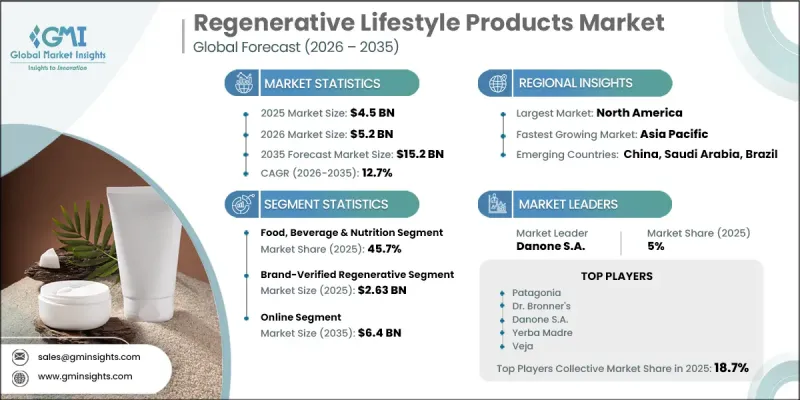
市場擴張的驅動力在於再生資源在包括食品、個人護理、服裝和家居用品在內的多個消費品類別中日益普及。隨著主要消費品製造商擴大再生農業規模並加強對負責任舉措的承諾,全球供應鏈中經認證的可再生原料供應量正在穩步成長。同時,認證標準的提升進一步拓展了產品差異化的機會,幫助品牌建立消費者信任並為高價策略提供基礎。隨著消費者越來越重視環境保護、永續生產方式和供應鏈透明度,對再生產品的需求持續成長。然而,由於再生產品往往比傳統替代品價格更高,高價策略仍然是其廣泛市場滲透的一大挑戰。隨著供應鏈的成熟和生產規模的擴大,可負擔性的提高有望提升整個可再生生活方式產品市場的可及性,從而推動長期成長。
| 市場範圍 | |
|---|---|
| 開始年份 | 2025 |
| 預測期 | 2026-2035 |
| 初始市場規模 | 45億美元 |
| 預計金額 | 152億美元 |
| 複合年成長率 | 12.7% |
食品、飲料和營養品產業佔45.7%的市場佔有率,預計到2025年銷售額將達到20億美元。該產業市場領先地位的關鍵因素在於其農業供應鏈中相對先進的可再生資源採購體系。消費者對永續生產的食品和營養產品的需求不斷成長,持續推動對再生原料採購的投資,從而支撐著整個品類的強勁成長。此外,全球消費者對環境永續性和負責任的食品生產方式的日益關注,也為該產業的發展提供了助力。
預計到2035年,線上分銷通路市場規模將達到64億美元,其中包括直接面對消費者的平台和數位市場。該通路可望持續維持再生生活方式產品市場中成長最快的銷售管道。這一強勁成長得益於數位平台能夠直接向消費者傳遞產品來源資訊、永續性記錄和品牌價值。此外,線上管道還使企業能夠維持高階定價策略,增強客戶參與,並透過建立直接關係和個人化購物體驗來培養長期的品牌忠誠度。
預計到2025年,北美再生生活方式產品市場規模將達到20億美元,市佔率將達到44.6%。該地區市場成長的驅動力包括高度發展的高階消費品生態系統、消費者對永續產品日益成長的需求以及消費者環保意識的增強。完善的零售基礎設施和先進的D2C銷售網路持續為再生生活方式產品在北美的廣泛應用和推廣創造有利條件。
目錄
第1章:調查方法和範圍
第2章執行摘要
第3章 行業洞察
- 產業生態系分析
- 影響產業的因素
- 促進因素
- 消費者對土壤健康、氣候影響和食品透明度的意識日益增強。
- 加速企業永續發展措施與範圍 3排放目標
- ROC產品系列按類別擴展
- 注重性價比的消費者對優質化和支付意願的趨勢
- 產業潛在風險與挑戰
- 全球缺乏統一的定義標準,認證體係也較為分散。
- 高昂的價格阻礙了其被一般消費者接受。
- 市場機遇
- 拓展到市場滲透率較低的類別(家居用品、保健品)。
- 受電子商務和 DTC 通路發展推動,能夠實現「從農場到消費者」故事講述的玩具。
- 促進因素
- 成長潛力分析
- 監理情勢
- 技術展望
- 最新科技趨勢
- 新興技術
- 價格趨勢分析
- 定價策略:按業務類型分類
- 價格溢價分析
- 未來市場趨勢
- 波特的分析
- PESTLE分析
- 貿易數據分析
- 按產品類別分類的進出口量和進口額趨勢
- 主要貿易路線及關稅對可再生產品的影響
- 人工智慧和生成式人工智慧對市場的影響
- 利用人工智慧改造現有經營模式
- 按細分市場分類的生成式人工智慧用例和部署藍圖
- 風險、限制和監管考量
- 目前分銷基礎設施和通路滲透情況
- 按地區與業態(現代零售與傳統零售)分類的通路覆蓋率
- 缺乏最後一公里基礎設施和不斷變化的管道
- 消費者洞察
第4章 競爭情勢
- 介紹
- 企業市佔率分析:按地區分類
- 北美洲
- 歐洲
- 亞太地區
- 中東和非洲
- 拉丁美洲
- 主要進展
- 重要合作夥伴關係和合作
- 併購主要趨勢
- 產品創新和新產品發布
- 市場擴大策略
- 競爭定位矩陣
第5章 市場規模及預測:依產品類型分類,2022-2035年
- 食品、飲料和營養
- 包裝食品
- 飲料
- 營養補充品和功能性食品
- 個人護理及美容
- 服裝、紡織品、家用紡織品
- 家居用品/日常必需品
第6章 市場規模及預測:依採購及認證標準分類,2022-2035年
- 第三方認證的回收材料
- 再生有機認證(ROC)
- 生物動力認證(德米特)
- 牧場放養/草飼農業認證
- 品牌認證翻新
第7章 市場規模及預測:依通路分類,2022-2035年
- 線上管道
- 直接面對消費者 (DTC) / 品牌自有商店
- 電子商務市場
- 特色及天然食品零售
- 量販店和超級市場
- 藥局/藥局
第8章 市場規模及預測:依地區分類,2022-2035年
- 北美洲
- 美國
- 加拿大
- 歐洲
- 德國
- 法國
- 英國
- 荷蘭
- 西班牙
- 義大利
- 亞太地區
- 中國
- 日本
- 韓國
- 印度
- 澳洲
- 中東和非洲
- 沙烏地阿拉伯
- UAE
- 南非
- 拉丁美洲
- 巴西
- 阿根廷
- 墨西哥
第9章:公司簡介
- 世界公司
- Patagonia
- Dr. Bronner's
- Danone SA
- General Mills Inc.
- Eileen Fisher Inc.
- Veja
- 當地公司
- Lundberg Family Farms
- Force of Nature Meats
- Manitoba Harvest Hemp Foods
- Thrive Natural Care
- prAna
- Yerba Madre(fka Guayaki)
- Groundwork Coffee
- Maggie's Organics
- Niche &Specialist Players
- SIMPLi
- FOND Bone Broth
- Lotus Foods
- evanhealy
- Babylife Organics
- Herb Pharm
- Outerknown
The Global Regenerative Lifestyle Products Market was valued at USD 4.5 billion in 2025 and is estimated to grow at a CAGR of 12.7% to reach USD 15.2 billion by 2035.
Market expansion is driven by the increasing commercialization of regenerative sourcing practices across multiple consumer product categories, including food, personal care, apparel, and household products. Growing commitments from major consumer goods manufacturers to expand regenerative agriculture and responsible sourcing initiatives are steadily increasing the availability of certified regenerative raw materials throughout global supply chains. At the same time, enhanced certification standards are creating stronger product differentiation opportunities, helping brands build consumer confidence and justify premium pricing strategies. Demand for regenerative products continues to rise as consumers place greater emphasis on environmental stewardship, sustainable production methods, and supply chain transparency. However, premium pricing remains a challenge for broader market adoption, as regenerative products often carry higher costs than conventional alternatives. As supply chains mature and production scales increase, greater affordability is expected to improve accessibility and support long-term growth across the regenerative lifestyle products market.
| Market Scope | |
|---|---|
| Start Year | 2025 |
| Forecast Year | 2026-2035 |
| Start Value | $4.5 Billion |
| Forecast Value | $15.2 Billion |
| CAGR | 12.7% |
The food, beverage, and nutrition segment held a 45.7% share, generating USD 2 billion in 2025. Its market leadership is largely attributed to the comparatively advanced development of regenerative sourcing frameworks within agricultural supply chains. Increasing consumer demand for sustainably produced food and nutrition products continues to drive investment in regenerative ingredient sourcing, supporting strong growth across this category. The segment also benefits from rising awareness of environmental sustainability and responsible food production practices among consumers worldwide.
The online distribution channel segment is expected to reach USD 6.4 billion by 2035, including direct-to-consumer platforms and digital marketplaces, is expected to remain the fastest-growing sales channel in the regenerative lifestyle products market. Strong growth is supported by the ability of digital platforms to communicate product sourcing information, sustainability credentials, and brand values directly to consumers. Online channels also enable companies to maintain premium pricing strategies, strengthen customer engagement, and foster long-term brand loyalty through direct relationships and personalized purchasing experiences.
North America Regenerative Lifestyle Products Market accounted for USD 2 billion in 2025 holding 44.6% share. Market growth in the region is supported by a highly developed premium consumer products ecosystem, increasing demand for sustainable goods, and strong consumer awareness regarding environmentally responsible purchasing decisions. Well-established retail infrastructure and advanced direct-to-consumer sales networks continue to create favorable conditions for regenerative lifestyle product adoption and expansion throughout North America.
Major companies operating in the global regenerative lifestyle products market include Danone S.A., Dr. Bronner's, Patagonia, Yerba Madre, Veja, Lundberg Family Farms, General Mills Inc., Manitoba Harvest Hemp Foods, Eileen Fisher Inc., Force of Nature Meats, Herb Pharm, Lotus Foods, prAna, SIMPLi, Groundwork Coffee, evanhealy, Outerknown, FOND Bone Broth, Maggie's Organics, Babylife Organics, and Thrive Natural Care. Companies participating in the regenerative lifestyle products market are implementing a range of strategic initiatives to strengthen their market presence and improve long-term competitiveness. Investment in regenerative sourcing programs remains a key priority as companies work to secure reliable supplies of certified raw materials and improve supply chain transparency. Product innovation and portfolio expansion are helping brands address growing consumer demand for sustainable alternatives across multiple product categories. Strategic partnerships with producers, certification organizations, and supply chain stakeholders are also supporting market growth and strengthening brand credibility. Many companies are increasing investments in digital marketing, direct-to-consumer sales channels, and consumer education initiatives to build stronger customer relationships and enhance brand loyalty.
Table of Contents
Chapter 1 Methodology & Scope
- 1.1 Research approach
- 1.2 Quality commitments
- 1.2.1 GMI AI policy & data integrity commitment
- 1.2.1.1 Source consistency protocol
- 1.2.1 GMI AI policy & data integrity commitment
- 1.3 Research trail & confidence scoring
- 1.3.1 Research trail components
- 1.3.2 Scoring components
- 1.4 Data collection
- 1.4.1 Partial list of primary sources
- 1.5 Data mining sources
- 1.5.1 Paid sources
- 1.5.1.1 Sources, by region
- 1.5.1 Paid sources
- 1.6 Base estimates and calculations
- 1.6.1 Base year calculation for any one approach
- 1.7 Market estimates & forecasts parameters
- 1.8 Forecast model
- 1.8.1 Quantified market impact analysis
- 1.8.1.1 Mathematical impact of growth parameters on forecast
- 1.8.1 Quantified market impact analysis
- 1.9 Research transparency addendum
- 1.9.1 Source attribution framework
- 1.9.2 Quality assurance metrics
- 1.9.3 Our commitment to trust
- 1.10 Market definitions
Chapter 2 Executive Summary
- 2.1 Industry synopsis, 2022 - 2035
- 2.1.1 Business trends
- 2.1.2 Product type trends
- 2.1.3 Sourcing & certification standard trends
- 2.1.4 Distribution channel trends
- 2.1.5 Regional trends
Chapter 3 Industry Insights
- 3.1 Industry ecosystem analysis
- 3.2 Industry impact forces
- 3.2.1 Growth drivers
- 3.2.1.1 Rising Consumer Consciousness Around Soil Health, Climate Impact & Food Transparency
- 3.2.1.2 Accelerating Corporate Sustainability Commitments & Scope 3 Emission Reduction Targets
- 3.2.1.3 Growth of ROC Product Portfolio Across Categories
- 3.2.1.4 Premiumization Trend & Willingness-to-Pay Among Values-Based Shoppers
- 3.2.2 Industry pitfalls and challenges
- 3.2.2.1 Lack of Standardized Global Definition & Certification Fragmentation
- 3.2.2.2 Premium Price Points Limiting Mainstream Consumer Adoption
- 3.2.3 Market opportunities
- 3.2.3.1 Expansion into Underpenetrated Categories (Home & Household, Supplements)
- 3.2.3.2 E-Commerce & DTC Channel Growth Enabling Farm-to-Consumer Storytelling Toys
- 3.2.1 Growth drivers
- 3.3 Growth potential analysis
- 3.4 Regulatory landscape (Driven by primary research)
- 3.4.1 North America
- 3.4.2 Europe
- 3.4.3 Asia Pacific
- 3.4.4 Latin America
- 3.4.5 MEA
- 3.5 Technology landscape
- 3.5.1 Current technological trends
- 3.5.2 Emerging technologies
- 3.6 Pricing trend analysis (Driven by primary research)
- 3.6.1 pricing strategy by player type
- 3.6.2 price premium analysis
- 3.7 Future market trends
- 3.8 Porter's analysis
- 3.9 PESTEL analysis
- 3.10 Trade data analysis (driven by paid database) (HS code: 33049990)
- 3.10.1 Import/export volume & value trends by product category
- 3.10.2 Key trade corridors & tariff impact on regenerative goods
- 3.11 Impact of AI & generative AI on the market
- 3.11.1 AI-driven disruption of existing business models
- 3.11.2 Genai use cases & adoption roadmap by segment
- 3.11.3 Risks, limitations & regulatory considerations
- 3.12 Distribution infrastructure & channel penetration landscape (driven by primary research)
- 3.12.1 Channel coverage by region & format (modern vs. Traditional trade) (driven by primary research)
- 3.12.2 Last-mile infrastructure gaps & emerging channel shifts (driven by primary research)
- 3.13 Consumer insights (Driven by primary research)
Chapter 4 Competitive Landscape, 2025
- 4.1 Introduction
- 4.2 Company market share analysis, by region, 2025
- 4.2.1 North America
- 4.2.2 Europe
- 4.2.3 Asia Pacific
- 4.2.4 Middle East & Africa
- 4.2.5 Latin America
- 4.3 Key developments
- 4.3.1 Key partnerships & collaborations
- 4.3.2 Major M&A activities
- 4.3.3 Product innovations & launches
- 4.3.4 Market expansion strategies
- 4.4 Competitive positioning matrix
Chapter 5 Market Size and Forecast, By Product Type, 2022 - 2035 (USD Billion)
- 5.1 Key trends
- 5.2 Food, Beverage & Nutrition
- 5.2.1 Packaged Food
- 5.2.2 Beverages
- 5.2.3 Dietary Supplements & Functional Nutrition
- 5.3 Personal Care & Beauty
- 5.4 Apparel, Textiles & Home Linens
- 5.5 Home & Household Products
Chapter 6 Market Size and Forecast, By Sourcing & Certification Standard, 2022 - 2035 (USD Billion)
- 6.1 Key trends
- 6.2 Third-Party Certified Regenerative
- 6.3 Regenerative Organic Certified (ROC)
- 6.4 Biodynamic Certified (Demeter)
- 6.5 Pasture-Raised / Grassfed Certified
- 6.6 Brand-Verified Regenerative
Chapter 7 Market Size and Forecast, By Distribution Channel, 2022 - 2035 (USD Billion)
- 7.1 Key trends
- 7.2 Online Channels
- 7.2.1 Direct-to-Consumer (DTC) / Brand-Owned
- 7.2.2 E-Commerce Marketplaces
- 7.3 Specialty & Natural Retail
- 7.4 Mass Retail & Supermarkets
- 7.5 Pharmacy & Drug Stores
Chapter 8 Market Size and Forecast, By Region, 2022 - 2035 (USD Billion)
- 8.1 Key trends
- 8.2 North America
- 8.2.1 U.S.
- 8.2.2 Canada
- 8.3 Europe
- 8.3.1 Germany
- 8.3.2 France
- 8.3.3 UK
- 8.3.4 Netherlands
- 8.3.5 Spain
- 8.3.6 Italy
- 8.4 Asia Pacific
- 8.4.1 China
- 8.4.2 Japan
- 8.4.3 South Korea
- 8.4.4 India
- 8.4.5 Australia
- 8.5 Middle East & Africa
- 8.5.1 Saudi Arabia
- 8.5.2 UAE
- 8.5.3 South Africa
- 8.6 Latin America
- 8.6.1 Brazil
- 8.6.2 Argentina
- 8.6.3 Mexico
Chapter 9 Company Profiles
- 9.1 Global Players
- 9.1.1 Patagonia
- 9.1.2 Dr. Bronner's
- 9.1.3 Danone S.A.
- 9.1.4 General Mills Inc.
- 9.1.5 Eileen Fisher Inc.
- 9.1.6 Veja
- 9.2 Regional Players
- 9.2.1 Lundberg Family Farms
- 9.2.2 Force of Nature Meats
- 9.2.3 Manitoba Harvest Hemp Foods
- 9.2.4 Thrive Natural Care
- 9.2.5 prAna
- 9.2.6 Yerba Madre (fka Guayaki)
- 9.2.7 Groundwork Coffee
- 9.2.8 Maggie's Organics
- 9.3 Niche & Specialist Players
- 9.3.1 SIMPLi
- 9.3.2 FOND Bone Broth
- 9.3.3 Lotus Foods
- 9.3.4 evanhealy
- 9.3.5 Babylife Organics
- 9.3.6 Herb Pharm
- 9.3.7 Outerknown


