

 |
市場調查報告書
商品編碼
2071168
動畫商品行銷市場機會、成長促進因素、產業趨勢分析及2026-2035年預測Anime Merchandising Market Opportunity, Growth Drivers, Industry Trend Analysis, and Forecast 2026 - 2035 |
||||||

據估計,到 2025 年,全球動畫商品行銷市場價值將達到 121 億美元,年複合成長率為 8.9%,到 2035 年將達到 288 億美元。
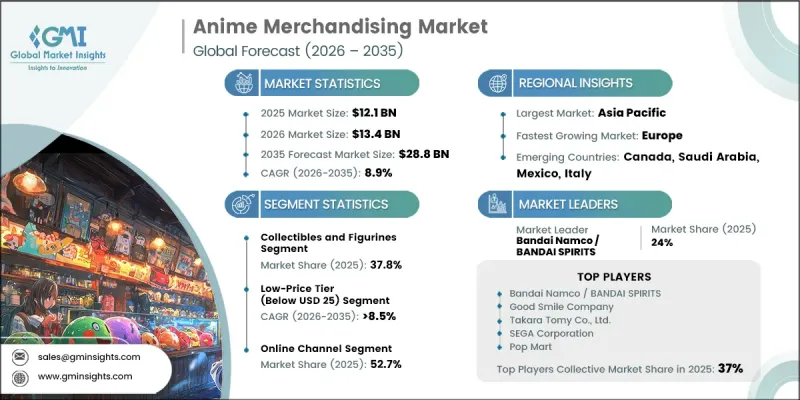
市場成長主要得益於動畫內容消費的全球持續擴張以及與娛樂系列相關的授權商品日益成長的人氣。動畫透過數位發行管道的廣泛傳播顯著擴大了其受眾群體,動畫從小眾愛好發展成為跨多個地區的主流娛樂類別。這種轉變擴大了對品牌商品感興趣的消費者群體,為商品製造商和授權商創造了龐大的商機。粉絲文化、收藏品需求以及數位消費行為的日益融合也對市場產生了積極影響,在廣泛的產品類別中創造了持續的需求。隨著動畫觀眾對智慧財產權(IP)的參與度不斷提高,對相關商品的需求往往遠遠超出單一內容的發行週期。品牌知名度的提升、零售通路的拓展以及消費者購買授權商品意願的增強,都在支撐著市場的長期成長。此外,國際消費者的參與度不斷提高,也有助於收入來源的多元化,從而增強了全球動畫商品行銷市場的整體前景。
| 市場範圍 | |
|---|---|
| 開始年份 | 2025 |
| 預測期 | 2026-2035 |
| 起始金額 | 121億美元 |
| 預測金額 | 288億美元 |
| 複合年成長率 | 8.9% |
預計到2025年,收藏品和人偶市場將佔據37.8%的市場。這一主導地位得益於消費者對收藏品和高階角色周邊產品的強勁需求。人偶兼具展示價值和長期收藏價值,仍然是愛好者中最受歡迎的產品類別之一。該細分市場受益於消費者對限量版、小批量生產和高品質產品的持續需求,這些產品深受狂熱粉絲的喜愛。隨著收藏文化在全球範圍內的不斷發展,預計對人偶及相關產品的需求仍將是推動整體市場成長的主要動力。
低價位產品(價格低於25美元)預計在2025年將佔據44.6%的市場佔有率,並在2026年至2035年間以8.5%的複合年成長率成長。此細分市場涵蓋種類繁多的平價商品,既能讓新消費者以實惠的價格輕鬆入門,又能鼓勵現有消費者重複購買。透過零售店、線上市場和粉絲專屬銷售管道建立的廣泛分銷網路,鞏固了該細分市場的強勁勢頭。此品類產品的平價優勢使其銷售量高、消費者參與度廣,因而有助於在不同的消費族群中維持穩定的需求,不受高階商品購買趨勢波動的影響。
預計到2025年,北美動畫商品行銷市場將佔據29.9%的市場佔有率,並在2035年之前維持9.2%的複合年成長率,超過整體市場成長率。該地區持續受益於龐大且忠實的消費群體,以及完善的零售網路和先進的電子商務基礎設施。動畫內容的日益普及、消費者在娛樂相關產品上的支出不斷成長,以及授權商品種類的持續豐富,都在推動著全部區域的市場需求。強大的分銷能力、廣泛的產品供應以及粉絲的高度參與,繼續鞏固北美作為全球市場成長貢獻最大地區之一的地位。
目錄
第1章:調查方法和範圍
第2章執行摘要
第3章 行業洞察
- 產業生態系分析
- 供應商情況
- 利潤率
- 每個階段增加的價值
- 影響價值鏈的因素
- 影響產業的因素
- 成長促進因素
- 動畫內容世界的變革
- 收藏文化的興起
- 強大的特許經營/智慧財產權變現模式
- 產業潛在風險與挑戰
- 高度依賴內容流行週期
- 供應鍊和生產風險
- 機會
- 高級限量版收藏品
- 數位和虛擬商品行銷
- 成長促進因素
- 成長潛力分析
- 監管和授權框架
- 各國關於動畫商品行銷的智慧財產權和版權保護法律
- 許可合約結構(製作委員會制度,日本)
- 區域法規差異(北美、歐洲、亞太地區)
- 反假冒法律與執法機制
- 價格分析
- 按產品類型分析歷史價格趨勢
- 依球員類型分類的定價策略(高級球員、超值球員、成本加成球員)
- 貿易數據分析
- 按產品類別分類的進出口量和進口額趨勢
- 主要貿易路線及關稅的影響
- 人工智慧和生成式人工智慧對市場的影響
- 利用人工智慧改造現有經營模式
- 按細分市場分類的生成式人工智慧用例和部署藍圖
- 風險、限制和監管考量
- 目前分銷基礎設施和通路滲透情況
- 按地區與業態(現代零售與傳統零售)分類的通路覆蓋率
- 缺乏最後一公里基礎設施和不斷變化的管道
第4章 競爭情勢
- 介紹
- 企業市佔率分析
- 按地區
- 企業矩陣分析
- 主要市場公司的競爭分析
- 競爭定位矩陣
- 主要進展
- 併購
- 夥伴關係和聯盟
- 新產品發布
- 業務拓展計劃
第5章 市場估算與預測:依產品類型分類,2022-2035年
- 收藏品和人偶
- 衣服
- 印刷品
- 玩具和遊戲
- 配件
- 數位產品
- 其他
第6章 市場估計與預測:依價格分類,2022-2035年
- 低價位(25美元以下)
- 中價位(25-100美元)
- 高價位(超過100美元)
第7章 市場估計與預測:依消費群組分類,2022-2035年
- 男性
- 女士
- 男女通用的
第8章 市場估算與預測:依最終使用者分類,2022-2035年
- 個人粉絲/消費者
- 收藏家和愛好者
- 禮品購買者
- 商業和機構買家
第9章 市場估價與預測:依通路分類,2022-2035年
- 線上
- 公司網站
- 電子商務網站
- 離線
- 專賣店
- 玩具店
- 超級市場和大賣場
第10章 市場估價與預測:依地區分類,2022-2035年
- 北美洲
- 美國
- 加拿大
- 歐洲
- 德國
- 英國
- 法國
- 義大利
- 西班牙
- 亞太地區
- 中國
- 日本
- 印度
- 澳洲
- 韓國
- 拉丁美洲
- 巴西
- 墨西哥
- 阿根廷
- 中東和非洲
- 南非
- 沙烏地阿拉伯
- UAE
第11章:公司簡介
- 世界公司
- Bandai Namco/BANDAI SPIRITS
- Good Smile Company
- Kotobukiya Co., Ltd.
- Medicom Toy Corporation
- Kaiyodo Co., Ltd.
- Takara Tomy Co., Ltd.
- Max Factory
- 當地公司
- Abysse Corp
- SEGA Corporation
- Bushiroad Inc.
- Alter Co., Ltd.
- Furyu Corporation
- Phat!Company
- Taito Corporation
- 新興企業
- Stronger Co., Ltd.
- Sentinel Co., Ltd.
- Pop Mart
- HobbyMax
- Union Creative
- Myethos
- APEX Innovation
The Global Anime Merchandising Market was valued at USD 12.1 billion in 2025 and is estimated to grow at a CAGR of 8.9% to reach USD 28.8 billion by 2035.
Market growth is driven by the continued global expansion of anime content consumption and the increasing popularity of licensed products associated with entertainment franchises. The widespread availability of anime through digital distribution channels has significantly broadened audience reach, transforming anime from a niche interest into a mainstream entertainment category across multiple regions. This shift has created substantial opportunities for merchandise manufacturers and licensors by expanding the pool of consumers interested in branded products. The market is also benefiting from the growing intersection of fandom culture, collectibles demand, and digitally connected consumer behavior, which continues to generate sustained demand across a wide range of merchandise categories. As anime audiences become more engaged with intellectual properties, demand for related products often extends well beyond the release cycle of individual content offerings. Increasing brand recognition, expanding retail availability, and greater consumer willingness to purchase licensed merchandise are supporting long-term market growth. In addition, rising participation from international consumers is contributing to a more diversified revenue base, strengthening the overall outlook for the global Anime Merchandising Market.
| Market Scope | |
|---|---|
| Start Year | 2025 |
| Forecast Year | 2026-2035 |
| Start Value | $12.1 Billion |
| Forecast Value | $28.8 Billion |
| CAGR | 8.9% |
The collectibles and figurines segment held 37.8% share in 2025. Its leading position is supported by strong consumer interest in collectible merchandise and premium character-based products. Figurines continue to serve as one of the most desirable merchandise categories among enthusiasts, offering both display value and long-term collectability. The segment benefits from ongoing demand for exclusive releases, limited-production products, and premium-quality merchandise that appeals to dedicated fans. As collectible culture continues to expand globally, demand for figurines and related products is expected to remain a major contributor to overall market growth.
The low-price category, consisting of products priced below USD 25, accounted for 44.6% share in 2025 and is projected to grow at a CAGR of 8.5% during 2026-2035. This segment includes a broad range of accessible merchandise products that provide an affordable entry point for new consumers while also encouraging repeat purchases among existing fans. Its strong market presence is supported by widespread distribution through retail outlets, online marketplaces, and fan-focused sales channels. The affordability of products within this category enables high-volume sales and broad consumer participation, helping sustain consistent demand across diverse customer groups regardless of fluctuations in premium merchandise purchasing activity.
North America Anime Merchandising Market held 29.9% share in 2025 and is forecast to register a CAGR of 9.2% through 2035, exceeding the overall market growth rate. The region continues to benefit from a large and highly engaged consumer base, supported by well-established retail networks and advanced e-commerce infrastructure. Growing awareness of anime content, increasing consumer spending on entertainment-related products, and the continued expansion of licensed merchandise offerings have strengthened market demand throughout the region. Strong distribution capabilities, extensive product availability, and high levels of fan engagement continue to support North America's position as one of the most significant contributors to global market growth.
Major companies operating in the Anime Merchandising Market include Bandai Namco / BANDAI SPIRITS, Good Smile Company, Takara Tomy, Pop Mart, SEGA Corporation, Kotobukiya, Medicom Toy, Furyu Corporation, Taito Corporation, Abysse Corp (ABYstyle), Bushiroad, Alter Co., Ltd., HobbyMax, Myethos, Max Factory, APEX Innovation, Union Creative, Phat! Company, Stronger Co., Sentinel Co., and Kaiyodo. Companies participating in the Anime Merchandising Market are implementing a variety of strategies to strengthen their competitive position and expand market share. Product diversification remains a key focus, with manufacturers introducing new merchandise categories, premium collectibles, and limited-edition releases designed to attract a wider range of consumers. Businesses are also increasing investments in licensing agreements and intellectual property partnerships to capitalize on the growing demand for franchise-based products. Expanding direct-to-consumer sales channels, strengthening e-commerce capabilities, and enhancing digital marketing efforts are helping companies improve customer reach and brand visibility. In addition, manufacturers are emphasizing product quality, innovation, and exclusive merchandise offerings to differentiate themselves in an increasingly competitive marketplace.
Table of Contents
Chapter 1 Methodology and Scope
- 1.1 Market scope and definition
- 1.2 Research design
- 1.2.1 Research approach
- 1.2.2 Data collection methods
- 1.3 Data mining sources
- 1.3.1 Global
- 1.3.2 Regional/Country
- 1.4 Base estimates and calculations
- 1.4.1 Base year calculation
- 1.4.2 Key trends for market estimation
- 1.5 Primary research and validation
- 1.5.1 Primary sources
- 1.6 Forecast model
- 1.7 Research assumptions and limitations
Chapter 2 Executive Summary
- 2.1 Industry 360° synopsis
- 2.2 Key market trends
- 2.2.1 Regional
- 2.2.2 Product type
- 2.2.3 Price
- 2.2.4 Consumer group
- 2.2.5 End user
- 2.2.6 Distribution channel
Chapter 3 Industry Insights
- 3.1 Industry ecosystem analysis
- 3.1.1 Supplier landscape
- 3.1.2 Profit margin
- 3.1.3 Value addition at each stage
- 3.1.4 Factor affecting the value chain
- 3.2 Industry impact forces
- 3.2.1 Growth drivers
- 3.2.1.1 Globalization of anime content
- 3.2.1.2 Rise of collectibles culture
- 3.2.1.3 Strong franchise/IP monetization model
- 3.2.2 Industry pitfalls & challenges
- 3.2.2.1 High dependence on content popularity cycles
- 3.2.2.2 Supply chain and production risks
- 3.2.3 Opportunities
- 3.2.3.1 Premium & limited-edition collectibles
- 3.2.3.2 Digital & virtual merchandising
- 3.2.1 Growth drivers
- 3.3 Growth potential analysis
- 3.4 Regulatory & licensing framework
- 3.4.1 Global IP & copyright protection laws for anime merchandise
- 3.4.2 Licensing agreement structures (production committee system, Japan)
- 3.4.3 Regional regulatory differences (North America, Europe, Asia Pacific)
- 3.4.4 Anti-counterfeiting legislation & enforcement mechanisms
- 3.5 Pricing analysis (driven by primary research)
- 3.5.1 Historical price trend analysis by product category
- 3.5.2 Pricing strategy by player type (premium / value / cost-plus)
- 3.6 Trade data analysis (driven by paid database)
- 3.6.1 Import/export volume & value trends by product category
- 3.6.2 Key trade corridors & tariff impact
- 3.7 Impact of AI & generative AI on the market
- 3.7.1 AI-driven disruption of existing business models
- 3.7.2 GenAI use cases & adoption roadmap by segment
- 3.7.3 Risks, limitations & regulatory considerations
- 3.8 Distribution infrastructure & channel penetration landscape (driven by primary research)
- 3.8.1 Channel coverage by region & format (modern vs. Traditional trade)
- 3.8.2 Last-mile infrastructure gaps & emerging channel shifts
Chapter 4 Competitive Landscape, 2025
- 4.1 Introduction
- 4.2 Company market share analysis
- 4.2.1 By region
- 4.2.1.1 North America
- 4.2.1.2 Europe
- 4.2.1.3 Asia Pacific
- 4.2.1.4 Latin America
- 4.2.1.5 Middle East and Africa
- 4.2.1 By region
- 4.3 Company matrix analysis
- 4.4 Competitive analysis of major market players
- 4.5 Competitive positioning matrix
- 4.6 Key developments
- 4.6.1 Mergers & acquisitions
- 4.6.2 Partnerships & collaborations
- 4.6.3 New product launches
- 4.6.4 Expansion plans
Chapter 5 Market Estimates and Forecast, By Product Type, 2022 - 2035 (USD Billion) (Million Units)
- 5.1 Key trends
- 5.2 Collectibles & figurines
- 5.3 Clothing
- 5.4 Printed materials
- 5.5 Toys & games
- 5.6 Accessories
- 5.7 Digital merchandise
- 5.8 Others
Chapter 6 Market Estimates and Forecast, By Price, 2022 - 2035 (USD Billion) (Million Units)
- 6.1 Key trends
- 6.2 Low (Below $25)
- 6.3 Medium ($25-$100)
- 6.4 High (Above $100)
Chapter 7 Market Estimates and Forecast, By Consumer Group, 2022 - 2035 (USD Billion) (Million Units)
- 7.1 Key trends
- 7.2 Men
- 7.3 Women
- 7.4 Unisex
Chapter 8 Market Estimates and Forecast, By End User, 2022 - 2035 (USD Billion) (Million Units)
- 8.1 Key trends
- 8.2 Individual fans/consumers
- 8.3 Collectors & hobbyists
- 8.4 Gift purchasers
- 8.5 Commercial/institutional buyers
Chapter 9 Market Estimates and Forecast, By Distribution Channel, 2022 - 2035 (USD Billion) (Million Units)
- 9.1 Key trends
- 9.2 Online
- 9.2.1 Company websites
- 9.2.2 E-commerce websites
- 9.3 Offline
- 9.3.1 Specialty stores
- 9.3.2 Toy stores
- 9.3.3 Supermarkets & hypermarkets
Chapter 10 Market Estimates and Forecast, By Region, 2022 - 2035 (USD Billion) (Million Units)
- 10.1 Key trends
- 10.2 North America
- 10.2.1 U.S.
- 10.2.2 Canada
- 10.3 Europe
- 10.3.1 Germany
- 10.3.2 UK
- 10.3.3 France
- 10.3.4 Italy
- 10.3.5 Spain
- 10.4 Asia Pacific
- 10.4.1 China
- 10.4.2 Japan
- 10.4.3 India
- 10.4.4 Australia
- 10.4.5 South Korea
- 10.5 Latin America
- 10.5.1 Brazil
- 10.5.2 Mexico
- 10.5.3 Argentina
- 10.6 Middle East and Africa
- 10.6.1 South Africa
- 10.6.2 Saudi Arabia
- 10.6.3 UAE
Chapter 11 Company Profiles
- 11.1 Global players
- 11.1.1 Bandai Namco / BANDAI SPIRITS
- 11.1.2 Good Smile Company
- 11.1.3 Kotobukiya Co., Ltd.
- 11.1.4 Medicom Toy Corporation
- 11.1.5 Kaiyodo Co., Ltd.
- 11.1.6 Takara Tomy Co., Ltd.
- 11.1.7 Max Factory
- 11.2 Regional players
- 11.2.1 Abysse Corp
- 11.2.2 SEGA Corporation
- 11.2.3 Bushiroad Inc.
- 11.2.4 Alter Co., Ltd.
- 11.2.5 Furyu Corporation
- 11.2.6 Phat! Company
- 11.2.7 Taito Corporation
- 11.3 Emerging players
- 11.3.1 Stronger Co., Ltd.
- 11.3.2 Sentinel Co., Ltd.
- 11.3.3 Pop Mart
- 11.3.4 HobbyMax
- 11.3.5 Union Creative
- 11.3.6 Myethos
- 11.3.7 APEX Innovation


