


 |
市場調查報告書
商品編碼
2061482
氫能發電機市場機會、成長要素、產業趨勢分析及2026-2035年預測。Hydrogen Powered Generator Market Opportunity, Growth Drivers, Industry Trend Analysis, and Forecast 2026 - 2035 |
||||||

預計到 2025 年,全球氫能發電市場規模將達到 32 億美元,並將以 14.9% 的複合年成長率成長,到 2035 年達到 128 億美元。
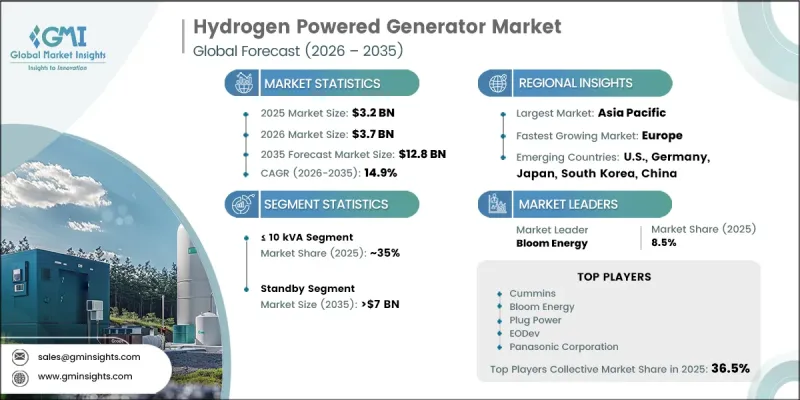
全球對清潔能源和環境永續性的日益關注正顯著推動市場擴張。人們對碳排放的日益關注,以及向替代能源技術的轉型,正促使各方積極投資氫能發電系統。各國政府和私營機構都在積極推動旨在減少對傳統燃料依賴的各項舉措,從而為該行業的長期發展創造有利環境。氫能發電機是一種先進的能源系統,它利用氫燃料發電,適用於住宅、商業、工業和間歇性供電等應用。這些發電機透過燃燒過程將儲存在氫氣中的化學能轉化為電能,是傳統燃料發電機的更清潔替代方案。對環保電力解決方案的需求不斷成長,加上減少排放氣體和降低運作噪音等優勢,進一步加速了產品的普及。此外,人們對能源可靠性、不斷電系統和永續營運實踐的日益重視,也促使企業和機構積極投資氫能技術。
| 市場範圍 | |
|---|---|
| 開始年份 | 2025 |
| 預測期 | 2026-2035 |
| 上市時的市場規模 | 32億美元 |
| 預測金額 | 128億美元 |
| 複合年成長率 | 14.9% |
額定輸出功率為10 kVA或以下的細分市場預計在2025年將佔據35%的市場佔有率,並在2035年之前以14.5%的複合年成長率成長。對緊湊、高效、環保的備用電源系統的需求穩步成長,推動了該細分市場的擴張。這些發電機因其運作安靜、碳排放低、供電可靠而廣受歡迎。它們適用於小規模應用和分散式電力需求,進一步刺激了市場需求。對永續能源基礎設施和清潔能源技術的投資增加,也加速了氫能系統在該細分市場的應用。
預計到2025年,備用電源市場將佔55.8%的市場佔有率,到2035年將達到70億美元。各行各業對可靠的間歇性備用電源解決方案的需求日益成長,推動了對備用氫氣發電機的強勁需求。這些系統因其在排放期間提供低排放、高可靠性電力,同時支援更廣泛的永續性目標而廣受認可。人們對彈性能源系統和更清潔發電技術的日益關注,進一步促進了備用電源應用市場的成長。
預計到2025年,北美氫能發電市場將佔據84%的市場佔有率,市場規模將達到4.96億美元。對清潔能源技術的投資不斷增加,以及低排放量備用電源系統的日益普及,持續為美國各地創造豐厚的商機。政府對永續能源舉措的支持以及氫能發電技術的廣泛應用,都推動了該產業的成長。氫能發電機在關鍵基礎設施和商業設施中的日益普及,也促進了美國市場的快速發展。
目錄
第1章:調查方法和範圍
第2章執行摘要
第3章 行業洞察
- 工業生態系分析
- 原物料供應及採購分析
- 生產能力評估
- 供應鏈韌性與風險因素
- 配電網路分析
- 影響產業的因素
- 促進因素
- 產業潛在風險與挑戰
- 監理情勢
- 成長潛力分析
- 波特的分析
- 供應商的議價能力
- 買方的議價能力
- 新進入者的威脅
- 替代品的威脅
- PESTLE分析
- 氫能發電機的成本結構分析
- 新機會與趨勢
- 清潔能源的獎勵措施和補貼
- 環境合規和排放標準
- 投資分析及未來展望
- 價格趨勢分析
- 按地區
- 按類型分類的額定輸出
- 生產能力和生產情況
- 各地區及主要生產商的產能
- 運轉率和擴張計劃
- 人工智慧和生成式人工智慧對市場的影響
- 利用人工智慧最佳化生產
- 預測性維護和故障檢測
第4章 競爭情勢
- 介紹
- 企業市佔率分析:按地區分類
- 北美洲
- 歐洲
- 亞太地區
- 中東和非洲
- 拉丁美洲
- 主要市場公司的競爭分析
- 競爭定位矩陣
- 併購
- 夥伴關係和聯盟
- 新產品發布
- 業務拓展計劃及資金籌措
- 按公司規模進行基準測試
- 排名分類標準與遴選標準
- 按銷售額、地區和創新能力分類的層級定位矩陣。
第5章 市場規模及預測:以額定產量計算,2022-2035年
- 10千伏安或以下
- 10~100kVA
- 100~200kVA
- 200千伏安或以下
第6章 市場規模與預測:依應用領域分類,2022-2035年
- 支援
- 尖峰用電調節
- 主電源
第7章 市場規模及預測:依安裝類型分類,2022-2035年
- 可攜式的
- 固定式
第8章 市場規模及預測:依最終用途分類,2022-2035年
- 住宅
- 商業
- 產業
第9章 市場規模及預測:依地區分類,2022-2035年
- 北美洲
- 美國
- 加拿大
- 歐洲
- 德國
- 英國
- 法國
- 義大利
- 西班牙
- 奧地利
- 亞太地區
- 日本
- 韓國
- 中國
- 印度
- 菲律賓
- 越南
- 印尼
- 中東和非洲
- 沙烏地阿拉伯
- 阿拉伯聯合大公國
- 伊朗
- 伊拉克
- 南非
- 拉丁美洲
- 巴西
- 秘魯
- 墨西哥
第10章:公司簡介
- 2G Energy
- AFC Energy
- Bloom Energy
- Caterpillar
- Cummins
- EODev
- GenCell
- GeoPura
- H2 Power System
- H2SYS
- H2X Global
- HYGEN Technologies
- Inocel
- Mitsubishi Heavy Industries
- Nuvera Fuel Cells
- Panasonic Corporation
- Plug Power
- PowerCell Sweden
- SFC Energy
- TOSHIBA CORPORATION
The Global Hydrogen Powered Generator Market was valued at USD 3.2 billion in 2025 and is estimated to grow at a CAGR of 14.9% to reach USD 12.8 billion by 2035.
The growing worldwide emphasis on clean energy adoption and environmental sustainability is significantly supporting market expansion. Rising concerns regarding carbon emissions, along with the transition toward alternative energy technologies, are encouraging strong investments in hydrogen-based power systems. Governments and private organizations are actively promoting initiatives aimed at reducing dependence on conventional fuels, creating favorable conditions for long-term industry growth. Hydrogen-powered generators are advanced energy systems that use hydrogen fuel to generate electricity for residential, commercial, industrial, and backup power applications. These generators convert the chemical energy stored in hydrogen into electrical power through combustion-based processes, offering a cleaner alternative to traditional fuel-powered generators. Increasing preference for environmentally friendly power solutions, combined with lower emissions and reduced operational noise, continues to strengthen product adoption. In addition, growing awareness regarding energy reliability, uninterrupted power supply, and sustainable operational practices is encouraging businesses and institutions to invest in hydrogen powered generation technologies.
| Market Scope | |
|---|---|
| Start Year | 2025 |
| Forecast Year | 2026-2035 |
| Start Value | $3.2 Billion |
| Forecast Value | $12.8 Billion |
| CAGR | 14.9% |
The <= 10 kVA rated segment accounted for 35% share in 2025 and is anticipated to grow at 14.5% through 2035. Demand for compact, efficient, and environmentally sustainable backup power systems is steadily increasing, contributing to the segment's expansion. These generators are gaining wider acceptance due to their quiet operation, low carbon emissions, and reliable energy output. Their suitability for small-scale applications and decentralized power requirements is further supports market demand. Rising investments in sustainable energy infrastructure and clean power technologies are also accelerating the deployment of hydrogen-powered systems within this segment.
The standby segment held a 55.8% share in 2025 and is projected to reach USD 7 billion by 2035. The increasing need for dependable emergency and backup power solutions is driving strong demand for standby hydrogen-powered generators across multiple industries. These systems are widely recognized for delivering low-emission and highly reliable power during outages while supporting broader sustainability objectives. Growing emphasis on resilient energy systems and cleaner electricity generation technologies is further strengthening market growth for standby applications.
North America Hydrogen Powered Generator Market held an 84% share in 2025 and generated USD 496 million. Rising investments in clean energy technologies, combined with increasing adoption of low-emission backup power systems, continue to create favorable business opportunities across the country. Government support for sustainable energy initiatives and the growing deployment of hydrogen-based power generation technologies are contributing to industry expansion. Increasing use of hydrogen powered generators across critical infrastructure and commercial operations is also supporting the rapid pace of market development in the U.S.
Key participants operating in the Global Hydrogen Powered Generator Industry include 2G Energy, AFC Energy, Bloom Energy, Caterpillar, Cummins, EODev, GenCell, GeoPura, H2 Power System, H2SYS, H2X Global, HYGEN Technologies, Inocel, Mitsubishi Heavy Industries, Nuvera Fuel Cells, Panasonic Corporation, Plug Power, PowerCell Sweden, SFC Energy, and TOSHIBA CORPORATION. Companies operating in the hydrogen powered generator market are adopting multiple strategic initiatives to strengthen their competitive position and expand their market presence. Industry participants are heavily investing in research and development activities to improve fuel efficiency, system durability, and operational performance of hydrogen-powered technologies. Strategic collaborations with energy providers, technology developers, and infrastructure companies are also becoming increasingly common to accelerate product commercialization and deployment. Many manufacturers are expanding their production capacities and focusing on advanced hydrogen storage and fuel cell technologies to enhance system reliability. In addition, companies are strengthening their regional distribution networks and increasing investments in sustainable energy projects to improve customer reach.
Table of Contents
Chapter 1 Methodology & Scope
- 1.1 Research approach
- 1.2 Quality commitments
- 1.2.1 GMI AI policy & data integrity commitment
- 1.2.1.1 Source consistency protocol
- 1.2.1 GMI AI policy & data integrity commitment
- 1.3 Research trail & confidence scoring
- 1.3.1 Research trail components
- 1.3.2 Scoring components
- 1.4 Data collection
- 1.4.1 Partial list of primary sources
- 1.5 Data mining sources
- 1.5.1 Paid sources
- 1.5.1.1 Sources, by region
- 1.5.1 Paid sources
- 1.6 Base estimates and calculations
- 1.6.1 Base year calculation for any one approach
- 1.7 Market estimates & forecasts parameters
- 1.8 Forecast model
- 1.8.1 Quantified market impact analysis
- 1.8.1.1 Mathematical impact of growth parameters on forecast
- 1.8.1 Quantified market impact analysis
- 1.9 Research transparency addendum
- 1.9.1 Source attribution framework
- 1.9.2 Quality assurance metrics
- 1.9.3 Our commitment to trust
- 1.10 Market definitions
Chapter 2 Executive Summary
- 2.1 Industry synopsis, 2022 - 2035
- 2.1.1 Business trends
- 2.1.2 Power rating trends
- 2.1.3 Application trends
- 2.1.4 Installation trends
- 2.1.5 End use trends
- 2.1.6 Regional trends
Chapter 3 Industry Insights
- 3.1 Industry ecosystem analysis
- 3.1.1 Raw material availability & sourcing analysis
- 3.1.2 Manufacturing capacity assessment
- 3.1.3 Supply chain resilience & risk factors
- 3.1.4 Distribution network analysis
- 3.2 Industry impact forces
- 3.2.1 Growth drivers
- 3.2.2 Industry pitfalls & challenges
- 3.3 Regulatory landscape
- 3.4 Growth potential analysis
- 3.5 Porter's analysis
- 3.5.1 Bargaining power of suppliers
- 3.5.2 Bargaining power of buyers
- 3.5.3 Threat of new entrants
- 3.5.4 Threat of substitutes
- 3.6 PESTEL analysis
- 3.6.1 Political factors
- 3.6.2 Economic factors
- 3.6.3 Social factors
- 3.6.4 Technological factors
- 3.6.5 Legal factors
- 3.6.6 Environmental factors
- 3.7 Cost structure analysis of hydrogen powered generators
- 3.8 Emerging opportunities & trends
- 3.9 Clean energy incentives & subsidies
- 3.10 Environmental compliance & emissions standards
- 3.11 Investment analysis & future prospects
- 3.12 Price trend analysis (USD/Unit) (Driven by Primary Research)
- 3.12.1 By region (Driven by Primary Research)
- 3.12.2 By power rating (Driven by Primary Research)
- 3.13 Capacity & production landscape (Driven by Primary Research)
- 3.13.1 Capacity by region & key producer (Driven by Primary Research)
- 3.13.2 Capacity utilization rates & expansion pipelines (Driven by Primary Research)
- 3.14 Impact of AI & Generative AI on the market (Driven by Primary Research)
- 3.14.1 AI-Driven production optimization (Driven by Primary Research)
- 3.14.2 Predictive maintenance & fault detection (Driven by Primary Research)
Chapter 4 Competitive Landscape, 2026
- 4.1 Introduction
- 4.2 Company market share analysis, by region, 2025
- 4.2.1 North America
- 4.2.2 Europe
- 4.2.3 Asia Pacific
- 4.2.4 Middle East & Africa
- 4.2.5 Latin America
- 4.3 Competitive analysis of major market players
- 4.4 Competitive positioning matrix
- 4.5 Key developments
- 4.5.1 Mergers & acquisitions
- 4.5.2 Partnerships & collaborations
- 4.5.3 New product launches
- 4.5.4 Expansion plans & funding
- 4.6 Company tier benchmarking
- 4.6.1 Tier classification criteria & qualifying thresholds
- 4.6.2 Tier positioning matrix by revenue, geography & innovation
Chapter 5 Market Size and Forecast, By Power Rating, 2022 - 2035 (USD Million & Units)
- 5.1 Key trends
- 5.2 ≤ 10 kVA
- 5.3 > 10 kVA - 100 kVA
- 5.4 > 100 kVA - 200 kVA
- 5.5 > 200 kVA
Chapter 6 Market Size and Forecast, By Application, 2022 - 2035 (USD Million & Units)
- 6.1 Key trends
- 6.2 Standby
- 6.3 Peak shaving
- 6.4 Prime power
Chapter 7 Market Size and Forecast, By Installation, 2022 - 2035 (USD Million & Units)
- 7.1 Key trends
- 7.2 Portable
- 7.3 Stationary
Chapter 8 Market Size and Forecast, By End Use, 2022 - 2035 (USD Million & Units)
- 8.1 Key trends
- 8.2 Residential
- 8.3 Commercial
- 8.4 Industrial
Chapter 9 Market Size and Forecast, By Region, 2022 - 2035 (USD Million & Units)
- 9.1 Key trends
- 9.2 North America
- 9.2.1 U.S.
- 9.2.2 Canada
- 9.3 Europe
- 9.3.1 Germany
- 9.3.2 UK
- 9.3.3 France
- 9.3.4 Italy
- 9.3.5 Spain
- 9.3.6 Austria
- 9.4 Asia Pacific
- 9.4.1 Japan
- 9.4.2 South Korea
- 9.4.3 China
- 9.4.4 India
- 9.4.5 Philippines
- 9.4.6 Vietnam
- 9.4.7 Indonesia
- 9.5 Middle East & Africa
- 9.5.1 Saudi Arabia
- 9.5.2 UAE
- 9.5.3 Iran
- 9.5.4 Iraq
- 9.5.5 South Africa
- 9.6 Latin America
- 9.6.1 Brazil
- 9.6.2 Peru
- 9.6.3 Mexico
Chapter 10 Company Profiles
- 10.1 2G Energy
- 10.2 AFC Energy
- 10.3 Bloom Energy
- 10.4 Caterpillar
- 10.5 Cummins
- 10.6 EODev
- 10.7 GenCell
- 10.8 GeoPura
- 10.9 H2 Power System
- 10.10 H2SYS
- 10.11 H2X Global
- 10.12 HYGEN Technologies
- 10.13 Inocel
- 10.14 Mitsubishi Heavy Industries
- 10.15 Nuvera Fuel Cells
- 10.16 Panasonic Corporation
- 10.17 Plug Power
- 10.18 PowerCell Sweden
- 10.19 SFC Energy
- 10.20 TOSHIBA CORPORATION

 拉丁美洲氫能產業的成長機會:2025-2040年
 2026-2030年全球氫能基礎設施市場氫氣液化設備市場規模、佔有率、成長、全球產業分析、區域趨勢及2026-2034年預測。氫能基礎設施市場規模、佔有率、成長、全球產業分析、區域趨勢及2026-2034年預測。全球氫氣液化設備市場規模、佔有率、趨勢和成長分析報告(2026-2034年)
 氫基航空燃料市場分析及至2035年預測:類型、產品、技術、組件、應用、製程、最終用戶、安裝方式、解決方案氫燃料電池城市穿梭巴士市場分析及預測(至2035年):類型、產品類型、服務、技術、組件、應用、部署狀態、最終用戶、功能、安裝配置
 攜帶式氫氣發生器市場機會、成長要素、產業趨勢分析及2026-2035年預測
 氫能技術測試、檢驗和認證市場規模、佔有率和成長分析:按服務類型、氫能應用、終端用戶產業、服務交付模式、組織結構和地區分類-2026-2033年產業預測
 氫動力出行市場預測至2034年-全球分析(按車輛類型、技術類型、燃料電池類型、氫氣儲存方式、應用、最終用戶和地區分類)