


 |
市場調查報告書
商品編碼
2061471
壓平機市場機會、成長要素、產業趨勢分析及2026-2035年預測。Tablet Press Machines Market Opportunity, Growth Drivers, Industry Trend Analysis, and Forecast 2026 - 2035 |
||||||

預計到 2025 年,全球壓片壓平機市場價值將達到 15.2 億美元,年複合成長率為 5.3%,到 2035 年將達到 25.6 億美元。
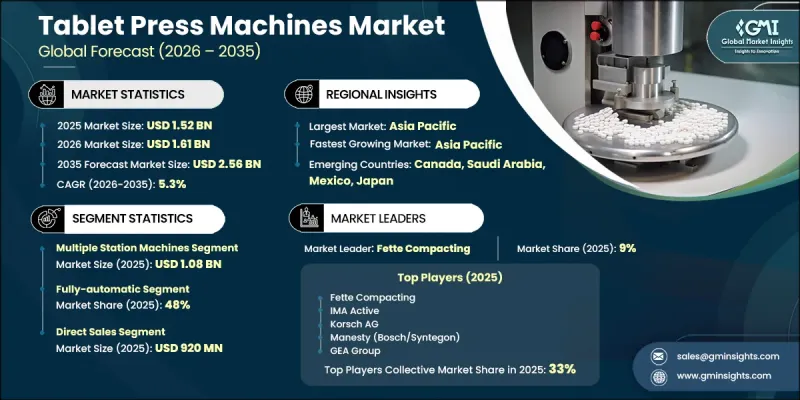
市場擴張主要受製藥業的持續成長和口服固體製劑產量增加的推動。片劑因其價格實惠、服用方便、保存期限長等優點,仍是最廣泛使用的給藥方式之一。慢性病在全球範圍內的日益普遍,進一步促使製藥公司擴大片劑生產,增加了對高產能、高性能壓片設備的需求。此外,學名藥生產的擴張也顯著促進了設備的普及,尤其是在新興市場,這些市場致力於為龐大的患者群體提供經濟有效的藥物。契約製造組織(CMO)也透過投資能夠處理不同配方和批量大小的靈活多功能壓片系統,進一步推動了需求成長。這種轉變推動了對先進設備的需求,這些設備能夠滿足整個製藥價值鏈的大規模生產需求,同時確保產品品質的穩定性。
| 市場範圍 | |
|---|---|
| 開始年份 | 2025 |
| 預測期 | 2026-2035 |
| 上市時的市場規模 | 15.2億美元 |
| 預計金額 | 25.6億美元 |
| 複合年成長率 | 5.3% |
預計2025年,多工位壓片機市場規模將達到10.8億美元。這類壓片機通常被稱為旋轉式壓片機,仍然是高產量生產環境的最佳選擇。這些機器採用具有多個工位的旋轉轉盤,可在每個循環中同時進行片劑壓制。與單工位系統相比,這種設計顯著提高了生產效率,使其成為對高產量要求極高的大規模製藥和營養補充劑生產企業的理想之選。
2025年,全自動片劑生產系統將佔據48%的市場。隨著全自動系統能夠以最小的人工干預實現片劑生產全過程的自動化,該細分市場正持續成長。粉末進料、壓片、重量調節和片劑排放等功能完全同步,確保產品品質穩定,並提高營運效率。此類系統廣泛應用於對精度、法規遵循和大規模生產要求極高的製藥和保健品生產企業。
美國壓片壓平機市場佔75.8%的佔有率,預計2025年市場規模將達到3.6億美元。該國市場成長的驅動力包括強勁的藥品需求、完善的醫療基礎設施和先進的生產能力。生產主要集中在用於治療慢性病和長期疾病的高品質口服固體製劑。此外,美國食品藥物管理局(FDA)實施的嚴格監管標準促使製造商投資先進的壓片技術,以確保整個生產週期內的合規性、精確性和產品一致性。
目錄
第1章:調查方法和範圍
第2章執行摘要
第3章 行業洞察
- 工業生態系分析
- 供應商情況
- 利潤率
- 每個階段增加的價值
- 影響價值鏈的因素
- 影響產業的因素
- 促進因素
- 製藥業的擴張
- 技術進步
- 監管機構對品質和合規性的重視
- 產業潛在風險與挑戰
- 巨額資本投資
- 維護和營運的複雜性
- 機會
- 與智慧製造的整合
- 永續性和能源效率
- 促進因素
- 成長潛力分析
- 監理框架
- 符合FDA法規和21 CFR第11部分
- cGMP(現行良好生產規範)標準
- 歐盟GMP附件15(合格和驗證)
- 中國國家藥品監督管理局醫療設備註冊要求
- 職業暴露限值 (OEB) 標準的控制
- 價格分析
- 對過去價格趨勢的分析
- 參與企業(高階、價值、成本加成)
- 區域價格波動
- 貿易資料分析(84798970)
- 進出口量及進口額趨勢
- 主要貿易路線及關稅的影響
- 跨境物流面臨的挑戰
- 人工智慧和生成式人工智慧對市場的影響
- 利用人工智慧改造現有經營模式
- 基於細分市場的生成式人工智慧的應用案例和部署藍圖
- 即時壓力回饋與自適應控制
- 預測性維護和減少停機時間
- 演算法主導的產量最佳化
- 品管和缺陷檢測(封蓋、層壓)
- 風險、限制和監管考量
- 生產能力和生產情況
- 設備產能:按地區和主要生產商分類
- 運轉率和擴張計劃
第4章 競爭情勢
- 介紹
- 企業市佔率分析
- 按地區
- 企業矩陣分析
- 主要市場公司的競爭分析
- 競爭定位矩陣
- 併購
- 夥伴關係和聯盟
- 新產品發布
- 業務拓展計劃
第5章 市場估價與預測:依機器類型分類,2022-2035年
- 單工位印刷
- 多工位印刷機
第6章 市場估計與預測:依營運模式分類,2022-2035年
- 手動的
- 半自動
- 全自動
第7章 市場估計與預測:依產能分類,2022-2035年
- 每小時5萬件或更少
- 每小時 5 萬至 10 萬件
- 每小時 10 萬至 20 萬件
- 每小時20萬件或更多
第8章 市場估算與預測:依最終用途產業分類,2022-2035年
- 製藥
- 營養補充品和營養補充品
- 飲食
- 化妝品和個人護理
- 其他
第9章 市場估價與預測:依通路分類,2022-2035年
- 直銷
- 間接銷售
第10章 市場估價與預測:依地區分類,2022-2035年
- 北美洲
- 美國
- 加拿大
- 歐洲
- 德國
- 英國
- 法國
- 義大利
- 西班牙
- 亞太地區
- 中國
- 日本
- 印度
- 澳洲
- 韓國
- 拉丁美洲
- 巴西
- 墨西哥
- 阿根廷
- 中東和非洲
- 南非
- 沙烏地阿拉伯
- 阿拉伯聯合大公國
第11章:公司簡介
- 世界公司
- Fette Compacting
- IMA Active
- Korsch AG
- GEA Group
- Romaco
- Manesty(Bosch/Syntegon)
- ACG Pharma Technologies
- 當地公司
- Cadmach Machinery
- Sejong Pharmatech
- Elizabeth Hata
- Stokes
- Shanghai Tianhe
- Riddhi Pharma
- Riva SA
- 新興企業
- PTK-GB
- Glatt
- Fluid Pack
- Karnavati/Rimek
- Prism Pharma
- Chamunda Pharma
- Compression Components & Service
The Global Tablet Press Machines Market was valued at USD 1.52 billion in 2025 and is estimated to grow at a CAGR of 5.3% to reach USD 2.56 billion by 2035.
Market expansion is driven by the continuous growth of the pharmaceutical sector and the rising production of oral solid dosage drugs. Tablets remain one of the most widely used drug delivery formats due to their affordability, ease of administration, and extended shelf life. Increasing global prevalence of chronic diseases is further pushing pharmaceutical companies to scale up tablet production, thereby increasing demand for high-capacity and high-performance compression equipment. In addition, the expansion of generic drug manufacturing is contributing significantly to equipment adoption, particularly in emerging economies focused on delivering cost-effective medicines to large patient populations. Contract manufacturing organizations are also strengthening demand by investing in flexible and multi-functional tablet compression systems capable of handling varied formulations and batch sizes. This shift is reinforcing the need for advanced machinery that ensures consistent output quality while supporting large-scale production requirements across the pharmaceutical value chain.
| Market Scope | |
|---|---|
| Start Year | 2025 |
| Forecast Year | 2026-2035 |
| Start Value | $1.52 Billion |
| Forecast Value | $2.56 Billion |
| CAGR | 5.3% |
The multiple station machines segment generated USD 1.08 billion in 2025. This category, commonly known as rotary tablet presses, remains the preferred choice for high-volume production environments. These machines operate using a rotating turret equipped with multiple tooling stations that allow simultaneous tablet compression during each cycle. This design significantly enhances production efficiency compared to single-station systems, making them ideal for large-scale pharmaceutical and nutraceutical manufacturing operations where high throughput is essential.
The fully-automatic segment accounted for 48% share in 2025. This segment continues to expand due to its ability to automate the entire tablet production process with minimal human intervention. Functions such as powder feeding, compression, weight adjustment, and tablet ejection are fully synchronized, ensuring consistent product quality and improved operational efficiency. Such systems are widely adopted in pharmaceutical and nutraceutical production environments where precision, regulatory compliance, and large-scale output are critical requirements.
U.S. Tablet Press Machines Market held a 75.8% share, generating USD 0.36 billion in 2025. Market growth in the country is supported by strong pharmaceutical demand, a well-established healthcare infrastructure, and advanced manufacturing capabilities. Production is largely focused on high-quality oral solid dosage forms used in the treatment of chronic and long-term conditions. In addition, strict regulatory standards enforced by the FDA are encouraging manufacturers to invest in advanced tablet compression technologies that ensure compliance, precision, and product consistency across production cycles.
Major players operating in the Global Tablet Press Machines Industry include Fette Compacting, IMA Active, GEA Group, Korsch AG, Romaco, ACG Pharma Technologies, Manesty (Bosch/Syntegon), Sejong Pharmatech, Cadmach Machinery, Elizabeth Hata, Stokes, Shanghai Tianhe, Riddhi Pharma, Riva S.A., Glatt, PTK-GB, Fluid Pack, Karnavati/Rimek, Prism Pharma, Chamunda Pharma, and Compression Components & Service. Companies in the tablet press machines market are focusing on advancing automation and precision engineering to improve production efficiency and product consistency. Manufacturers are integrating digital monitoring systems, real-time process control, and predictive maintenance capabilities to reduce downtime and enhance operational reliability. Expansion of modular machine designs is enabling flexible production setups that accommodate different tablet sizes and formulations. Firms are also investing in high-speed rotary systems to meet growing demand for large-scale pharmaceutical manufacturing. Strategic partnerships with pharmaceutical companies and contract manufacturers are strengthening market penetration. Additionally, emphasis on regulatory compliance, energy-efficient systems, and reduced material wastage is helping companies improve competitiveness.
Table of Contents
Chapter 1 Methodology and Scope
- 1.1 Market scope and definition
- 1.2 Research design
- 1.2.1 Research approach
- 1.2.2 Data collection methods
- 1.3 Data mining sources
- 1.3.1 Global
- 1.3.2 Regional/Country
- 1.4 Base estimates and calculations
- 1.4.1 Base year calculation
- 1.4.2 Key trends for market estimation
- 1.5 Primary research and validation
- 1.5.1 Primary sources
- 1.6 Forecast model
- 1.7 Research assumptions and limitations
Chapter 2 Executive Summary
- 2.1 Industry 360° synopsis
- 2.2 Key market trends
- 2.2.1 Regional
- 2.2.2 Machine type
- 2.2.3 Mode of operation
- 2.2.4 Production capacity
- 2.2.5 End use industry
- 2.2.6 Distribution channel
Chapter 3 Industry Insights
- 3.1 Industry ecosystem analysis
- 3.1.1 Supplier landscape
- 3.1.2 Profit margin
- 3.1.3 Value addition at each stage
- 3.1.4 Factor affecting the value chain
- 3.2 Industry impact forces
- 3.2.1 Growth drivers
- 3.2.1.1 Pharmaceutical industry expansion
- 3.2.1.2 Technological advancements
- 3.2.1.3 Regulatory emphasis on quality & compliance
- 3.2.2 Industry pitfalls & challenges
- 3.2.2.1 High capital investment
- 3.2.2.2 Maintenance & operational complexity
- 3.2.3 Opportunities
- 3.2.3.1 Integration with smart manufacturing
- 3.2.3.2 Sustainability & energy efficiency
- 3.2.1 Growth drivers
- 3.3 Growth potential analysis
- 3.4 Regulatory framework
- 3.4.1 FDA regulations & 21 CFR Part 11 compliance
- 3.4.2 cGMP (current good manufacturing practice) standards
- 3.4.3 EU GMP Annex 15 (qualification & validation)
- 3.4.4 China NMPA equipment registration requirements
- 3.4.5 OEB (occupational exposure band) standards for containment
- 3.5 Pricing analysis
- 3.5.1 Historical price trend analysis (driven by primary research)
- 3.5.2 Pricing strategy by player type (premium / value / cost-plus)
- 3.5.3 Regional price variations
- 3.6 Trade data analysis (driven by paid database) (84798970)
- 3.6.1 Import/export volume & value trends
- 3.6.2 Key trade corridors & tariff impact
- 3.6.3 Cross-border logistics challenges
- 3.7 Impact of AI & generative AI on the market
- 3.7.1 AI-driven disruption of existing business models
- 3.7.2 GenAI use cases & adoption roadmap by segment
- 3.7.2.1 Real-time pressure feedback & adaptive control
- 3.7.2.2 Predictive maintenance & downtime reduction
- 3.7.2.3 Algorithm-driven yield optimization
- 3.7.2.4 Quality control & defect detection (capping, lamination)
- 3.7.3 Risks, limitations & regulatory considerations
- 3.8 Capacity & production landscape (driven by primary research)
- 3.8.1 Installed capacity by region & key producer
- 3.8.2 Capacity utilization rates & expansion pipelines
Chapter 4 Competitive Landscape, 2025
- 4.1 Introduction
- 4.2 Company market share analysis
- 4.2.1 By region
- 4.2.1.1 North America
- 4.2.1.2 Europe
- 4.2.1.3 Asia Pacific
- 4.2.1.4 Latin America
- 4.2.1.5 Middle East and Africa
- 4.2.1 By region
- 4.3 Company matrix analysis
- 4.4 Competitive analysis of major market players
- 4.5 Competitive positioning matrix
- 4.6 Key developments
- 4.6.1 Mergers & acquisitions
- 4.6.2 Partnerships & collaborations
- 4.6.3 New product launches
- 4.6.4 Expansion plans
Chapter 5 Market Estimates and Forecast, By Machine Type, 2022 - 2035 (USD Billion)
- 5.1 Key trends
- 5.2 Single station presses
- 5.3 Multi-station presses
Chapter 6 Market Estimates and Forecast, By Mode of Operation, 2022 - 2035 (USD Billion)
- 6.1 Key trends
- 6.2 Manual
- 6.3 Semi-automatic
- 6.4 Fully automatic
Chapter 7 Market Estimates and Forecast, By Production Capacity, 2022 - 2035 (USD Billion)
- 7.1 Key trends
- 7.2 Below 50,000 pcs/hr
- 7.3 50,000 - 100,000 pcs/hr
- 7.4 100,000 - 200,000 pcs/hr
- 7.5 Above 200,000 pcs/hr
Chapter 8 Market Estimates and Forecast, By End Use Industry, 2022 - 2035 (USD Billion)
- 8.1 Key trends
- 8.2 Pharmaceutical
- 8.3 Nutraceuticals & dietary supplements
- 8.4 Food & beverages
- 8.5 Cosmetics & personal care
- 8.6 Others
Chapter 9 Market Estimates and Forecast, By Distribution Channel, 2022 - 2035 (USD Billion)
- 9.1 Key trends
- 9.2 Direct sales
- 9.3 Indirect sales
Chapter 10 Market Estimates and Forecast, By Region, 2022 - 2035 (USD Billion)
- 10.1 Key trends
- 10.2 North America
- 10.2.1 U.S.
- 10.2.2 Canada
- 10.3 Europe
- 10.3.1 Germany
- 10.3.2 UK
- 10.3.3 France
- 10.3.4 Italy
- 10.3.5 Spain
- 10.4 Asia Pacific
- 10.4.1 China
- 10.4.2 Japan
- 10.4.3 India
- 10.4.4 Australia
- 10.4.5 South Korea
- 10.5 Latin America
- 10.5.1 Brazil
- 10.5.2 Mexico
- 10.5.3 Argentina
- 10.6 Middle East and Africa
- 10.6.1 South Africa
- 10.6.2 Saudi Arabia
- 10.6.3 UAE
Chapter 11 Company Profiles
- 11.1 Global players
- 11.1.1 Fette Compacting
- 11.1.2 IMA Active
- 11.1.3 Korsch AG
- 11.1.4 GEA Group
- 11.1.5 Romaco
- 11.1.6 Manesty (Bosch/Syntegon)
- 11.1.7 ACG Pharma Technologies
- 11.2 Regional players
- 11.2.1 Cadmach Machinery
- 11.2.2 Sejong Pharmatech
- 11.2.3 Elizabeth Hata
- 11.2.4 Stokes
- 11.2.5 Shanghai Tianhe
- 11.2.6 Riddhi Pharma
- 11.2.7 Riva S.A.
- 11.3 Emerging players
- 11.3.1 PTK-GB
- 11.3.2 Glatt
- 11.3.3 Fluid Pack
- 11.3.4 Karnavati/Rimek
- 11.3.5 Prism Pharma
- 11.3.6 Chamunda Pharma
- 11.3.7 Compression Components & Service

 2026-2030年全球液壓壓平機市場
 松香壓平機市場規模、佔有率和成長分析:按機器類型、壓板尺寸、應用、最終用戶、產能和地區分類-2026-2033年產業預測
 冷壓市場機會、成長要素、產業趨勢分析及2026-2035年預測。
 液壓機市場:按類型、應用和地區分類
 關節式壓床市場:按壓機類型、產能、自動化程度、驅動系統、應用和最終用戶分類 - 全球預測 2026-2032單柱液壓機市場:按機架結構、產能、操作方式、應用和終端用戶產業分類-全球預測,2026-2032年伺服沖床市場:按類型、噸位、驅動系統、控制系統、自動化程度、終端用戶產業和應用分類-全球預測,2026-2032年四柱液壓機市場:按機架類型、運作模式、容量範圍和最終用途產業分類-全球預測,2026-2032年框架式液壓機市場:按框架類型、操作模式、應用和最終用戶產業分類-全球預測,2026-2032年
 日本液壓機市場規模、佔有率、趨勢和預測:按類型、應用、最終用戶和地區分類,2026-2034年