

 |
市場調查報告書
商品編碼
2061470
休閒車(RV)公園市場:商業機會、成長要素、產業趨勢分析及2026-2035年預測Recreational Vehicle Parks Market Opportunity, Growth Drivers, Industry Trend Analysis, and Forecast 2026 - 2035 |
||||||

全球休閒車(RV)公園市場預計到 2025 年價值 79 億美元,預計到 2035 年將以 5.5% 的複合年成長率成長至 132 億美元。
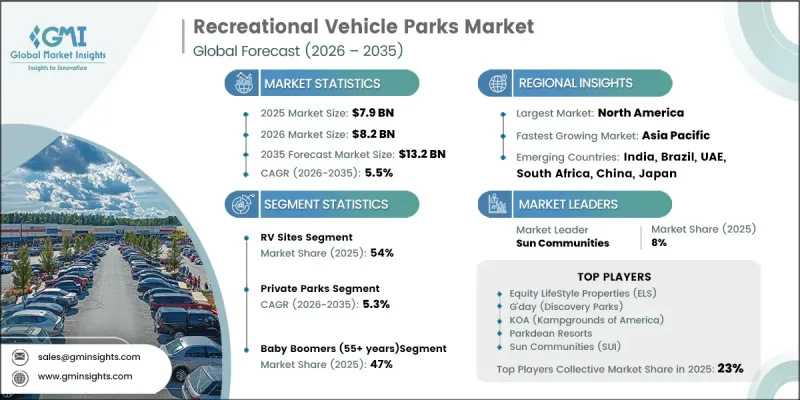
消費者對國內旅行和戶外旅遊體驗日益成長的偏好是全球市場成長的主要驅動力。與傳統住宿設施相比,旅客越來越傾向於選擇以大自然為主題的目的地、鄉村旅遊和戶外休閒體驗。遠距辦公和彈性辦公模式的興起也擴大了房車公園的基本客群,因為越來越多的商務人士正在尋找交通便利、網路連接可靠且擁有專屬工作空間的地點。此外,對高階旅行體驗的需求不斷成長,正在加速專為富裕且注重體驗的消費者設計的豪華房車度假村和高檔露營設施的發展。現代房車公園正在超越傳統的露營環境,引入豪華設施和以舒適為中心的飯店服務,以吸引更廣泛的旅客。年輕消費者和首次旅客對高階戶外住宿設施的日益青睞,進一步推動了市場擴張。對提升賓客體驗和高階休閒基礎設施的持續投資,將繼續支撐房車公園產業的長期發展。
| 市場範圍 | |
|---|---|
| 開始年份 | 2025 |
| 預測期 | 2026-2035 |
| 上市時的市場規模 | 79億美元 |
| 預測金額 | 132億美元 |
| 複合年成長率 | 5.5% |
預計到2025年,房車營地市佔率將達到54%,並在2026年至2035年間以5.4%的複合年成長率成長。營運商正不斷升級房車營地,為其配備先進的公用設施,包括大容量電力系統、供水、污水處理和高速網際網路基礎設施,以適應配備媲美住宅設施的現代化休閒車輛。市場參與企業也正在調整營運策略,轉向月租和季租模式,以確保更穩定的收入來源,並滿足長期旅客、退休人員和遠距辦公人員日益成長的需求。對便利性、連結性和長期住宿設施的日益重視,正顯著影響著全球現代化房車營地基礎設施的發展。
預計到2025年,私人露營地市佔率將達到71.7%,並在2035年之前以5.3%的複合年成長率成長。隨著機構投資者、房地產投資集團和私募股權公司不斷收購獨立露營地,建構規模更大、盈利更強的房地產投資組合,該行業正經歷積極的整合。私人業者越來越注重高階賓客設施、提升客戶體驗和採用先進的定價策略,以最大限度地提高運轉率和增加單站收入。投資組合擴張和營運標準化的趨勢也有助於私人露營地營運商提高效率、鞏固市場地位並擴大投資管道。
美國房車公園市場預計到2025年將達到31億美元,並在2026年至2035年間以5.7%的複合年成長率成長,繼續保持其在北美市場的主導地位。活性化市場成長的主要因素是私人投資公司和大型房地產營運商收購獨立房車公園,以提高營運規模和盈利,加劇了市場整合。遠距辦公生活方式的興起也正在改變美國房車公園的格局,推動了對長期住宿和永久房車居住的需求。房車公園正透過投資高速網路基礎設施、提供靈活的住宿選擇以及支持長期住宿和持續產生收入的辦公便利設施,不斷適應不斷變化的消費者偏好。人們對戶外旅行體驗和高階休閒住宿設施日益成長的興趣,也持續支撐著美國市場的強勁需求。
目錄
第1章:調查方法
第2章執行摘要
第3章:行業洞察
- 工業生態系分析
- 供應商情況
- 利潤率
- 成本結構
- 每個階段增加的價值
- 影響價值鏈的因素
- 中斷
- 影響產業的因素
- 促進因素
- 房車旅行和露營參與人數增加
- 國內旅遊和自然旅遊的成長
- 遠距辦公和房車永久居住越來越受歡迎。
- 豪華房車度假村和豪華露營設施的擴建
- 產業潛在風險與挑戰
- 高昂的土地徵用成本和基礎建設成本
- 季節性需求波動和對天氣的依賴
- 市場機遇
- 開發高階體驗式露營車度假村
- 數位預訂和智慧公園管理解決方案的整合
- 向服務不足的農村地區和風景名勝區擴張。
- 引進永續基礎設施和電動車充電設施
- 促進因素
- 成長潛力分析
- 技術與創新展望
- 最新科技趨勢
- 新技術
- 價格分析
- 對過去價格趨勢的分析
- 定價策略:按業務類型分類
- 監理情勢
- 北美洲
- 國家公園管理局(NPS)
- 美國環保署(EPA)
- 歐洲
- 歐盟委員會(環境總司)
- 歐洲消費者保護合作(CPC)網路
- 亞太地區
- 中國文化與旅遊部
- 印度旅遊部
- 拉丁美洲
- 巴西旅遊部
- 墨西哥旅遊部(SECTUR)
- 中東和非洲
- 阿拉伯聯合大公國經濟和旅遊部
- 南非國家公園(SANParks)
- 北美洲
- 波特的分析
- PESTLE分析
- 專利分析
- 人工智慧和生成式人工智慧對市場的影響
- 利用人工智慧改造現有經營模式
- 基於細分市場的生成式人工智慧的應用案例和部署藍圖
- 風險、限制和監管考量
- 永續性和環境方面
- 永續發展計劃
- 減少廢棄物策略
- 生產中的能源效率
- 環保舉措
- 考慮碳足跡
- 預測假設和情境分析
- 基本案例:驅動複合年成長率的關鍵宏觀經濟與產業變量
- 樂觀情境:宏觀經濟與產業的利多因素
- 悲觀情景:宏觀經濟放緩或產業逆風
第4章 競爭情勢
- 介紹
- 企業市佔率分析
- 北美洲
- 歐洲
- 亞太地區
- 拉丁美洲
- 中東和非洲
- 主要市場公司的競爭分析
- 競爭定位矩陣
- 併購
- 夥伴關係和聯盟
- 新產品發布
- 業務拓展計劃及資金籌措
- 按公司規模進行基準測試
- 排名分類標準與遴選標準
- 按銷售額、地區和創新能力分類的層級定位矩陣。
第5章 市場估價與預測:依園區類型分類,2022-2035年
- 房車營地
- 帳篷露營
- 豪華露營設施
第6章 市場估計與預測:依所有權類型分類,2022-2035年
- 公園
- 私人公園
- 非營利公園
第7章 市場估計與預測:依年齡層別分類,2022-2035年
- 嬰兒潮世代(55歲以上)
- X世代(40-54歲)
- 千禧世代(25-39歲)
第8章 市場估算與預測:依配套服務分類,2022-2035年
- 基本的
- 中間的
- 奢華
- 特別的
第9章 市場估計與預測:依收入模式分類,2022-2035年
- 基於參與費
- 基於訂閱
- 免費訪問
第10章 市場估價與預測:依最終用途分類,2022-2035年
- 家庭
- 團體
- 個人
第11章 市場估價與預測:按地區分類,2022-2035年
- 北美洲
- 美國
- 加拿大
- 歐洲
- 德國
- 英國
- 法國
- 義大利
- 西班牙
- 俄羅斯
- 荷蘭
- 亞太地區
- 中國
- 印度
- 日本
- 韓國
- 澳洲
- 越南
- 印尼
- 拉丁美洲
- 巴西
- 墨西哥
- 阿根廷
- 中東和非洲
- 南非
- 沙烏地阿拉伯
- 阿拉伯聯合大公國
第12章:公司簡介
- 世界公司
- Equity LifeStyle Properties(ELS)
- G'day Group(Discovery Parks)
- Huttopia
- Ingenia Communities
- KOA(Kampgrounds of America)
- Landal GreenParks
- Parkdean Resorts
- Roompot Parks
- Sun Communities(SUI)
- Westgate Resorts
- 當地公司
- BIG4 Holiday Parks
- Jellystone Park Camp-Resorts
- NRMA Parks & Resorts
- Parkbridge
- RVC Outdoor Destinations
- Sun Outdoors
- Thousand Trails(Encore RV Resorts)
- 新興企業
- AutoCamp
- Under Canvas
- Camp Margaritaville RV Resort
The Global Recreational Vehicle Parks Market was valued at USD 7.9 billion in 2025 and is estimated to grow at a CAGR of 5.5% to reach USD 13.2 billion by 2035.
Rising consumer preference for domestic travel and outdoor tourism experiences is playing a major role in driving market growth worldwide. Travelers are increasingly choosing nature-focused destinations, rural tourism, and outdoor recreational experiences over conventional accommodation options. The growing popularity of remote and flexible working arrangements is also expanding the customer base for recreational vehicle parks, as working professionals seek travel-friendly locations equipped with reliable internet connectivity and dedicated workspaces. In addition, the increasing demand for premium travel experiences has accelerated the development of luxury RV resorts and upscale glamping destinations designed for experience-oriented consumers with higher spending capacity. Modern RV parks are evolving beyond traditional camping environments by incorporating luxury amenities and comfort-driven hospitality services that appeal to a broader demographic of travelers. The growing popularity of premium outdoor accommodations among younger consumers and first-time travelers is further contributing to market expansion. Increasing investment in enhanced guest experiences and high-end recreational infrastructure continues to support the long-term growth of the recreational vehicle parks industry.
| Market Scope | |
|---|---|
| Start Year | 2025 |
| Forecast Year | 2026-2035 |
| Start Value | $7.9 Billion |
| Forecast Value | $13.2 Billion |
| CAGR | 5.5% |
The RV sites segment accounted for 54% share in 2025 and is anticipated to grow at a CAGR of 5.4% from 2026 to 2035. Operators are increasingly upgrading RV sites with advanced utility connections, including high-capacity electrical systems, water access, sewer connectivity, and high-speed internet infrastructure to support modern recreational vehicles equipped with residential-style features. Market participants are also shifting operational strategies toward monthly and seasonal rental models to generate more stable revenue streams and accommodate the growing demand from long-term travelers, retirees, and remote workers. The increasing emphasis on convenience, connectivity, and extended-stay accommodations is significantly influencing the development of modern RV site infrastructure worldwide.
The private parks segment held a 71.7% share in 2025 and is projected to grow at a CAGR of 5.3% during 2035. The segment is experiencing strong consolidation activity as institutional investors, real estate investment groups, and private equity firms continue acquiring independent RV parks to establish larger and more profitable property portfolios. Private operators are increasingly focusing on premium guest amenities, enhanced customer experiences, and advanced pricing strategies designed to maximize occupancy rates and improve revenue generation per site. The growing trend toward portfolio expansion and operational standardization is also helping private park operators improve efficiency, strengthen market positioning, and expand access to investment capital.
U.S. Recreational Vehicle Parks Market reached USD 3.1 billion in 2025 and is expected to grow at a CAGR of 5.7% from 2026 to 2035, maintaining its dominant position across North America. Market growth in the country is being supported by rising consolidation activities involving private investment firms and large property operators acquiring independent RV parks to improve operational scale and profitability. The increasing adoption of remote working lifestyles is also transforming the U.S. recreational vehicle park landscape by driving higher demand for long-term stays and full-time RV residency options. Recreational vehicle parks are increasingly adapting to evolving consumer preferences by investing in high-speed internet infrastructure, flexible accommodation options, and work-friendly amenities designed to support extended occupancy and recurring revenue generation. Growing interest in outdoor travel experiences and premium recreational accommodations continues to support strong demand across the U.S. market.
Major companies operating in the Global Recreational Vehicle Parks Market include Discovery Parks, Equity LifeStyle Properties (ELS), Huttopia, Ingenia Communities, KOA (Kampgrounds of America), Landal GreenParks, Parkdean Resorts, Roompot Parks, Sun Communities (SUI), and Westgate Resorts (RV/Glamping). Companies operating in the recreational vehicle parks industry are implementing several strategic initiatives to strengthen their market presence and improve long-term competitiveness. Leading operators are increasing investments in luxury amenities, premium guest experiences, and modern infrastructure upgrades to attract a broader customer base and enhance occupancy rates. Businesses are also focusing on expanding long-term stay offerings and improving digital connectivity features to accommodate the growing population of remote workers and full-time travelers. Strategic acquisitions, portfolio consolidation, and partnerships with investment firms are helping companies expand regional presence and improve operational efficiency. In addition, market participants are emphasizing technology integration, dynamic pricing models, and customer experience optimization to increase revenue generation and guest retention. The growing demand for upscale outdoor accommodations and experience-driven travel continues to encourage innovation and expansion throughout the recreational vehicle parks market.
Table of Contents
Chapter 1 Methodology
- 1.1 Research approach
- 1.2 Quality Commitments
- 1.2.1 GMI AI policy & data integrity commitment
- 1.2.1.1 Source consistency protocol
- 1.2.1 GMI AI policy & data integrity commitment
- 1.3 Research Trail & Confidence Scoring
- 1.3.1 Research Trail Components
- 1.3.2 Scoring Components
- 1.4 Data Collection
- 1.4.1 Partial list of primary sources
- 1.5 Data mining sources
- 1.5.1 Paid sources
- 1.5.1.1 Sources, by region
- 1.5.1 Paid sources
- 1.6 Base estimates and calculations
- 1.6.1 Base year calculation
- 1.7 Forecast model
- 1.7.1 Quantified market impact analysis
- 1.7.1.1 Mathematical impact of growth parameters on forecast
- 1.7.1 Quantified market impact analysis
- 1.8 Research transparency addendum
- 1.8.1 Source attribution framework
- 1.8.2 Quality assurance metrics
- 1.8.3 Our commitment to trust
Chapter 2 Executive Summary
- 2.1 Industry 360° synopsis
- 2.2 Key market trends
- 2.2.1 Regional
- 2.2.2 Park type
- 2.2.3 Ownership
- 2.2.4 Age group
- 2.2.5 Amenities & services
- 2.2.6 Revenue model
- 2.2.7 End use
- 2.3 TAM analysis, 2026-2035
- 2.4 CXO perspectives: Strategic imperatives
Chapter 3 Industry Insights
- 3.1 Industry ecosystem analysis
- 3.1.1 Supplier landscape
- 3.1.2 Profit margin
- 3.1.3 Cost structure
- 3.1.4 Value addition at each stage
- 3.1.5 Factor affecting the value chain
- 3.1.6 Disruptions
- 3.2 Industry impact forces
- 3.2.1 Growth drivers
- 3.2.1.1 Rising participation in RV travel and camping
- 3.2.1.2 Growth in domestic and nature-based tourism
- 3.2.1.3 Increasing adoption of remote work and full-time RV living
- 3.2.1.4 Expansion of luxury RV resorts and glamping facilities
- 3.2.2 Industry pitfalls and challenges
- 3.2.2.1 High land acquisition and infrastructure development costs
- 3.2.2.2 Seasonal demand fluctuations and weather dependency
- 3.2.3 Market opportunities
- 3.2.3.1 Development of premium and experience-based RV resorts
- 3.2.3.2 Integration of digital booking and smart park management solutions
- 3.2.3.3 Expansion into underserved rural and scenic destinations
- 3.2.3.4 Adoption of sustainable infrastructure and EV charging facilities
- 3.2.1 Growth drivers
- 3.3 Growth potential analysis
- 3.4 Technology and innovation landscape
- 3.4.1 Current technological trends
- 3.4.2 Emerging technologies
- 3.5 Pricing Analysis (Driven by Primary Research)
- 3.5.1 Historical Price Trend Analysis
- 3.5.2 Pricing Strategy by Player Type
- 3.6 Regulatory landscape
- 3.6.1 North America
- 3.6.1.1 National Park Service (NPS)
- 3.6.1.2 U.S. Environmental Protection Agency (EPA)
- 3.6.2 Europe
- 3.6.2.1 European Commission (DG Environment)
- 3.6.2.2 European Consumer Protection Cooperation (CPC) Network
- 3.6.3 Asia Pacific
- 3.6.3.1 Ministry of Culture and Tourism (China)
- 3.6.3.2 Ministry of Tourism (India)
- 3.6.4 Latin America
- 3.6.4.1 Ministerio do Turismo (Brazil)
- 3.6.4.2 Secretaria de Turismo (Mexico - SECTUR)
- 3.6.5 Middle East & Africa
- 3.6.5.1 Ministry of Economy and Tourism (UAE)
- 3.6.5.2 South African National Parks (SANParks)
- 3.6.1 North America
- 3.7 Porter's analysis
- 3.8 PESTEL analysis
- 3.9 Patent analysis (Driven by Primary Research)
- 3.10 Impact of AI & Generative AI on the Market
- 3.10.1 AI-driven disruption of existing business models
- 3.10.2 Gen AI use cases & adoption roadmap by segment
- 3.10.3 Risks, limitations & regulatory considerations
- 3.11 Sustainability and environmental aspects
- 3.11.1 Sustainable practices
- 3.11.2 Waste reduction strategies
- 3.11.3 Energy efficiency in production
- 3.11.4 Eco-friendly initiatives
- 3.11.5 Carbon footprint considerations
- 3.12 Forecast assumptions & scenario analysis (Driven by primary research)
- 3.12.1 Base Case - key macro & industry variables driving CAGR
- 3.12.2 Optimistic Scenarios - Favorable macro and industry tailwinds
- 3.12.3 Pessimistic Scenario - Macroeconomic slowdown or industry headwinds
Chapter 4 Competitive Landscape, 2025
- 4.1 Introduction
- 4.2 Company market share analysis
- 4.2.1 North America
- 4.2.2 Europe
- 4.2.3 Asia Pacific
- 4.2.4 LATAM
- 4.2.5 MEA
- 4.3 Competitive analysis of major market players
- 4.4 Competitive positioning matrix
- 4.5 Key developments
- 4.5.1 Mergers & acquisitions
- 4.5.2 Partnerships & collaborations
- 4.5.3 New product launches
- 4.5.4 Expansion plans and funding
- 4.6 Company tier benchmarking
- 4.6.1 Tier classification criteria & qualifying thresholds
- 4.6.2 Tier positioning matrix by revenue, geography & innovation
Chapter 5 Market Estimates & Forecast, By Park Type, 2022 - 2035 ($Mn)
- 5.1 Key trends
- 5.2 RV sites
- 5.3 Tent camps
- 5.4 Glamping sites
Chapter 6 Market Estimates & Forecast, By Ownership, 2022 - 2035 ($Mn)
- 6.1 Key trends
- 6.2 Public parks
- 6.3 Private parks
- 6.4 Non-profit parks
Chapter 7 Market Estimates & Forecast, By Age Group, 2022 - 2035 ($Mn)
- 7.1 Key trends
- 7.2 Baby Boomers (55+ years)
- 7.3 Generation X (40-54 years)
- 7.4 Millennials (25-39 years)
Chapter 8 Market Estimates & Forecast, By Amenities & Services, 2022 - 2035 ($Mn)
- 8.1 Key trends
- 8.2 Basic
- 8.3 Mid-range
- 8.4 Luxury
- 8.5 Specialized
Chapter 9 Market Estimates & Forecast, By Revenue Model, 2022 - 2035 ($Mn)
- 9.1 Key trends
- 9.2 Entry-fee based
- 9.3 Subscription-based
- 9.4 Free entry
Chapter 10 Market Estimates & Forecast, By End use, 2022 - 2035 ($Mn)
- 10.1 Key trends
- 10.2 Family
- 10.3 Groups
- 10.4 Individuals
Chapter 11 Market Estimates & Forecast, By Region, 2022 - 2035 ($Mn)
- 11.1 Key trends
- 11.2 North America
- 11.2.1 U.S.
- 11.2.2 Canada
- 11.3 Europe
- 11.3.1 Germany
- 11.3.2 UK
- 11.3.3 France
- 11.3.4 Italy
- 11.3.5 Spain
- 11.3.6 Russia
- 11.3.7 Netherlands
- 11.4 Asia Pacific
- 11.4.1 China
- 11.4.2 India
- 11.4.3 Japan
- 11.4.4 South Korea
- 11.4.5 Australia
- 11.4.6 Vietnam
- 11.4.7 Indonesia
- 11.5 Latin America
- 11.5.1 Brazil
- 11.5.2 Mexico
- 11.5.3 Argentina
- 11.6 MEA
- 11.6.1 South Africa
- 11.6.2 Saudi Arabia
- 11.6.3 UAE
Chapter 12 Company Profiles
- 12.1 Global players
- 12.1.1 Equity LifeStyle Properties (ELS)
- 12.1.2 G'day Group (Discovery Parks)
- 12.1.3 Huttopia
- 12.1.4 Ingenia Communities
- 12.1.5 KOA (Kampgrounds of America)
- 12.1.6 Landal GreenParks
- 12.1.7 Parkdean Resorts
- 12.1.8 Roompot Parks
- 12.1.9 Sun Communities (SUI)
- 12.1.10 Westgate Resorts
- 12.2 Regional players
- 12.2.1 BIG4 Holiday Parks
- 12.2.2 Jellystone Park Camp-Resorts
- 12.2.3 NRMA Parks & Resorts
- 12.2.4 Parkbridge
- 12.2.5 RVC Outdoor Destinations
- 12.2.6 Sun Outdoors
- 12.2.7 Thousand Trails (Encore RV Resorts)
- 12.3 Emerging players
- 12.3.1 AutoCamp
- 12.3.2 Under Canvas
- 12.3.3 Camp Margaritaville RV Resort

 露營裝備市場-2026-2032年全球市場預測
 房車市場規模、佔有率和成長分析:按類型、長度、最終用戶、通路和地區分類-2026-2033年產業預測
 露營與登山裝備市場:規模、佔有率、成長、全球產業分析、區域趨勢及2026年至2034年預測
 露營炊具市場-全球產業規模、佔有率、趨勢、機會和預測:按產品類型、分銷管道、地區和競爭格局分類,2021-2031年露營車市場-全球產業規模、佔有率、趨勢、機會、預測:按類型、旅行者類型、年齡層、地區和競爭格局分類,2021-2031年
 露營和房車市場規模、佔有率和成長分析:按產品類型、運輸方式、通路、最終用戶和地區分類-2026-2033年產業預測
 露營冷藏箱市場預測至2034年-按產品類型、材料、產能、應用和地區分類的全球分析房車市場:2026-2032年全球市場預測(按房車類型、銷售管道和應用分類)露營廚房市場:2026-2032年全球市場預測(按產品類型、燃料類型、價格範圍、活動類型、材料類型、分銷管道和最終用戶分類)露營椅市場:2026-2032年全球市場預測(依產品類型、材料、價格範圍、承重能力、銷售管道及最終用戶分類)