

 |
市場調查報告書
商品編碼
2061466
探險旅遊市場機會、成長要素、產業趨勢分析及2026-2035年預測Adventure Tourism Market Opportunity, Growth Drivers, Industry Trend Analysis, and Forecast 2026 - 2035 |
||||||

預計到 2025 年,全球探險旅遊市場價值將達到 6,013 億美元,並預計以 16.8% 的複合年成長率成長,到 2035 年達到 2.73 兆美元。
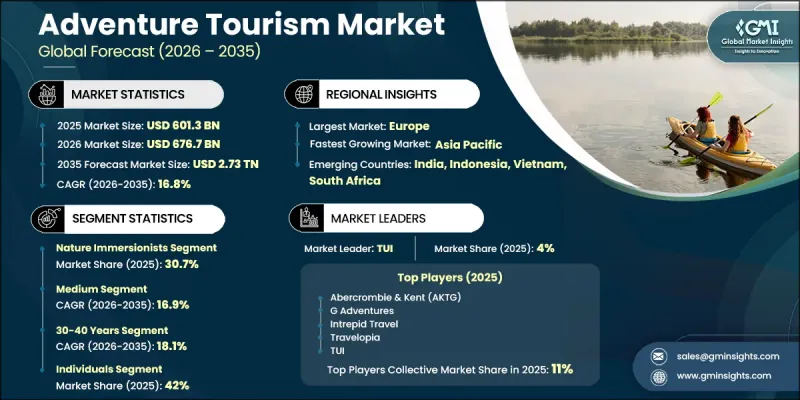
由於消費者越來越偏好身臨其境型、親近自然且注重環保的旅遊體驗,市場呈現出強勁的成長動能。旅行者們越來越傾向於選擇能讓他們與自然景觀親密接觸,同時又能支持永續旅遊實踐的戶外活動。健行、劃橡皮艇、觀賞野生動物和遠足等活動以及類似的體驗在全球範圍內廣受歡迎。年輕一代,尤其是千禧世代和Z世代,將健康、永續性和體驗式旅行放在首位,從而推動了市場需求。能夠提供真實自然體驗的目的地,遊客數量和停留時間都在增加。國家公園在探險旅遊中繼續扮演著核心角色,其完善的基礎設施為戶外休閒和豐富的自然景觀提供了支持。國家公園對國內外遊客的便利交通進一步提升了其吸引力。來自公共和私營部門的投資不斷改善公園的設施、服務和遊客體驗,增強了這些目的地的競爭力。此外,收入水準的提高和全球交通網路的擴展也推動了人們進行長途探險旅行。人們越來越關注負責任的旅遊,加上環保意識的提高,預計將進一步加速世界各地不同地區的長期市場擴張。
| 市場範圍 | |
|---|---|
| 開始年份 | 2025 |
| 預測期 | 2026-2035 |
| 上市時的市場規模 | 6013億美元 |
| 預計金額 | 2.73兆美元 |
| 複合年成長率 | 16.8% |
預計到2025年,「自然體驗」細分市場將佔據30.7%的市場佔有率,並在2026年至2035年間以17.1%的複合年成長率成長。這個細分市場的主要驅動力是那些尋求透過健行、露營、生態度假和野生動物觀賞等活動與自然環境建立更深層聯繫的旅客。這些旅客重視永續性、寧靜以及與生態系統的真正互動,他們通常會選擇那些能讓他們逃離都市生活、重新與自然和生物多樣性建立聯繫的目的地。
預計到2025年,中檔旅遊套裝市場佔有率將達到46.3%,並在2035年之前以16.9%的複合年成長率成長。此類別包括結構化的旅遊套餐,融合了導覽體驗、高品質設備、標準住宿設施、交通途徑和餐飲,但不包含豪華服務。中等收入旅客、年輕的商務人士以及尋求性價比兼顧體驗價值的家庭普遍青睞此類套餐。該細分市場的營運商致力於提供高品質的體驗,以贏得回頭客和積極的客戶回饋,同時保持高效的營運。
美國探險旅遊市場預計到2025年將達到1,097億美元,並在2026年至2035年間以15.9%的複合年成長率成長。這一成長得益於美國龐大的國家公園網路,這些公園是戶外旅遊活動的重要樞紐。主要保護區的高遊客量持續支撐著健行、露營和野生動物觀賞等體驗活動的需求。完善的旅遊基礎設施和發達的區域間交通網路進一步促進了國內外遊客的參與。美國地形多樣,包括山區、森林、沙漠和沿海地區,使得滑雪、衝浪和健行等探險活動全年皆可進行,提升了整體市場表現。
目錄
第1章:調查方法
第2章執行摘要
第3章 行業洞察
- 產業生態系分析
- 供應商情況
- 利潤率
- 成本結構
- 每個階段增加的價值
- 影響價值鏈的因素
- 中斷
- 影響產業的因素
- 促進因素
- 對自然旅遊的需求日益成長
- 一個迷人的國家公園
- 商業休閒旅遊趨勢的擴展
- 戶外活動生態系的擴展
- 產業潛在風險與挑戰
- 氣候變遷和野火造成的破壞
- 高昂的住宿和差旅費用
- 市場機遇
- 再生型及社區型旅遊
- 一次將健康養生融入冒險體驗的旅程。
- 面向消費者的數位預訂和個人化服務
- 新興的探險目的地,超越了主流旅遊景點
- 促進因素
- 成長潛力分析
- 技術與創新展望
- 最新科技趨勢
- 新興技術
- 監理情勢
- 北美洲
- 美國國家公園管理局
- 美國林務局
- 歐洲
- 歐盟委員會內部市場、工業、創業和中小企業總司(DG GROW)
- 歐洲旅遊委員會
- 亞太地區
- 中華人民共和國文化與旅遊部
- 印度旅遊部
- 拉丁美洲
- 觀光部
- 觀光局
- 中東和非洲
- 杜拜經濟與旅遊局
- 觀光部
- 北美洲
- 價格分析
- 對過去價格趨勢的分析
- 定價策略:按業務類型分類
- 波特的分析
- PESTLE分析
- 專利分析
- 人工智慧和生成式人工智慧對市場的影響
- 利用人工智慧改造現有經營模式
- 按細分市場分類的生成式人工智慧用例和部署藍圖
- 風險、限制和監管考量
- 永續性和環境方面
- 永續計劃
- 減少廢棄物策略
- 生產中的能源效率
- 具有環保意識的舉措
- 考慮碳足跡
- 預測假設和情境分析
- 基本案例:驅動複合年成長率的關鍵宏觀經濟與產業變量
- 樂觀情境:宏觀經濟與產業的順風
- 悲觀情景:宏觀經濟放緩或產業逆風
第4章 競爭情勢
- 介紹
- 企業市佔率分析
- 北美洲
- 歐洲
- 亞太地區
- LATAM
- 中東和非洲
- 主要市場公司的競爭分析
- 競爭定位矩陣
- 主要進展
- 併購
- 夥伴關係和聯盟
- 新產品發布
- 業務拓展計劃及資金籌措
- 按公司規模進行基準測試
- 排名分類標準與遴選標準
- 按銷售額、地區和創新能力分類的層級定位矩陣。
第5章 市場估計與預測:依受眾類型分類,2022-2035年
- 尋求刺激的人
- 自然體驗愛好者
- 健康逃逸者
- 參與活動的訪客
- 商務休閒延長器
第6章 市場估計與預測:依活動領域分類,2022-2035年
- 健行
- 滑雪和單板滑雪
- 皮划艇和漂流
- 露營和豪華露營
- 自行車和山地自行車
- 釣魚和野生動物之旅
第7章 市場估計與預測:依年齡層別分類,2022-2035年
- 20-30歲
- 30-40歲
- 40-50歲
- 超過50歲
第8章 市場估算與預測:依預訂量法,2022-2035年
- 旅行社
- 個人
- 活動企劃
第9章 市場估價與預測:依包裝類型分類,2022-2035年
- 低的
- 中等的
- 優質的
第10章 市場估價與預測:依地區分類,2022-2035年
- 北美洲
- 美國
- 加拿大
- 歐洲
- 德國
- 英國
- 法國
- 義大利
- 西班牙
- 俄羅斯
- 荷蘭
- 亞太地區
- 中國
- 印度
- 日本
- 韓國
- 澳洲
- 越南
- 印尼
- 拉丁美洲
- 巴西
- 墨西哥
- 阿根廷
- 中東和非洲
- 南非
- 沙烏地阿拉伯
- UAE
第11章:公司簡介
- 世界公司
- Abercrombie & Kent
- Backroads
- Butterfield & Robinson
- G Adventures
- Intrepid Travel
- Lindblad Expeditions
- Travelopia
- TUI
- 當地公司
- & Beyond
- African Travel
- Alpenwild
- Andean Trails
- Arabian Adventures
- 亞太探險旅行
- Contiki(TTC)
- New Zealand Walking Tours
- 新興企業
- Austin Adventures
- DuVine Cycling+Adventure
- Natural Habitat Adventures
- Remote Lands
The Global Adventure Tourism Market was valued at USD 601.3 billion in 2025 and is estimated to grow at a CAGR of 16.8% to reach USD 2.73 trillion by 2035.
The market is witnessing strong momentum due to increasing consumer preference for immersive, nature-based, and environmentally responsible travel experiences. Travelers are increasingly choosing outdoor activities that allow close interaction with natural landscapes while supporting sustainable tourism practices. Activities such as trekking, kayaking, wildlife exploration, hiking, and similar experiences are gaining strong traction globally. Younger demographics, particularly Millennials and Generation Z, are driving demand through their focus on wellness, sustainability, and experiential travel. Destinations offering authentic natural engagement are experiencing higher visitation rates and extended stays. National parks continue to serve as core hubs for adventure tourism, offering well-developed infrastructure and diverse natural attractions that support outdoor recreation. Their accessibility to both domestic and international travelers further strengthens their appeal. Public and private sector investments are continuously improving facilities, services, and visitor experiences, enhancing the competitiveness of these destinations. In addition, rising income levels and expanding global connectivity are encouraging long-distance travel for adventure-based experiences. The growing emphasis on responsible tourism, combined with increasing awareness of environmental conservation, is expected to further strengthen long-term market expansion across global regions.
| Market Scope | |
|---|---|
| Start Year | 2025 |
| Forecast Year | 2026-2035 |
| Start Value | $601.3 Billion |
| Forecast Value | $2.73 Trillion |
| CAGR | 16.8% |
The nature immersionists segment accounted for 30.7% share in 2025 and is projected to grow at a CAGR of 17.1% from 2026 to 2035. This segment is driven by travelers seeking deep engagement with natural environments through activities such as hiking, camping, eco-focused retreats, and wildlife experiences. These travelers prioritize sustainability, tranquility, and authentic interactions with ecosystems, often choosing destinations that allow them to disconnect from urban lifestyles and reconnect with nature and biodiversity.
The medium package segment held a 46.3% share in 2025 and is expected to grow at a CAGR of 16.9% through 2035. This category includes structured travel offerings that combine guided experiences, quality equipment, standard accommodation, transportation, and meals without luxury-level services. It is widely preferred by middle-income travelers, young professionals, and families who seek balanced cost and experience value. Operators in this segment focus on maintaining efficient operations while ensuring high-quality experiences that encourage repeat visits and positive customer feedback.
United States Adventure Tourism Market was valued at USD 109.7 billion in 2025 and is forecast to grow at a CAGR of 15.9% from 2026 to 2035. Growth in the country is strongly supported by its extensive network of national parks, which act as major centers for outdoor tourism activities. High visitor volumes across major protected landscapes continue to support demand for hiking, camping, and wildlife-related experiences. Strong tourism infrastructure and well-developed regional travel networks further enhance domestic and international participation. The country's diverse geography, including mountains, forests, deserts, and coastal regions, enables year-round adventure activities such as skiing, surfing, and trekking, strengthening overall market performance.
Major players operating in the Global Adventure Tourism Industry include Intrepid Travel, G Adventures, Abercrombie & Kent (AKTG), TUI, Lindblad Expeditions, Backroads, Travelopia, Butterfield & Robinson, Natural Habitat Adventures, and Contiki (TTC Group). Companies in the adventure tourism market are strengthening their position by expanding curated and experience-driven travel packages that focus on personalization and sustainability. They are investing in digital booking platforms and AI-based itinerary planning tools to enhance customer convenience and engagement. Strategic partnerships with local tour operators and conservation organizations are helping improve destination authenticity and environmental responsibility. Operators are also focusing on niche travel experiences such as eco-tourism, wellness travel, and cultural immersion to attract diverse customer segments. In addition, companies are enhancing safety standards, upgrading guide training programs, and improving on-ground infrastructure to build trust and customer satisfaction. Aggressive marketing through social media and influencer collaborations is further boosting brand visibility and customer acquisition across global markets.
Table of Contents
Chapter 1 Methodology
- 1.1 Research approach
- 1.2 Quality Commitments
- 1.2.1 GMI AI policy & data integrity commitment
- 1.2.1.1 Source consistency protocol
- 1.2.1 GMI AI policy & data integrity commitment
- 1.3 Research Trail & Confidence Scoring
- 1.3.1 Research Trail Components
- 1.3.2 Scoring Components
- 1.4 Data Collection
- 1.4.1 Partial list of primary sources
- 1.5 Data mining sources
- 1.5.1 Paid sources
- 1.5.1.1 Sources, by region
- 1.5.1 Paid sources
- 1.6 Base estimates and calculations
- 1.6.1 Base year calculation
- 1.7 Forecast model
- 1.7.1 Quantified market impact analysis
- 1.7.1.1 Mathematical impact of growth parameters on forecast
- 1.7.1 Quantified market impact analysis
- 1.8 Research transparency addendum
- 1.8.1 Source attribution framework
- 1.8.2 Quality assurance metrics
- 1.8.3 Our commitment to trust
Chapter 2 Executive Summary
- 2.1 Industry 360° synopsis
- 2.2 Key market trends
- 2.2.1 Regional
- 2.2.2 Audience type
- 2.2.3 Activity interest
- 2.2.4 Age group
- 2.2.5 Booking mode
- 2.2.6 Packages
- 2.3 TAM analysis, 2026-2035
- 2.4 CXO perspectives: Strategic imperatives
Chapter 3 Industry Insights
- 3.1 Industry ecosystem analysis
- 3.1.1 Supplier landscape
- 3.1.2 Profit margin
- 3.1.3 Cost structure
- 3.1.4 Value addition at each stage
- 3.1.5 Factor affecting the value chain
- 3.1.6 Disruptions
- 3.2 Industry impact forces
- 3.2.1 Growth drivers
- 3.2.1.1 Rising nature-based travel demand
- 3.2.1.2 Strong national park attractions
- 3.2.1.3 Growth of bleisure tourism trend
- 3.2.1.4 Expanding outdoor event ecosystem
- 3.2.2 Industry pitfalls and challenges
- 3.2.2.1 Climate and wildfire disruptions
- 3.2.2.2 High lodging and travel costs
- 3.2.3 Market opportunities
- 3.2.3.1 Regenerative and community-based tourism
- 3.2.3.2 Wellness-integrated adventure experiences
- 3.2.3.3 Direct-to-consumer digital booking and personalization
- 3.2.3.4 Emerging adventure destinations beyond mainstream hotspots
- 3.2.1 Growth drivers
- 3.3 Growth potential analysis
- 3.4 Technology and innovation landscape
- 3.4.1 Current technological trends
- 3.4.2 Emerging technologies
- 3.5 Regulatory landscape
- 3.5.1 North America
- 3.5.1.1 U.S. National Park Service
- 3.5.1.2 U.S. Forest Service
- 3.5.2 Europe
- 3.5.2.1 European Commission Directorate-General for Internal Market, Industry, Entrepreneurship and SMEs (DG GROW)
- 3.5.2.2 European Travel Commission
- 3.5.3 Asia Pacific
- 3.5.3.1 Ministry of Culture and Tourism of the People's Republic of China
- 3.5.3.2 Ministry of Tourism, Government of India
- 3.5.4 Latin America
- 3.5.4.1 Ministerio do Turismo
- 3.5.4.2 Secretaria de Turismo
- 3.5.5 Middle East & Africa
- 3.5.5.1 Dubai Department of Economy and Tourism
- 3.5.5.2 Saudi Ministry of Tourism
- 3.5.1 North America
- 3.6 Pricing Analysis (Driven by Primary Research)
- 3.6.1 Historical Price Trend Analysis
- 3.6.2 Pricing Strategy by Player Type
- 3.7 Porter's analysis
- 3.8 PESTEL analysis
- 3.9 Patent analysis (Driven by Primary Research)
- 3.10 Impact of AI & Generative AI on the Market
- 3.10.1 AI-driven disruption of existing business models
- 3.10.2 Gen AI use cases & adoption roadmap by segment
- 3.10.3 Risks, limitations & regulatory considerations
- 3.11 Sustainability and environmental aspects
- 3.11.1 Sustainable practices
- 3.11.2 Waste reduction strategies
- 3.11.3 Energy efficiency in production
- 3.11.4 Eco-friendly initiatives
- 3.11.5 Carbon footprint considerations
- 3.12 Forecast assumptions & scenario analysis (Driven by primary research)
- 3.12.1 Base Case - key macro & industry variables driving CAGR
- 3.12.2 Optimistic Scenarios - Favorable macro and industry tailwinds
- 3.12.3 Pessimistic Scenario - Macroeconomic slowdown or industry headwinds
Chapter 4 Competitive Landscape, 2025
- 4.1 Introduction
- 4.2 Company market share analysis
- 4.2.1 North America
- 4.2.2 Europe
- 4.2.3 Asia Pacific
- 4.2.4 LATAM
- 4.2.5 MEA
- 4.3 Competitive analysis of major market players
- 4.4 Competitive positioning matrix
- 4.5 Key developments
- 4.5.1 Mergers & acquisitions
- 4.5.2 Partnerships & collaborations
- 4.5.3 New product launches
- 4.5.4 Expansion plans and funding
- 4.6 Company tier benchmarking
- 4.6.1 Tier classification criteria & qualifying thresholds
- 4.6.2 Tier positioning matrix by revenue, geography & innovation
Chapter 5 Market Estimates & Forecast, By Audience Type, 2022 - 2035 ($Bn)
- 5.1 Key trends
- 5.2 Adrenaline chasers
- 5.3 Nature immersionists
- 5.4 Wellness escapists
- 5.5 Event-driven visitors
- 5.6 Bleisure extenders
Chapter 6 Market Estimates & Forecast, By Activity Interest, 2022 - 2035 ($Bn)
- 6.1 Key trends
- 6.2 Hiking & Trekking
- 6.3 Skiing & Snowboarding
- 6.4 Kayaking & Rafting
- 6.5 Camping & Glamping
- 6.6 Cycling & Mountain Biking
- 6.7 Fishing & Wildlife Tours
Chapter 7 Market Estimates & Forecast, By Age Group, 2022 - 2035 ($Bn)
- 7.1 Key trends
- 7.2 20-30 years
- 7.3 30-40 years
- 7.4 40-50 years
- 7.5 Above 50
Chapter 8 Market Estimates & Forecast, By Booking Mode, 2022 - 2035 ($Bn)
- 8.1 Key trends
- 8.2 Travel Agent
- 8.3 Individuals
- 8.4 Event Planners
Chapter 9 Market Estimates & Forecast, By Packages, 2022 - 2035 ($Bn)
- 9.1 Key trends
- 9.2 Low
- 9.3 Medium
- 9.4 Premium
Chapter 10 Market Estimates & Forecast, By Region, 2022 - 2035 ($Bn)
- 10.1 Key trends
- 10.2 North America
- 10.2.1 U.S.
- 10.2.2 Canada
- 10.3 Europe
- 10.3.1 Germany
- 10.3.2 UK
- 10.3.3 France
- 10.3.4 Italy
- 10.3.5 Spain
- 10.3.6 Russia
- 10.3.7 Netherlands
- 10.4 Asia Pacific
- 10.4.1 China
- 10.4.2 India
- 10.4.3 Japan
- 10.4.4 South Korea
- 10.4.5 Australia
- 10.4.6 Vietnam
- 10.4.7 Indonesia
- 10.5 Latin America
- 10.5.1 Brazil
- 10.5.2 Mexico
- 10.5.3 Argentina
- 10.6 MEA
- 10.6.1 South Africa
- 10.6.2 Saudi Arabia
- 10.6.3 UAE
Chapter 11 Company Profiles
- 11.1 Global players
- 11.1.1 Abercrombie & Kent
- 11.1.2 Backroads
- 11.1.3 Butterfield & Robinson
- 11.1.4 G Adventures
- 11.1.5 Intrepid Travel
- 11.1.6 Lindblad Expeditions
- 11.1.7 Travelopia
- 11.1.8 TUI
- 11.2 Regional players
- 11.2.1 &Beyond
- 11.2.2 African Travel
- 11.2.3 Alpenwild
- 11.2.4 Andean Trails
- 11.2.5 Arabian Adventures
- 11.2.6 Asia Pacific Adventure Travel
- 11.2.7 Contiki (TTC)
- 11.2.8 New Zealand Walking Tours
- 11.3 Emerging players
- 11.3.1 Austin Adventures
- 11.3.2 DuVine Cycling + Adventure
- 11.3.3 Natural Habitat Adventures
- 11.3.4 Remote Lands

 探險旅遊市場規模、佔有率、成長率及全球產業分析、區域趨勢及2026-2034年預測
 戶外探險旅遊服務市場規模、佔有率和成長分析:按活動類型、旅遊類型、服務類型、旅行者類型、預訂管道和地區分類 - 2026-2033 年行業預測
 青少年探險旅遊市場:全球市場預測,2026-2032年青少年及兒童探險旅遊市場-2026-2032年全球市場預測
 極限旅遊市場規模、佔有率和成長分析:按旅遊類型、活動、預訂管道、旅行者類型、年齡層、最終用戶和地區分類-2026-2033年產業預測
 水上探險旅遊市場規模、佔有率和成長分析:按活動類型、旅客類型、預訂方式、最終用戶、旅遊類型和地區分類-2026-2033年產業預測探險旅遊市場:按活動類型、旅行時間、旅行安排、旅行者類型和分銷管道分類-全球預測,2026-2032年全球探險旅遊市場規模、佔有率、趨勢和成長分析報告(2026-2034年)全球探險旅遊市場規模、佔有率、趨勢和成長分析報告(2026-2034)
 2026-2030年全球探險旅遊市場