


 |
市場調查報告書
商品編碼
2061428
陶瓷油墨市場機會、成長促進因素、產業趨勢分析及2026-2035年預測。Ceramic Inks Market Opportunity, Growth Drivers, Industry Trend Analysis, and Forecast 2026 - 2035 |
||||||

全球陶瓷油墨市場預計到 2025 年將價值 22 億美元,預計到 2035 年將以 5.5% 的複合年成長率成長至 38 億美元。
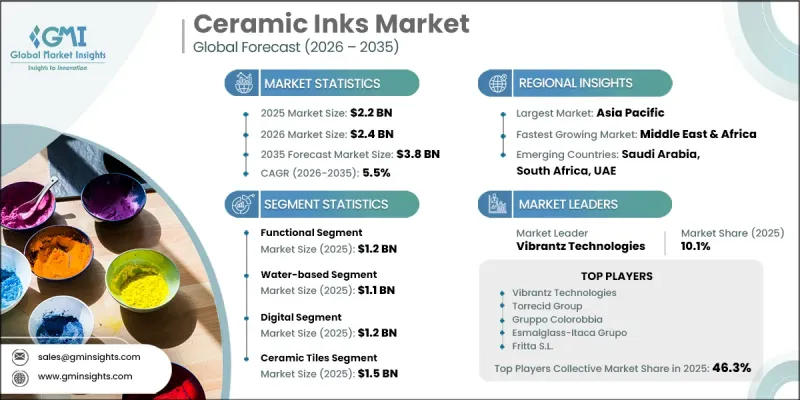
由於住宅、商業和工業領域對裝飾性和功能性陶瓷產品的需求不斷成長,陶瓷油墨產業正在蓬勃發展。陶瓷油墨是專為印刷、塗覆和裝飾陶瓷表面而專門開發的組合藥物,即使在高溫加工條件下也能保持其耐久性。這些油墨通常由精細加工的顏料、液體載體和性能增強添加劑組成,可將圖案永久固定在陶瓷基材上。因此,印刷表面能夠維持長期的色彩穩定性、耐磨性和視覺品質。製造商擴大採用先進的印刷方法,例如數位印刷、捲筒印刷和網版印刷,來使用陶瓷油墨,以實現精細的紋理、客製化的圖案和高精度的表面處理。對高階室內表面材料、建材和耐用裝飾產品的需求不斷成長,並持續推動市場成長。此外,數位陶瓷印刷技術的不斷進步提高了生產效率,減少了材料浪費,並使製造商能夠為更廣泛的應用提供更複雜、更個性化的設計。
| 市場範圍 | |
|---|---|
| 開始年份 | 2025 |
| 預測期 | 2026-2035 |
| 起始金額 | 22億美元 |
| 預測金額 | 38億美元 |
| 複合年成長率 | 5.5% |
預計到2025年,功能性陶瓷油墨市場規模將達到12億美元,成為該市場中最大的類別。隨著工業領域對兼具裝飾性和性能增強特性的材料的需求日益成長,對功能性陶瓷油墨的需求也隨之增加。這些油墨具有卓越的耐磨性、耐化學腐蝕性、耐濕性和耐環境腐蝕性,使其成為工業表面、建築結構和特殊塗料應用的理想選擇。其持久耐用性以及即使在惡劣條件下也能保持外觀的特性,持續推動它們在商業和工業項目中的應用。
預計到2025年,磁磚市場規模將達到15億美元。數位陶瓷印刷技術在定製瓷磚設計和紋理飾面方面的日益普及,顯著推動了陶瓷油墨的需求成長。製造商越來越注重在住宅和商業環境中實現高清晰度表面處理、自然紋理再現以及提升產品耐久性。同時,隨著裝飾性和功能性表面處理對陶瓷油墨的需求不斷成長,玻璃應用領域也呈現穩定成長的態勢。在建築玻璃和特殊表面應用領域,對更高附著力、可控透明度和更強耐久性的需求正在推動市場需求。
預計到2025年,美國陶瓷油墨市場規模將達到2.407億美元。這一成長主要得益於陶瓷生產設施的現代化以及各行業對客製化裝飾表面日益成長的需求。美國製造商正穩步採用數位陶瓷印刷技術,以提高生產精度、減少運作並實現穩定的裝飾品質。對高效、高精度印刷方法的日益成長的需求也推動了陶瓷油墨在工業和建築領域的廣泛應用。
目錄
第1章:調查方法和範圍
第2章執行摘要
第3章 行業洞察
- 產業生態系分析
- 供應商情況
- 利潤率
- 每個階段增加的價值
- 影響價值鏈的因素
- 中斷
- 影響產業的因素
- 成長促進因素
- 數位印刷陶瓷表面的需求日益成長
- 建設活動的活性化正在推動瓷磚消費量的成長。
- 人們對客製化美學設計方案的興趣日益濃厚。
- 產業潛在風險與挑戰
- 原料成本上漲正在影響生產的穩定性。
- 化學油墨成分引發的環境問題
- 市場機遇
- 數位印刷技術在陶瓷領域的拓展
- 開發環保、低排放油墨配方
- 在高級建築和室內設計應用中不斷擴展應用。
- 成長促進因素
- 成長潛力分析
- 監理情勢
- 波特的分析
- PESTLE分析
- 技術與創新展望
- 最新科技趨勢
- 新興技術
- 價格趨勢
- 按地區
- 依產品
- 未來市場趨勢
- 專利趨勢
- 貿易統計
- 主要進口國
- 主要出口國
- 永續性和環境方面
- 永續計劃
- 減少廢棄物策略
- 生產中的能源效率
- 具有環保意識的舉措
- 考慮碳足跡
第4章 競爭情勢
- 介紹
- 企業市佔率分析
- 按地區
- 北美洲
- 歐洲
- 亞太地區
- 拉丁美洲
- 中東和非洲
- 按地區
- 企業矩陣分析
- 主要市場公司的競爭分析
- 競爭定位矩陣
- 主要進展
- 併購
- 夥伴關係和聯盟
- 新產品發布
- 業務拓展計劃
第5章 市場估價與預測:依產品分類,2022-2035年
- 功能
- 裝飾性的
第6章 市場估價與預測:依配方分類,2022-2035年
- 溶劑型
- 水溶液
- 油膩的
第7章 市場估計與預測:依技術分類,2022-2035年
- 數位的
- 模擬
第8章 市場估算與預測:依基材分類,2022-2035年
- 磁磚
- 玻璃
- 餐具
- 其他
第9章 市場估計與預測:依最終用途分類,2022-2035年
- 建築/施工
- 車
- 食品和飲料容器
- 其他(消費品包裝、陶瓷等)
第10章 市場估價與預測:依地區分類,2022-2035年
- 北美洲
- 美國
- 加拿大
- 歐洲
- 德國
- 英國
- 法國
- 西班牙
- 義大利
- 其他歐洲國家
- 亞太地區
- 中國
- 印度
- 日本
- 澳洲
- 韓國
- 其他亞太國家
- 拉丁美洲
- 巴西
- 墨西哥
- 阿根廷
- 其他拉丁美洲國家
- 中東和非洲
- 沙烏地阿拉伯
- 南非
- UAE
- 其他中東和非洲國家
第11章:公司簡介
- Vibrantz Technologies
- Torrecid Group
- Gruppo Colorobbia
- Esmalglass-Itaca Grupo
- Fritta SL
- Sun Chemical Corporation
- Zschimmer & Schwarz
- Sicer SpA
- Kao Chimigraf
- Tecglass
- Dip-Tech Digital
- Marabu GmbH
- FENZI SpA
The Global Ceramic Inks Market was valued at USD 2.2 billion in 2025 and is estimated to grow at a CAGR of 5.5% to reach USD 3.8 billion by 2035.
The ceramic inks industry is expanding due to rising demand for decorative and functional ceramic applications across residential, commercial, and industrial sectors. Ceramic inks are specially developed formulations designed for printing, coating, and decorating ceramic surfaces while maintaining durability under high-temperature processing conditions. These inks typically consist of finely processed pigments, liquid carriers, and performance-enhancing additives that allow the design to permanently bond with ceramic substrates. As a result, the printed surfaces maintain long-term color stability, wear resistance, and visual quality. Manufacturers increasingly utilize ceramic inks through advanced printing methods such as digital, rotary, and screen printing to achieve detailed textures, customized patterns, and high-precision finishes. Growing demand for premium interior surfaces, architectural materials, and durable decorative products continues to support market growth. In addition, ongoing advancements in digital ceramic printing technologies are improving production efficiency, reducing material waste, and enabling manufacturers to deliver more sophisticated and customized designs for a wide range of applications.
| Market Scope | |
|---|---|
| Start Year | 2025 |
| Forecast Year | 2026-2035 |
| Start Value | $2.2 Billion |
| Forecast Value | $3.8 Billion |
| CAGR | 5.5% |
The functional ceramic inks segment generated USD 1.2 billion in 2025, making it the leading category within the market. Demand for functional ceramic inks is increasing as industries prioritize materials that deliver both decorative appeal and enhanced performance characteristics. These inks are designed to provide superior resistance against abrasion, chemicals, moisture, and environmental exposure, making them highly suitable for industrial surfaces, architectural structures, and specialty coating applications. Their long-lasting durability and ability to maintain appearance under demanding conditions continue to strengthen adoption across commercial and industrial projects.
The ceramic tiles segment accounted for USD 1.5 billion in 2025. Rising adoption of digital ceramic printing technologies for customized tile designs and textured finishes is significantly contributing to demand for ceramic inks. Manufacturers are increasingly focusing on high-definition surface finishes, natural texture replication, and improved product durability for both residential and commercial environments. At the same time, the glass application segment is witnessing steady growth as ceramic inks gain traction for decorative and functional surface treatments. Market demand is being supported by the need for improved adhesion performance, controlled transparency, and enhanced durability in architectural glass and specialty surface applications.
U.S. Ceramic Inks Market was valued at USD 240.7 million in 2025. Growth in the country is being driven by increasing modernization of ceramic production facilities and rising demand for customized decorative surfaces across multiple industries. Manufacturers in the U.S. are steadily adopting digital ceramic printing technologies to improve production precision, reduce operational downtime, and achieve consistent decorative quality. The growing preference for efficient and high-accuracy printing methods is also contributing to the wider integration of ceramic inks across industrial and architectural applications.
Major companies operating in the Ceramic Inks Market include Torrecid Group, Vibrantz Technologies, Gruppo Colorobbia, Esmalglass-Itaca Grupo, Fritta S.L., Sun Chemical Corporation, Zschimmer & Schwarz, Sicer S.p.A., Kao Chimigraf, Tecglass, Dip-Tech Digital, Marabu GmbH, and FENZI SpA. Companies active in the ceramic inks market are implementing several strategic initiatives to strengthen their market position and expand their global presence. Leading manufacturers are investing heavily in research and development to introduce advanced ink formulations that provide improved durability, color consistency, and environmental resistance. Businesses are also focusing on expanding digital ceramic printing capabilities to meet growing demand for customized and high-definition decorative surfaces. Strategic partnerships with ceramic tile manufacturers, glass processors, and architectural material suppliers are helping companies broaden their customer base and improve product integration. In addition, market participants are increasing investments in sustainable production technologies and eco-friendly ink formulations to align with evolving environmental standards.
Table of Contents
Chapter 1 Methodology & Scope
- 1.1 Market scope and definition
- 1.2 Research design
- 1.2.1 Research approach
- 1.2.2 Data collection methods
- 1.3 Data mining sources
- 1.3.1 Global
- 1.3.2 Regional/Country
- 1.4 Base estimates and calculations
- 1.4.1 Base year calculation
- 1.4.2 Key trends for market estimation
- 1.5 Primary research and validation
- 1.5.1 Primary sources
- 1.6 Forecast model
- 1.7 Research assumptions and limitations
Chapter 2 Executive Summary
- 2.1 Industry 360° synopsis
- 2.2 Key market trends
- 2.2.1 Product
- 2.2.2 Formulation
- 2.2.3 Technology
- 2.2.4 Substrate
- 2.2.5 End Use
- 2.2.6 Regional
- 2.3 TAM Analysis, 2026-2035
- 2.4 CXO perspectives: Strategic imperatives
- 2.5 Future outlook and strategic recommendations
Chapter 3 Industry Insights
- 3.1 Industry ecosystem analysis
- 3.1.1 Supplier landscape
- 3.1.2 Profit margin
- 3.1.3 Value addition at each stage
- 3.1.4 Factor affecting the value chain
- 3.1.5 Disruptions
- 3.2 Industry impact forces
- 3.2.1 Growth drivers
- 3.2.1.1 Rising demand for digitally printed ceramic surfaces
- 3.2.1.2 Increasing construction activities boosting tile consumption
- 3.2.1.3 Growing focus on customized aesthetic design solutions
- 3.2.2 Industry pitfalls and challenges
- 3.2.2.1 High raw material costs affecting production stability
- 3.2.2.2 Environmental concerns related to chemical ink compositions
- 3.2.3 Market opportunities
- 3.2.3.1 Expansion of digital printing technologies in ceramics
- 3.2.3.2 Development of eco-friendly and low-emission ink formulations
- 3.2.3.3 Increasing use in advanced architectural and interior applications
- 3.2.1 Growth drivers
- 3.3 Growth potential analysis
- 3.4 Regulatory landscape
- 3.4.1 North America
- 3.4.2 Europe
- 3.4.3 Asia Pacific
- 3.4.4 Latin America
- 3.4.5 Middle East & Africa
- 3.5 Porter's analysis
- 3.6 PESTEL analysis
- 3.7 Technology and innovation landscape
- 3.7.1 Current technological trends
- 3.7.2 Emerging technologies
- 3.8 Price trends
- 3.8.1 By region
- 3.8.2 By product
- 3.9 Future market trends
- 3.10 Patent landscape
- 3.11 Trade statistics (HS code)
- 3.11.1 Major importing countries
- 3.11.2 Major exporting countries
- 3.12 Sustainability and environmental aspects
- 3.12.1 Sustainable practices
- 3.12.2 Waste reduction strategies
- 3.12.3 Energy efficiency in production
- 3.12.4 Eco-friendly initiatives
- 3.13 Carbon footprint consideration
Chapter 4 Competitive Landscape, 2025
- 4.1 Introduction
- 4.2 Company market share analysis
- 4.2.1 By region
- 4.2.1.1 North America
- 4.2.1.2 Europe
- 4.2.1.3 Asia Pacific
- 4.2.1.4 LATAM
- 4.2.1.5 MEA
- 4.2.1 By region
- 4.3 Company matrix analysis
- 4.4 Competitive analysis of major market players
- 4.5 Competitive positioning matrix
- 4.6 Key developments
- 4.6.1 Mergers & acquisitions
- 4.6.2 Partnerships & collaborations
- 4.6.3 New product launches
- 4.6.4 Expansion plans
Chapter 5 Market Estimates and Forecast, By Product, 2022-2035 (USD Million) (Kilo Tons)
- 5.1 Key trends
- 5.2 Functional
- 5.3 Decorative
Chapter 6 Market Estimates and Forecast, By Formulation, 2022-2035 (USD Million) (Kilo Tons)
- 6.1 Key trends
- 6.2 Solvent-based
- 6.3 Water-based
- 6.4 Oil-based
Chapter 7 Market Estimates and Forecast, By Technology, 2022-2035 (USD Million) (Kilo Tons)
- 7.1 Key trends
- 7.2 Digital
- 7.3 Analog
Chapter 8 Market Estimates and Forecast, By Substrate, 2022-2035 (USD Million) (Kilo Tons)
- 8.1 Key trends
- 8.2 Ceramic tiles
- 8.3 Glass
- 8.4 Table wear
- 8.5 Others
Chapter 9 Market Estimates and Forecast, By End use, 2022-2035 (USD Million) (Kilo Tons)
- 9.1 Key trends
- 9.2 Building & construction
- 9.3 Automotive
- 9.4 Food & beverage containers
- 9.5 Others (consumer goods packaging, pottery, etc.)
Chapter 10 Market Estimates and Forecast, By Region, 2022-2035 (USD Million) (Kilo Tons)
- 10.1 Key trends
- 10.2 North America
- 10.2.1 U.S.
- 10.2.2 Canada
- 10.3 Europe
- 10.3.1 Germany
- 10.3.2 UK
- 10.3.3 France
- 10.3.4 Spain
- 10.3.5 Italy
- 10.3.6 Rest of Europe
- 10.4 Asia Pacific
- 10.4.1 China
- 10.4.2 India
- 10.4.3 Japan
- 10.4.4 Australia
- 10.4.5 South Korea
- 10.4.6 Rest of Asia Pacific
- 10.5 Latin America
- 10.5.1 Brazil
- 10.5.2 Mexico
- 10.5.3 Argentina
- 10.5.4 Rest of Latin America
- 10.6 Middle East and Africa
- 10.6.1 Saudi Arabia
- 10.6.2 South Africa
- 10.6.3 UAE
- 10.6.4 Rest of Middle East and Africa
Chapter 11 Company Profiles
- 11.1 Vibrantz Technologies
- 11.2 Torrecid Group
- 11.3 Gruppo Colorobbia
- 11.4 Esmalglass-Itaca Grupo
- 11.5 Fritta S.L.
- 11.6 Sun Chemical Corporation
- 11.7 Zschimmer & Schwarz
- 11.8 Sicer S.p.A.
- 11.9 Kao Chimigraf
- 11.10 Tecglass
- 11.11 Dip-Tech Digital
- 11.12 Marabu GmbH
- 11.13 FENZI SpA


