

 |
市場調查報告書
商品編碼
2061419
抗真菌藥物市場機會、成長促進因素、產業趨勢分析及2026-2035年預測。Antifungal Drugs Market Opportunity, Growth Drivers, Industry Trend Analysis, and Forecast 2026 - 2035 |
||||||

預計到 2025 年,全球抗真菌藥物市場價值將達到 168 億美元,並預計以 4.1% 的複合年成長率成長,到 2035 年達到 255 億美元。
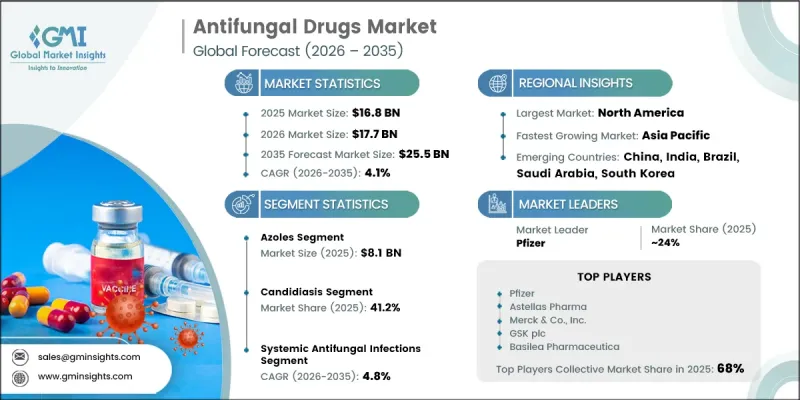
由於醫療機構中真菌感染疾病的發生率不斷上升,以及全球免疫力缺乏患者數量的成長,市場正穩步擴張。醫院獲得性真菌感染疾病的增加,以及人們對早期診斷和治療侵襲性真菌感染疾病重要性的認知不斷提高,進一步推動了市場成長。此外,多重抗藥性真菌病原體的快速傳播引發了人們對抗真菌藥物抗藥性的擔憂,從而產生了對更有效治療方法的強烈需求。藥物研發的持續進步、醫療服務可及性的改善以及已開發市場和新興市場抗真菌療法的日益普及,也對該行業產生了積極影響。對感染疾病控制投入的增加以及對預防性醫療保健的日益重視,進一步促進了市場的長期成長。隨著醫療機構繼續專注於先進的治療方案和早期療育策略,預計在整個預測期內,對創新抗真菌藥物的需求將保持強勁。
| 市場範圍 | |
|---|---|
| 開始年份 | 2025 |
| 預測期 | 2026-2035 |
| 起始金額 | 168億美元 |
| 預測金額 | 255億美元 |
| 複合年成長率 | 4.1% |
抗真菌藥物市場專注於預防、治療和管理多種治療類別的淺層、全身性和侵襲性真菌感染疾病。這些藥物被廣泛用於治療影響身體各部位的多種真菌感染疾病。人們對抗藥性真菌菌株日益成長的擔憂正在顯著改變該行業的競爭格局。高抗藥性真菌在醫療機構中的快速傳播,使得對有效治療方法和先進抗真菌製劑的需求變得迫切。此外,醫療保健意識的提高和診斷技術的進步使得早期發現和更快啟動治療成為可能。市場也看到了對療效更佳、安全性更高、抗真菌作用範圍更廣的治療方法的臨床需求不斷成長,這持續推動著全球產品創新和商業化活動。
預計到2025年,Azole類抗真菌藥物市場規模將達到81億美元,主要得益於其廣譜抗真菌活性以及在所有醫療機構中廣泛的臨床接受度。Azole抗真菌藥物因其治療柔軟性和多種劑型而持續廣泛使用。它們在醫院、門診和預防保健項目中的廣泛使用進一步推動了該細分市場的成長。此外,醫生對其的熟悉程度、良好的吸收特性以及已建立的療效也持續支持著Azole抗真菌藥物的廣泛應用。該細分市場也受益於其作為多種真菌感染疾病一線治療方法的持續使用,從而鞏固了其在全球抗真菌藥物市場的主導地位。
預計到2025年,念珠菌症市場將佔據41.2%的市場。念珠菌症仍然是全球最常見的真菌感染疾病之一,顯著推高了抗真菌治療的需求。真菌疾病的日益普及和嚴重程度提高了人們對早期診斷和治療重要性的認知,從而導致抗真菌藥物的使用增加。醫療保健領域對感染控制的日益重視以及臨床上對真菌疾病併發症的關注度不斷提高,也推動了該領域的成長。此外,真菌感染疾病對弱勢族群造成的負擔日益加重,也持續加速了對有效念珠菌症治療方法的需求。
預計到2025年,北美抗真菌藥物市佔率將達到38.6%。該地區憑藉其先進的醫療基礎設施、高診斷率和治療率,以及大型製藥企業在抗真菌藥物研發和商業化方面的強大實力,持續引領著產業發展。免疫免疫力缺乏患者、老齡化人口、癌症患者和器官移植受者中真菌感染疾病病例的不斷增加,顯著推動了全部區域的市場需求。此外,優惠的醫保報銷政策、不斷成長的醫療支出以及對感染疾病研究的持續投入,也為北美市場的持續擴張提供了支持。
目錄
第1章:調查方法和範圍
第2章執行摘要
第3章 行業洞察
- 產業生態系分析
- 影響產業的因素
- 成長促進因素
- 侵襲性和機會性真菌感染疾病的盛行率增加
- 免疫力缺乏患者數量增加
- 抗真菌藥物研發進展
- 快速真菌診斷技術的廣泛應用
- 人們對抗真菌藥物抗藥性的認知不斷提高
- 產業潛在風險與挑戰
- 抗真菌藥物的抗藥性增強
- 先進抗真菌療法的費用很高
- 缺乏認知和診斷延誤
- 市場機遇
- 擴大新型抗真菌藥物的研發管線
- 新興市場醫療保健投資不斷成長
- 成長促進因素
- 成長潛力分析
- 監理情勢
- 技術與創新展望
- 最新技術
- 新興技術
- 價格分析
- 對過去價格趨勢的分析
- 按藥物類別分類的定價策略
- 管線分析和臨床試驗趨勢
- 人工智慧和生成式人工智慧對市場的影響
- 波特的分析
- PESTLE分析
第4章 競爭情勢
- 介紹
- 企業市佔率分析
- 北美洲
- 歐洲
- 亞太地區
- 企業矩陣分析
- 主要市場公司的競爭分析
- 競爭定位矩陣
- 主要進展
- 併購
- 夥伴關係和聯盟
- 新產品發布
- 業務拓展計劃
第5章 市場估計與預測:依藥物類別分類,2022-2035年
- Azole
- 棘白菌素類藥物
- Polyenes
- Allylamines
- 其他藥物類別
第6章 市場估計與預測:依適應症分類,2022-2035年
- 皮膚絲狀菌症
- 麴菌症
- 念珠菌症
- 白黴菌症
- 其他改編
第7章 市場估計與預測:依感染類型分類,2022-2035年
- 全身性抗黴菌感染疾病
- 表層抗真菌感染疾病
第8章 市場估計與預測:依給藥途徑分類,2022-2035年
- 口服
- 外用
- 注射藥物
第9章 市場估計與預測:依藥物分類,2022-2035年
- 處方
- OTC
第10章 市場估價與預測:依類型分類,2022-2035年
- 品牌
- 非專利的
第11章 市場估價與預測:依通路分類,2022-2035年
- 醫院藥房
- 零售藥房
- 網路藥房
第12章 市場估計與預測:依地區分類,2022-2035年
- 北美洲
- 美國
- 加拿大
- 歐洲
- 德國
- 英國
- 法國
- 西班牙
- 義大利
- 荷蘭
- 亞太地區
- 中國
- 日本
- 印度
- 澳洲
- 韓國
- 拉丁美洲
- 巴西
- 墨西哥
- 阿根廷
- 中東和非洲
- 南非
- 沙烏地阿拉伯
- UAE
第13章:公司簡介
- Astellas Pharma
- Bayer AG
- Cipla
- Gilead Sciences
- Glenmark Pharmaceuticals
- GlaxoSmithKline
- Hikma Pharmaceuticals
- Merck & Co.
- Novartis AG
- Pfizer
- Scynexis
- Sun Pharmaceutical Industries
- Sanofi
The Global Antifungal Drugs Market was valued at USD 16.8 billion in 2025 and is estimated to grow at a CAGR of 4.1% to reach USD 25.5 billion by 2035.
The market is steadily advancing due to the growing occurrence of fungal infections across healthcare settings, coupled with the increasing population of immunocompromised patients worldwide. Rising cases of hospital-associated fungal infections and growing awareness regarding timely diagnosis and treatment of invasive fungal diseases are further supporting market expansion. In addition, concerns surrounding antifungal resistance have intensified due to the rapid spread of multidrug-resistant fungal pathogens, creating strong demand for more effective therapeutic solutions. The industry is also benefiting from ongoing advancements in pharmaceutical research, improved access to healthcare services, and expanding adoption of antifungal therapies in both developed and emerging economies. Increasing investments in infectious disease management and rising emphasis on preventive healthcare measures are further contributing to long-term market growth. As healthcare providers continue focusing on advanced treatment protocols and early intervention strategies, the demand for innovative antifungal medications is expected to remain strong throughout the forecast period.
| Market Scope | |
|---|---|
| Start Year | 2025 |
| Forecast Year | 2026-2035 |
| Start Value | $16.8 Billion |
| Forecast Value | $25.5 Billion |
| CAGR | 4.1% |
The antifungal drugs market focuses on the prevention, treatment, and management of superficial, systemic, and invasive fungal infections through multiple therapeutic drug categories. These medications are widely prescribed for a broad range of fungal conditions affecting different parts of the body. Growing concern regarding resistant fungal strains is significantly transforming the competitive landscape of the industry. The rapid spread of highly resistant fungal organisms across healthcare facilities has increased the urgency for effective treatment approaches and advanced antifungal formulations. In addition, rising healthcare awareness and improvements in diagnostic technologies are supporting earlier detection and faster treatment initiation. The market is also witnessing increased clinical demand for therapies that offer enhanced efficacy, improved safety profiles, and broader antifungal coverage, which continues to drive product innovation and commercialization activities globally.
The azoles segment generated USD 8.1 billion in 2025 owing to its broad-spectrum antifungal activity and strong clinical acceptance across healthcare settings. Azole-based antifungal therapies continue to be widely utilized because of their flexibility in treatment applications and availability in multiple formulations. Their extensive use in hospital environments, outpatient care facilities, and preventive treatment programs has further strengthened segment growth. In addition, physician familiarity, favorable absorption characteristics, and established therapeutic effectiveness continue to support the widespread adoption of azole antifungal medications. The segment is also benefiting from continued use in first-line treatment approaches for multiple fungal conditions, reinforcing its dominance in the global antifungal drugs market.
The candidiasis segment accounted for 41.2% share in 2025. Candidiasis remains one of the most diagnosed fungal infections worldwide, contributing significantly to the demand for antifungal therapies. The growing prevalence and increasing severity of fungal diseases have improved awareness regarding early diagnosis and treatment, resulting in greater utilization of antifungal medications. Rising healthcare initiatives focused on infection management and increasing clinical attention toward fungal disease complications are also supporting segment expansion. Furthermore, the increasing burden of fungal infections among vulnerable patient populations continues to accelerate the demand for effective treatment solutions targeting candidiasis.
North America Antifungal Drugs Market held 38.6% share in 2025. The region continues to dominate the industry due to its advanced healthcare infrastructure, high diagnosis and treatment rates, and the strong presence of major pharmaceutical companies engaged in antifungal drug development and commercialization. The growing number of fungal infection cases among immunocompromised individuals, aging populations, oncology patients, and organ transplant recipients is significantly contributing to market demand across the region. In addition, favorable reimbursement systems, increasing healthcare expenditure, and ongoing investments in infectious disease research are supporting continued market expansion throughout North America.
Key companies operating in the Antifungal Drugs Market include Pfizer, Merck & Co., Gilead Sciences, Novartis AG, Sanofi, Astellas Pharma, Bayer AG, GlaxoSmithKline, Cipla, Hikma Pharmaceuticals, Glenmark Pharmaceuticals, Sun Pharmaceutical Industries, and Scynexis. Companies active in the antifungal drugs market are implementing several strategic initiatives to strengthen their market position and expand their global footprint. Leading pharmaceutical manufacturers are increasing investments in research and development activities to introduce advanced antifungal therapies capable of addressing resistant fungal strains and improving treatment outcomes. Strategic collaborations, licensing agreements, and partnerships with research institutions are also helping companies accelerate product innovation and clinical development programs. In addition, businesses are focusing on expanding their product portfolios through new drug approvals, formulation enhancements, and geographic expansion into high-growth healthcare markets. Manufacturers are also prioritizing the development of therapies with improved efficacy, broader antifungal coverage, and enhanced patient safety profiles.
Table of Contents
Chapter 1 Methodology and Scope
- 1.1 Market scope and definition
- 1.2 Research approach
- 1.3 Quality commitments
- 1.3.1 GMI AI policy and data integrity commitment
- 1.3.1.1 Source consistency protocol
- 1.3.1 GMI AI policy and data integrity commitment
- 1.4 Research trail and confidence scoring
- 1.4.1 Research trail components
- 1.4.2 Scoring components
- 1.5 Data collection
- 1.5.1 Partial list of primary sources
- 1.6 Data mining sources
- 1.6.1 Paid sources
- 1.6.1.1 Sources, by region
- 1.6.1 Paid sources
- 1.7 Base estimates and calculations
- 1.7.1 Revenue share analysis
- 1.7.2 Base year calculation
- 1.8 Forecast model
- 1.9 Research transparency addendum
- 1.9.1 Source attribution framework
- 1.9.2 Quality assurance metrics
- 1.9.3 Our commitment to trust
Chapter 2 Executive Summary
- 2.1 Industry 360° synopsis
- 2.2 Key market trends
- 2.2.1 Regional trends
- 2.2.2 Drug class trends
- 2.2.3 Indication trends
- 2.2.4 Infection type trends
- 2.2.5 Route of administration trends
- 2.2.6 Medication trends
- 2.2.7 Type trends
- 2.2.8 Distribution channel trends
- 2.3 CXO perspectives: Strategic imperatives
Chapter 3 Industry Insights
- 3.1 Industry ecosystem analysis
- 3.2 Industry impact forces
- 3.2.1 Growth drivers
- 3.2.1.1 Rising prevalence of invasive and opportunistic fungal infections
- 3.2.1.2 Growing immunocompromised patient population
- 3.2.1.3 Advancements in antifungal drug development
- 3.2.1.4 Expansion of rapid fungal diagnostic technologies
- 3.2.1.5 Growing awareness regarding antifungal resistance
- 3.2.2 Industry pitfalls and challenges
- 3.2.2.1 Rising antifungal resistance
- 3.2.2.2 High treatment costs for advanced antifungal therapies
- 3.2.2.3 Limited awareness and delayed diagnosis
- 3.2.3 Market opportunities
- 3.2.3.1 Expansion of novel antifungal pipelines
- 3.2.3.2 Increasing healthcare investments in emerging markets
- 3.2.1 Growth drivers
- 3.3 Growth potential analysis
- 3.4 Regulatory landscape
- 3.4.1 North America
- 3.4.2 Europe
- 3.4.3 Asia Pacific
- 3.4.4 Latin America
- 3.4.5 Middle East & Africa
- 3.5 Technology and innovation landscape
- 3.5.1 Current technologies
- 3.5.2 Emerging technologies (Driven by Primary Research)
- 3.6 Pricing analysis (Driven by Primary Research)
- 3.6.1 Historical price trend analysis
- 3.6.2 Pricing strategy, by drug class
- 3.7 Pipeline analysis and clinical trial landscape
- 3.8 Impact of AI & Generative AI on the market
- 3.9 Porter's analysis
- 3.10 PESTEL analysis
Chapter 4 Competitive Landscape, 2025
- 4.1 Introduction
- 4.2 Company market share analysis
- 4.2.1 North America
- 4.2.2 Europe
- 4.2.3 Asia Pacific
- 4.3 Company matrix analysis
- 4.4 Competitive analysis of major market players
- 4.5 Competitive positioning matrix
- 4.6 Key developments
- 4.6.1 Merger and acquisition
- 4.6.2 Partnership and collaboration
- 4.6.3 New product launches
- 4.6.4 Expansion plans
Chapter 5 Market Estimates and Forecast, By Drug Class, 2022 - 2035 ($ Mn)
- 5.1 Key trends
- 5.2 Azoles
- 5.3 Echinocandins
- 5.4 Polyenes
- 5.5 Allylamines
- 5.6 Other drug classes
Chapter 6 Market Estimates and Forecast, By Indication, 2022 - 2035 ($ Mn)
- 6.1 Key trends
- 6.2 Dermatophytosis
- 6.3 Aspergillosis
- 6.4 Candidiasis
- 6.5 Mucormycosis
- 6.6 Other indications
Chapter 7 Market Estimates and Forecast, By Infection Type, 2022 - 2035 ($ Mn)
- 7.1 Key trends
- 7.2 Systemic antifungal infections
- 7.3 Superficial antifungal infections
Chapter 8 Market Estimates and Forecast, By Route of Administration, 2022 - 2035 ($ Mn)
- 8.1 Key trends
- 8.2 Oral
- 8.3 Topical
- 8.4 Injectable
Chapter 9 Market Estimates and Forecast, By Medication, 2022 - 2035 ($ Mn)
- 9.1 Key trends
- 9.2 Prescription
- 9.3 OTC
Chapter 10 Market Estimates and Forecast, By Type, 2022 - 2035 ($ Mn)
- 10.1 Key trends
- 10.2 Branded
- 10.3 Generic
Chapter 11 Market Estimates and Forecast, By Distribution Channel, 2022 - 2035 ($ Mn)
- 11.1 Key trends
- 11.2 Hospital pharmacies
- 11.3 Retail pharmacies
- 11.4 Online pharmacies
Chapter 12 Market Estimates and Forecast, By Region, 2022 - 2035 ($ Mn)
- 12.1 Key trends
- 12.2 North America
- 12.2.1 U.S.
- 12.2.2 Canada
- 12.3 Europe
- 12.3.1 Germany
- 12.3.2 UK
- 12.3.3 France
- 12.3.4 Spain
- 12.3.5 Italy
- 12.3.6 Netherlands
- 12.4 Asia Pacific
- 12.4.1 China
- 12.4.2 Japan
- 12.4.3 India
- 12.4.4 Australia
- 12.4.5 South Korea
- 12.5 Latin America
- 12.5.1 Brazil
- 12.5.2 Mexico
- 12.5.3 Argentina
- 12.6 Middle East and Africa
- 12.6.1 South Africa
- 12.6.2 Saudi Arabia
- 12.6.3 UAE
Chapter 13 Company Profiles
- 13.1 Astellas Pharma
- 13.2 Bayer AG
- 13.3 Cipla
- 13.4 Gilead Sciences
- 13.5 Glenmark Pharmaceuticals
- 13.6 GlaxoSmithKline
- 13.7 Hikma Pharmaceuticals
- 13.8 Merck & Co.
- 13.9 Novartis AG
- 13.10 Pfizer
- 13.11 Scynexis
- 13.12 Sun Pharmaceutical Industries
- 13.13 Sanofi

 富硒農產品市場預測-按產品類型、通路、應用和地區分類的全球分析-2034年
 抗真菌藥物市場報告:按藥物類別、適應症和地區分類(2026-2034 年)
 抗真菌藥物市場:2026-2032年全球市場預測(按藥物類別、劑型、治療領域、通路和最終用戶分類)
 全球抗真菌藥物市場規模、佔有率、趨勢和成長分析報告(2026-2034年)
 抗真菌藥物市場規模、佔有率和趨勢分析報告:按藥物類別、適應症、劑型、分銷管道、地區和細分市場預測(2026-2033 年)日本抗真菌藥物市場報告(按藥物類別(唑類、棘白菌素類、多烯類、烯丙胺類及其他)、適應症(皮癬菌病、曲霉病、念珠菌病及其他)和地區分類,2026-2034年)
 抗真菌藥物市場規模、佔有率和成長分析(按藥物類別、適應症、劑型、分銷管道和地區分類)—產業預測(2026-2033 年)
 Selenium:全球市佔率和排名、總收入和需求預測(2025-2031年)美國抗真菌藥物市場規模、佔有率和趨勢分析報告:按藥物類別、適應症、劑型、分銷管道和細分市場預測,2025-2030 年
 抗真菌藥物的全球市場,規模,佔有率,趨勢,產業分析報告:各類藥物,各適應症,各劑型,各流通管道,各地區 - 市場預測,2025年~2034年