


 |
市場調查報告書
商品編碼
2061398
人工智慧在腫瘤領域的市場機會、成長要素、產業趨勢分析及2026-2035年預測AI in Oncology Market Opportunity, Growth Drivers, Industry Trend Analysis, and Forecast 2026 - 2035 |
||||||

2025 年全球腫瘤學領域的 AI 市場價值為 31 億美元,預計到 2035 年將達到 320 億美元,年複合成長率為 27.2%。
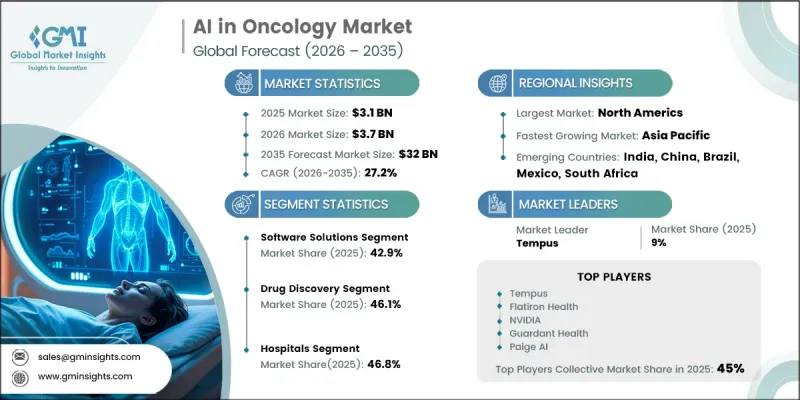
由於全球癌症負擔日益加重、早期檢測需求不斷成長以及精準醫療的加速發展,腫瘤人工智慧市場正在迅速擴張。腫瘤人工智慧是指應用機器學習、數據分析和先進的計算模型來支援癌症的檢測、診斷、治療方案製定和藥物研發過程。人口老化、文明病相關風險以及環境暴露導致癌症病例數量和複雜性不斷增加,給傳統的診斷和治療系統帶來了沉重的負擔。人工智慧技術透過提高診斷準確性、縮短檢測結果返回時間以及加強臨床決策,正在幫助應對這些挑戰。對早期癌症篩檢的日益重視也是市場擴張的主要推動因素,因為早期療育能夠直接提高存活率、降低治療成本並改善病患管理。此外,對數位醫療基礎設施的投入不斷增加以及醫療機構對數據驅動型腫瘤解決方案的日益普及,也進一步加速了全球市場的成長。
| 市場範圍 | |
|---|---|
| 開始年份 | 2025 |
| 預測期 | 2026-2035 |
| 初始市場規模 | 31億美元 |
| 預測金額 | 320億美元 |
| 複合年成長率 | 27.2% |
預計到2025年,軟體解決方案市佔率將達到42.9%。由於腫瘤工作流程中對先進分析平台和臨床決策支援系統的依賴性日益增強,該領域將繼續保持主導地位。這些軟體解決方案能夠有效處理大量的臨床記錄、影像資料集和基因組訊息,從而支持精準診斷、最佳化治療和預後預測。擴充性和互通性,以及與現有醫療IT生態系統的整合,正促使其在醫院、研究機構和診斷檢查室中廣泛應用。朝向個人化醫療和實證治療方案的轉變,進一步推動了對腫瘤領域人工智慧軟體解決方案的需求。
預計到2025年,藥物研發領域將佔全球市場佔有率的46.1%。該領域的成長主要受加速癌症治療藥物研發和縮短治療方法創新週期的迫切需求所驅動。人工智慧技術正被廣泛用於簡化化合物篩檢、識別治療標靶並更準確地預測藥物反應。這些功能顯著降低了傳統藥物研發流程所需的時間和成本,同時提高了腫瘤學研究的臨床成功率。
預計到2025年,美國人工智慧腫瘤市場規模將達12億美元。該國市場成長的主要驅動力是癌症發病率的上升以及對先進診斷和篩檢解決方案日益成長的需求。人工智慧驅動的影像工具和預測分析技術正在醫療保健系統中加速普及,以提高早期檢測和治療的準確性。強大的數位醫療基礎設施、高技術普及率和成熟的臨床研究能力進一步推動了人工智慧技術在腫瘤診療路徑中的應用。
目錄
第1章:調查方法
第2章執行摘要
第3章 行業洞察
- 產業生態系分析
- 影響產業的因素
- 促進因素
- 對癌症早期檢測和分類的需求日益成長
- 癌症發生率上升
- 精準醫療的廣泛應用
- 醫療基礎設施快速發展
- 產業潛在風險與挑戰
- 高昂的採購和實施成本
- 法規的重大影響
- 市場機遇
- 業務拓展至罕見癌症及兒童腫瘤領域
- 促進因素
- 成長潛力分析
- 監理情勢
- 技術展望
- 最新科技趨勢
- 人工智慧驅動的醫學影像診斷
- 基因組學和精準腫瘤學分析
- 新興技術
- 多模態人工智慧(整合資料平台)
- 真實世界數據與預測腫瘤學
- 最新科技趨勢
- 未來市場趨勢
- 人工智慧和生成式人工智慧對市場的影響
- 價格趨勢分析
- 波特的分析
- PESTLE分析
第4章 競爭情勢
- 介紹
- 企業市佔率分析
- 世界
- 北美洲
- 歐洲
- 亞太地區
- 企業矩陣分析
- 主要市場公司的競爭分析
- 競爭定位矩陣
- 主要進展
- 併購
- 夥伴關係和聯盟
- 新產品發布
- 業務拓展計劃
第5章 市場估計與預測:依組件分類,2022-2035年
- 軟體解決方案
- 硬體
- 服務
第6章 市場估計與預測:依癌症類型分類,2022-2035年
- 乳癌
- 肺癌
- 攝護腺癌
- 結腸癌
- 腦腫瘤
- 其他癌症
第7章 市場估計與預測:依應用領域分類,2022-2035年
- 癌症檢測與診斷
- 治療計劃和最佳化
- 藥物發現
- 藥物研發和臨床試驗
第8章 市場估算與預測:依最終用途分類,2022-2035年
- 醫院
- 診斷中心
- 專科診所
- 其他最終用戶
第9章 市場估計與預測:依地區分類,2022-2035年
- 北美洲
- 美國
- 加拿大
- 歐洲
- 德國
- 英國
- 法國
- 西班牙
- 義大利
- 荷蘭
- 亞太地區
- 中國
- 日本
- 印度
- 澳洲
- 韓國
- 拉丁美洲
- 巴西
- 墨西哥
- 阿根廷
- 中東和非洲
- 南非
- 沙烏地阿拉伯
- UAE
第10章:公司簡介
- Aidoc
- Freenome
- Flatiron Health
- GE HealthCare
- Guardant Health
- Ibex Medical Analytics
- Lunit
- Merative
- NVIDIA
- Paige AI
- PathAI
- Qure.ai
- Siemens Healthineers
- SOPHiA GENETICS
- Tempus
The Global AI In Oncology Market was valued at USD 3.1 billion in 2025 and is estimated to grow at a CAGR of 27.2% to reach USD 32 billion by 2035.
The market is experiencing rapid expansion due to the rising global burden of cancer, increasing demand for early-stage detection, and the accelerating shift toward precision medicine approaches. Artificial intelligence in oncology refers to the application of machine learning, data analytics, and advanced computational models to support cancer detection, diagnosis, treatment planning, and drug development processes. The growing complexity and volume of oncology cases, driven by aging populations, lifestyle-related risks, and environmental exposures, is placing significant pressure on traditional diagnostic and treatment systems. AI-enabled technologies help address these challenges by improving diagnostic accuracy, reducing turnaround times, and enhancing clinical decision-making. Increasing emphasis on early cancer detection is also contributing strongly to market expansion, as early intervention is directly linked to improved survival outcomes, lower treatment costs, and better patient management. In addition, expanding investments in digital healthcare infrastructure and rising adoption of data-driven oncology solutions across healthcare institutions are further accelerating market growth globally.
| Market Scope | |
|---|---|
| Start Year | 2025 |
| Forecast Year | 2026-2035 |
| Start Value | $3.1 Billion |
| Forecast Value | $32 Billion |
| CAGR | 27.2% |
The software solutions segment accounted for 42.9% share in 2025. This segment continues to dominate due to the increasing dependence on advanced analytics platforms and clinical decision-support systems in oncology workflows. These software solutions enable efficient processing of large volumes of clinical records, imaging datasets, and genomic information, supporting accurate diagnosis, treatment optimization, and outcome prediction. Their ability to integrate with existing healthcare IT ecosystems while offering scalability and interoperability is driving widespread adoption across hospitals, research organizations, and diagnostic laboratories. The increasing shift toward personalized medicine and evidence-based treatment planning is further reinforcing demand for AI-driven oncology software solutions.
The drug discovery segment held a 46.1% share in 2025. Growth in this segment is primarily driven by the rising need to accelerate cancer drug development and improve therapeutic innovation timelines. AI technologies are being widely utilized to streamline compound screening, identify therapeutic targets, and predict drug responses with higher precision. These capabilities significantly reduce the time and cost associated with traditional drug development processes while improving the probability of clinical success in oncology research.
U.S. AI in Oncology Market was valued at USD 1.2 billion in 2025. Market growth in the country is supported by the rising incidence of cancer and the increasing demand for advanced diagnostic and screening solutions. The adoption of AI-powered imaging tools and predictive analytics is accelerating across healthcare systems to improve early detection and treatment accuracy. Strong digital healthcare infrastructure, high technology penetration, and established clinical research capabilities are further supporting the integration of AI technologies into oncology care pathways.
Key companies operating in the AI in Oncology Market include Aidoc, Freenome, Flatiron Health, GE HealthCare, Guardant Health, Ibex Medical Analytics, Lunit, Merative, NVIDIA, Paige AI, PathAI, Qure.ai, Siemens Healthineers, SOPHiA GENETICS, and Tempus. Companies operating in the AI in oncology market are adopting a range of strategic initiatives to strengthen their market position and expand clinical adoption. Leading players are heavily investing in advanced machine learning models, multimodal data integration, and next-generation diagnostic algorithms to improve cancer detection accuracy and treatment personalization. Strategic collaborations with hospitals, research institutions, and pharmaceutical companies are enabling broader clinical validation and faster commercialization of AI-based oncology solutions. Organizations are also focusing on expanding cloud-based platforms and interoperable software systems to ensure seamless integration into existing healthcare infrastructures. In addition, companies are strengthening their presence through regulatory approvals, clinical trials, and real-world evidence generation to enhance trust and adoption among healthcare providers.
Table of Contents
Chapter 1 Research Methodology
- 1.1 Research approach
- 1.2 Quality commitments
- 1.2.1 GMI AI policy and data integrity commitment
- 1.2.1.1 Source consistency protocol
- 1.2.1 GMI AI policy and data integrity commitment
- 1.3 Research trail and confidence scoring
- 1.3.1 Research trail components
- 1.3.2 Scoring components
- 1.4 Data collection
- 1.4.1 Partial list of primary sources
- 1.5 Data mining sources
- 1.5.1 Paid sources
- 1.5.1.1 Sources, by region
- 1.5.1 Paid sources
- 1.6 Base estimates and calculations
- 1.6.1 Base year calculation for any one approach
- 1.7 Forecast model
- 1.7.1 Quantified market impact analysis
- 1.7.1.1 Mathematical impact of growth parameters on forecast
- 1.7.1 Quantified market impact analysis
- 1.8 Research transparency addendum
- 1.8.1 Source attribution framework
- 1.8.2 Quality assurance metrics
- 1.8.3 Our commitment to trust
Chapter 2 Executive Summary
- 2.1 Industry 3600 synopsis
- 2.2 Key market trends
- 2.2.1 Component trends
- 2.2.2 Cancer type trends
- 2.2.3 Application trends
- 2.2.4 End use trends
- 2.2.5 Regional trends
- 2.3 CXO perspectives: Strategic imperatives
Chapter 3 Industry Insights
- 3.1 Industry ecosystem analysis
- 3.2 Industry impact forces
- 3.2.1 Growth drivers
- 3.2.1.1 Rising demand for early detection and classification of cancer
- 3.2.1.2 Increasing prevalence of cancer
- 3.2.1.3 Growing adoption of precision medicine
- 3.2.1.4 Surging advancements in healthcare infrastructure
- 3.2.2 Industry pitfalls and challenges
- 3.2.2.1 High procurement and implementation cost
- 3.2.2.2 High impact of regulations
- 3.2.3 Market opportunities
- 3.2.3.1 Expansion into rare cancers and pediatric oncology
- 3.2.1 Growth drivers
- 3.3 Growth potential analysis
- 3.4 Regulatory landscape (Driven by primary research)
- 3.4.1 North America
- 3.4.2 Europe
- 3.4.3 Asia Pacific
- 3.4.4 Latin America
- 3.4.5 Middle East and Africa
- 3.5 Technology landscape (Driven by primary research)
- 3.5.1 Current technological trends
- 3.5.1.1 AI-powered medical imaging & diagnostics
- 3.5.1.2 Genomics & precision oncology analytics
- 3.5.2 Emerging technologies
- 3.5.2.1 Multimodal ai (integrated data platforms)
- 3.5.2.2 Real-world evidence & predictive oncology
- 3.5.1 Current technological trends
- 3.6 Future market trends (Driven by primary research)
- 3.7 Impact of AI and Generative AI on the market (Driven by primary research)
- 3.8 Pricing trend analysis (Driven by primary research)
- 3.9 Porter’s analysis
- 3.10 PESTEL analysis
Chapter 4 Competitive Landscape, 2025
- 4.1 Introduction
- 4.2 Company market share analysis
- 4.2.1 Global
- 4.2.2 North America
- 4.2.3 Europe
- 4.2.4 Asia Pacific
- 4.3 Company matrix analysis
- 4.4 Competitive analysis of major market players
- 4.5 Competitive positioning matrix
- 4.6 Key developments
- 4.6.1 Mergers and acquisitions
- 4.6.2 Partnerships and collaborations
- 4.6.3 New product launches
- 4.6.4 Expansion plans
Chapter 5 Market Estimates and Forecast, By Component, 2022 - 2035 ($ Mn)
- 5.1 Key trends
- 5.2 Software solutions
- 5.3 Hardware
- 5.4 Services
Chapter 6 Market Estimates and Forecast, By Cancer Type, 2022 - 2035 ($ Mn)
- 6.1 Key trends
- 6.2 Breast cancer
- 6.3 Lung cancer
- 6.4 Prostate cancer
- 6.5 Colorectal cancer
- 6.6 Brain tumor
- 6.7 Other cancer types
Chapter 7 Market Estimates and Forecast, By Application, 2022 - 2035 ($ Mn)
- 7.1 Key trends
- 7.2 Cancer detection and diagnosis
- 7.3 Treatment planning and optimization
- 7.4 Drug discovery
- 7.5 Drug development and clinical trials
Chapter 8 Market Estimates and Forecast, By End Use, 2022 - 2035 ($ Mn)
- 8.1 Key trends
- 8.2 Hospitals
- 8.3 Diagnostics centers
- 8.4 Specialty clinics
- 8.5 Other end users
Chapter 9 Market Estimates and Forecast, By Region, 2022 - 2035 ($ Mn)
- 9.1 Key trends
- 9.2 North America
- 9.2.1 U.S.
- 9.2.2 Canada
- 9.3 Europe
- 9.3.1 Germany
- 9.3.2 UK
- 9.3.3 France
- 9.3.4 Spain
- 9.3.5 Italy
- 9.3.6 Netherlands
- 9.4 Asia Pacific
- 9.4.1 China
- 9.4.2 Japan
- 9.4.3 India
- 9.4.4 Australia
- 9.4.5 South Korea
- 9.5 Latin America
- 9.5.1 Brazil
- 9.5.2 Mexico
- 9.5.3 Argentina
- 9.6 Middle East and Africa
- 9.6.1 South Africa
- 9.6.2 Saudi Arabia
- 9.6.3 UAE
Chapter 10 Company Profiles
- 10.1 Aidoc
- 10.2 Freenome
- 10.3 Flatiron Health
- 10.4 GE HealthCare
- 10.5 Guardant Health
- 10.6 Ibex Medical Analytics
- 10.7 Lunit
- 10.8 Merative
- 10.9 NVIDIA
- 10.10 Paige AI
- 10.11 PathAI
- 10.12 Qure.ai
- 10.13 Siemens Healthineers
- 10.14 SOPHiA GENETICS
- 10.15 Tempus

 腫瘤學人工智慧市場:按組件、癌症類型、治療類型、最終用戶和地區分類
 腫瘤人工智慧市場:依組件、癌症類型和應用劃分-全球預測至2036年
 全球腫瘤人工智慧市場:預測至 2032 年—按組件、癌症類型、技術、應用、最終用戶和地區分類的分析
 腫瘤學人工智慧市場(按產品類型、技術、癌症類型、應用、最終用戶和部署模式)—全球預測,2025-2030 年
 腫瘤學人工智慧市場-全球產業規模、佔有率、趨勢、機會和預測,按成分、癌症類型、治療類型、地區和競爭細分,2020-2030 年
 癌症領域人工智慧的全球市場(~2030年):公司類型(整合套件)、應用(藥物發現、新藥設計、診斷、精準醫療、基因組學)、技術(CNN、NLP)、癌症類型(肺癌)、最終按使用者(醫院/製藥公司)/地區