

 |
市場調查報告書
商品編碼
2061384
防曬油產品市場機會、成長要素、產業趨勢分析及2026-2035年預測。Suncare Products Market Opportunity, Growth Drivers, Industry Trend Analysis, and Forecast 2026 - 2035 |
||||||

2025年全球防曬油市場價值為166億美元,預計到2035年將以6.1%的複合年成長率成長至298億美元。
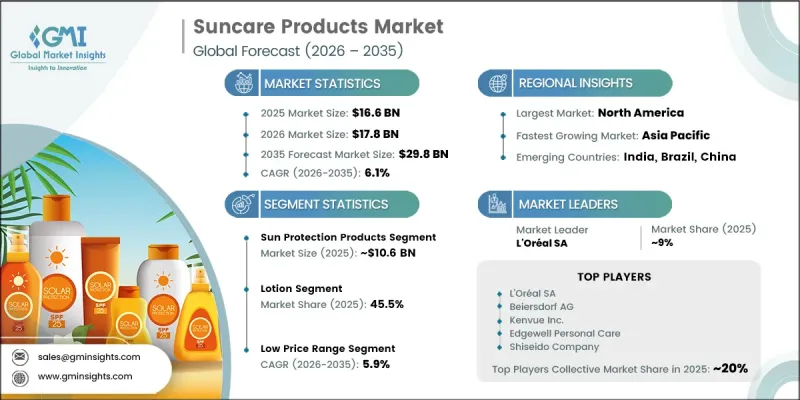
隨著全球消費者對紫外線輻射及其長期皮膚損傷的危害意識不斷增強,防曬產品市場正經歷穩定成長。防曬油產品不再只是用於季節性旅行或戶外活動,而是逐漸成為日常護膚的必備品。消費者對皮膚老化、色素沉著和其他日曬相關皮膚問題的日益關注,促使他們將防曬油納入日常個人護理程序。此外,人們對護膚和健康潮流的日益關注,也對各個年齡層的市場需求產生了積極影響。戶外休閒的增加和旅遊頻率的提高,也推動了先進防曬油配方的普及。消費者越來越需要兼具護膚功效和有效防曬性能的產品,這推動了輕盈、保濕和多功能配方的研發。此外,積極的生活方式和戶外健身活動的日益流行,也加速了對高性能產品的需求,這些產品旨在提供持久防護、防水性能以及在各種環境條件下的廣譜紫外線防護。
| 市場範圍 | |
|---|---|
| 開始年份 | 2025 |
| 預測期 | 2026-2035 |
| 上市時的市場規模 | 166億美元 |
| 預測金額 | 298億美元 |
| 複合年成長率 | 6.1% |
預計到2025年,防曬油產品市場規模將達到106億美元,並在2026年至2035年間以6.3%的複合年成長率成長。隨著全球消費者對長期日曬危害的認知不斷提高,該細分市場繼續保持其在防曬油產品市場的主導地位。消費者對預防性護膚和日常紫外線防護的日益重視,推動了防曬油及相關防護產品全年強勁的需求。此外,持續不斷的宣傳活動和護膚專家的建議,進一步強化了消費者將防曬油產品納入日常護膚程序的趨勢。
預計到2025年,乳液型防曬產品將佔據45.5%的市場佔有率,成為防曬油產業的主導產品類型。乳液型產品因其使用方便、塗抹順滑、易於大面積均勻塗抹而備受青睞。其保濕效果和舒適的膚感也深受消費者喜愛,使其適合長時間戶外活動和日常使用。乳液的多功能性和便利性持續支撐著個人和家庭消費者對乳液型防曬產品的強勁市場需求。
美國防曬油市場預計到2025年將達到47億美元,並在2026年至2035年間以5.7%的複合年成長率成長。美國仍然是全球最具影響力的市場之一,這主要得益於消費者對防曬益處的認知不斷提高,以及對具有防曬指數(SPF)的多功能護膚產品需求的日益成長。美國消費者越來越重視質地輕盈、不油膩且具有廣譜紫外線防護功能的產品,這些產品適合日常護膚。持續的產品創新、皮膚科醫生的強大影響力以及眾多知名護膚品牌的存在,進一步鞏固了美國在區域市場的主導地位。
目錄
第1章:調查方法和範圍
第2章執行摘要
第3章 行業洞察
- 產業生態系分析
- 供應商情況
- 原物料供應商
- UV防曬製造商
- 潤膚劑和保濕劑供應商
- 包裝材料供應商(管材、瓶子、幫浦)
- 香料和添加劑供應商
- 品牌所有者和產品開發商
- 配送/物流層
- 零售和終端通路合作夥伴
- 每個階段增加的價值
- 利潤率
- 影響價值鏈的因素
- 影響產業的因素
- 促進因素
- 人們對皮膚癌和紫外線防護的認知不斷提高
- 戶外休閒活動和旅遊業的成長
- 對多功能美容產品的需求日益成長
- 產業潛在風險與挑戰
- 新原料的核准流程非常嚴格。
- 關於化學UV防曬的環境問題
- 機會
- 礦物和混合配方方面的創新
- 開發藍光阻隔及污染防治產品
- 對永續且對珊瑚礁友好的防曬油。
- 促進因素
- 成長潛力分析
- 未來市場趨勢
- 技術與創新展望
- UV防曬技術的演變
- 藥物製劑技術的顯著進步
- 交付系統的創新
- 多功能產品的開發
- 永續發展和清潔美容領域的創新
- 對珊瑚礁友善的配方
- 可生物分解的UV防曬
- 包裝設計充分考慮了海洋環境。
- 無水配方及高濃度型
- 純素且不經動物實驗認證
- 數位智慧防曬油技術
- 配備紫外線感測器的穿戴式裝置和皮膚貼片
- 基於人工智慧驅動的皮膚分析應用程式的防曬係數推薦
- 新興技術的前沿
- 口服防曬油(口服光防護)
- 紅外線 (IR) 輻射防護
- DNA修復酶(由解離酶整合)
- 仿生黑色素技術
- 價格趨勢
- 依產品
- 對過去價格趨勢的分析
- 按業務類型分類的定價策略(溢價/價值/成本加成)
- 區域價格波動分析
- 監理情勢
- 全球監管分類系統
- 非成藥)分類(美國、加拿大、澳洲)
- 化妝品分類(歐盟、亞洲大部分地區)
- 準藥品分類(日本、韓國)
- 北美洲
- 美國
- 美國消費品安全委員會(CPSC)《聯邦法規彙編》(CFR)第16篇第1512節
- FDA非處方藥專論系統(21 CFR 352)
- GRASE 認證(通常被認為是安全有效的)
- 新成分核准流程(《桑迪亞法案》的影響)
- SPF 測試要求(FDA 最終規則 2011/2019)
- 關於標籤和功效聲明(頻譜、防水)的規定
- 州級禁令
- 加拿大
- 國際標準化組織(ISO)4210
- NPN(天然產物編號)的要求
- 上市前核准流程
- SPF 和 UVA 測試標準
- 美國
- 歐洲
- 歐盟化妝品法規(EC)第1223/2009號
- 附件六(授權紫外線吸收劑清單)
- 產品資訊文件 (PIF) 要求
- 德國:德國標準化協會 (DIN)、歐洲標準 (EN)、ISO 4210
- 英國
- 歐洲標準 (EN) ISO 4210 /英國合格評定 (UKCA)
- UKCA標誌和CE標誌之間的過渡
- 英國責任要求
- 與歐盟法規的差異
- 法國:歐洲標準 (EN) ISO 4210
- 亞太地區
- 中國
- 國家標準(GB)3565
- 進口和國產產品的註冊流程
- NMPA註冊所需時間(18-24個月)
- 動物試驗的要求和豁免
- 衛生許可證要求
- 新成分核准流程(IECIC清單)
- 印度:印度標準 (IS) 10613
- 日本
- 日本工業標準(JIS)D 9110
- 防曬油被歸類為準藥品。
- 化妝品及準藥品核准標準
- PA等級系統(UVA防護等級)
- 製造和進口許可
- 韓國
- 功能性化妝品的認定
- 上市前通知及上市後通知
- SPF 和 PA 測試要求
- 韓國美妝出口認證
- 澳洲
- 2022年治療產品(防曬油)條例
- 在澳洲治療產品註冊局 (ARTG) 註冊
- SPF 和頻譜測試(AS/NZS 2604)
- 初級和次級防曬油的分類
- 癌症控制委員會的標籤批准義務
- 中國
- 拉丁美洲
- 巴西
- 巴西技術標準協會 (ABNT)、巴西標準 (NBR)、ISO 4210
- RDC 69/2016(防曬油產品技術法規)
- 上市前通知(表格 1)與註冊
- 墨西哥
- 國際標準化組織(ISO)4210
- 衛生登記要求
- 聯邦衛生風險防護委員會(COFEPRIS)上市前審核時間表
- 顯示要求(西班牙語)
- 阿根廷(ANMAT法規)
- 巴西
- 中東和非洲
- UAE
- 化妝品註冊證書
- 與海灣合作理事會標準化組織(GSO)保持一致
- 特定成分的清真認證
- 南非:南非國家標準 (SANS) 311
- 沙烏地阿拉伯:沙烏地阿拉伯標準、計量和品質組織 (SASO)、海灣標準化組織 (GSO)、ISO 4210
- UAE
- 全球監管分類系統
- 供應鏈分析
- 原物料採購狀況
- 製造地
- 物流及配送網路
- 供應鏈韌性與風險因素
- 供應鏈永續性舉措
- 貿易統計
- 主要進口國
- 主要出口國
- 進出口量及進口額趨勢
- 主要貿易路線及關稅的影響
- 人工智慧和生成式人工智慧對市場的影響
- 利用人工智慧改造現有經營模式
- 按細分市場分類的生成式人工智慧用例和部署藍圖
- 行銷內容創作(產品說明、社群媒體)
- 客戶服務聊天機器人和虛擬助手
- 加速研發(分子發現、製劑測試)
- 供應鏈最佳化
- 風險、限制和監管考量
- 目前分銷基礎設施和通路滲透情況
- 按地區與業態(現代零售與傳統零售)分類的通路覆蓋率
- 缺乏最後一公里基礎設施和不斷變化的管道
- 波特的分析
- PESTLE分析
- 消費者購買行為分析
- 購買決策流程
- 人口趨勢
- 影響購買決策的因素
- 消費者產品採納
- 首選分銷管道
- 品牌偏好
第4章 競爭情勢
- 介紹
- 企業市佔率分析
- 按地區
- 企業矩陣分析
- 主要市場公司的競爭分析
- 競爭定位矩陣
- 主要進展
- 併購
- 夥伴關係和聯盟
- 新產品發布
- 業務拓展計劃
第5章 市場估算與預測:依產品類型分類,2022-2035年
- 防曬油產品
- 日常防曬油(SPF 15-30)
- 高倍防曬油(SPF 50+)
- 含防曬係數的潤飾防曬油和BB/CC霜
- 曬後保養用品
- 清涼凝膠乳液
- 修復和保濕護理
- 抗老曬後護理
- 自曬黑產品
- 逐漸變色的曬黑產品
- 速效古銅粉
- 曬傷慕斯/噴霧
- 其他
第6章 市場估算與預測:依產品類型分類,2022-2035年
- 化學防曬油
- 礦物防曬油
- 混合配方
第7章 市場估計與預測:依形式分類,2022-2035年
- 洗劑
- 噴
- 凝膠
- 戳
- 其他
第8章 市場估計與預測:依價格分類,2022-2035年
- 低的
- 中等的
- 高的
第9章 市場估計與預測:依消費群組分類,2022-2035年
- 男性
- 女士
- 孩子們
第10章 市場估價與預測:依應用領域分類,2022-2035年
- 身體
- 臉
- 嘴唇
第11章 市場估價與預測:依通路分類,2022-2035年
- 線上
- 電子商務網站
- 公司網站
- 離線
- 大賣場和超級市場
- 專賣店
- 藥局/藥局
- 其他
第12章 市場估計與預測:依地區分類,2022-2035年
- 北美洲
- 美國
- 加拿大
- 歐洲
- 德國
- 英國
- 法國
- 義大利
- 西班牙
- 亞太地區
- 中國
- 印度
- 日本
- 韓國
- 澳洲
- 拉丁美洲
- 巴西
- 墨西哥
- 阿根廷
- 中東和非洲
- 沙烏地阿拉伯
- UAE
- 南非
第13章:公司簡介
- 世界公司
- L'Oreal
- Beiersdorf AG
- Johnson & Johnson Consumer Health
- P&G
- Shiseido Company
- Unilever
- Kao Corporation
- Edgewell Personal Care
- 雅詩蘭黛公司
- Amorepacific Corporation
- Coty Inc.
- 當地公司
- Pierre Fabre Group
- ISDIN
- Rohto Pharmaceutical
- Lotus Herbals
- Cancer Council
- Grupo Boticario
- Genomma Lab Internacional
- 新興企業
- Supergoop!
- Sun Bum
- Bondi Sands
- Coola LLC
The Global Suncare Products Market was valued at USD 16.6 billion in 2025 and is estimated to grow at a CAGR of 6.1% to reach USD 29.8 billion by 2035.
The market is experiencing steady growth as consumer awareness regarding the harmful effects of ultraviolet radiation and long-term skin damage continues to increase worldwide. Suncare products are increasingly becoming a daily skincare essential rather than a product used only during seasonal travel or outdoor activities. Growing concerns related to skin aging, pigmentation, and other sun-related skin conditions are encouraging consumers to incorporate sun protection products into their regular personal care routines. In addition, expanding interest in skincare and wellness trends is positively influencing market demand across multiple age groups. Rising participation in outdoor leisure activities and increased travel frequency are also supporting the adoption of advanced sun protection formulations. Consumers are increasingly seeking products that combine skincare benefits with effective UV protection, driving innovation in lightweight, hydrating, and multifunctional formulations. Furthermore, the growing popularity of active lifestyles and outdoor fitness activities is accelerating demand for high-performance products designed to offer long-lasting coverage, water resistance, and broad-spectrum protection across diverse environmental conditions.
| Market Scope | |
|---|---|
| Start Year | 2025 |
| Forecast Year | 2026-2035 |
| Start Value | $16.6 Billion |
| Forecast Value | $29.8 Billion |
| CAGR | 6.1% |
The sun protection products segment generated USD 10.6 billion in 2025 and is anticipated to grow at a CAGR of 6.3% between 2026 and 2035. This segment continues to maintain a dominant position within the suncare products market as awareness regarding the long-term effects of sun exposure continues to rise among consumers globally. Increasing emphasis on preventive skincare and daily UV protection is contributing to strong year-round demand for sunscreen and related protective products. In addition, ongoing educational initiatives and recommendations from skincare professionals are further strengthening consumer preference for sun protection solutions as part of regular skincare routines.
The lotion segment held 45.5% share in 2025, emerging as the leading product format within the suncare products industry. Lotion-based formulations remain highly preferred due to their ease of use, smooth application, and ability to provide even coverage across larger areas of the body. Consumers also favor lotions because of their moisturizing properties and comfortable skin feel, making them suitable for extended outdoor exposure and everyday use. Their versatility and convenience continue to support strong market demand across both individual and family-oriented consumer categories.
U.S. Suncare Products Market reached USD 4.7 billion in 2025, and is expected to grow at a CAGR of 5.7% from 2026 to 2035. The country continues to represent one of the most influential markets globally due to strong consumer understanding of sun protection benefits and rising demand for multifunctional skincare solutions containing SPF protection. Consumers in the U.S. are increasingly prioritizing lightweight textures, non-greasy formulations, and broad-spectrum coverage suitable for daily skincare use. Continuous product innovation, strong dermatologist influence, and the presence of established skincare brands are further supporting the country's leadership position within the regional market.
Major companies operating in the Suncare Products Market include L'Oreal, Beiersdorf AG, Johnson & Johnson Consumer Health, P&G, Shiseido Company, Unilever, Kao Corporation, Edgewell Personal Care, Estee Lauder Companies, Amorepacific Corporation, and Coty Inc., among global participants. Regional companies active in the industry include Pierre Fabre Group, ISDIN, Rohto Pharmaceutical, Lotus Herbals, Cancer Council, Grupo Boticario, and Genomma Lab Internacional. Emerging companies shaping the competitive landscape include Supergoop!, Sun Bum, Bondi Sands, and Coola LLC. Companies operating in the suncare products industry are implementing various strategic initiatives to strengthen their market position and expand consumer reach. Leading manufacturers are focusing on product innovation by introducing advanced formulations with multifunctional benefits, including hydration, anti-aging properties, and lightweight textures suitable for everyday use. Many companies are also investing in research and development to create mineral-based, reef-safe, and skin-sensitive formulations aligned with evolving consumer preferences. Strategic partnerships with skincare specialists, retailers, and digital platforms are helping brands improve visibility and market penetration. In addition, businesses are expanding their online sales channels and strengthening direct-to-consumer strategies to enhance customer engagement.
Table of Contents
Chapter 1 Methodology & Scope
- 1.1 Market scope & definitions
- 1.2 Research design
- 1.2.1 Research approach
- 1.2.2 Data collection methods
- 1.3 Base estimates and calculations
- 1.3.1 Base year calculation
- 1.3.2 Market estimates & forecasts parameters
- 1.4 Forecast Model
- 1.4.1 Key trends for market estimates
- 1.4.2 Quantified market impact analysis
- 1.4.2.1 Mathematical impact of growth parameters on forecast
- 1.4.3 Scenario analysis framework
- 1.5 Primary research and validation
- 1.5.1 Some of the primary sources (but not limited to)
- 1.6 Data mining sources
- 1.6.1 Paid Sources
- 1.7 Primary research and validation
- 1.7.1 Primary sources
- 1.8 Research Trail & confidence scoring
- 1.8.1 Research trail components
- 1.8.2 Scoring components
- 1.9 Research transparency addendum
- 1.9.1 Source attribution framework
- 1.9.2 Quality assurance metrics
- 1.9.3 Our commitment to trust
- 1.10 Market Definitions
Chapter 2 Executive Summary
- 2.1 Industry 360° synopsis
- 2.2 Key market trends
- 2.2.1 Region
- 2.2.2 Product type
- 2.2.3 Product formulation
- 2.2.4 Form
- 2.2.5 Price
- 2.2.6 Consumer group
- 2.2.7 Application
- 2.2.8 Distribution channel
Chapter 3 Industry Insights
- 3.1 Industry ecosystem analysis
- 3.1.1 Supplier landscape
- 3.1.2 Raw material suppliers
- 3.1.2.1 UV filter manufacturers
- 3.1.2.2 Emollient & moisturizer suppliers
- 3.1.2.3 Packaging material providers (tubes, bottles, pumps)
- 3.1.2.4 Fragrance & additive suppliers
- 3.1.3 Brand owners & product developers
- 3.1.4 Distribution & logistics layer
- 3.1.5 Retail & End-Channel partners
- 3.1.6 Value addition at each stage
- 3.1.7 Profit margin
- 3.1.8 Factor affecting the value chain
- 3.2 Industry impact forces
- 3.2.1 Growth drivers
- 3.2.1.1 Rising awareness of skin cancer & UV protection
- 3.2.1.2 Increasing outdoor recreational activities & tourism
- 3.2.1.3 Growing demand for multi-functional beauty products
- 3.2.2 Industry pitfalls & challenges
- 3.2.2.1 Stringent regulatory approval processes for new ingredients
- 3.2.2.2 Environmental concerns over chemical UV filters
- 3.2.3 Opportunities
- 3.2.3.1 Innovation in mineral & hybrid formulations
- 3.2.3.2 Blue light protection & anti-pollution product development
- 3.2.3.3 Sustainable & reef-safe sunscreen demand
- 3.2.1 Growth drivers
- 3.3 Growth potential analysis
- 3.4 Future market trends
- 3.5 Technology and innovation landscape
- 3.5.1 UV filter technology evolution
- 3.5.2 Formulation technology breakthroughs
- 3.5.3 Delivery system innovations
- 3.5.4 Multi-functional product development
- 3.5.5 Sustainability & clean beauty innovations
- 3.5.5.1 Reef-safe formulations
- 3.5.5.2 Biodegradable UV filters
- 3.5.5.3 Ocean-friendly packaging
- 3.5.5.4 Waterless formulations & concentrated formats
- 3.5.5.5 Vegan & cruelty-free certifications
- 3.5.6 Digital & smart suncare technologies
- 3.5.6.1 UV sensor wearables & skin patches
- 3.5.6.2 AI-powered skin analysis apps for SPF recommendations
- 3.5.7 Emerging technology frontiers
- 3.5.7.1 Ingestible sun protection (oral photoprotection)
- 3.5.7.2 Infrared (IR) radiation protection
- 3.5.7.3 DNA repair enzymes (photolyase integration)
- 3.5.7.4 Biomimetic melanin technology
- 3.6 Price trends
- 3.6.1 By product
- 3.6.2 Historical price trend analysis
- 3.6.3 Price pricing strategy by player type (premium / value / cost-plus)
- 3.6.4 Regional price variation analysis
- 3.7 Regulatory landscape
- 3.7.1 Global Regulatory Classification Systems
- 3.7.1.1 OTC Drug Classification (US, Canada, Australia)
- 3.7.1.2 Cosmetic Classification (EU, Most of Asia)
- 3.7.1.3 Quasi-Drug Classification (Japan, South Korea)
- 3.7.2 North America
- 3.7.2.1 US
- 3.7.2.1.1 Consumer Product Safety Commission (CPSC) 16 Code of Federal Regulations (CFR) part 1512
- 3.7.2.1.2 FDA OTC Monograph System (21 CFR 352)
- 3.7.2.1.3 GRASE (Generally Recognized as Safe & Effective) Status
- 3.7.2.1.4 New Ingredient Approval Pathway (SUNDIA Act Implications)
- 3.7.2.1.5 SPF Testing Requirements (FDA Final Rule 2011/2019)
- 3.7.2.1.6 Labeling & Claims Regulations (Broad Spectrum, Water Resistance)
- 3.7.2.1.7 State-Level Bans
- 3.7.2.2 Canada
- 3.7.2.2.1 International Organization for Standardization (ISO) 4210
- 3.7.2.2.2 NPN (Natural Product Number) Requirements
- 3.7.2.2.3 Pre-Market Authorization Process
- 3.7.2.2.4 SPF & UVA Testing Standards
- 3.7.2.1 US
- 3.7.3 Europe
- 3.7.3.1 EU Cosmetics Regulation (EC) No 1223/2009
- 3.7.3.2 Annex VI (Allowed UV Filters List)
- 3.7.3.3 Product Information File (PIF) Requirements
- 3.7.3.4 Germany: Deutsches Institut fur Normung (DIN) European Norm (EN) ISO 4210
- 3.7.3.5 UK
- 3.7.3.5.1 European Norm (EN) ISO 4210 / United Kingdom Conformity Assessed (UKCA)
- 3.7.3.5.2 UKCA Marking vs CE Marking Transition
- 3.7.3.5.3 UK Responsible Person Requirements
- 3.7.3.5.4 Divergence from EU Regulations
- 3.7.3.6 France: European Norm (EN) ISO 4210
- 3.7.4 Asia Pacific
- 3.7.4.1 China
- 3.7.4.1.1 Guobiao (GB) 3565
- 3.7.4.1.2 Import vs Domestic Product Registration Pathway
- 3.7.4.1.3 NMPA Registration Timeline (18-24 months)
- 3.7.4.1.4 Animal Testing Requirements & Exemptions
- 3.7.4.1.5 Hygienic License Requirements
- 3.7.4.1.6 New Ingredient Approval Process (IECIC List)
- 3.7.4.2 India: Indian Standard (IS) 10613
- 3.7.4.3 Japan
- 3.7.4.3.1 Japanese Industrial Standard (JIS) D 9110
- 3.7.4.3.2 Quasi-Drug Classification for Sunscreens
- 3.7.4.3.3 Approval Standards for Cosmetics/Quasi-Drugs
- 3.7.4.3.4 PA Rating System (Protection Grade of UVA)
- 3.7.4.3.5 Manufacturing & Import Licensing
- 3.7.4.4 South Korea
- 3.7.4.4.1 Functional Cosmetics Designation
- 3.7.4.4.2 Pre-Market vs Post-Market Notification
- 3.7.4.4.3 SPF & PA Testing Requirements
- 3.7.4.4.4 K-Beauty Export Certification
- 3.7.4.5 Australia
- 3.7.4.5.1 Therapeutic Goods (Sunscreens) Order 2022
- 3.7.4.5.2 ARTG (Australian Register of Therapeutic Goods) Listing
- 3.7.4.5.3 SPF & Broad Spectrum Testing (AS/NZS 2604)
- 3.7.4.5.4 Primary vs Secondary Sunscreen Classification
- 3.7.4.5.5 Mandatory Cancer Council Endorsement for Claims
- 3.7.4.1 China
- 3.7.5 Latin America
- 3.7.5.1 Brazil
- 3.7.5.1.1 Associacao Brasileira de Normas Tecnicas (ABNT) Norma Brasileira (NBR) ISO 4210
- 3.7.5.1.2 RDC 69/2016 (Sunscreen Product Technical Regulation)
- 3.7.5.1.3 Pre-Market Notification (Form 1) vs Registration
- 3.7.5.2 Mexico
- 3.7.5.2.1 International Organization for Standardization (ISO) 4210
- 3.7.5.2.2 Sanitary Registration Requirements
- 3.7.5.2.3 COFEPRIS Pre-Market Approval Timeline
- 3.7.5.2.4 Labeling Requirements (Spanish Language)
- 3.7.5.3 Argentina (ANMAT Regulation)
- 3.7.5.1 Brazil
- 3.7.6 Middle East & Africa
- 3.7.6.1 UAE
- 3.7.6.1.1 Cosmetic Product Registration Certificate
- 3.7.6.1.2 GCC Standardization Organization (GSO) Alignment
- 3.7.6.1.3 Halal Certification for Certain Ingredients
- 3.7.6.2 South Africa: South African National Standard (SANS) 311
- 3.7.6.3 Saudi Arabia: Saudi Standards, Metrology and Quality Organization (SASO) Gulf Standardization Organization (GSO) ISO 4210
- 3.7.6.1 UAE
- 3.7.1 Global Regulatory Classification Systems
- 3.8 Supply chain analysis
- 3.8.1 Raw material sourcing landscape
- 3.8.2 Manufacturing footprint
- 3.8.3 Logistics & distribution networks
- 3.8.4 Supply chain resilience & risk factors
- 3.8.5 Supply chain sustainability initiatives
- 3.9 Trade statistics (HS code- 33049990)
- 3.9.1 Major importing countries
- 3.9.2 Major exporting countries
- 3.9.3 Import/export volume & value trends
- 3.9.4 Key trade corridors & tariff impact
- 3.10 Impact of AI & Generative AI on the Market
- 3.10.1 AI-driven disruption of existing business models
- 3.10.2 GenAI use cases & adoption roadmap by segment
- 3.10.2.1 Content generation for marketing (product descriptions, social media)
- 3.10.2.2 Customer service chatbots & virtual assistants
- 3.10.2.3 R&D acceleration (molecule discovery, formulation testing)
- 3.10.2.4 Supply chain optimization
- 3.10.3 Risks, limitations & regulatory considerations
- 3.11 Distribution infrastructure & channel penetration landscape (driven by primary research)
- 3.11.1 Channel coverage by region & format (modern vs. Traditional trade)
- 3.11.2 Last-mile infrastructure gaps & emerging channel shifts
- 3.12 Porter's analysis
- 3.13 PESTEL analysis
- 3.14 Consumer buying behaviour analysis
- 3.14.1 Purchase Decision-Making Process
- 3.14.2 Demographic trends
- 3.14.3 Factors affecting buying decisions
- 3.14.4 Consumer product adoption
- 3.14.5 Preferred distribution channel
- 3.14.6 Brand preference
Chapter 4 Competitive Landscape, 2025
- 4.1 Introduction
- 4.2 Company market share analysis
- 4.2.1 By Region
- 4.2.1.1 North America
- 4.2.1.2 Europe
- 4.2.1.3 Asia Pacific
- 4.2.1.4 Latin America
- 4.2.1.5 Middle East & Africa
- 4.2.1 By Region
- 4.3 Company matrix analysis
- 4.4 Competitive analysis of major market players
- 4.5 Competitive positioning matrix
- 4.6 Key developments
- 4.6.1 Mergers & acquisitions
- 4.6.2 Partnerships & collaborations
- 4.6.3 New product launches
- 4.6.4 Expansion plans
Chapter 5 Market Estimates & Forecast, By Product Type, 2022 - 2035, (USD Billion) (Million Units)
- 5.1 Key trends
- 5.2 Sun protection products
- 5.2.1 Daily wear sunscreen (SPF 15-30)
- 5.2.2 High protection sunscreens (SPF 50+)
- 5.2.3 Tinted sunscreens & bb/cc creams with SPF
- 5.3 After sun products
- 5.3.1 Cooling gels & lotions
- 5.3.2 Repair & hydration treatments
- 5.3.3 Anti-aging after-sun care
- 5.4 Self-tanning products
- 5.4.1 Gradual tanners
- 5.4.2 Instant bronzers
- 5.4.3 Tanning mousses & sprays
- 5.5 Others
Chapter 6 Market Estimates & Forecast, By Product Formulation, 2022 - 2035, (USD Billion) (Million Units)
- 6.1 Key trends
- 6.2 Chemical sunscreens
- 6.3 Mineral sunscreens
- 6.4 Hybrid formulations
Chapter 7 Market Estimates & Forecast, By Form, 2022 - 2035, (USD Billion) (Million Units)
- 7.1 Key trends
- 7.2 Lotion
- 7.3 Spray
- 7.4 Gel
- 7.5 Stick
- 7.6 Others
Chapter 8 Market Estimates & Forecast, By Price, 2022 - 2035, (USD Billion) (Million Units)
- 8.1 Key trends
- 8.2 Low
- 8.3 Medium
- 8.4 High
Chapter 9 Market Estimates & Forecast, By Consumer Group, 2022 - 2035, (USD Billion) (Million Units)
- 9.1 Key trends
- 9.2 Men
- 9.3 Women
- 9.4 Kids
Chapter 10 Market Estimates & Forecast, By Application, 2022 - 2035, (USD Billion) (Million Units)
- 10.1 Key trends
- 10.2 Body
- 10.3 Face
- 10.4 Lip
Chapter 11 Market Estimates & Forecast, By Distribution Channel, 2022 - 2035, (USD Billion) (Million Units)
- 11.1 Key trends
- 11.2 Online
- 11.2.1 E-commerce websites
- 11.2.2 Company-owned websites
- 11.3 Offline
- 11.3.1 Hypermarkets & supermarkets
- 11.3.2 Specialty stores
- 11.3.3 Pharmacies & drugstores
- 11.3.4 Others
Chapter 12 Market Estimates & Forecast, By Region, 2022 - 2035, (USD Billion) (Million Units)
- 12.1 Key trends
- 12.2 North America
- 12.2.1 U.S.
- 12.2.2 Canada
- 12.3 Europe
- 12.3.1 Germany
- 12.3.2 UK
- 12.3.3 France
- 12.3.4 Italy
- 12.3.5 Spain
- 12.4 Asia Pacific
- 12.4.1 China
- 12.4.2 India
- 12.4.3 Japan
- 12.4.4 South Korea
- 12.4.5 Australia
- 12.5 Latin America
- 12.5.1 Brazil
- 12.5.2 Mexico
- 12.5.3 Argentina
- 12.6 MEA
- 12.6.1 Saudi Arabia
- 12.6.2 UAE
- 12.6.3 South Africa
Chapter 13 Company Profiles
- 13.1 Global Players
- 13.1.1 L'Oreal
- 13.1.2 Beiersdorf AG
- 13.1.3 Johnson & Johnson Consumer Health
- 13.1.4 P&G
- 13.1.5 Shiseido Company
- 13.1.6 Unilever
- 13.1.7 Kao Corporation
- 13.1.8 Edgewell Personal Care
- 13.1.9 Estee Lauder Companies
- 13.1.10 Amorepacific Corporation
- 13.1.11 Coty Inc.
- 13.2 Regional players
- 13.2.1 Pierre Fabre Group
- 13.2.2 ISDIN
- 13.2.3 Rohto Pharmaceutical
- 13.2.4 Lotus Herbals
- 13.2.5 Cancer Council
- 13.2.6 Grupo Boticario
- 13.2.7 Genomma Lab Internacional
- 13.3 Emerging Players
- 13.3.1 Supergoop!
- 13.3.2 Sun Bum
- 13.3.3 Bondi Sands
- 13.3.4 Coola LLC

 防曬油產品市場:全球市場預測,2026-2032年
 防曬油市場-全球產業規模、佔有率、趨勢、機會和預測:按形狀、防曬係數範圍、分銷管道、地區和競爭格局分類,2021-2031年
 防曬油產品市場報告:按產品類型、產品形式、性別、銷售管道和地區分類(2026-2034 年)阿伏苯宗市場:按產品形式、應用、最終用戶和分銷管道分類-全球預測,2026-2032年
 2026-2034年全球天然和有機防曬油市場規模、佔有率、趨勢和成長分析報告全球運動防曬油市場規模、佔有率、趨勢和成長分析報告(2026-2034年)全球防曬產品市場規模、佔有率、趨勢和成長分析報告(2026-2034年)全球防曬產品市場規模、佔有率、成長率、按產品類型和應用分類的全球產業分析、區域趨勢以及 2026-2034 年預測。有色防曬油市場-全球產業規模、佔有率、趨勢、機會和預測:按產品類型、紫外線防護指數、分銷管道、地區和競爭格局分類,2021-2031年防曬油產品市場 - 全球產業規模、佔有率、趨勢、機會及預測(按類型、銷售管道、地區及競爭格局分類,2021-2031年)