

 |
市場調查報告書
商品編碼
2061382
洗碗機市場機會、成長要素、產業趨勢分析及2026-2035年預測Dishwasher Market Opportunity, Growth Drivers, Industry Trend Analysis, and Forecast 2026 - 2035 |
||||||

2025 年全球洗碗機市場規模預計為 270 億美元,預計到 2035 年將達到 352 億美元,年複合成長率為 2.6%。
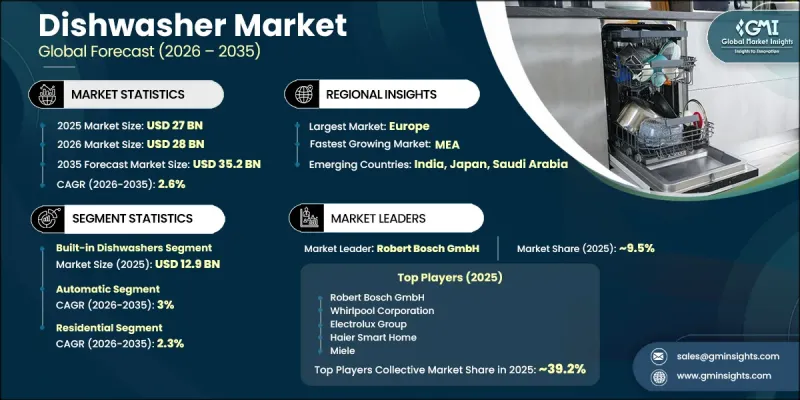
由於住宅和商業環境中自動化廚房電器的普及率不斷提高,洗碗機市場正經歷穩定成長。消費者越來越傾向於選擇能夠最大限度減少人工勞動、提高清潔效率並最佳化用水的洗碗解決方案。洗碗機因其能夠提供一致的衛生保障、便捷的操作和高效的運行,而被廣泛應用於家庭、住宿設施、餐廳和商用廚房。製造商正積極拓展產品線,採用先進的清潔技術、提升能源效率並整合智慧功能,以促進全球市場的普及。與手洗相比,現代洗碗機能夠以更少的水量實現更好的衛生效果,而人們對節水和衛生標準的日益重視也進一步推動了市場需求。鼓勵節能電器的扶持性法規以及對永續生活解決方案日益成長的需求,都促進了洗碗機在已開發市場和新興市場的廣泛應用。此外,現代住宅基礎設施的擴建和模組化廚房的日益普及也推動了市場的長期成長。飯店、餐廳、咖啡簡餐店和商用廚房等商業用戶需求的成長,持續在全球市場擴張中發揮重要作用。
| 市場範圍 | |
|---|---|
| 開始年份 | 2025 |
| 預測期 | 2026-2035 |
| 上市時的市場規模 | 270億美元 |
| 預測金額 | 352億美元 |
| 複合年成長率 | 2.6% |
預計到2025年,嵌入式洗碗機市場規模將達到1,29億美元,並在2026年至2035年間維持4.2%的複合年成長率。推動這一市場成長的主要因素是模組化廚房設計的日益普及以及高階家電在住宅和商業空間中的應用不斷成長。嵌入式洗碗機因其能夠無縫融入廚房佈局、容量大、操作便利且外觀精美而廣受歡迎。持續的城市發展和可支配收入的成長進一步推動了全球對嵌入式洗碗機的強勁需求。
預計到2025年,自動洗碗機市場佔有率將達到85.1%,並在2035年之前保持3%的複合年成長率。消費者對全自動廚房解決方案的偏好日益成長,這些方案能夠減少人工勞動並提高效率,從而支撐了自動洗碗機的主導地位。住宅和商用自動洗碗機均提供多種洗滌設定、感測器控制的洗滌週期、節水功能以及更高的衛生標準。智慧家庭科技和節能家電的日益普及也加速了這一領域的成長。製造商們正在推出先進的全自動系統,這些系統整合了智慧控制、互聯功能和最佳化的能源利用,旨在提升用戶體驗和運作效率。
德國洗碗機市場預計到2025年將達到22億美元,並在2026年至2035年間以1.9%的複合年成長率成長。德國市場擴張的主要驅動力是自動化廚房電器的日益普及以及對節能型嵌入式洗碗機系統需求的成長。消費者越來越重視節水技術、與現代廚房的融合以及永續的電器產品。智慧家庭生態系統需求的成長也進一步推動了市場成長。此外,飯店、餐廳、商用廚房和食品服務基礎設施的商業需求也持續為區域市場成長做出重要貢獻。
目錄
第1章:調查方法和範圍
第2章執行摘要
第3章 行業洞察
- 產業生態系分析
- 供應商情況
- 利潤率
- 每個階段增加的價值
- 影響價值鏈的因素
- 影響產業的因素
- 促進因素
- 自動化廚房設備在住宅和商業領域的廣泛應用。
- 人們日益提高對節水和衛生標準的認知
- 飯店和餐飲服務業基礎設施的擴張
- 潛在風險和挑戰
- 先進洗碗系統安裝維護成本高昂
- 對穩定的水力發電基礎設施的依賴
- 機會
- 對智慧節能廚房電器的需求日益成長
- 模組化廚房和豪華住宅專案的拓展
- 促進因素
- 成長潛力分析
- 未來市場趨勢
- 技術與創新展望
- 最新科技趨勢
- 新興技術
- 監理情勢
- 標準和合規要求
- 區域監理框架
- 認證標準
- 波特的分析
- PESTLE分析
- 價格分析
- 對過去價格趨勢的分析
- 依球員類型分類的定價策略(高級球員、超值球員、成本加成球員)
- 區域價格波動
- 組件成本對最終用戶定價的影響
- 貿易數據分析
- 進出口量及進口額趨勢
- 主要貿易路線及關稅的影響
- 主要出口國及進口國
- 人工智慧和生成式人工智慧對市場的影響
- 利用人工智慧改造現有經營模式
- 按細分市場分類的生成式人工智慧用例和部署藍圖
- 預測性維護和診斷
- 風險、限制和監管考量
- 目前分銷基礎設施和通路滲透情況
- 按地區與業態(現代零售與傳統零售)分類的通路覆蓋率
- 缺乏最後一公里基礎設施和不斷變化的管道
第4章 競爭情勢
- 介紹
- 企業市佔率分析
- 按地區
- 企業矩陣分析
- 主要市場公司的競爭分析
- 競爭定位矩陣
- 主要進展
- 併購
- 夥伴關係和聯盟
- 新產品發布
- 業務拓展計劃
第5章 市場估算與預測:依產品類型分類,2022-2035年
- 內建式洗碗機
- 桌上型洗碗機
- 桌上型洗碗機
- 桌上型洗碗機
第6章 市場估計與預測:依產能分類,2022-2035年
- 可供 6 人食用
- 可供 7-10 人食用
- 可供 10 人以上使用
第7章 市場估計與預測:依營運模式分類,2022-2035年
- 自動的
- 半自動
- 手動的
第8章 市場估算與預測:依價格區間分類,2022-2035年
- 經濟
- 中階
- 優質的
第9章 市場估價與預測:依最終用戶分類,2022-2035年
- 住宅
- 商業
- 飯店和餐廳
- 辦公室和學校食堂
- 其他
第10章 市場估價與預測:依通路分類,2022-2035年
- 離線
- 大賣場和超級市場
- 專賣店
- 多品牌商店
- 其他零售店
- 線上
- 電子商務平台
- 公司網站
第11章 市場估價與預測:按地區分類,2022-2035年
- 北美洲
- 美國
- 加拿大
- 歐洲
- 德國
- 英國
- 法國
- 義大利
- 西班牙
- 亞太地區
- 中國
- 印度
- 日本
- 韓國
- 澳洲
- 拉丁美洲
- 巴西
- 墨西哥
- 阿根廷
- 中東和非洲
- 沙烏地阿拉伯
- UAE
- 南非
第12章:公司簡介
- 世界頂尖公司
- Whirlpool Corporation
- Robert Bosch GmbH(BSH Home Appliances)
- Electrolux AB
- LG Electronics
- Samsung Electronics
- Haier Group
- Miele & Cie. KG
- 該地區的領先企業
- The Smeg Group
- Meiko Maschinenbau GmbH & Co. KG
- Panasonic Corporation
- Beko
- Midea Group
- Hisense(Gorenje Group)
- Bertazzoni SpA
- 新興企業和專業公司
- Godrej Appliances
- IFB Appliances
- Hindware Home Innovation Limited
- Voltas Beko
- Hobart(ITW Food Equipment Group)
- Winterhalter Gastronom GmbH
- Sub-Zero Group(Cove Dishwasher)
The Global Dishwasher Market was valued at USD 27 billion in 2025 and is estimated to grow at a CAGR of 2.6% to reach USD 35.2 billion by 2035.
The market is experiencing steady growth due to the rising penetration of automated kitchen appliances across both residential and commercial environments. Consumers are increasingly shifting toward dishwashing solutions that minimize manual labor, improve cleaning effectiveness, and optimize water usage. Dishwashers are widely used across homes, hospitality establishments, restaurants, and institutional kitchens due to their ability to deliver consistent hygiene, convenience, and operational efficiency. Manufacturers are actively enhancing product offerings with advanced cleaning technologies, improved energy efficiency, and integration of smart features to expand global adoption. Growing awareness regarding water conservation and hygiene standards is further strengthening market demand, as modern dishwashers use significantly less water compared to manual washing methods while ensuring superior sanitation performance. Supportive regulations promoting energy-efficient household appliances, along with rising demand for sustainable living solutions, are contributing to broader adoption across both developed and emerging economies. In addition, the expansion of modern residential infrastructure and the increasing installation of modular kitchens are reinforcing long-term market growth. Rising demand from commercial users such as hotels, restaurants, cafeterias, and institutional kitchens continues to play a key role in driving overall market expansion worldwide.
| Market Scope | |
|---|---|
| Start Year | 2025 |
| Forecast Year | 2026-2035 |
| Start Value | $27 Billion |
| Forecast Value | $35.2 Billion |
| CAGR | 2.6% |
The built-in dishwasher segment accounted for USD 12.9 billion in 2025 and is expected to register a CAGR of 4.2% from 2026 to 2035. This segment leads the market due to the growing popularity of modular kitchen designs and increasing adoption of premium home appliances across residential and commercial spaces. Built-in dishwashers are widely preferred because they offer seamless integration into kitchen layouts, higher load capacity, improved usability, and enhanced aesthetic appeal. Ongoing urban development and rising disposable incomes are further supporting strong demand for built-in systems globally.
The automatic dishwasher segment held a 85.1% share in 2025 and is projected to grow at a CAGR of 3% through 2035. Its leadership is driven by increasing consumer preference for fully automated kitchen solutions that reduce manual effort and enhance efficiency. Automatic models offer multiple wash settings, sensor-driven cleaning cycles, reduced water consumption, and improved hygiene performance across residential and commercial applications. The rising adoption of smart home technologies and energy-efficient appliances continues to accelerate segment growth. Manufacturers are also introducing advanced fully automated systems integrated with intelligent controls, connected features, and optimized energy usage to improve user experience and operational efficiency.
Germany Dishwasher Market reached USD 2.2 billion in 2025 and is expected to grow at a CAGR of 1.9% from 2026 to 2035. Market expansion in the country is supported by strong adoption of automated kitchen appliances and increasing preference for energy-efficient and built-in dishwasher systems. Consumers are increasingly prioritizing water-saving technologies, modern kitchen integration, and sustainable home appliances. Growing demand for smart home ecosystems further supports market growth. In addition, commercial demand from hospitality establishments, restaurants, institutional kitchens, and food service infrastructure continues to contribute significantly to regional market development.
Major players operating in the Global Dishwasher Industry include Whirlpool Corporation, Robert Bosch GmbH (BSH Home Appliances), Electrolux AB, LG Electronics, Samsung Electronics, Haier Group, Miele & Cie. KG, The Smeg Group, Midea Group, Beko, Hisense (Gorenje Group), Panasonic Corporation, Meiko Maschinenbau GmbH & Co. KG, Bertazzoni S.p.A., Godrej Appliances, IFB Appliances, Hindware Home Innovation Limited, Voltas Beko, Hobart (ITW Food Equipment Group), Winterhalter Gastronom GmbH, and Sub-Zero Group (Cove Dishwasher). Companies in the dishwasher market are focusing on strengthening their competitive position through continuous product innovation, particularly by integrating smart technologies, sensor-based cleaning systems, and energy-efficient operations. They are expanding their portfolios with premium and built-in models tailored for modern kitchen designs. Strategic emphasis is also being placed on sustainability, with manufacturers developing low-water and low-energy consumption appliances to align with regulatory standards and consumer expectations. Partnerships with real estate developers and kitchen infrastructure providers are helping expand market reach.
Table of Contents
Chapter 1 Methodology & Scope
- 1.1 Market scope and definition
- 1.2 Research design
- 1.2.1 Research approach
- 1.2.2 Data collection methods
- 1.3 Data mining sources
- 1.3.1 Global
- 1.3.2 Regional/Country
- 1.4 Base estimates and calculations
- 1.4.1 Base year calculation
- 1.4.2 Key trends for market estimation
- 1.5 Primary research and validation
- 1.5.1 Primary sources
- 1.6 Forecast model
- 1.7 Research assumptions and limitations
Chapter 2 Executive Summary
- 2.1 Industry 360° synopsis
- 2.2 Key market trends
- 2.2.1 Regional
- 2.2.2 Product Type
- 2.2.3 Capacity
- 2.2.4 Mode of Operation
- 2.2.5 Price Range
- 2.2.6 End User
- 2.2.7 Distribution Channel
Chapter 3 Industry Insights
- 3.1 Industry ecosystem analysis
- 3.1.1 Supplier landscape
- 3.1.2 Profit margin
- 3.1.3 Value addition at each stage
- 3.1.4 Factor affecting the value chain
- 3.2 Industry impact forces
- 3.2.1 Growth drivers
- 3.2.1.1 Rising adoption of automated kitchen appliances across residential and commercial sectors
- 3.2.1.2 Growing awareness regarding water conservation and hygiene standards
- 3.2.1.3 Expansion of hospitality and foodservice infrastructure
- 3.2.2 Pitfalls & Challenges
- 3.2.2.1 High installation and maintenance costs associated with advanced dishwasher systems
- 3.2.2.2 Dependence on stable water and electricity infrastructure
- 3.2.3 Opportunities
- 3.2.3.1 Rising demand for smart and energy-efficient kitchen appliances
- 3.2.3.2 Expansion of modular kitchen and premium housing projects
- 3.2.1 Growth drivers
- 3.3 Growth potential analysis
- 3.4 Future market trends
- 3.5 Technology and innovation landscape
- 3.5.1 Current technological trends
- 3.5.2 Emerging technologies
- 3.6 Regulatory landscape
- 3.6.1 Standards and compliance requirements
- 3.6.2 Regional regulatory frameworks
- 3.6.3 Certification standards
- 3.7 Porter's analysis
- 3.8 PESTEL analysis
- 3.9 Pricing analysis (driven by primary research)
- 3.9.1 Historical price trend analysis (driven by primary research)
- 3.9.2 Pricing strategy by player type (premium / value / cost-plus) (driven by primary research)
- 3.9.3 Regional price variations (driven by primary research)
- 3.9.4 Impact of component costs on end-user pricing (driven by primary research)
- 3.10 Trade data analysis (HS code of household dishwasher- 8422.11) (driven by paid data base)
- 3.10.1 Import/export volume and value trends (driven by paid data base)
- 3.10.2 Key trade corridors and tariff impact (driven by paid data base)
- 3.10.3 Major importing and exporting countries (driven by paid data base)
- 3.11 Impact of AI and generative AI on the market
- 3.11.1 AI-driven disruption of existing business models
- 3.11.2 GenAI use cases and adoption roadmap by segment
- 3.11.3 Predictive maintenance and diagnostics
- 3.11.4 Risks, limitations and regulatory considerations
- 3.12 Distribution infrastructure and channel penetration landscape (driven by primary research)
- 3.12.1 Channel coverage by region and format (modern vs. traditional trade) (driven by primary research)
- 3.12.2 Last-mile infrastructure gaps and emerging channel shifts (driven by primary research)
Chapter 4 Competitive Landscape, 2025
- 4.1 Introduction
- 4.2 Company market share analysis
- 4.2.1 By Region
- 4.2.1.1 North America
- 4.2.1.2 Europe
- 4.2.1.3 Asia Pacific
- 4.2.1.4 Latin America
- 4.2.1.5 Middle East & Africa
- 4.2.1 By Region
- 4.3 Company matrix analysis
- 4.4 Competitive analysis of major market players
- 4.5 Competitive positioning matrix
- 4.6 Key developments
- 4.6.1 Mergers & acquisitions
- 4.6.2 Partnerships & collaborations
- 4.6.3 New product launches
- 4.6.4 Expansion plans
Chapter 5 Market Estimates & Forecast, By Product Type, 2022 - 2035, (USD Billion) (Thousand Units)
- 5.1 Key trends
- 5.2 Built-in Dishwashers
- 5.3 Freestanding Dishwashers
- 5.4 Countertop Dishwashers
- 5.5 Tabletop Dishwashers
Chapter 6 Market Estimates & Forecast, By Capacity, 2022 - 2035, (USD Billion) (Thousand Units)
- 6.1 Key trends
- 6.2 Up to 6 Place Settings
- 6.3 7-10 Place Settings
- 6.4 Above 10 Place Settings
Chapter 7 Market Estimates & Forecast, By Mode of Operation, 2022 - 2035, (USD Billion) (Thousand Units)
- 7.1 Key trends
- 7.2 Automatic
- 7.3 Semi-automatic
- 7.4 Manual
Chapter 8 Market Estimates & Forecast, By Price Range, 2022 - 2035, (USD Billion) (Thousand Units)
- 8.1 Key trends
- 8.2 Economy
- 8.3 Mid-Range
- 8.4 Premium
Chapter 9 Market Estimates & Forecast, By End User, 2022 - 2035, (USD Billion) (Thousand Units)
- 9.1 Key trends
- 9.2 Residential
- 9.3 Commercial
- 9.3.1 Hotels & restaurants
- 9.3.2 Office and school canteens
- 9.3.3 Others
Chapter 10 Market Estimates & Forecast, By Distribution Channel, 2022 - 2035, (USD Billion) (Thousand Units)
- 10.1 Key trends
- 10.2 Offline
- 10.2.1 Hypermarkets/Supermarkets
- 10.2.2 Specialty Stores
- 10.2.3 Multi-brand Stores
- 10.2.4 Other Retail Stores
- 10.3 Online
- 10.3.1 E-commerce Platforms
- 10.3.2 Company-owned Websites
Chapter 11 Market Estimates & Forecast, By Region, 2022 - 2035, (USD Billion) (Thousand Units)
- 11.1 Key trends
- 11.2 North America
- 11.2.1 U.S.
- 11.2.2 Canada
- 11.3 Europe
- 11.3.1 Germany
- 11.3.2 UK
- 11.3.3 France
- 11.3.4 Italy
- 11.3.5 Spain
- 11.4 Asia Pacific
- 11.4.1 China
- 11.4.2 India
- 11.4.3 Japan
- 11.4.4 South Korea
- 11.4.5 Australia
- 11.5 Latin America
- 11.5.1 Brazil
- 11.5.2 Mexico
- 11.5.3 Argentina
- 11.6 MEA
- 11.6.1 Saudi Arabia
- 11.6.2 UAE
- 11.6.3 South Africa
Chapter 12 Company Profiles
- 12.1 Top Global Players
- 12.1.1 Whirlpool Corporation
- 12.1.2 Robert Bosch GmbH (BSH Home Appliances)
- 12.1.3 Electrolux AB
- 12.1.4 LG Electronics
- 12.1.5 Samsung Electronics
- 12.1.6 Haier Group
- 12.1.7 Miele & Cie. KG
- 12.2 Regional Champions
- 12.2.1 The Smeg Group
- 12.2.2 Meiko Maschinenbau GmbH & Co. KG
- 12.2.3 Panasonic Corporation
- 12.2.4 Beko
- 12.2.5 Midea Group
- 12.2.6 Hisense (Gorenje Group)
- 12.2.7 Bertazzoni S.p.A.
- 12.3 Emerging & Specialized Players
- 12.3.1 Godrej Appliances
- 12.3.2 IFB Appliances
- 12.3.3 Hindware Home Innovation Limited
- 12.3.4 Voltas Beko
- 12.3.5 Hobart (ITW Food Equipment Group)
- 12.3.6 Winterhalter Gastronom GmbH
- 12.3.7 Sub-Zero Group (Cove Dishwasher)

 全球洗碗機市場規模、佔有率、趨勢和成長分析報告(2026-2034年)
 洗碗機市場:按產品類型、容量、最終用戶和銷售管道分類的全球市場預測,2026-2032年
 日本洗碗機市場規模、佔有率、趨勢和預測:按產品類型、分銷管道、最終用戶和地區分類,2026-2034年加熱貨架組件及配件市場(按產品類型、分銷管道、材料類型、應用和最終用戶行業分類),全球預測,2026-2032年
 洗碗機市場規模、佔有率和成長分析(按產品、類型、應用、分銷管道和地區分類)-2026-2033年產業預測
 洗碗機:全球市場佔有率和排名、總收入和需求預測(2025-2031 年)
 印度洗碗機市場評估:依產品類型、依容量、依最終用戶、依通路、依地區、機會和預測,2019-2033年