

 |
市場調查報告書
商品編碼
2061377
高爾夫球車電池市場機會、成長要素、產業趨勢分析及2026-2035年預測。Golf Cart Battery Market Opportunity, Growth Drivers, Industry Trend Analysis, and Forecast 2026 - 2035 |
||||||

預計到 2025 年,全球高爾夫球車電池市場價值將達到 5.916 億美元,年複合成長率為 12.8%,到 2035 年將達到 21 億美元。
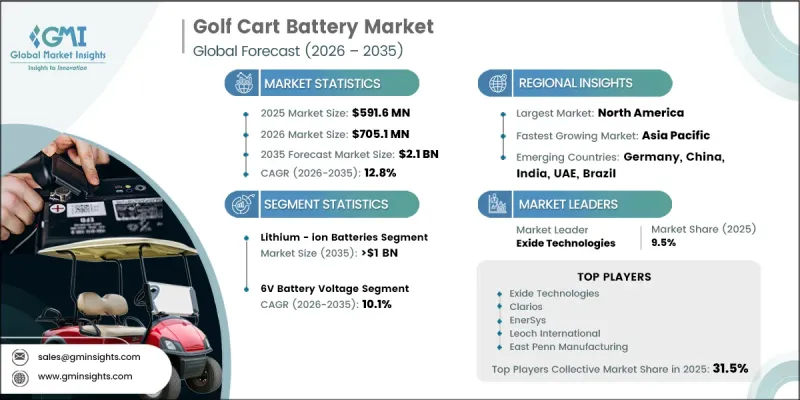
電動高爾夫球車的日益普及推動了市場成長。與燃油車相比,電動高爾夫球車具有營運成本更低、環境影響更小等優勢。這種轉變正促使高爾夫球場、旅遊景點和規劃中的住宅開發項目轉向電動出行解決方案,以減少排放氣體並提高效率。此外,全球為實現永續性所做的努力以及支持清潔能源技術的更嚴格的環境法規,也進一步增加了對先進電池系統的需求。
| 市場範圍 | |
|---|---|
| 開始年份 | 2025 |
| 預測期 | 2026-2035 |
| 初始市場規模 | 5.916億美元 |
| 預計金額 | 21億美元 |
| 複合年成長率 | 12.8% |
此外,該市場正受惠於能源儲存系統,特別是鋰離子電池技術的快速發展。鋰離子電池憑藉其高效率和長使用壽命,正在取代傳統電池類型。隨著GPS導航、藍牙連接和先進電池監控系統等數位功能的日益普及,對可靠耐用電源的性能要求也越來越高。能量密度、充電速度和循環壽命的不斷提升,使得現代電池能夠適應更長時間的使用,包括傳統高爾夫球場以外的應用場景。此外,電池成本的下降和可回收性的提高也推動了電池的普及。政府主導的永續性舉措和碳排放目標進一步加速了向電動出行解決方案的轉型,先進的高爾夫球車電池正成為下一代交通系統的關鍵組成部分。
預計到2035年,鋰離子電池市場規模將達到10億美元。其高能量密度可延長高爾夫球車的續航里程並提高運行效率。使用者對這類電池的需求日益成長,尤其是在需要長時間使用的應用場景中,因為它們能夠提供更長的運作時間和更優異的移動性。與鉛酸電池相比,鋰離子電池的使用壽命顯著更長,在性能衰減明顯之前可以承受更多的充放電循環。
按電壓分類,市場細分包括 6V、8V、12V 和其他類別,其中 6V 電池預計到 2035 年將以 10.1% 的複合年成長率成長。由於 6V 電池與高爾夫球車電氣系統相容,且能夠滿足穩定的性能要求,因此市場對 6V 電池的需求仍然強勁。其最佳化的輸出使其成為追求日常使用中效率和可靠性平衡的終端用戶的首選。
預計到2035年,美國高爾夫球車電池市場規模將達到8.848億美元。先進電池管理系統日益普及,透過增強電池均衡、充電控制以及過充的過放保護,顯著提升了電池效能。這些技術能夠顯著延長電池壽命並提高運作可靠性。日益增強的環保意識以及對可回收和環保電池解決方案的需求不斷成長,也進一步推動了美國市場的擴張。
目錄
第1章:調查方法和範圍
第2章執行摘要
第3章 行業洞察
- 產業生態系分析
- 原物料供應及採購分析
- 生產能力評估
- 供應鏈韌性與風險因素
- 配電網路分析
- 監理情勢
- 影響產業的因素
- 促進因素
- 產業潛在風險與挑戰
- 成長潛力分析
- 波特的分析
- PESTLE分析
- 生產能力和生產情況
- 主要製造商的生產能力
- 運轉率和擴張計劃
- 人工智慧和生成式人工智慧對市場(核心解決方案)的影響
- 人工智慧驅動的生產最佳化(核心解決方案)
- 預測性維護和故障檢測(核心解決方案)
- 新機會與趨勢
- 投資分析及未來展望
- 永續發展措施與工業4.0的融合
第4章 競爭情勢
- 介紹
- 企業市佔率分析:按地區分類
- 北美洲
- 歐洲
- 亞太地區
- 中東和非洲
- 拉丁美洲
- 主要進展
- 主要夥伴關係和聯盟
- 主要併購活動
- 產品創新和新產品發布
- 市場擴大策略
- 競爭定位矩陣
第5章 市場規模及預測:依電池類型分類,2022-2035年
- 鉛酸電池
- 鋰離子
第6章 市場規模及預測:依電壓等級分類,2022-2035年
- 6V
- 8V
- 12V
- 其他
第7章 市場規模與預測:依最終用戶分類,2022-2035年
- 高爾夫球場
- 商業服務
第8章 市場規模及預測:依銷售管道分類,2022-2035年
- 目的地設備製造商 (OEM)
- 售後市場
第9章 市場規模及預測:依地區分類,2022-2035年
- 北美洲
- 美國
- 加拿大
- 墨西哥
- 歐洲
- 英國
- 法國
- 德國
- 義大利
- 俄羅斯
- 西班牙
- 亞太地區
- 中國
- 澳洲
- 印度
- 日本
- 韓國
- 中東和非洲
- 沙烏地阿拉伯
- UAE
- 土耳其
- 南非
- 埃及
- 拉丁美洲
- 巴西
- 阿根廷
第10章:公司簡介
- Clarios
- CloudEnergy
- Continental Battery Systems
- Crown Battery Manufacturing
- Duracell
- East Penn Manufacturing
- EnerSys
- Exide Technologies
- Fullriver Battery USA
- Interstate Batteries
- Leoch International Technology
- Lifeline Batteries
- Power Sonic Corporation
- RELiON Batteries
- Trojan Battery Company
The Global Golf Cart Battery Market was valued at USD 591.6 million in 2025 and is estimated to grow at a CAGR of 12.8% to reach USD 2.1 billion by 2035.
Growth in this market is linked to the rising adoption of electric golf carts, supported by their lower operating costs and reduced environmental impact compared to fuel-powered alternatives. This shift is encouraging golf courses, hospitality destinations, and planned residential developments to transition toward electric mobility solutions to lower emissions and improve efficiency. The demand for advanced battery systems is further reinforced by the global push toward sustainability and stricter environmental regulations that favor clean energy technologies.
| Market Scope | |
|---|---|
| Start Year | 2025 |
| Forecast Year | 2026-2035 |
| Start Value | $591.6 Million |
| Forecast Value | $2.1 Billion |
| CAGR | 12.8% |
The market is also benefiting from rapid technological progress in energy storage systems, especially lithium-ion chemistry, which is increasingly replacing conventional battery types due to higher efficiency and longer service life. Growing integration of digital features such as GPS navigation, Bluetooth connectivity, and advanced battery monitoring systems is raising performance requirements for reliable and durable power sources. Continuous improvements in energy density, charging speed, and lifecycle performance are making modern batteries more suitable for extended operational use, including applications beyond traditional golf environments. Additionally, declining battery costs and improved recyclability are strengthening adoption trends. Government-led sustainability initiatives and carbon reduction targets are further accelerating the shift toward electric mobility solutions, positioning advanced golf cart batteries as a critical component of next-generation transport systems.
The lithium-ion batteries segment is projected to generate USD 1 billion by 2035. Their strong energy density enables extended driving range and improved operational efficiency for golf carts. Users increasingly prefer these batteries due to their ability to deliver longer runtime and enhanced mobility performance, especially in applications requiring sustained usage. Compared to lead-based alternatives, lithium-ion variants also offer significantly longer service life and can endure a higher number of charge-discharge cycles before performance degradation becomes noticeable.
The voltage-based segmentation of the market includes 6V, 8V, 12V, and other categories, with the 6V segment expected to grow at a CAGR of 10.1% through 2035. Demand for 6V batteries remains strong due to their compatibility with golf cart electrical systems and their ability to support stable performance requirements. Their optimized power output makes them a preferred choice among end users seeking balanced efficiency and reliability for everyday operation.
U.S. Golf Cart Battery Market is projected to reach USD 884.8 million by 2035. The adoption of advanced battery management systems is increasing due to their role in enhancing performance through improved cell balancing, controlled charging, and protection against overcharging and over-discharging. These technologies significantly extend battery lifespan and improve operational reliability. Rising environmental awareness and the growing demand for recyclable and eco-friendly battery solutions are further strengthening market expansion in the country.
Key players operating in the Global Golf Cart Battery Market include Clarios, EnerSys, East Penn Manufacturing, Exide Technologies, Trojan Battery Company, Duracell, Interstate Batteries, Crown Battery Manufacturing, RELiON Batteries, Fullriver Battery USA, Leoch International Technology, CloudEnergy, Power Sonic Corporation, Lifeline Batteries, and Continental Battery Systems. Companies in the market are focusing on expanding lithium-ion product portfolios to meet rising demand for high-performance energy storage solutions. They are investing heavily in research and development to improve energy density, charging efficiency, and overall lifecycle performance. Strategic partnerships with golf cart manufacturers are being used to strengthen integration across vehicle platforms. Manufacturers are also enhancing production capabilities to achieve cost efficiency and scale. In addition, firms are prioritizing smart battery technologies with integrated monitoring systems to improve user control and safety.
Table of Contents
Chapter 1 Methodology & Scope
- 1.1 Research approach
- 1.2 Quality commitments
- 1.2.1 GMI AI policy & data integrity commitment
- 1.2.1.1 Source consistency protocol
- 1.2.1 GMI AI policy & data integrity commitment
- 1.3 Research trail & confidence scoring
- 1.3.1 Research trail components
- 1.3.2 Scoring components
- 1.4 Data collection
- 1.4.1 Partial list of primary sources
- 1.5 Data mining sources
- 1.5.1 Paid sources
- 1.5.1.1 Sources, by region
- 1.5.1 Paid sources
- 1.6 Base estimates and calculations
- 1.6.1 Base year calculation for any one approach
- 1.7 Market estimates & forecasts parameters
- 1.8 Forecast model
- 1.8.1 Quantified market impact analysis
- 1.8.1.1 Mathematical impact of growth parameters on forecast
- 1.8.1 Quantified market impact analysis
- 1.9 Research transparency addendum
- 1.9.1 Source attribution framework
- 1.9.2 Quality assurance metrics
- 1.9.3 Our commitment to trust
- 1.10 Market definitions
Chapter 2 Executive Summary
- 2.1 Industry synopsis, 2022 - 2035
- 2.1.1 Business trends
- 2.1.2 Battery type trends
- 2.1.3 Voltage trends
- 2.1.4 End user trends
- 2.1.5 Sales channel trends
- 2.1.6 Regional trends
Chapter 3 Industry Insights
- 3.1 Industry ecosystem analysis
- 3.1.1 Raw material availability & sourcing analysis
- 3.1.2 Manufacturing capacity assessment
- 3.1.3 Supply chain resilience & risk factors
- 3.1.4 Distribution network analysis
- 3.2 Regulatory landscape
- 3.3 Industry impact forces
- 3.3.1 Growth drivers
- 3.3.2 Industry pitfalls & challenges
- 3.4 Growth potential analysis
- 3.5 Porter's analysis
- 3.5.1 Bargaining power of suppliers
- 3.5.2 Bargaining power of buyers
- 3.5.3 Threat of new entrants
- 3.5.4 Threat of substitutes
- 3.6 PESTEL analysis
- 3.6.1 Political factors
- 3.6.2 Economic factors
- 3.6.3 Social factors
- 3.6.4 Technological factors
- 3.6.5 Legal factors
- 3.6.6 Environmental factors
- 3.7 Capacity & production landscape (Driven by Primary Research)
- 3.7.1 Capacity by key producer (Driven by Primary Research)
- 3.7.2 Capacity utilization rates & expansion pipelines (Driven by Primary Research)
- 3.8 Impact of AI & Generative AI on the market (Core Solution)
- 3.8.1 AI-Driven production optimization (Core Solution)
- 3.8.2 Predictive maintenance & fault detection (Core Solution)
- 3.9 Emerging opportunities & trends
- 3.10 Investment analysis & future prospects
- 3.11 Sustainability initiatives & industry 4.0 integration
Chapter 4 Competitive Landscape, 2026
- 4.1 Introduction
- 4.2 Company market share analysis, by region, 2025
- 4.2.1 North America
- 4.2.2 Europe
- 4.2.3 Asia Pacific
- 4.2.4 Middle East & Africa
- 4.2.5 Latin America
- 4.3 Key developments
- 4.3.1 Key partnerships & collaborations
- 4.3.2 Major M&A activities
- 4.3.3 Product innovations & launches
- 4.3.4 Market expansion strategies
- 4.4 Competitive positioning matrix
Chapter 5 Market Size and Forecast, By Battery Type, 2022 - 2035 (USD Million)
- 5.1 Key trends
- 5.2 Lead acid
- 5.3 Lithium ion
Chapter 6 Market Size and Forecast, By Voltage, 2022 - 2035 (USD Million)
- 6.1 Key trends
- 6.2 6V
- 6.3 8V
- 6.4 12V
- 6.5 Others
Chapter 7 Market Size and Forecast, By End User, 2022 - 2035 (USD Million)
- 7.1 Key trends
- 7.2 Golf courses
- 7.3 Commercial services
Chapter 8 Market Size and Forecast, By Sales Channel, 2022 - 2035 (USD Million)
- 8.1 Key trends
- 8.2 Original Equipment Manufacturer (OEM)
- 8.3 Aftermarket
Chapter 9 Market Size and Forecast, By Region, 2022 - 2035 (USD Million)
- 9.1 Key trends
- 9.2 North America
- 9.2.1 U.S.
- 9.2.2 Canada
- 9.2.3 Mexico
- 9.3 Europe
- 9.3.1 UK
- 9.3.2 France
- 9.3.3 Germany
- 9.3.4 Italy
- 9.3.5 Russia
- 9.3.6 Spain
- 9.4 Asia Pacific
- 9.4.1 China
- 9.4.2 Australia
- 9.4.3 India
- 9.4.4 Japan
- 9.4.5 South Korea
- 9.5 Middle East & Africa
- 9.5.1 Saudi Arabia
- 9.5.2 UAE
- 9.5.3 Turkey
- 9.5.4 South Africa
- 9.5.5 Egypt
- 9.6 Latin America
- 9.6.1 Brazil
- 9.6.2 Argentina
Chapter 10 Company Profiles
- 10.1 Clarios
- 10.2 CloudEnergy
- 10.3 Continental Battery Systems
- 10.4 Crown Battery Manufacturing
- 10.5 Duracell
- 10.6 East Penn Manufacturing
- 10.7 EnerSys
- 10.8 Exide Technologies
- 10.9 Fullriver Battery USA
- 10.10 Interstate Batteries
- 10.11 Leoch International Technology
- 10.12 Lifeline Batteries
- 10.13 Power Sonic Corporation
- 10.14 RELiON Batteries
- 10.15 Trojan Battery Company


