

 |
市場調查報告書
商品編碼
2061374
個人化護膚市場機會、成長要素、產業趨勢分析及2026-2035年預測。Personalized Skin Care Market Opportunity, Growth Drivers, Industry Trend Analysis, and Forecast 2026 - 2035 |
||||||

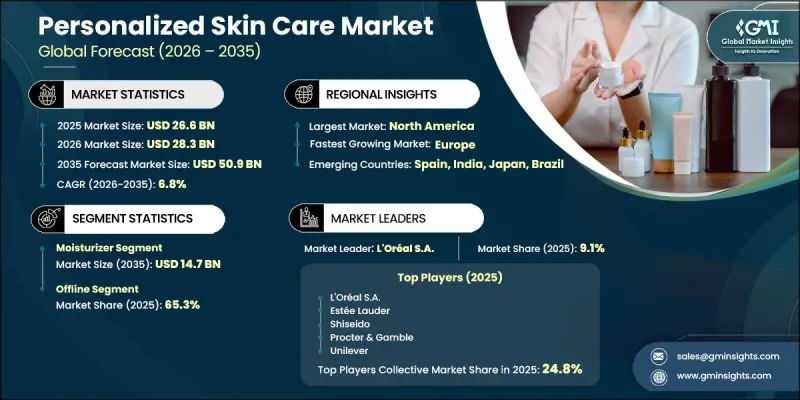
2025年全球個人化護膚市場價值為266億美元,預計到2035年將以6.8%的複合年成長率成長至509億美元。
隨著消費者從標準化護膚產品轉向基於自身生物和環境數據的高度客製化解決方案,市場正經歷重大變革。使用者尋求能夠提供更精準、更有針對性且具有臨床意義的日常皮膚健康管理產品,因此對高度個人化護膚的需求日益成長。人工智慧、影像工具和數位皮膚分析技術的快速發展,使得在家即可進行更精準的皮膚診斷,讓消費者更容易獲得專業級的評估。基因組分析和微生物組分析的融合進一步革新了產品研發,使品牌能夠設計出針對皮膚問題根源而非僅針對錶面症狀的配方。消費者對清潔美容和極簡配方的追求,也推動了產品創新,這得益於小批量生產模式的普及以及消費者對透明度和更安全成分的日益成長的偏好。數據分析的廣泛應用,使品牌能夠識別不斷變化的皮膚需求,最佳化個人化演算法,並持續改進產品推薦。數位化互動和科技主導護膚解決方案的廣泛應用,正持續加速全球美容和個人護理行業的市場擴張。
| 市場範圍 | |
|---|---|
| 開始年份 | 2025 |
| 預測期 | 2026-2035 |
| 上市時的市場規模 | 266億美元 |
| 預計金額 | 509億美元 |
| 複合年成長率 | 6.8% |
預計到2025年,保濕霜市場規模將達到73億美元,到2035年將達到147億美元。保濕霜仍然是個人化護膚流程的基礎產品,也是許多消費者開始嘗試客製化美容護理的切入點。其廣泛應用源自於人們對保濕的基本需求,而這種需求會因氣候條件、年齡和皮膚屏障功能狀況而異。人們對保護皮膚屏障和長期皮膚健康的日益重視,並持續推動著針對個人需求量身定做的保濕霜的強勁需求。
預計到2025年,線下銷售管道將佔總銷售額的65.3%,繼續維持其主導地位。實體店憑藉先進的診斷工具(例如皮膚掃描系統和水分分析儀)繼續發揮至關重要的作用。這些技術能夠提供高度精準的皮膚診斷,提升個人化服務的有效性,並有助於推薦高級產品。消費者也非常重視專業人士、皮膚科醫生和護膚顧問的專家諮詢。專家檢驗和現場評估能夠建立信任,尤其對於高價客製化護膚產品而言,這進一步鞏固了線下管道的優勢。
到2025年,美國個人化護膚市場將佔據78.3%的佔有率。該市場的特點是消費者意識高、自由裁量權支出巨大,以及對先進美容技術的快速接受。人工智慧診斷、皮膚科醫生客製化方案和數位化護膚方案正有力地支撐著市場需求。電子商務平台的蓬勃發展和數據驅動的消費者互動模式持續改變消費者的購買行為。各大品牌也正在增加對智慧護膚設備和行動端皮膚分析平台的投資,以提升個人化服務能力。隨著消費者對產品持續最佳化的需求不斷成長,訂閱式個人化護膚服務正蓬勃發展。持續的創新和強大的技術應用進一步鞏固了美國市場的領先地位。
目錄
第1章:調查方法和範圍
第2章執行摘要
第3章 行業洞察
- 產業生態系分析
- 供應商情況
- 利潤率
- 每個階段增加的價值
- 影響價值鏈的因素
- 影響產業的因素
- 促進因素
- 對個人化護膚方案的需求
- 人工智慧驅動的皮膚診斷和數據分析的進展
- 消費者對成分透明度和功效的關注度日益提高。
- 產業潛在風險與挑戰
- 高昂的配方、技術和營運成本
- 監管複雜性和資料隱私合規風險
- 機會
- D2C(直接面對消費者)和數位個人化平台的成長
- 採用生物技術、潔淨標示和基於微生物組的配方
- 促進因素
- 成長潛力分析
- 監理框架
- 關鍵市場趨勢與顛覆性因素
- 技術與創新展望
- 價格分析
- 對過去價格趨勢的分析
- 依球員類型分類的定價策略(高級球員、超值球員、成本加成球員)
- 未來市場趨勢
- 貿易數據分析
- 進出口量及進口額趨勢
- 主要貿易路線及關稅的影響
- 人工智慧和生成式人工智慧對市場的影響
- 利用人工智慧改造現有經營模式
- 按細分市場分類的生成式人工智慧用例和部署藍圖
- 風險、限制和監管考量
- 波特的分析
- PESTLE分析
- 目前分銷基礎設施和通路滲透情況
- 按地區與業態(現代零售與傳統零售)分類的通路覆蓋率
- 缺乏最後一公里基礎設施和不斷變化的管道
第4章 競爭情勢
- 介紹
- 企業市佔率分析
- 按地區
- 企業矩陣分析
- 主要市場公司的競爭分析
- 競爭定位矩陣
- 主要進展
- 併購
- 夥伴關係和聯盟
- 新產品發布
- 業務拓展計劃
第5章 市場估算與預測:依產品類型分類,2022-2035年
- 潔面乳
- 凝膠型潔顏乳
- 泡沫洗面乳
- 油基潔面乳
- 膠束水
- 臉部精華液
- 保濕精華液
- 美白精華液
- 抗老精華液
- 祛痘精華液
- 保濕霜
- 日間保濕霜
- 晚霜
- 輕質凝膠
- 滋潤乳霜,適合乾性肌膚
- 積極的
- 視網醇/類視色素療法
- 維生素C治療
- AHA/BHA去角質劑
- 含有菸鹼醯胺的產品
- 身體乳液
- 保濕身體乳
- 身體緊緻與抗衰老治療
- 針對特定部位的身體保養(毛周角化症、色素沉著過度)
- 身體二重奏
- 防曬油和防曬
- 礦物/物理防曬油
- 化學防曬油
- 有色防曬油
- 其他
- 片狀面膜和霜狀面膜
- 眼霜和精華液
- 唇部護理產品
第6章 市場估計與預測:依技術分類,2022-2035年
- 人工智慧和機器學習分析
- 基因檢測和基因組分析
- 微生物組分析
- 3D皮膚映射和成像
- 其他(驗血、皮膚科會診、混合模式)
第7章 市場估計與預測:依皮膚病分類,2022-2035年
- 抗老(皺紋、緊緻度、彈性)
- 痤瘡和皮膚問題
- 色素沉澱/瑕疵
- 敏感肌膚/泛紅
- 乾燥和保濕
- 其他
第8章 市場估算與預測:依類別分類,2022-2035年
- 臉部保養
- 身體保養
第9章 市場估計與預測:依價格區間分類,2022-2035年
- 低的
- 中等的
- 高的
第10章 市場估計與預測:依消費者區隔市場分類,2022-2035年
- 男性
- 女士
- 孩子
第11章 市場估價與預測:依通路分類,2022-2035年
- 離線
- 線上
第12章 市場估計與預測:依地區分類,2022-2035年
- 北美洲
- 美國
- 加拿大
- 歐洲
- 德國
- 英國
- 法國
- 西班牙
- 義大利
- 亞太地區
- 中國
- 日本
- 印度
- 澳洲
- 韓國
- 拉丁美洲
- 巴西
- 墨西哥
- 阿根廷
- 中東和非洲
- 南非
- 沙烏地阿拉伯
- UAE
第13章:公司簡介
- Global Company
- Beiersdorf
- Estee Lauder
- Johnson &Johnson
- L'Oreal SA
- Procter &Gamble
- Shiseido
- Unilever
- Regional Company
- Amorepacific
- Clarins Group
- Coty
- Henkel
- Kao Corporation
- Kose Corporation
- LG H&H
- 新興企業
- Bioeffect
- Chanel
- Colgate-Palmolive
- Natura &Co
- Pola Orbis
- Proya
- Sisley-Paris
The Global Personalized Skin Care Market was valued at USD 26.6 billion in 2025 and is estimated to grow at a CAGR of 6.8% to reach USD 50.9 billion by 2035.
The market is undergoing a significant transformation as consumers increasingly move away from standardized skincare products toward highly tailored solutions based on individual biological and environmental data. Demand for hyper-personalized skincare is rising as users seek products that deliver more accurate, targeted, and clinically relevant outcomes for daily skin health management. Rapid advancements in artificial intelligence, diagnostic imaging tools, and digital skin analysis technologies are enabling more precise at-home skin assessments, making professional-grade evaluation more accessible to consumers. Integration of genomic insights and microbiome profiling is further reshaping product development, allowing brands to design formulations that address root causes of skin concerns rather than surface-level symptoms. The shift toward clean beauty and minimalist ingredient formulations is also influencing product innovation, supported by small-batch production models and growing consumer preference for transparency and safer ingredient profiles. Expanding use of data analytics is enabling brands to identify evolving skin needs, refine personalization algorithms, and continuously improve product recommendations over time. Rising digital engagement and increasing adoption of technology-driven skincare solutions continue to accelerate market expansion across global beauty and personal care industries.
| Market Scope | |
|---|---|
| Start Year | 2025 |
| Forecast Year | 2026-2035 |
| Start Value | $26.6 Billion |
| Forecast Value | $50.9 Billion |
| CAGR | 6.8% |
The moisturizer category generated USD 7.3 billion in 2025 and is expected to reach USD 14.7 billion by 2035. Moisturizers continue to represent a foundational product in personalized skincare routines, serving as the entry point for most consumers adopting customized beauty regimens. Their widespread usage is driven by essential hydration needs that vary depending on climate conditions, age, and skin barrier health. Increasing awareness of skin barrier protection and long-term skin health continues to support strong demand for personalized moisturizer formulations tailored to individual requirements.
The offline distribution channel accounted for 65.3% in 2025, maintaining its dominant position. Physical retail environments continue to play a critical role due to the availability of advanced diagnostic tools such as skin scanning systems and hydration analysis equipment. These technologies provide highly accurate skin assessments that enhance personalization outcomes and support premium product recommendations. Consumers also place strong value on expert consultations provided by trained professionals, dermatologists, and skincare advisors. The presence of expert validation and hands-on evaluation builds trust, particularly for high-value customized skincare products, reinforcing the strength of offline channels.
U.S. Personalized Skin Care Market held a 78.3% share in 2025. The country's market is characterized by strong consumer awareness, high discretionary spending, and rapid adoption of advanced beauty technologies. Demand is strongly supported by AI-powered diagnostics, dermatologist-guided customization, and digitally enabled skincare solutions. Increasing penetration of e-commerce platforms and data-driven consumer engagement models continues to reshape purchasing behavior. Brands are also expanding investment in connected skincare devices and mobile-based skin analysis platforms to enhance personalization capabilities. Subscription-based customized skincare offerings are gaining momentum as consumers seek ongoing product optimization. Continuous innovation and strong technology adoption continue to reinforce the leadership position of the U.S. market.
Major companies operating in the Global Personalized Skin Care Market include Shiseido, L'Oreal S.A., Estee Lauder, Unilever, Procter & Gamble, Johnson & Johnson, Beiersdorf, Amorepacific, Kao Corporation, Kose Corporation, LG H&H, Coty, Henkel, Natura & Co, Pola Orbis, Sisley-Paris, Clarins Group, Bioeffect, Proya, Chanel, and Colgate-Palmolive. Companies operating in the personalized skin care market are adopting several strategic initiatives to strengthen their competitive position and expand consumer reach. Leading brands are heavily investing in artificial intelligence, skin diagnostic technologies, and data analytics platforms to enhance personalization accuracy and product effectiveness. Businesses are also focusing on integrating genomic and microbiome insights into product development to create highly targeted skincare formulations. Expansion of digital ecosystems, including mobile applications and connected skincare devices, is helping companies improve consumer engagement and retention. Strategic partnerships with dermatologists, technology providers, and beauty retailers are further strengthening product credibility and distribution networks.
Table of Contents
Chapter 1 Methodology & Scope
- 1.1 Research approach
- 1.2 Quality Commitments
- 1.2.1 GMI AI policy & data integrity commitment
- 1.2.1.1 Source consistency protocol
- 1.2.1 GMI AI policy & data integrity commitment
- 1.3 Research Trail & Confidence Scoring
- 1.3.1 Research Trail Components
- 1.3.2 Scoring Components
- 1.4 Data Collection
- 1.4.1 Partial list of primary sources
- 1.5 Data mining sources
- 1.5.1 Paid sources
- 1.5.1.1 Sources, by region
- 1.5.1 Paid sources
- 1.6 Base estimates and calculations
- 1.6.1 Base year calculation for any one approach
- 1.7 Forecast model
- 1.7.1 Quantified market impact analysis
- 1.7.1.1 Mathematical impact of growth parameters on forecast
- 1.7.1 Quantified market impact analysis
- 1.8 Research transparency addendum
- 1.8.1 Source attribution framework
- 1.8.2 Quality assurance metrics
- 1.9 Our commitment to trust
Chapter 2 Executive Summary
- 2.1 Industry 360° synopsis
- 2.2 Key market trends
- 2.2.1 Regional
- 2.2.2 Product Type
- 2.2.3 Technology
- 2.2.4 Skin Condition
- 2.2.5 Category
- 2.2.6 Price
- 2.2.7 Consumer Group
- 2.2.8 Distribution Channel
Chapter 3 Industry Insights
- 3.1 Industry ecosystem analysis
- 3.1.1 Supplier landscape
- 3.1.2 Profit margin
- 3.1.3 Value addition at each stage
- 3.1.4 Factor affecting the value chain
- 3.2 Industry impact forces
- 3.2.1 Growth drivers
- 3.2.1.1 Demand for individualized skin care solutions
- 3.2.1.2 Advancements in AI-based skin diagnostics and data analytics
- 3.2.1.3 Rising consumer focus on ingredient transparency and efficacy
- 3.2.2 Industry pitfalls & challenges
- 3.2.2.1 High formulation, technology, and operational costs
- 3.2.2.2 Regulatory complexity and data privacy compliance risks
- 3.2.3 Opportunities
- 3.2.3.1 Growth of direct-to-consumer and digital personalization platforms
- 3.2.3.2 Adoption of biotech, clean-label, and microbiome-based formulations
- 3.2.1 Growth drivers
- 3.3 Growth potential analysis
- 3.4 Regulatory framework
- 3.5 Major market trends and disruptions
- 3.6 Technology/innovation landscape
- 3.7 Pricing Analysis (driven by primary research)
- 3.7.1 Historical price trend analysis (driven by primary research)
- 3.7.2 Pricing strategy by player type (premium / value / cost-plus) (driven by primary research)
- 3.8 Future market trends
- 3.9 Trade data analysis (driven by paid database) (HS code- 330499)
- 3.9.1 Import/export volume & value trends (driven by primary research)
- 3.9.2 Key trade corridors & tariff impact (driven by primary research)
- 3.10 Impact of AI & Generative AI on the Market
- 3.10.1 AI-driven disruption of existing business models
- 3.10.2 Gen-AI use cases & adoption roadmap by segment
- 3.10.3 Risks, limitations & regulatory considerations
- 3.11 Porter’s analysis
- 3.12 PESTEL analysis
- 3.13 Distribution infrastructure & channel penetration landscape (driven by primary research)
- 3.13.1 Channel coverage by region & format (modern vs. Traditional trade) (driven by primary research)
- 3.13.2 Last-mile infrastructure gaps & emerging channel shifts (driven by primary research)
Chapter 4 Competitive landscape, 2025
- 4.1 Introduction
- 4.2 Company market share analysis
- 4.2.1 By region
- 4.2.1.1 North America
- 4.2.1.2 Europe
- 4.2.1.3 Asia Pacific
- 4.2.1.4 Latin America
- 4.2.1.5 MEA
- 4.2.1 By region
- 4.3 Company matrix analysis
- 4.4 Competitive analysis of major market players
- 4.5 Competitive positioning matrix
- 4.6 Key developments
- 4.6.1 Mergers & acquisitions
- 4.6.2 Partnerships & collaborations
- 4.6.3 New product launches
- 4.6.4 Expansion plans
Chapter 5 Market Estimates & Forecast, By Product Type, 2022 - 2035 (USD Billion) (Thousand Units)
- 5.1 Key trends
- 5.2 Cleanser
- 5.2.1 Gel-based cleansers
- 5.2.2 Foam cleansers
- 5.2.3 Oil-based cleansers
- 5.3 Micellar water
- 5.4 Face serum
- 5.4.1 Hydrating serums
- 5.4.2 Brightening serums
- 5.4.3 Anti-aging serums
- 5.4.4 Acne treatment serums
- 5.5 Moisturizer
- 5.5.1 Day moisturizers
- 5.5.2 Night creams
- 5.5.3 Lightweight gels
- 5.5.4 Rich creams for dry skin
- 5.6 Active
- 5.6.1 Retinol/retinoid treatments
- 5.6.2 Vitamin C treatments
- 5.6.3 AHA/BHA exfoliants
- 5.6.4 Niacinamide treatments
- 5.7 Body lotion
- 5.7.1 Hydrating body lotions
- 5.7.2 Firming & anti-aging body treatments
- 5.7.3 Targeted body treatments (keratosis pilaris, hyperpigmentation)
- 5.8 Body duo
- 5.9 Sunscreen & sun care
- 5.9.1 Mineral/physical sunscreens
- 5.9.2 Chemical sunscreens
- 5.9.3 Tinted sunscreens
- 5.10 Others
- 5.10.1 Sheet & cream masks
- 5.10.2 Eye creams & serums
- 5.10.3 Lip treatments
Chapter 6 Market Estimates & Forecast, By Technology, 2022 - 2035 (USD Billion) (Thousand Units)
- 6.1 Key trends
- 6.2 AI & machine learning analysis
- 6.3 Genetic testing & genomics-based
- 6.4 Microbiome profiling
- 6.5 3D skin mapping & imaging
- 6.6 Others (blood tests, dermatologist consultations, hybrid models)
Chapter 7 Market Estimates & Forecast, By Skin Condition, 2022 - 2035 (USD Billion) (Thousand Units)
- 7.1 Key trends
- 7.2 Anti-aging (wrinkles, firmness, elasticity)
- 7.3 Acne & blemishes
- 7.4 Hyperpigmentation & dark spots
- 7.5 Sensitivity & redness
- 7.6 Dryness & hydration
- 7.7 Others
Chapter 8 Market Estimates & Forecast, By Category, 2022 - 2035 (USD Billion) (Thousand Units)
- 8.1 Key trends
- 8.2 Face care
- 8.3 Body care
Chapter 9 Market Estimates & Forecast, By Price Range, 2022 - 2035 (USD Billion) (Thousand Units)
- 9.1 Key trends
- 9.2 Low
- 9.3 Medium
- 9.4 High
Chapter 10 Market Estimates & Forecast, By Consumer Group, 2022 - 2035 (USD Billion) (Thousand Units)
- 10.1 Key trends
- 10.2 Men
- 10.3 Women
- 10.4 Kid
Chapter 11 Market Estimates & Forecast, By Distribution Channel, 2022 - 2035 (USD Billion) (Thousand Units)
- 11.1 Key trends
- 11.2 Offline
- 11.3 Online
Chapter 12 Market Estimates & Forecast, By Region, 2022 - 2035 (USD Billion) (Thousand Units)
- 12.1 Key trends
- 12.2 North America
- 12.2.1 U.S.
- 12.2.2 Canada
- 12.3 Europe
- 12.3.1 Germany
- 12.3.2 UK
- 12.3.3 France
- 12.3.4 Spain
- 12.3.5 Italy
- 12.4 Asia Pacific
- 12.4.1 China
- 12.4.2 Japan
- 12.4.3 India
- 12.4.4 Australia
- 12.4.5 South Korea
- 12.5 Latin America
- 12.5.1 Brazil
- 12.5.2 Mexico
- 12.5.3 Argentina
- 12.6 MEA
- 12.6.1 South Africa
- 12.6.2 Saudi Arabia
- 12.6.3 UAE
Chapter 13 Company Profiles
- 13.1 Global Company
- 13.1.1 Beiersdorf
- 13.1.2 Estee Lauder
- 13.1.3 Johnson & Johnson
- 13.1.4 L'Oreal S.A.
- 13.1.5 Procter & Gamble
- 13.1.6 Shiseido
- 13.1.7 Unilever
- 13.2 Regional Company
- 13.2.1 Amorepacific
- 13.2.2 Clarins Group
- 13.2.3 Coty
- 13.2.4 Henkel
- 13.2.5 Kao Corporation
- 13.2.6 Kose Corporation
- 13.2.7 LG H&H
- 13.3 Emerging Companies
- 13.3.1 Bioeffect
- 13.3.2 Chanel
- 13.3.3 Colgate-Palmolive
- 13.3.4 Natura & Co
- 13.3.5 Pola Orbis
- 13.3.6 Proya
- 13.3.7 Sisley-Paris

 全球護膚市場規模、佔有率、趨勢和成長分析報告(2026-2034年)
 爽膚水市場規模、佔有率和成長分析:按類型、膚質、通路、消費者和地區分類-2026-2033年產業預測
 臉部噴霧市場 - 全球產業規模、佔有率、趨勢、機會、預測:按類型、應用、分銷管道、地區和競爭格局分類,2021-2031年
 護膚市場規模、佔有率和成長分析:按類型、價格範圍、成分、有機產品、使用場合、品牌、性別、最終用戶和地區分類-2026-2033年產業預測
 電子商務個人保健產品市場報告:趨勢、預測和競爭分析(至2035年)
 舒緩壓力護膚市場規模、佔有率及成長分析:依產品類型、活性成分、膚質、價格範圍、通路、最終用戶及地區分類-2026-2033年產業預測
 化學換膚市場:按化學試劑、最終用戶、應用和分銷管道分類的全球市場預測,2026-2032年護膚品市場:2026-2032年全球市場預測(依產品類型、肌膚問題、銷售管道及最終用戶分類)醫用級護膚市場:2026-2032年全球市場預測(按產品類型、原料來源、膚質、配方、活性成分類型、價格範圍、包裝、功能、應用、分銷管道和最終用戶分類)
 護膚品市場:依產品類型、銷售管道、最終用戶和地區分類