


 |
市場調查報告書
商品編碼
2061367
低溫運輸設備市場:商業機會、成長要素、產業趨勢分析及2026-2035年預測Cold Chain Equipment Market Opportunity, Growth Drivers, Industry Trend Analysis, and Forecast 2026 - 2035 |
||||||

2025年全球低溫運輸設備市場價值為395億美元,預計2035年將以7.6%的複合年成長率成長至812億美元。
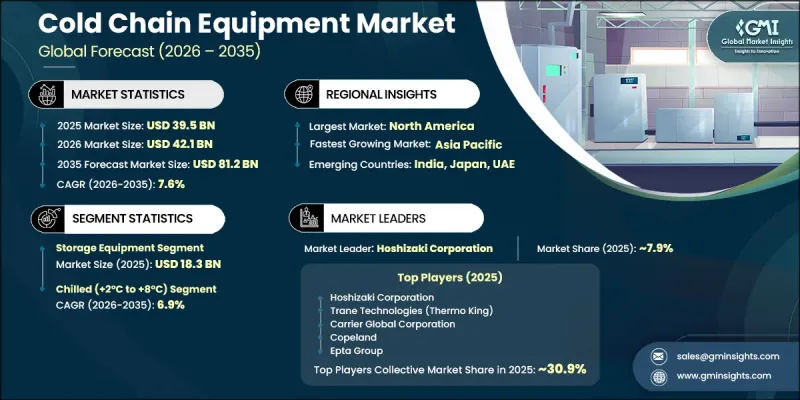
由於製藥、生物技術、醫療保健以及食品飲料行業對溫控儲存和運輸的需求不斷成長,市場正經歷強勁擴張。全球生物製藥、疫苗、冷凍食品和溫敏藥品的消費量增加,顯著推動了對先進冷凍系統和溫控物流基礎設施的需求。低溫運輸設備在確保產品安全方面發揮著至關重要的作用,它能夠在整個供應鏈中維持精確的溫度條件,從而最大限度地減少產品變質並確保符合監管要求。有組織的零售網路、藥品分銷系統和電子商務食品平台的快速擴張進一步促進了市場成長。同時,隨著物聯網監控系統、智慧感測器和即時追蹤解決方案的整合,該行業正在經歷重大的技術變革,以提高可視性和營運管理水平。自動化技術的日益普及使企業能夠提高效率並降低產品損失風險。日益嚴格的食品安全標準和藥品處理要求的監管壓力,持續推動對先進低溫運輸基礎設施的投資。此外,生物製藥生產的擴張和全球疫苗供應計畫的發展,進一步加速了已開發經濟體和新興經濟體對可靠且擴充性的低溫運輸系統的需求。
| 市場範圍 | |
|---|---|
| 開始年份 | 2025 |
| 預測期 | 2026-2035 |
| 上市時的市場規模 | 395億美元 |
| 預測金額 | 812億美元 |
| 複合年成長率 | 7.6% |
預計到2025年,倉儲設施市場規模將達到183億美元,並在2026年至2035年間以5.4%的複合年成長率成長。此市場成長的主要驅動力是冷藏倉庫、冷庫、工業冷卻系統和醫藥級倉儲設施投資的不斷增加。這些解決方案對於在食品加工、疫苗儲存、生技藥品儲存和藥品庫存管理等應用中維持長期溫度穩定性至關重要。有組織的冷藏倉庫網路的持續擴張和全球冷凍食品供應鏈的成長進一步推動了該市場的成長。
預計到2025年,低溫(2 度C至8 度C)市場將佔據37.9%的市場佔有率,並在2035年之前以6.9%的複合年成長率成長。由於其在乳製品、疫苗、生鮮食品、生物製藥和溫度敏感型藥品等領域的廣泛應用,該市場仍然至關重要。冷凍系統有助於維持產品質量,同時降低儲存和運輸過程中產品劣化的風險。生物製藥和加工食品的日益普及,以及它們對穩定冷藏環境的需求,持續推動對冷藏低溫運輸解決方案的強勁需求。
美國低溫運輸設備市場預計到2025年將達到109億美元,並在2035年之前以6.8%的複合年成長率成長。這一成長主要得益於強大的藥品生產能力、先進的醫療物流系統以及高度發展的冷藏食品配送網路。疫苗、生物製藥、冷凍食品和溫度敏感型藥品需求的不斷成長,推動了對冷藏倉庫基礎設施和運輸冷凍技術的投資增加。此外,節能型冷卻系統、自動化倉庫和基於物聯網的監控平台的日益普及也促進了市場發展,這些技術提高了營運效率和合規性。
目錄
第1章:調查方法和範圍
第2章執行摘要
第3章 行業洞察
- 產業生態系分析
- 供應商情況
- 利潤率
- 每個階段增加的價值
- 影響價值鏈的因素
- 影響產業的因素
- 促進因素
- 對溫控運輸和倉儲解決方案的需求日益成長。
- 生物製藥、疫苗和溫度敏感藥物的擴張
- 增加對有組織的冷藏倉庫基礎設施和食品物流的投資。
- 潛在風險和挑戰
- 先進製冷系統安裝和運作成本高昂
- 低溫運輸基礎設施的能源消耗和維護複雜性
- 機會
- 物聯網監控和自動化技術的廣泛應用。
- 新興國家藥品低溫運輸基礎設施的擴建
- 促進因素
- 成長潛力分析
- 未來市場趨勢
- 技術與創新展望
- 最新科技趨勢
- 新興技術
- 監理情勢
- 標準和合規要求
- 區域監理框架
- 認證標準
- 波特的分析
- PESTLE分析
- 價格分析
- 對過去價格趨勢的分析
- 依球員類型分類的定價策略(高級球員、超值球員、成本加成球員)
- 貿易數據分析
- 進出口量及進口額趨勢
- 主要貿易路線及關稅的影響
- 人工智慧和生成式人工智慧對市場的影響
- 利用人工智慧改造現有經營模式
- 按細分市場分類的生成式人工智慧用例和部署藍圖
- 風險、限制和監管考量
- 生產能力和生產情況
- 設備產能:按地區和主要生產商分類
- 運轉率和擴張計劃
第4章 競爭情勢
- 介紹
- 企業市佔率分析
- 按地區
- 北美洲
- 歐洲
- 亞太地區
- 拉丁美洲
- 中東和非洲
- 按地區
- 企業矩陣分析
- 主要市場公司的競爭分析
- 競爭定位矩陣
- 主要進展
- 併購
- 夥伴關係和聯盟
- 新產品發布
- 業務拓展計劃
第5章 市場估算與預測:依設備類型分類,2022-2035年
- 儲存裝置
- 運輸設備
- 監控系統
- 溫控包裝
第6章 市場估計與預測:依溫度範圍分類,2022-2035年
- 控制環境(+15 度C至 +25 度C)
- 冷藏(+2 度C至 +8 度C)
- 冷凍(-18 度C至 -25 度C)
- 低溫(低於-80 度C)
第7章 市場估計與預測:依應用領域分類,2022-2035年
- 食品/飲料
- 水果和蔬菜
- 乳製品
- 肉類、魚貝類
- 加工食品及即食食品
- 麵包糖果甜點
- 其他
- 製藥
- 疫苗
- 生物製藥和生物相似藥
- 溫度敏感型原料藥
- 臨床試驗材料
- 衛生保健
- 血液製品和血漿
- 用於移植的器官和組織
- 醫療用品和試劑
- 化學品
- 特種化學品
- 揮發性化合物
- 生物技術
- 細胞和基因治療
- 調查樣本和生物銀行
- 其他
第8章 市場估算與預測:依營運模式分類,2022-2035年
- 主動系統
- 被動系統
第9章 市場估價與預測:依通路分類,2022-2035年
- 直銷
- 間接銷售
第10章 市場估價與預測:依地區分類,2022-2035年
- 北美洲
- 美國
- 加拿大
- 歐洲
- 德國
- 英國
- 法國
- 義大利
- 西班牙
- 亞太地區
- 中國
- 印度
- 日本
- 韓國
- 澳洲
- 拉丁美洲
- 巴西
- 墨西哥
- 阿根廷
- 中東和非洲
- 沙烏地阿拉伯
- UAE
- 南非
第11章:公司簡介
- 世界頂尖公司
- Carrier Global Corporation
- Daikin Industries Ltd.
- Trane Technologies
- Copeland
- Johnson Controls International PLC
- Danfoss A/S
- Dover Corporation(Hillphoenix)
- 該地區的領先企業
- Blue Star Limited
- Voltas Limited
- CIMC(China International Marine Containers)
- Liebherr Group
- Hoshizaki Corporation
- Arneg Group
- Epta Group
- 新興企業和專業公司
- ThermoSafe
- Peli BioThermal
- Cold Chain Technologies
- va-Q-tec AG
- Panasonic Corporation
- Haier Biomedical
- Frigoglass SA
The Global Cold Chain Equipment Market was valued at USD 39.5 billion in 2025 and is estimated to grow at a CAGR of 7.6% to reach USD 81.2 billion by 2035.
The market is witnessing strong expansion owing to rising demand for temperature-controlled storage and transportation across pharmaceuticals, biotechnology, healthcare, and food and beverage industries. The increasing global consumption of biologics, vaccines, frozen foods, and temperature-sensitive pharmaceutical products is significantly strengthening the need for advanced refrigeration systems and controlled logistics infrastructure. Cold chain equipment plays a crucial role in ensuring product safety by maintaining precise temperature conditions across end-to-end supply chains, thereby minimizing spoilage and ensuring regulatory compliance. The rapid expansion of organized retail networks, pharmaceutical distribution systems, and e-commerce grocery platforms is further reinforcing market growth. At the same time, the industry is undergoing a major technological shift with the integration of IoT-enabled monitoring systems, smart sensors, and real-time tracking solutions that improve visibility and operational control. Automation adoption is also rising, allowing companies to enhance efficiency and reduce product loss risks. Increasing regulatory pressure regarding food safety standards and pharmaceutical handling requirements continues to encourage investments in advanced cold chain infrastructure. Additionally, the expansion of biologics manufacturing and global vaccine distribution programs is further accelerating demand for reliable and scalable cold chain systems across developed and emerging economies.
| Market Scope | |
|---|---|
| Start Year | 2025 |
| Forecast Year | 2026-2035 |
| Start Value | $39.5 Billion |
| Forecast Value | $81.2 Billion |
| CAGR | 7.6% |
The storage equipment segment accounted for USD 18.3 billion in 2025 and is expected to grow at a CAGR of 5.4% from 2026 to 2035. This segment leads the market due to rising investments in refrigerated warehouses, cold rooms, industrial cooling systems, and pharmaceutical-grade storage facilities. These solutions are essential for preserving temperature stability over long durations across applications such as food processing, vaccine storage, biologics preservation, and pharmaceutical inventory management. Continued expansion of organized cold storage networks and the growing global frozen food supply chain are further strengthening segment performance.
The chilled temperature range segment (2°C to 8°C) held 37.9% share in 2025 and is projected to grow at a CAGR of 6.9% through 2035. This segment remains highly important due to its extensive use in dairy products, vaccines, fresh produce, biologics, and temperature-sensitive medicines. Chilled systems help maintain product integrity while reducing deterioration risks during storage and transportation. Rising distribution of biologics and processed food products requiring stable refrigerated environments continues to drive consistent demand for chilled cold chain solutions.
United States Cold Chain Equipment Market reached USD 10.9 billion in 2025 and is forecast to grow at a CAGR of 6.8% through 2035. Growth in the country is supported by strong pharmaceutical production capabilities, advanced healthcare logistics systems, and highly developed refrigerated food distribution networks. Increasing demand for vaccines, biologics, frozen foods, and temperature-sensitive medicines is encouraging greater investment in cold storage infrastructure and transport refrigeration technologies. The market is also benefiting from the growing adoption of energy-efficient cooling systems, automated warehouses, and IoT-based monitoring platforms that enhance operational performance and regulatory adherence.
Major players operating in the Global Cold Chain Equipment Industry Include Carrier Global Corporation, Trane Technologies, Daikin Industries Ltd., Johnson Controls International PLC, Copeland, Danfoss A/S, Dover Corporation (Hillphoenix), Liebherr Group, Blue Star Limited, Voltas Limited, CIMC (China International Marine Containers), Arneg Group, Hoshizaki Corporation, Epta Group, ThermoSafe, Peli BioThermal, Cold Chain Technologies, va-Q-tec AG, Panasonic Corporation, Haier Biomedical, and Frigoglass S.A. Companies in the cold chain equipment market are focusing on strengthening their position through digital transformation, especially by integrating IoT-based tracking systems, smart temperature sensors, and cloud-enabled monitoring platforms. They are investing heavily in energy-efficient refrigeration technologies to reduce operational costs while meeting sustainability goals. Strategic partnerships with logistics providers and pharmaceutical firms are expanding their service networks and improving distribution efficiency. Many players are also prioritizing automation in warehousing and transportation to enhance accuracy and reduce human error. Product innovation, particularly in modular and scalable cold storage systems, is helping companies address diverse end-user requirements.
Table of Contents
Chapter 1 Methodology & Scope
- 1.1 Market scope and definition
- 1.2 Research design
- 1.2.1 Research approach
- 1.2.2 Data collection methods
- 1.3 Data mining sources
- 1.3.1 Global
- 1.3.2 Regional/Country
- 1.4 Base estimates and calculations
- 1.4.1 Base year calculation
- 1.4.2 Key trends for market estimation
- 1.5 Primary research and validation
- 1.5.1 Primary sources
- 1.6 Forecast model
- 1.7 Research assumptions and limitations
Chapter 2 Executive Summary
- 2.1 Industry 360° synopsis
- 2.2 Key market trends
- 2.2.1 Regional
- 2.2.2 Equipment type
- 2.2.3 Temperature range
- 2.2.4 Application
- 2.2.5 Mode of operation
- 2.2.6 Distribution channel
Chapter 3 Industry Insights
- 3.1 Industry ecosystem analysis
- 3.1.1 Supplier landscape
- 3.1.2 Profit margin
- 3.1.3 Value addition at each stage
- 3.1.4 Factor affecting the value chain
- 3.2 Industry impact forces
- 3.2.1 Growth drivers
- 3.2.1.1 Rising demand for temperature-sensitive transportation and storage solutions
- 3.2.1.2 Expansion of biologics, vaccines, and temperature-sensitive pharmaceutical products
- 3.2.1.3 Growing investment in organized cold storage infrastructure and food logistics
- 3.2.2 Pitfalls & Challenges
- 3.2.2.1 High installation and operational costs associated with advanced refrigeration systems
- 3.2.2.2 Energy consumption and maintenance complexity of cold chain infrastructure
- 3.2.3 Opportunities
- 3.2.3.1 Increasing adoption of IoT-enabled monitoring and automation technologies
- 3.2.3.2 Expansion of pharmaceutical cold chain infrastructure across emerging economies
- 3.2.1 Growth drivers
- 3.3 Growth potential analysis
- 3.4 Future market trends
- 3.5 Technology and innovation landscape
- 3.5.1 Current technological trends
- 3.5.2 Emerging technologies
- 3.6 Regulatory landscape
- 3.6.1 Standards and compliance requirements
- 3.6.2 Regional regulatory frameworks
- 3.6.3 Certification standards
- 3.7 Porter’s analysis
- 3.8 PESTEL analysis
- 3.9 Pricing analysis (driven by primary research)
- 3.9.1 Historical price trend analysis (driven by primary research)
- 3.9.2 Pricing strategy by player type (premium / value / cost-plus) (driven by primary research)
- 3.10 Trade data analysis (HS Code 8418 for active refrigerating/freezing machinery and HS Code 9406 for insulated cold room structures) (driven by paid database)
- 3.10.1 Import/export volume and value trends (driven by paid database)
- 3.10.2 Key trade corridors and tariff impact (driven by paid database)
- 3.11 Impact of AI and generative AI on the market
- 3.11.1 AI-driven disruption of existing business models
- 3.11.2 GenAI use cases and adoption roadmap by segment
- 3.11.3 Risks, limitations and regulatory considerations
- 3.12 Capacity and production landscape (driven by primary research)
- 3.12.1 Installed capacity by region and key producer (driven by primary research)
- 3.12.2 Capacity utilization rates and expansion pipelines (driven by primary research)
Chapter 4 Competitive Landscape, 2025
- 4.1 Introduction
- 4.2 Company market share analysis
- 4.2.1 By Region
- 4.2.1.1 North America
- 4.2.1.2 Europe
- 4.2.1.3 Asia Pacific
- 4.2.1.4 Latin America
- 4.2.1.5 Middle East & Africa
- 4.2.1 By Region
- 4.3 Company matrix analysis
- 4.4 Competitive analysis of major market players
- 4.5 Competitive positioning matrix
- 4.6 Key developments
- 4.6.1 Mergers & acquisitions
- 4.6.2 Partnerships & collaborations
- 4.6.3 New product launches
- 4.6.4 Expansion plans
Chapter 5 Market Estimates & Forecast, By Equipment Type, 2022 - 2035, (USD Billion) (Thousand Units)
- 5.1 Key trends
- 5.2 Storage Equipment
- 5.3 Transportation Equipment
- 5.4 Monitoring & Control Systems
- 5.5 Temperature-Controlled Packaging
Chapter 6 Market Estimates & Forecast, By Temperature Range, 2022 - 2035, (USD Billion) (Thousand Units)
- 6.1 Key trends
- 6.2 Controlled Ambient (+15°C to +25°C)
- 6.3 Chilled (+2°C to +8°C)
- 6.4 Frozen (-18°C to -25°C)
- 6.5 Cryogenic (Below -80°C)
Chapter 7 Market Estimates & Forecast, By Application, 2022 - 2035, (USD Billion) (Thousand Units)
- 7.1 Key trends
- 7.2 Food & Beverages
- 7.2.1 Fruits & Vegetables
- 7.2.2 Dairy Products
- 7.2.3 Meat, Fish & Seafood
- 7.2.4 Processed Food & Ready-to-Eat Meals
- 7.2.5 Bakery & Confectioneries
- 7.2.6 Others
- 7.3 Pharmaceuticals
- 7.3.1 Vaccines
- 7.3.2 Biologics & Biosimilars
- 7.3.3 Temperature-Sensitive APIs
- 7.3.4 Clinical Trial Materials
- 7.4 Healthcare
- 7.4.1 Blood Products & Plasma
- 7.4.2 Organs & Tissue for Transplantation
- 7.4.3 Medical Supplies & Reagents
- 7.5 Chemicals
- 7.5.1 Specialty Chemicals
- 7.5.2 Volatile Compounds
- 7.6 Biotechnology
- 7.6.1 Cell & Gene Therapies
- 7.6.2 Research Samples & Biobanking
- 7.7 Others
Chapter 8 Market Estimates & Forecast, By Mode of Operation, 2022 - 2035, (USD Billion) (Thousand Units)
- 8.1 Key trends
- 8.2 Active Systems
- 8.3 Passive Systems
Chapter 9 Market Estimates & Forecast, By Distribution Channel, 2022 - 2035, (USD Billion) (Thousand Units)
- 9.1 Key trends
- 9.2 Direct Sales
- 9.3 Indirect Sales
Chapter 10 Market Estimates & Forecast, By Region, 2022 - 2035, (USD Billion) (Thousand Units)
- 10.1 Key trends
- 10.2 North America
- 10.2.1 U.S.
- 10.2.2 Canada
- 10.3 Europe
- 10.3.1 Germany
- 10.3.2 UK
- 10.3.3 France
- 10.3.4 Italy
- 10.3.5 Spain
- 10.4 Asia Pacific
- 10.4.1 China
- 10.4.2 India
- 10.4.3 Japan
- 10.4.4 South Korea
- 10.4.5 Australia
- 10.5 Latin America
- 10.5.1 Brazil
- 10.5.2 Mexico
- 10.5.3 Argentina
- 10.6 MEA
- 10.6.1 Saudi Arabia
- 10.6.2 UAE
- 10.6.3 South Africa
Chapter 11 Company Profiles
- 11.1 Top Global Players
- 11.1.1 Carrier Global Corporation
- 11.1.2 Daikin Industries Ltd.
- 11.1.3 Trane Technologies
- 11.1.4 Copeland
- 11.1.5 Johnson Controls International PLC
- 11.1.6 Danfoss A/S
- 11.1.7 Dover Corporation (Hillphoenix)
- 11.2 Regional Champions
- 11.2.1 Blue Star Limited
- 11.2.2 Voltas Limited
- 11.2.3 CIMC (China International Marine Containers)
- 11.2.4 Liebherr Group
- 11.2.5 Hoshizaki Corporation
- 11.2.6 Arneg Group
- 11.2.7 Epta Group
- 11.3 Emerging & Specialized Players
- 11.3.1 ThermoSafe
- 11.3.2 Peli BioThermal
- 11.3.3 Cold Chain Technologies
- 11.3.4 va-Q-tec AG
- 11.3.5 Panasonic Corporation
- 11.3.6 Haier Biomedical
- 11.3.7 Frigoglass S.A.

 醫藥冷鏈設備市場:全球市場預測,2026-2032年
 日本低溫運輸設備市場規模、佔有率、趨勢和預測:按設備類型、應用和地區分類,2026-2034年
 冷鏈設備市場規模、佔有率、成長及全球產業分析:依類型、應用和地區劃分的洞察與預測(2026-2034年)
 低溫運輸設備市場規模、佔有率及成長分析(按類型、應用和地區分類)-2026-2033年產業預測
 低溫運輸設備:全球市佔率及排名、總收入及需求預測(2025-2031年)全球冷鏈設備市場研究報告-產業分析、規模、佔有率、成長、趨勢與預測 2025 年至 2033 年
 低溫運輸設備市場規模、佔有率、趨勢分析報告:按設備類型、按應用、按地區、細分市場預測,2025-2030年