


 |
市場調查報告書
商品編碼
2061362
銑床市場:市場機會、成長要素、產業趨勢分析及2026-2035年預測Milling machines Market Opportunity, Growth Drivers, Industry Trend Analysis, and Forecast 2026 - 2035 |
||||||

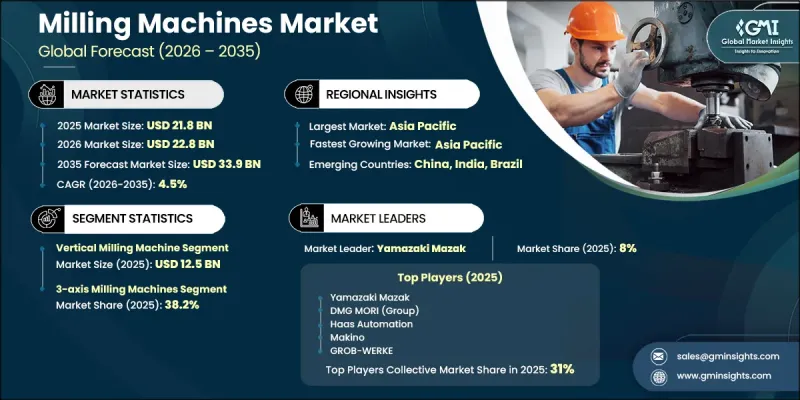
2025年全球銑床市場價值為218億美元,預計到2035年將以4.5%的複合年成長率成長至339億美元。
在當今的製造業環境中,隨著對高精度、操作柔軟性和可靠加工性能的需求不斷成長,銑床產業正在穩步發展。銑床仍然是包括汽車、航太、電子、建築和通用機械工程在內的所有行業工業生產流程中不可或缺的組成部分。市場正在經歷重大變革,從傳統的手動操作設備轉向先進的自動化和數位化控制系統,以提高一致性、減少生產誤差並最大限度地減少對高技能勞動力的依賴。智慧製造技術和數位互聯生產設施的日益普及,進一步加速了能夠更高效地處理複雜加工任務的智慧銑削系統的推出。製造商也在優先考慮具有增強的安全功能、簡化的機器操作和長期服務可靠性的設備,以提高生產率並減少運作。對工廠自動化和精密製造技術的持續投資,不斷推動全球市場的擴張。此外,對能夠提供高度可重複精度和改進工作流程整合的高效加工解決方案的需求不斷成長,也增強了全球銑床市場的長期前景。
| 市場範圍 | |
|---|---|
| 開始年份 | 2025 |
| 預測期 | 2026-2035 |
| 上市時的市場規模 | 218億美元 |
| 預測金額 | 339億美元 |
| 複合年成長率 | 4.5% |
預計2025年,立式銑床市場規模將達125億美元。其強勁的市場地位得益於其對現代製造需求的適應性以及在工業環境中易於操作的特性。立式銑床系統能夠提升操作員在機器設定、調整和生產監控過程中的可視性,進而減少操作失誤和操作員訓練時間。這些優勢提高了整體生產效率,使立式銑床成為尋求可靠且易於使用的加工解決方案的中小型製造企業的理想之選。
到2025年,三軸銑床市佔率將達到38.2%。這些工具機需求持續強勁,因為它們在操作靈活性和成本效益之間實現了有效平衡。大多數標準加工應用,例如鑽孔、輪廓加工、開槽和表面切削,都可以使用三軸系統有效完成。三軸系統能夠支援一致且可重複的生產流程,使其成為專注於常規零件製造和一般工業應用的商業加工車間的理想選擇。
美國銑床市場佔80%的佔有率,預計到2025年市場規模將達到45億美元。美國成熟的工業生產基礎持續推動對先進加工技術的需求,這些技術強調精度、自動化和長期運作性能。航太、國防、汽車和工業設備製造等產業正不斷增加對數位化整合加工系統的投資,以提高生產效率並減少停機時間。此外,美國市場的買家高度重視設備安全、技術支援服務、機器可靠性和操作員培訓解決方案,以提高生產效率並維持具有競爭力的生產標準。
目錄
第1章:調查方法和範圍
第2章執行摘要
第3章 行業洞察
- 產業生態系分析
- 原物料供應商
- 設備製造商
- 每個階段增加的價值
- 影響價值鏈的因素
- 影響產業的因素
- 促進因素
- 產業潛在風險與挑戰
- 市場機遇
- 成長潛力分析
- 監理框架
- 北美監管標準
- 歐洲CE標誌和安全指令
- 亞太製造標準
- 關於環境和永續性的法規
- 關鍵市場趨勢與顛覆性因素
- 技術與創新展望
- 最新科技趨勢
- 新興技術
- 價格分析
- 對過去價格趨勢的分析
- 定價策略:按業務類型分類
- 數控設備與傳統設備的價格比較
- 區域價格波動
- 波特的分析
- PESTLE分析
- 貿易資料分析(HS編碼8459)
- 進出口量及進口額趨勢
- 主要貿易路線及關稅的影響
- 中國出口優勢分析
- 回流和近岸外包的趨勢
- 人工智慧和生成式人工智慧對市場的影響
- 利用人工智慧改造現有經營模式
- 按細分市場分類的生成式人工智慧用例和部署藍圖
- 預測性維護與數位雙胞胎的整合
- 風險、限制和監管考量
- 生產能力和生產情況
- 設備產能:按地區和主要生產商分類
- 運轉率和擴張計劃
第4章 競爭情勢
- 介紹
- 企業市佔率分析
- 企業矩陣分析
- 主要市場公司的競爭分析
- 競爭定位矩陣
- 主要進展
- 併購
- 夥伴關係和聯盟
- 新產品發布
- 業務拓展計劃
第5章 市場估計與預測:依類型分類,2022-2035年
- 立式銑床
- 臥式銑床
第6章 市場估計與預測:依運作技術分類,2022-2035年
- 電腦數值控制(CNC)
- 傳統的
第7章 市場估計與預測:依軸線組成分類 2022-2035 年
- 雙軸銑床
- 三軸銑床
- 四軸銑床
- 五軸銑床
- 其他(6軸、7軸等)
第8章 市場估算與預測:依最終用途分類 2022-2035 年
- 航太/國防
- 車
- 電子設備
- 通用機械
- 其他
第9章 市場估算與預測:通路 2022-2035
- 直銷
- 間接銷售
第10章 市場估計與預測:各國具體情況(2022-2035年)
- 北美洲
- 美國
- 加拿大
- 歐洲
- 英國
- 德國
- 法國
- 義大利
- 西班牙
- 亞太地區
- 印度
- 中國
- 日本
- 澳洲
- 中東和非洲
- UAE
- 沙烏地阿拉伯
- 南非
- 拉丁美洲
- 巴西
- 墨西哥
第11章:公司簡介
- 世界公司
- Haas Automation, Inc.
- Yamazaki Mazak Corporation
- DMG MORI Co., Ltd.
- Okuma Corporation
- Makino Milling Machine Co., Ltd.
- FANUC Corporation
- Doosan Machine Tools/DN Solutions
- Hyundai WIA Corporation
- GROB-WERKE GmbH &Co. KG
- CHIRON Group
- 中國公司
- Jier Machine Tool Group Co., Ltd.
- Qiqihar Heavy CNC Equipment Co., Ltd.
- Zhejiang Rifa Precision Machinery Co., Ltd.
- Beijing Jingdiao Group Co., Ltd.
- Ningbo Haitian Precision Machinery Co., Ltd.
- Jinan First Machine Tool Co., Ltd.
- Wuhan Heavy Duty Machine Tool Group Co., Ltd.
- Baoji Machine Tool Group Co., Ltd.
- Kede CNC Co., Ltd.
- Shandong Weida Precision Intelligent Machinery Co., Ltd.
The Global Milling Machines Market was valued at USD 21.8 billion in 2025 and is estimated to grow at a CAGR of 4.5% to reach USD 33.9 billion by 2035.
The milling machines industry is evolving steadily as modern manufacturing environments increasingly demand high precision, operational flexibility, and reliable machining performance. Milling machines remain a critical part of industrial production processes across sectors, including automotive, aerospace, electronics, construction, and general engineering. The market has experienced a significant transformation with the shift from traditional manually operated equipment to advanced automated and digitally controlled systems that improve consistency, reduce production errors, and minimize dependency on highly skilled labor. Growing adoption of smart manufacturing technologies and digitally connected production facilities is further accelerating the deployment of intelligent milling systems capable of handling complex machining tasks with greater efficiency. Manufacturers are also prioritizing equipment that offers enhanced safety features, simplified machine operation, and long-term service reliability to improve productivity and reduce operational downtime. Rising investment in factory automation and precision manufacturing technologies continues to support market expansion globally. In addition, demand for efficient machining solutions that can deliver repeatable accuracy and improved workflow integration is strengthening the long-term outlook for the global milling machines market.
| Market Scope | |
|---|---|
| Start Year | 2025 |
| Forecast Year | 2026-2035 |
| Start Value | $21.8 Billion |
| Forecast Value | $33.9 Billion |
| CAGR | 4.5% |
The vertical milling machines generated USD 12.5 billion in 2025. Their strong market position is supported by compatibility with modern manufacturing requirements and ease of operation in industrial environments. Vertical milling systems provide improved operator visibility during machine setup, adjustment, and production monitoring, helping reduce operational errors and training time for machine operators. These advantages improve overall production efficiency and make vertical milling machines highly preferred among small and medium-sized manufacturing facilities seeking reliable and user-friendly machining solutions.
The 3-axis milling machines segment accounted for 38.2% share in 2025. These machines continue to maintain strong demand because they provide an effective balance between operational versatility and cost efficiency. Most standard machining applications, including drilling, contouring, slotting, and surface cutting, can be performed efficiently using 3-axis systems. Their ability to support consistent and repeatable production processes makes them a preferred choice for commercial machine shops focused on routine component manufacturing and general industrial applications.
U.S. Milling Machines Market held an 80% share, generating USD 4.5 billion in 2025. The country's mature industrial manufacturing base continues to drive demand for advanced machining technologies that emphasize precision, automation, and long-term operational performance. Industries including aerospace, defense, automotive, and industrial equipment manufacturing are increasingly investing in digitally integrated machining systems capable of improving productivity and reducing downtime. Buyers across the U.S. market are also placing strong emphasis on equipment safety, technical support services, machine reliability, and operator training solutions to enhance manufacturing efficiency and maintain competitive production standards.
Key companies operating in the Global Milling Machines Market include Haas Automation, Inc., Yamazaki Mazak Corporation, DMG MORI Co., Ltd., Okuma Corporation, Makino Milling Machine Co., Ltd., FANUC Corporation, Doosan Machine Tools / DN Solutions, Hyundai WIA Corporation, GROB-WERKE GmbH & Co. KG, CHIRON Group, Jier Machine Tool Group Co., Ltd., Qiqihar Heavy CNC Equipment Co., Ltd., Zhejiang Rifa Precision Machinery Co., Ltd., Beijing Jingdiao Group Co., Ltd., Ningbo Haitian Precision Machinery Co., Ltd., Jinan First Machine Tool Co., Ltd., Wuhan Heavy Duty Machine Tool Group Co., Ltd., Baoji Machine Tool Group Co., Ltd., Kede CNC Co., Ltd., and Shandong Weida Precision Intelligent Machinery Co., Ltd. Companies operating in the milling machines market are implementing a range of strategic initiatives to strengthen their market position and expand their global customer base. Major manufacturers are investing heavily in automation technologies, artificial intelligence integration, and digital monitoring systems to improve machine efficiency and precision. Businesses are also focusing on developing smart CNC milling solutions capable of supporting connected factory environments and predictive maintenance capabilities. Strategic partnerships with industrial manufacturers and technology providers are helping companies expand their product portfolios and improve technological capabilities. In addition, manufacturers are strengthening after-sales service networks, technical training programs, and maintenance support to improve customer retention and operational reliability.
Table of Contents
Chapter 1 Methodology & Scope
- 1.1 Research approach
- 1.2 Quality Commitments
- 1.2.1 GMI AI policy & data integrity commitment
- 1.2.1.1 Source consistency protocol
- 1.2.1 GMI AI policy & data integrity commitment
- 1.3 Research Trail & Confidence Scoring
- 1.3.1 Research Trail Components
- 1.3.2 Scoring Components
- 1.4 Data Collection
- 1.4.1 Partial list of primary sources
- 1.5 Data mining sources
- 1.5.1 Paid sources
- 1.5.1.1 Sources, by region
- 1.5.1 Paid sources
- 1.6 Base estimates and calculations
- 1.6.1 Base year calculation for any one approach
- 1.7 Forecast model
- 1.7.1 Quantified market impact analysis
- 1.7.1.1 Mathematical impact of growth parameters on forecast
- 1.7.1 Quantified market impact analysis
- 1.8 Research transparency addendum
- 1.8.1 Source attribution framework
- 1.8.2 Quality assurance metrics
- 1.8.3 Our commitment to trust
Chapter 2 Executive summary
- 2.1 Industry 360° synopsis
- 2.2 Key market trends
- 2.2.1 Country
- 2.2.2 Type
- 2.2.3 Operating Technology
- 2.2.4 Axis Configuration
- 2.2.5 End Use
- 2.2.6 Distribution Channel
Chapter 3 Industry insights
- 3.1 Industry ecosystem analysis
- 3.1.1 Raw material suppliers
- 3.1.2 Equipment manufacturers
- 3.1.3 Value addition at each stage
- 3.1.4 Factor affecting the value chain
- 3.2 Industry impact forces
- 3.2.1 Growth drivers
- 3.2.2 Industry pitfalls and challenges
- 3.2.3 Market opportunities
- 3.3 Growth potential analysis
- 3.4 Regulatory framework
- 3.4.1 North America regulatory standards
- 3.4.2 European CE marking and safety directives
- 3.4.3 Asia Pacific manufacturing standards
- 3.4.4 Environmental and sustainability regulations
- 3.5 Major market trends and disruptions
- 3.6 Technological and innovation landscape
- 3.6.1 Current technological trends
- 3.6.2 Emerging technologies
- 3.7 Pricing analysis (driven by primary research)
- 3.7.1 Historical price trend analysis (driven by primary research)
- 3.7.2 Pricing strategy by player type
- 3.7.3 Price comparison between CNC and conventional equipment
- 3.7.4 Regional price variations
- 3.8 Porter’s analysis
- 3.9 Pestle analysis
- 3.10 Trade data analysis (driven by paid database) ( HS Code 8459)
- 3.10.1 Import and export volume and value trends
- 3.10.2 Key trade corridors and tariff impact
- 3.10.3 China’s export dominance analysis
- 3.10.4 Reshoring and nearshoring trends
- 3.11 Impact of AI and generative AI on the market
- 3.11.1 AI-driven disruption of existing business models
- 3.11.2 GenAI use cases and adoption roadmap by segment
- 3.11.3 Predictive maintenance and digital twin integration
- 3.12 Risks, limitations, and regulatory considerations
- 3.12.1 Capacity and production landscape (driven by primary research)
- 3.12.2 Installed capacity by region and key producer (driven by primary research)
- 3.12.3 Capacity utilization rates and expansion pipelines (driven by primary research)
Chapter 4 Competitive landscape, 2025
- 4.1 Introduction
- 4.2 Company market share analysis
- 4.3 Company matrix analysis
- 4.4 Competitive analysis of major market players
- 4.5 Competitive positioning matrix
- 4.6 Key developments
- 4.6.1 Mergers & acquisitions
- 4.6.2 Partnerships & collaborations
- 4.6.3 New product launches
- 4.7 Expansion plans
Chapter 5 Market Estimates & Forecast, By Type 2022 - 2035, (USD Billion; Thousand Units)
- 5.1 Key trends
- 5.2 Vertical milling machine
- 5.3 Horizontal milling machine
Chapter 6 Market Estimates & Forecast, By Operating Technology 2022 - 2035, (USD Billion; Thousand Units)
- 6.1 Key trends
- 6.2 Computer numerical control (CNC)
- 6.3 Conventional
Chapter 7 Market Estimates & Forecast, By Axis Configuration 2022 - 2035, (USD Billion; Thousand Units)
- 7.1 Key trends
- 7.2 2-Axis milling machine
- 7.3 3-Axis milling machine
- 7.4 4-Axis milling machine
- 7.5 5-Axis milling machine
- 7.6 Others (6-axis, 7-axis. etc.)
Chapter 8 Market Estimates & Forecast, By End Use 2022 - 2035, (USD Billion; Thousand Units)
- 8.1 Key trends
- 8.2 Aerospace & defence
- 8.3 Automotive
- 8.4 Electronics
- 8.5 General machinery
- 8.6 Others
Chapter 9 Market Estimates & Forecast, By Distribution Channel 2022 - 2035, (USD Billion; Thousand Units)
- 9.1 Key trends
- 9.2 Direct sales
- 9.3 Indirect sales
Chapter 10 Market Estimates & Forecast, By Country 2022 - 2035, (USD Billion; Thousand Units)
- 10.1 Key trends
- 10.2 North America
- 10.2.1 U.S
- 10.2.2 Canada
- 10.3 Europe
- 10.3.1 U.K
- 10.3.2 Germany
- 10.3.3 France
- 10.3.4 Italy
- 10.3.5 Spain
- 10.4 Asia Pacific
- 10.4.1 India
- 10.4.2 China
- 10.4.3 Japan
- 10.4.4 Australia
- 10.5 Middle East and Africa
- 10.5.1 UAE
- 10.5.2 Saudi Arabia
- 10.5.3 South Africa
- 10.6 Latin America
- 10.6.1 Brazil
- 10.6.2 Mexico
Chapter 11 Company Profiles
- 11.1 Global Companies
- 11.1.1 Haas Automation, Inc.
- 11.1.2 Yamazaki Mazak Corporation
- 11.1.3 DMG MORI Co., Ltd.
- 11.1.4 Okuma Corporation
- 11.1.5 Makino Milling Machine Co., Ltd.
- 11.1.6 FANUC Corporation
- 11.1.7 Doosan Machine Tools / DN Solutions
- 11.1.8 Hyundai WIA Corporation
- 11.1.9 GROB-WERKE GmbH & Co. KG
- 11.1.10 CHIRON Group
- 11.2 China Companies
- 11.2.1 Jier Machine Tool Group Co., Ltd.
- 11.2.2 Qiqihar Heavy CNC Equipment Co., Ltd.
- 11.2.3 Zhejiang Rifa Precision Machinery Co., Ltd.
- 11.2.4 Beijing Jingdiao Group Co., Ltd.
- 11.2.5 Ningbo Haitian Precision Machinery Co., Ltd.
- 11.2.6 Jinan First Machine Tool Co., Ltd.
- 11.2.7 Wuhan Heavy Duty Machine Tool Group Co., Ltd.
- 11.2.8 Baoji Machine Tool Group Co., Ltd.
- 11.2.9 Kede CNC Co., Ltd.
- 11.2.10 Shandong Weida Precision Intelligent Machinery Co., Ltd.

 電動道路銑鉋機市場:全球市場預測,2026-2032年
 大型臥式砂磨機市場規模、佔有率和成長分析:按機器類型、研磨介質、應用、最終用戶產業、營運方式和地區分類-2026-2033年產業預測移動式立柱銑床市場:全球市場預測,2026-2032年銑床市場-2026-2032年全球市場預測離子研磨系統市場-2026-2032年全球市場預測
 離子研磨系統市場規模、佔有率和成長分析:按系統類型、離子類型、應用、最終用戶和地區分類-2026-2033年產業預測
 榨油機械市場規模、佔有率和成長分析:按機器類型、運作模式、應用、種子類型、加工能力、最終用戶和地區分類-2026-2033年產業預測
 2026年全球銑床切割機市場報告實驗室樣品研磨機市場:按研磨機類型、材料類型、分銷管道、應用和最終用戶分類-全球預測,2026-2032年小米碾米機械市場:依機器類型、產能、技術、自動化程度、最終用戶、通路分類,全球預測(2026-2032年)