


 |
市場調查報告書
商品編碼
2061319
電動汽車暖通空調服務市場機會、成長要素、產業趨勢分析及2026-2035年預測Electric Vehicle HVAC Service Market Opportunity, Growth Drivers, Industry Trend Analysis, and Forecast 2026 - 2035 |
||||||

2025 年全球電動車 HVAC 服務市場價值為 67 億美元,預計到 2035 年將達到 340 億美元,年複合成長率為 16.5%。
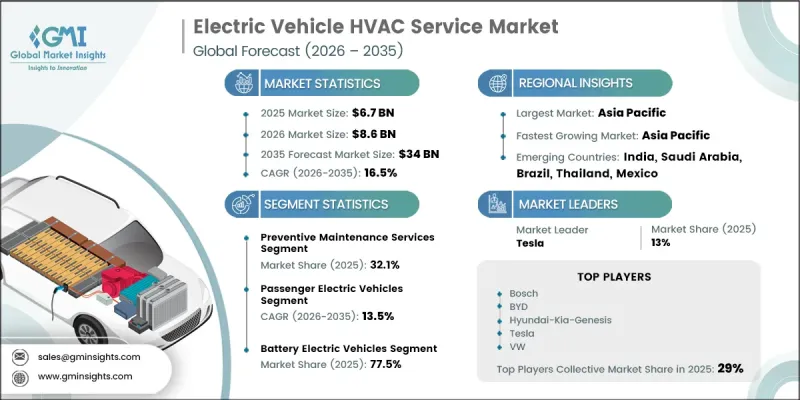
隨著電動車 (EV) 在全球範圍內的普及,對暖通空調 (HVAC) 系統維護、診斷和維修服務的需求持續顯著成長。電動車製造商不斷將先進的溫度控管技術和熱泵系統整合到現代車輛中,因此對系統校準、感測器測試和能源效率最佳化服務的需求也在加速成長。向軟體主導的暖通空調系統運作模式的轉變也增加了對定期檢查和技術維護的需求。汽車製造商和車隊營運商越來越重視電池效率、續航里程最佳化和車輛能源管理,進一步凸顯了暖通空調系統維護的重要性。由於溫度控管系統直接影響電池溫度穩定性和電力消耗,因此預防性維護已成為至關重要的營運重點。商用電動車隊的快速部署也推動了整個電動出行生態系統對暖通空調服務解決方案的需求成長。
| 市場範圍 | |
|---|---|
| 開始年份 | 2025 |
| 預測期 | 2026-2035 |
| 上市時的市場規模 | 67億美元 |
| 預測金額 | 340億美元 |
| 複合年成長率 | 16.5% |
預計到2025年,預防性保養服務市佔率將達到32.1%,並在2026年至2035年間維持14.5%的複合年成長率。該細分市場持續保持主導地位,主要得益於對日常檢查、冷媒監測、過濾器更換和持續熱力系統聯網汽車的日益重視。車主和車隊管理人員越來越依賴預防性維護策略來提高暖通空調系統效率、降低長期維修成本並維持車輛整體性能。互聯汽車技術和預測性維護平台的擴展也促進了電動汽車產業對定期暖通空調服務計畫的日益普及。
預計到2025年,搭乘用電動車市佔率將達到77.7%,並在2035年之前以13.5%的複合年成長率成長。先進的暖通空調(HVAC)技術,包括先進的熱泵和電池溫度控管系統,其日益普及推動了對專業維護和軟體校準支援的需求。汽車製造商致力於提升車內舒適度、保持電池冷卻效率並最大限度地延長車輛續航里程,這進一步增強了搭乘用電動車對專業HVAC維護服務的需求。此外,消費者對車輛性能和能源最佳化的期望不斷提高,也推動了溫度控管系統的定期維護。
預計到2025年,中國電動車暖通空調(HVAC)服務市場將佔據61%的市場佔有率,市場規模將達到22億美元。憑藉龐大的電動車保有量、強大的國內電動車製造網路以及快速發展的電動出行基礎設施,中國持續引領區域產業的發展。搭乘用電動車、公共交通車輛和商用電動車的日益普及,顯著提升了對HVAC診斷、維修、維護和軟體校準服務的需求。此外,電動車在物流和運輸領域的廣泛應用,也加速了全國對商用電動車HVAC服務解決方案的需求。
目錄
第1章:調查方法
第2章執行摘要
第3章 行業洞察
- 產業生態系分析
- 供應商情況
- 利潤率分析
- 成本結構
- 每個階段增加的價值
- 影響價值鏈的因素
- 中斷
- 影響產業的因素
- 促進因素
- 電動車的廣泛應用
- 先進的溫度控管系統
- 擴大商用電動車隊規模
- 暖通空調系統軟體整合的進展
- 產業潛在風險與挑戰
- 服務交付的高度複雜性
- 熟練勞動力短缺
- 市場機遇
- 擴大電動車售後服務網路
- 熱泵的廣泛應用
- 車隊維護合約的成長
- 促進因素
- 成長潛力分析
- 技術與創新展望
- 最新科技趨勢
- 新興技術
- 價格分析
- 對過去價格趨勢的分析
- 定價策略:按業務類型分類
- 監理情勢
- 北美洲
- 美國環保署 (EPA) 關於提供機動車輛空調 (MVAC) 的規定
- 美國環保署 (EPA) 技術認證標準
- 美國環保署 (EPA) 冷媒處理標準
- 加拿大聯邦鹵代烴法規
- 歐洲
- 歐盟氟氣法規
- 歐盟汽車空調指令
- 德國氣候保護化學品法規
- 亞太地區
- 日本氟化合物管制法
- 日本汽車回收法
- 澳洲臭氧層保護法
- 印度降溫行動計劃
- 印度HCFC分階段退役與管理計劃
- 拉丁美洲
- 巴西逐步淘汰氫氯氟烴
- 巴西冷媒控制標準
- 墨西哥的車輛排放氣體標準
- 中東和非洲
- 阿拉伯聯合大公國綠色出行法規
- 阿拉伯聯合大公國冷媒控制標準
- 南非空氣品質法
- 南非關於消耗臭氧層物質的法規
- 北美洲
- 波特的分析
- PESTLE分析
- 專利分析
- 成本細分分析
- 人工智慧和生成式人工智慧對市場的影響
- 利用人工智慧改造現有經營模式
- 按細分市場分類的生成式人工智慧用例和部署藍圖
- 風險、限制和監管考量
- 永續性和環境方面
- 永續計劃
- 減少廢棄物策略
- 生產中的能源效率
- 具有環保意識的舉措
- 考慮碳足跡
- 預測假設和情境分析
- 基本案例:驅動複合年成長率的關鍵宏觀經濟與產業變量
- 樂觀情境:宏觀經濟與產業的順風
- 悲觀情景:宏觀經濟放緩或產業逆風
第4章 競爭情勢
- 介紹
- 企業市佔率分析
- 北美洲
- 歐洲
- 亞太地區
- LATAM
- 中東和非洲
- 主要市場公司的競爭分析
- 競爭定位矩陣
- 主要進展
- 併購
- 夥伴關係和聯盟
- 新產品發布
- 業務拓展計劃及資金籌措
- 按公司規模進行基準測試
- 排名分類標準與遴選標準
- 按銷售額、地區和創新能力分類的層級定位矩陣。
第5章 市場估計與預測:依服務業分類,2022-2035年
- 預防性維護服務
- 診斷服務
- 維修和更換服務
- 安裝和維修服務
- 軟體和校準服務
第6章 市場估價與預測:依車輛類型分類,2022-2035年
- 搭乘用電動車
- 掀背車
- 轎車
- SUV 與跨界車
- 商用電動車
- 輕型商用車(LCV)
- 中型和重型商用車輛(M&HCV)
- 電動巴士
第7章 市場估計與預測:依促進因素分類,2022-2035年
- 電池式電動車(BEV)
- 插電式混合動力車(PHEV)
- 混合動力電動車(HEV)
第8章 市場估算與預測:依最終使用者分類,2022-2035年
- 私家車車主
- 車隊營運商
- 共享旅遊公司
- 大眾運輸管理局
- 物流/配送公司
第9章 市場估計與預測:依地區分類,2022-2035年
- 北美洲
- 美國
- 加拿大
- 歐洲
- 德國
- 英國
- 法國
- 義大利
- 西班牙
- 俄羅斯
- 挪威
- 荷蘭
- 瑞典
- 亞太地區
- 中國
- 印度
- 日本
- 澳洲
- 韓國
- 新加坡
- 泰國
- 印尼
- 越南
- 拉丁美洲
- 巴西
- 墨西哥
- 阿根廷
- 中東和非洲
- 南非
- 沙烏地阿拉伯
- UAE
- 土耳其
第10章:公司簡介
- 世界公司
- BMW
- Bosch
- BYD
- DENSO
- Hyundai Motor
- Mercedes-Benz
- Stellantis
- Tesla
- Valeo
- Volkswagen
- 當地公司
- NIO
- Geely Auto
- Mahindra Electric Automobile
- Rivian
- SAIC Motor
- Tata Motors
- 新興企業
- Li Auto
- Lucid Motors
- VinFast
- Xpeng Motors
The Global Electric Vehicle HVAC Service Market was valued at USD 6.7 billion in 2025 and is estimated to grow at a CAGR of 16.5% to reach USD 34 billion by 2035.
The rising global adoption of electric vehicles continues to create substantial demand for HVAC maintenance, diagnostics, and repair services. As EV manufacturers increasingly integrate advanced thermal management technologies and heat pump systems into modern vehicles, the requirement for system calibration, sensor testing, and energy-efficiency optimization services is accelerating. The growing shift toward software-driven HVAC operations is also contributing to the need for periodic inspections and technical servicing. Automotive companies and fleet operators are placing stronger emphasis on battery efficiency, driving range optimization, and vehicle energy management, further increasing the importance of HVAC system upkeep. Since thermal management systems directly influence battery temperature stability and power consumption, preventive servicing has become a critical operational priority. The rapid deployment of electric commercial fleets is also supporting higher demand for HVAC servicing solutions across the broader electric mobility ecosystem.
| Market Scope | |
|---|---|
| Start Year | 2025 |
| Forecast Year | 2026-2035 |
| Start Value | $6.7 Billion |
| Forecast Value | $34 Billion |
| CAGR | 16.5% |
The preventive maintenance services segment accounted for 32.1% share in 2025 and are anticipated to witness a CAGR of 14.5% between 2026 and 2035. The segment continues to maintain a leading position due to the growing focus on scheduled inspections, refrigerant monitoring, filter replacements, and ongoing thermal system maintenance. Vehicle owners and fleet management companies increasingly rely on proactive servicing strategies to improve HVAC system efficiency, reduce long-term repair costs, and maintain overall vehicle performance. The expansion of connected vehicle technologies and predictive maintenance platforms is also contributing to higher adoption of routine HVAC service programs across the EV industry.
The passenger electric vehicles segment held a 77.7% share in 2025 and is forecast to grow at a CAGR of 13.5% through 2035. The increasing integration of sophisticated HVAC technologies, including advanced heat pumps and battery thermal management systems, is driving the need for specialized servicing and software calibration support. Automakers are heavily focused on enhancing cabin comfort, maintaining battery cooling efficiency, and maximizing vehicle driving range, which continues to strengthen demand for professional HVAC maintenance services in passenger EVs. In addition, rising consumer expectations for vehicle performance and energy optimization are encouraging regular servicing of thermal management systems.
China Electric Vehicle HVAC Service Market held a 61% share and generated USD 2.2 billion in 2025. The country continues to lead the regional industry due to its massive electric vehicle population, robust domestic EV manufacturing network, and rapidly expanding electric mobility infrastructure. Strong adoption of electric passenger vehicles, public transportation fleets, and commercial EVs has significantly increased the requirement for HVAC diagnostics, repair, maintenance, and software calibration services. The ongoing expansion of electric transportation within logistics and transit sectors is also accelerating the need for commercial EV HVAC servicing solutions throughout the country.
Key participants operating in the Global Electric Vehicle HVAC Service Market include BMW, Bosch, BYD, Geely, Hyundai-Kia-Genesis, Mercedes-Benz, NIO Service, Stellantis, Tesla, and Volkswagen. Companies operating in the electric vehicle HVAC service market are actively implementing several strategic initiatives to strengthen their market presence and improve long-term competitiveness. Major industry participants are investing heavily in advanced diagnostic technologies, AI-driven predictive maintenance platforms, and software-based HVAC calibration systems to improve service efficiency and vehicle performance. Many companies are expanding their authorized service networks and strengthening partnerships with EV manufacturers and fleet operators to increase customer reach and aftermarket support capabilities. Businesses are also prioritizing technician training programs focused on advanced thermal management systems and next-generation heat pump technologies. In addition, market players are increasing investments in digital service platforms, remote diagnostics, and connected vehicle solutions to enhance customer experience, reduce downtime, and support the growing demand for efficient electric vehicle HVAC maintenance services across global markets.
Table of Contents
Chapter 1 Research Methodology
- 1.1 Research approach
- 1.2 Quality Commitments
- 1.2.1 GMI AI policy & data integrity commitment
- 1.2.1.1 Source consistency protocol
- 1.2.1 GMI AI policy & data integrity commitment
- 1.3 Research Trail & Confidence Scoring
- 1.3.1 Research Trail Components
- 1.3.2 Scoring Components
- 1.4 Data Collection
- 1.4.1 Partial list of primary sources
- 1.5 Data mining sources
- 1.5.1 Paid sources
- 1.5.1.1 Sources, by region
- 1.5.1 Paid sources
- 1.6 Base estimates and calculations
- 1.6.1 Base year calculation for any one approach
- 1.7 Forecast model
- 1.7.1 Quantified market impact analysis
- 1.7.1.1 Mathematical impact of growth parameters on forecast
- 1.7.1 Quantified market impact analysis
- 1.8 Research transparency addendum
- 1.8.1 Source attribution framework
- 1.8.2 Quality assurance metrics
- 1.8.3 Our commitment to trust
Chapter 2 Executive Summary
- 2.1 Industry 360° synopsis, 2022 - 2035
- 2.2 Key market trends
- 2.2.1 Regional
- 2.2.2 Service
- 2.2.3 Vehicle
- 2.2.4 Propulsion
- 2.2.5 End User
- 2.3 TAM Analysis, 2026-2035
- 2.4 CXO perspectives: Strategic imperatives
Chapter 3 Industry Insights
- 3.1 Industry ecosystem analysis
- 3.1.1 Supplier landscape
- 3.1.2 Profit margin analysis
- 3.1.3 Cost structure
- 3.1.4 Value addition at each stage
- 3.1.5 Factor affecting the value chain
- 3.1.6 Disruptions
- 3.2 Industry impact forces
- 3.2.1 Growth drivers
- 3.2.1.1 Rising electric vehicle adoption
- 3.2.1.2 Growth in advanced thermal management systems
- 3.2.1.3 Expansion of commercial electric vehicle fleets
- 3.2.1.4 Increasing software integration in HVAC systems
- 3.2.2 Industry pitfalls and challenges
- 3.2.2.1 High servicing complexity
- 3.2.2.2 Limited skilled workforce
- 3.2.3 Market opportunities
- 3.2.3.1 Expansion of EV aftermarket service networks
- 3.2.3.2 Increasing heat pump adoption
- 3.2.3.3 Growth in fleet maintenance contracts
- 3.2.1 Growth drivers
- 3.3 Growth potential analysis
- 3.4 Technology and innovation landscape
- 3.4.1 Current technological trends
- 3.4.2 Emerging technologies
- 3.5 Pricing Analysis (Driven by primary research)
- 3.5.1 Historical Price Trend Analysis
- 3.5.2 Pricing Strategy by Player Type
- 3.6 Regulatory landscape
- 3.6.1 North America
- 3.6.1.1 U.S. EPA MVAC Servicing Regulations
- 3.6.1.2 U.S. EPA Technician Certification Standards
- 3.6.1.3 U.S. EPA Refrigerant Handling Standards
- 3.6.1.4 Canada Federal Halocarbon Regulations
- 3.6.2 Europe
- 3.6.2.1 EU Fluorinated Gas Regulation
- 3.6.2.2 EU Mobile Air Conditioning Directive
- 3.6.2.3 Germany Climate Protection Chemical Regulation
- 3.6.3 Asia Pacific
- 3.6.3.1 Japan Fluorocarbon Management Act
- 3.6.3.2 Japan Vehicle Recycling Act
- 3.6.3.3 Australia Ozone Protection Act
- 3.6.3.4 India Cooling Action Plan
- 3.6.3.5 India HCFC Phase Out Management Plan
- 3.6.4 Latin America
- 3.6.4.1 Brazil HCFC Phase Out Regulations
- 3.6.4.2 Brazil Refrigerant Management Standards
- 3.6.4.3 Mexico Vehicle Emission Standards
- 3.6.5 Middle East & Africa
- 3.6.5.1 UAE Green Mobility Regulations
- 3.6.5.2 UAE Refrigerant Management Standards
- 3.6.5.3 South Africa Air Quality Act
- 3.6.5.4 South Africa Ozone Depleting Substance Regulations
- 3.6.1 North America
- 3.7 Porter's analysis
- 3.8 PESTEL analysis
- 3.9 Patent analysis (Driven by primary research)
- 3.10 Cost breakdown analysis
- 3.11 Impact of AI and Generative AI on the Market
- 3.11.1 AI Driven Disruption of Existing Business Models
- 3.11.2 GenAI Use Cases and Adoption Roadmap by Segment
- 3.11.3 Risks Limitations and Regulatory Considerations
- 3.12 Sustainability and environmental aspects
- 3.12.1 Sustainable practices
- 3.12.2 Waste reduction strategies
- 3.12.3 Energy efficiency in production
- 3.12.4 Eco-friendly Initiatives
- 3.12.5 Carbon footprint considerations
- 3.13 Forecast assumptions & scenario analysis (Driven by Primary Research)
- 3.13.1 Base Case- Key Macro & Industry Variables Driving CAGR
- 3.13.2 Optimistic Scenarios- Favorable macro and industry tailwinds
- 3.13.3 Pessimistic Scenario - Macroeconomic slowdown or industry headwinds
Chapter 4 Competitive Landscape, 2025
- 4.1 Introduction
- 4.2 Company market share analysis
- 4.2.1 North America
- 4.2.2 Europe
- 4.2.3 Asia Pacific
- 4.2.4 LATAM
- 4.2.5 MEA
- 4.3 Competitive analysis of major market players
- 4.4 Competitive positioning matrix
- 4.5 Key developments
- 4.5.1 Mergers & acquisitions
- 4.5.2 Partnerships & collaborations
- 4.5.3 New Product Launches
- 4.5.4 Expansion Plans and funding
- 4.6 Company tier benchmarking
- 4.6.1 Tier classification criteria & qualifying thresholds
- 4.6.2 Tier positioning matrix by revenue, geography & innovation
Chapter 5 Market Estimates & Forecast, By Service, 2022 - 2035 (USD Mn)
- 5.1 Key trends
- 5.2 Preventive Maintenance Services
- 5.3 Diagnostic Services
- 5.4 Repair & Replacement Services
- 5.5 Installation & Retrofit Services
- 5.6 Software & Calibration Services
Chapter 6 Market Estimates & Forecast, By Vehicle, 2022 - 2035 (USD Mn)
- 6.1 Key trends
- 6.2 Passenger Electric Vehicles
- 6.2.1 Hatchbacks
- 6.2.2 Sedans
- 6.2.3 SUVs & Crossovers
- 6.3 Commercial Electric Vehicles
- 6.3.1 Light Commercial Vehicles (LCVs)
- 6.3.2 Medium & Heavy Commercial Vehicles (M&HCVs)
- 6.3.3 Electric Buses
Chapter 7 Market Estimates & Forecast, By Propulsion, 2022 - 2035 (USD Mn)
- 7.1 Key trends
- 7.2 Battery Electric Vehicles (BEVs)
- 7.3 Plug-in Hybrid Electric Vehicles (PHEVs)
- 7.4 Hybrid Electric Vehicles (HEVs)
Chapter 8 Market Estimates & Forecast, By End User, 2022 - 2035 (USD Mn)
- 8.1 Key trends
- 8.2 Individual Vehicle Owners
- 8.3 Fleet Operators
- 8.4 Ride-Hailing & Mobility Companies
- 8.5 Public Transport Authorities
- 8.6 Logistics & Delivery Operators
Chapter 9 Market Estimates & Forecast, By Region, 2022 - 2035 (USD Mn)
- 9.1 Key trends
- 9.2 North America
- 9.2.1 US
- 9.2.2 Canada
- 9.3 Europe
- 9.3.1 Germany
- 9.3.2 UK
- 9.3.3 France
- 9.3.4 Italy
- 9.3.5 Spain
- 9.3.6 Russia
- 9.3.7 Norway
- 9.3.8 Netherlands
- 9.3.9 Sweden
- 9.4 Asia Pacific
- 9.4.1 China
- 9.4.2 India
- 9.4.3 Japan
- 9.4.4 Australia
- 9.4.5 South Korea
- 9.4.6 Singapore
- 9.4.7 Thailand
- 9.4.8 Indonesia
- 9.4.9 Vietnam
- 9.5 Latin America
- 9.5.1 Brazil
- 9.5.2 Mexico
- 9.5.3 Argentina
- 9.6 MEA
- 9.6.1 South Africa
- 9.6.2 Saudi Arabia
- 9.6.3 UAE
- 9.6.4 Turkey
Chapter 10 Company Profiles
- 10.1 Global Players
- 10.1.1 BMW
- 10.1.2 Bosch
- 10.1.3 BYD
- 10.1.4 DENSO
- 10.1.5 Hyundai Motor
- 10.1.6 Mercedes-Benz
- 10.1.7 Stellantis
- 10.1.8 Tesla
- 10.1.9 Valeo
- 10.1.10 Volkswagen
- 10.2 Regional Players
- 10.2.1 NIO
- 10.2.2 Geely Auto
- 10.2.3 Mahindra Electric Automobile
- 10.2.4 Rivian
- 10.2.5 SAIC Motor
- 10.2.6 Tata Motors
- 10.3 Emerging Players
- 10.3.1 Li Auto
- 10.3.2 Lucid Motors
- 10.3.3 VinFast
- 10.3.4 Xpeng Motors

 汽車電動空調壓縮機市場規模、佔有率和成長分析:按車輛類型、驅動系統、銷售管道和地區分類-2026-2033年產業預測
 2026年全球汽車電動空調壓縮機市場報告
 汽車空氣壓縮機市場:2026-2032年全球市場預測(依車輛類型、產品類型、驅動系統、潤滑方式、應用、銷售管道及最終用途分類)
 全球電動汽車壓縮機市場規模、佔有率、趨勢和成長分析報告(2026-2034)汽車空氣壓縮機市場(按壓縮機類型、驅動系統、應用、最終用途和分銷管道分類)-2026-2032年全球預測汽車空氣壓縮機市場:2026-2032年全球預測(依車輛類型、技術、應用、驅動系統、潤滑系統和冷卻系統分類)
 汽車電子壓縮機市場 - 全球產業規模、佔有率、趨勢、機會和預測,按產品、車輛類型、驅動系統、地區和競爭格局分類,2020-2030 年預測
 全球電動汽車壓縮機市場全球汽車電動暖通空調壓縮機市場
 全球汽車 HVAC 壓縮機市場(2025-2029)