


 |
市場調查報告書
商品編碼
2061297
衛星衛星群市場機會、成長要素、產業趨勢分析及2026-2035年預測Satellite Mega-Constellation Market Opportunity, Growth Drivers, Industry Trend Analysis, and Forecast 2026 - 2035 |
||||||

全球衛星衛星群市場預計到 2025 年將價值 149 億美元,預計到 2035 年將以 14.4% 的複合年成長率成長至 580 億美元。
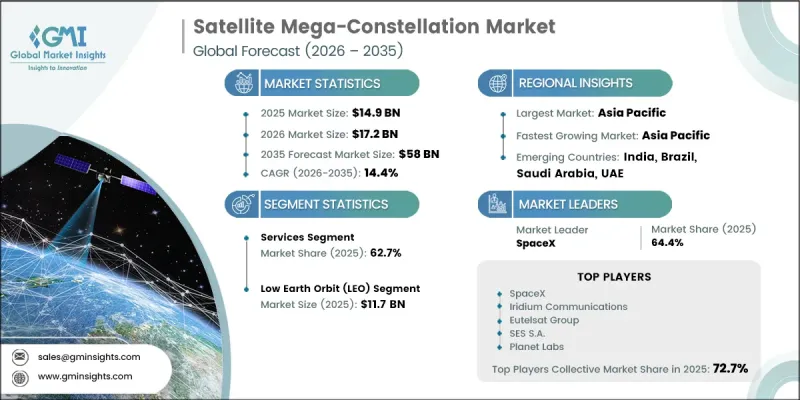
衛星衛星群產業的整體成長主要受以下因素驅動:對不間斷全球寬頻存取日益成長的需求、對太空基礎設施的資本投入不斷增加,以及衛星通訊和資料傳輸服務的部署不斷擴展。發射技術和衛星製造流程的持續改進正在降低營運成本並縮短大規模衛星群的部署週期。對低延遲通訊網路的需求也在加速全球先進衛星系統的擴張。隨著衛星連接在通訊、交通、航空、航運和數位服務等眾多行業的廣泛應用,市場呈現出強勁的成長勢頭。地球觀測、遙感探測、即時分析、物聯網 (IoT) 連接和直接設備通訊等應用的擴展進一步增強了市場需求。此外,自 2022 年起,軟體定義衛星架構的整合透過實現在軌變更、自適應網路管理和提高任務效率,顯著提升了運作柔軟性。這些進步不斷提升覆蓋範圍、通訊可靠性和網路性能,為全球衛星衛星群市場創造了有利的成長機會。
| 市場範圍 | |
|---|---|
| 開始年份 | 2025 |
| 預測期 | 2026-2035 |
| 上市時的市場規模 | 149億美元 |
| 預測金額 | 580億美元 |
| 複合年成長率 | 14.4% |
預計到2035年,太空領域將以16.2%的複合年成長率成長,這主要得益於衛星發射技術的快速發展和衛星群擴展舉措投資的增加。製造能力的提升和發射效率的提高,有助於快速部署在軌資產,並加強衛星衛星群產業網路基礎設施的整體發展。
預計到2025年,低軌道(LEO)衛星市場規模將達1,17億美元。 LEO系統日益普及的原因在於其能夠提供低延遲通訊、高速資料傳輸以及廣泛的區域和全球覆蓋範圍。 LEO系統適用於大規模衛星群部署和即時連接應用,這持續推動多個終端用戶領域的商業需求。
預計到2025年,北美衛星衛星群市場將佔據41.1%的市場。區域市場成長的驅動力來自成熟的私人航太公司、先進的航太基礎設施以及高度發展的商業航太生態系統。大規模衛星網路的持續部署和日益頻繁的發射活動正在推動全部區域的技術進步和市場擴張。衛星寬頻服務的早期商業化,以及政府和企業部門不斷成長的需求,進一步增強了北美衛星衛星群產業的發展前景。
目錄
第1章:調查方法和範圍
第2章執行摘要
第3章 行業洞察
- 產業生態系分析
- 供應商情況
- 利潤率
- 成本結構
- 每個階段增加的價值
- 影響價值鏈的因素
- 中斷
- 影響產業的因素
- 促進因素
- 全球對寬頻連線的需求日益成長
- 增加國防和軍事對太空通訊網路的投資
- 可重複使用火箭和衛星製造技術的進步
- 對即時地球觀測和數據分析的需求日益成長
- 物聯網和設備直接衛星通訊服務的擴展
- 產業潛在風險與挑戰
- 高額資本需求及較長的投資回收期
- 太空碎片和監管挑戰
- 市場機遇
- 擴展在軌資料處理與邊緣運算能力
- 基於SaaS的衛星經營模式的興起
- 促進因素
- 成長潛力分析
- 監理情勢
- 北美洲
- 歐洲
- 亞太地區
- 拉丁美洲
- 中東和非洲
- 波特的分析
- PESTLE分析
- 技術與創新展望
- 最新科技趨勢
- 新興技術
- 價格趨勢
- 按地區
- 依產品
- 定價策略
- 新興經營模式
- 合規要求
- 專利和智慧財產權分析
第4章 競爭情勢
- 介紹
- 企業市佔率分析
- 按地區
- 北美洲
- 歐洲
- 亞太地區
- 拉丁美洲
- 中東和非洲
- 市場集中度分析
- 按地區
- 主要公司的競爭標竿分析
- 財務績效比較
- 收入
- 利潤率
- R&D
- 產品系列比較
- 產品線寬度
- 科技
- 創新
- 區域擴張比較
- 全球擴張分析
- 服務網路覆蓋
- 按地區分類的市場滲透率
- 競爭定位矩陣
- 領導者
- 挑戰者
- 追蹤者
- 小眾玩家
- 戰略展望矩陣
- 財務績效比較
- 主要進展
- 併購
- 夥伴關係和聯盟
- 技術進步
- 擴張和投資策略
- 數位轉型計劃
- 新興企業競爭公司和新創企業的發展趨勢
第5章 市場估計與預測:依組件分類,2022-2035年
- 單一衛星巨型衛星群裝置
- 空間段
- 衛星載具
- 有效載荷
- 推進系統
- 其他
- 地面段
- 車站和設施
- 網路營運中心
- 使用者終端和地面設備
- 其他
- 啟動和部署服務
- 專用發射服務
- 共享出行服務啟動
- 在軌部署和試運行
- 服務
- 維護和生命週期管理
- 網路控制與編配平台
- 其他
第6章 市場估計與預測:依應用領域分類,2022-2035年
- 寬頻連線
- 住宅網路服務
- 企業連結
- 其他
- 地球觀測與遙感探測
- 環境監測
- 農業情報
- 海事和船舶追蹤
- 氣候和天氣分析
- 其他
- 國防/監視
- 軍事通訊
- 情報、監視和偵察(ISR)
- 其他
- 導航和定位
- 媒體與廣播
- 其他
第7章 市場估計與預測:依軌道類型分類,2022-2035年
- 低地球軌道(LEO)
- 中地球軌道(MEO)
- 地球靜止軌道(GEO)
第8章 市場估計與預測:依衛星群規模分類,2022-2035年
- 小規模(100-500 台)
- 中等規模(501-1000 台)
- 大規模(1001至3000台)
- 超大型(超過3000台)
第9章 市場估價與預測:依最終用戶分類,2022-2035年
- 商業
- 電信服務供應商
- 衛星網路營運商
- 網際服務供應商
- 其他
- 政府/國防
- 軍事和國防組織
- 國家安全局
- 其他
- 研究機構和航太機構
- 航太局
- 學術和研究機構
- 其他
第10章 市場估價與預測:依地區分類,2022-2035年
- 北美洲
- 美國
- 加拿大
- 歐洲
- 德國
- 英國
- 法國
- 西班牙
- 義大利
- 俄羅斯
- 亞太地區
- 中國
- 印度
- 日本
- 澳洲
- 韓國
- 拉丁美洲
- 巴西
- 墨西哥
- 阿根廷
- 中東和非洲
- 南非
- 沙烏地阿拉伯
- UAE
第11章:公司簡介
- 全球主要公司
- SpaceX
- Iridium Communications
- Eutelsat Group
- SES SA
- Planet Labs
- 該地區的主要公司
- 北美洲
- Amazon
- Telesat
- AST SpaceMobile
- Lynk Global
- Spire Global
- 亞太地區
- China Aerospace Science &Technology Corporation
- Shanghai Spacecom Satellite Technology
- 歐洲
- Sateliot
- E-Space
- Middle East &Africa
- Satellogic
- 北美洲
The Global Satellite Mega-Constellation Market was valued at USD 14.9 billion in 2025 and is estimated to grow at a CAGR of 14.4% to reach USD 58 billion by 2035.
Growth across the satellite mega-constellation industry is fueled by the increasing requirement for uninterrupted global broadband access, rising capital inflow into space-based infrastructure, and the growing deployment of satellite communication and data transmission services. Continuous improvements in launch technologies and satellite production processes are reducing operational costs and enabling faster deployment cycles for large-scale constellations. Demand for low-latency communication networks is also accelerating the expansion of advanced satellite systems worldwide. The market is witnessing strong momentum from the increasing adoption of satellite-enabled connectivity across industries, including telecommunications, transportation, aviation, maritime, and digital services. Expanding applications in Earth monitoring, remote sensing, real-time analytics, Internet of Things connectivity, and direct-to-device communication are further strengthening market demand. In addition, the integration of software-defined satellite architectures since 2022 has transformed operational flexibility by enabling in-orbit modifications, adaptive network management, and enhanced mission efficiency. These developments continue to improve coverage capabilities, communication reliability, and network performance, creating favorable growth opportunities for the global satellite mega-constellation market.
| Market Scope | |
|---|---|
| Start Year | 2025 |
| Forecast Year | 2026-2035 |
| Start Value | $14.9 Billion |
| Forecast Value | $58 Billion |
| CAGR | 14.4% |
The space segment is expected to record a CAGR of 16.2% throughout 2035, owing to the rapid pace of satellite launches and increasing investments in constellation expansion initiatives. Enhanced manufacturing capabilities and greater launch efficiency are supporting the faster deployment of orbital assets and reinforcing overall network infrastructure development within the satellite mega-constellation industry.
The low Earth orbit (LEO) segment accounted for USD 11.7 billion in 2025. Strong adoption of LEO systems is attributed to their ability to deliver low-latency communication, high-speed data transfer, and extensive regional and global coverage. Their suitability for large constellation deployments and real-time connectivity applications continues to drive commercial demand across multiple end-use sectors.
North America Satellite Mega-Constellation Market captured 41.1% share in 2025. Regional market growth is supported by the presence of established private space enterprises, advanced aerospace infrastructure, and a highly developed commercial space ecosystem. Ongoing deployment of large-scale satellite networks and increasing launch activities are contributing to technological progress and market expansion across the region. Early commercialization of satellite broadband services, combined with rising demand from government and enterprise sectors, is further strengthening the North America satellite mega-constellation industry outlook.
Key companies operating in the Global Satellite Mega-Constellation Market include SpaceX, Eutelsat Group, Amazon, Telesat, Iridium Communications, China Aerospace Science & Technology Corporation, Shanghai Spacecom Satellite Technology, SES S.A., Sateliot, AST SpaceMobile, Lynk Global, Planet Labs, Spire Global, Satellogic, and E-Space. Leading participants in the satellite mega-constellation market are focusing on strategic partnerships, advanced satellite manufacturing, and aggressive constellation deployment programs to strengthen their market position. Companies are increasing investments in reusable launch technologies, software-defined satellite systems, and next-generation communication platforms to improve operational efficiency and reduce deployment costs. Many industry players are also expanding their global coverage capabilities through collaborations with telecom providers, government agencies, and technology firms. Continuous investment in research and development is enabling the introduction of low-latency connectivity solutions, enhanced Earth observation services, and direct-to-device communication technologies.
Table of Contents
Chapter 1 Methodology and Scope
- 1.1 Market scope and definition
- 1.2 Research design
- 1.2.1 Research approach
- 1.2.2 Data collection methods
- 1.3 Data mining sources
- 1.3.1 Global
- 1.3.2 Regional/Country
- 1.4 Base estimates and calculations
- 1.4.1 Base year calculation
- 1.4.2 Key trends for market estimation
- 1.5 Primary research and validation
- 1.5.1 Primary sources
- 1.6 Forecast model
- 1.7 Research assumptions and limitations
Chapter 2 Executive Summary
- 2.1 Industry 360° synopsis, 2022 - 2035
- 2.2 Key market trends
- 2.2.1 Component trends
- 2.2.2 Application trends
- 2.2.3 Orbit Type trends
- 2.2.4 Constellation Size trends
- 2.2.5 End- User trends
- 2.2.6 Regional trends
- 2.3 TAM Analysis, 2026-2035
- 2.4 CXO perspectives: Strategic imperatives
Chapter 3 Industry Insights
- 3.1 Industry ecosystem analysis
- 3.1.1 Supplier Landscape
- 3.1.2 Profit Margin
- 3.1.3 Cost structure
- 3.1.4 Value addition at each stage
- 3.1.5 Factor affecting the value chain
- 3.1.6 Disruptions
- 3.2 Industry impact forces
- 3.2.1 Growth drivers
- 3.2.1.1 Rising demand for global broadband connectivity
- 3.2.1.2 Rising defense and military investments in space based communication networks
- 3.2.1.3 Advancements in reusable launch vehicles and satellite manufacturing technologies
- 3.2.1.4 Growing demand for real time earth observation and data analytics
- 3.2.1.5 Increasing deployment of IoT and direct-to-device satellite connectivity services
- 3.2.2 Industry pitfalls and challenges
- 3.2.2.1 High capital requirements and long return cycles
- 3.2.2.2 Space debris and regulatory challenges
- 3.2.3 Market opportunities
- 3.2.3.1 Expansion of in-orbit data processing and edge computing capabilities
- 3.2.3.2 Emergence of satellite-as-a-service business models
- 3.2.1 Growth drivers
- 3.3 Growth potential analysis
- 3.4 Regulatory landscape
- 3.4.1 North America
- 3.4.2 Europe
- 3.4.3 Asia Pacific
- 3.4.4 Latin America
- 3.4.5 Middle East & Africa
- 3.5 Porter’s analysis
- 3.6 PESTEL analysis
- 3.7 Technology and Innovation landscape
- 3.7.1 Current technological trends
- 3.7.2 Emerging technologies
- 3.8 Price trends
- 3.8.1 By region
- 3.8.2 By product
- 3.9 Pricing Strategies
- 3.10 Emerging Business Models
- 3.11 Compliance Requirements
- 3.12 Patent and IP analysis
Chapter 4 Competitive Landscape, 2025
- 4.1 Introduction
- 4.2 Company market share analysis
- 4.2.1 By region
- 4.2.1.1 North America
- 4.2.1.2 Europe
- 4.2.1.3 Asia Pacific
- 4.2.1.4 Latin America
- 4.2.1.5 Middle East & Africa
- 4.2.2 Market concentration analysis
- 4.2.1 By region
- 4.3 Competitive benchmarking of key players
- 4.3.1 Financial performance comparison
- 4.3.1.1 Revenue
- 4.3.1.2 Profit margin
- 4.3.1.3 R&D
- 4.3.2 Product portfolio comparison
- 4.3.2.1 Product range breadth
- 4.3.2.2 Technology
- 4.3.2.3 Innovation
- 4.3.3 Geographic presence comparison
- 4.3.3.1 Global footprint analysis
- 4.3.3.2 Service network coverage
- 4.3.3.3 Market penetration by region
- 4.3.4 Competitive positioning matrix
- 4.3.4.1 Leaders
- 4.3.4.2 Challengers
- 4.3.4.3 Followers
- 4.3.4.4 Niche players
- 4.3.5 Strategic outlook matrix
- 4.3.1 Financial performance comparison
- 4.4 Key developments
- 4.4.1 Mergers and acquisitions
- 4.4.2 Partnerships and collaborations
- 4.4.3 Technological advancements
- 4.4.4 Expansion and investment strategies
- 4.4.5 Digital transformation initiatives
- 4.5 Emerging/ startup competitors landscape
Chapter 5 Market Estimates and Forecast, By Component, 2022 - 2035 (USD Million)
- 5.1 Key trends
- 5.2 Discrete satellite mega-constellation devices
- 5.3 Space segment
- 5.3.1 Satellite buses
- 5.3.2 Payloads
- 5.3.3 Propulsion systems
- 5.3.4 Others
- 5.4 Ground segment
- 5.4.1 Stations and facilities
- 5.4.2 Network operations centers
- 5.4.3 User terminals & ground equipment
- 5.4.4 Others
- 5.5 Launch & deployment services
- 5.5.1 Dedicated launch services
- 5.5.2 Rideshare launch services
- 5.5.3 On-orbit deployment & commissioning
- 5.6 Services
- 5.6.1 Maintenance & lifecycle management
- 5.6.2 Network control & orchestration platforms
- 5.6.3 Others
Chapter 6 Market Estimates and Forecast, By Application, 2022 - 2035 (USD Million)
- 6.1 Key trends
- 6.2 Broadband connectivity
- 6.2.1 Residential internet services
- 6.2.2 Enterprise & corporate connectivity
- 6.2.3 Others
- 6.3 Earth observation & remote sensing
- 6.3.1 Environmental monitoring
- 6.3.2 Agricultural intelligence
- 6.3.3 Maritime & vessel tracking
- 6.3.4 Climate & weather analysis
- 6.3.5 Others
- 6.4 Defense & surveillance
- 6.4.1 Military communications
- 6.4.2 Intelligence, surveillance & reconnaissance (ISR)
- 6.4.3 Others
- 6.5 Navigation & positioning
- 6.6 Media & broadcasting
- 6.7 Others
Chapter 7 Market Estimates and Forecast, By Orbit Type, 2022 - 2035 (USD Million)
- 7.1 Key trends
- 7.2 Low earth orbit (LEO)
- 7.3 Medium earth orbit (MEO)
- 7.4 Geostationary earth orbit (GEO)
Chapter 8 Market Estimates and Forecast, By Constellation Size, 2022 - 2035 (USD Million)
- 8.1 Key trends
- 8.2 Small (100-500 satellites)
- 8.3 Medium (501-1,000 satellites)
- 8.4 Large (1,001-3,000 satellites)
- 8.5 Very Large (Above 3,000 satellites)
Chapter 9 Market Estimates and Forecast, By End-User, 2022 - 2035 (USD Million)
- 9.1 Key trends
- 9.2 Commercial operators
- 9.2.1 Telecommunications service providers
- 9.2.2 Satellite network operators
- 9.2.3 Internet service providers
- 9.2.4 Others
- 9.3 Government & defense
- 9.3.1 Military & defense agencies
- 9.3.2 National security organizations
- 9.3.3 Others
- 9.4 Research & space organizations
- 9.4.1 Space agencies
- 9.4.2 Academic & research institutions
- 9.4.3 Others
Chapter 10 Market Estimates and Forecast, By Region, 2022 - 2035 (USD Million)
- 10.1 Key trends
- 10.2 North America
- 10.2.1 U.S.
- 10.2.2 Canada
- 10.3 Europe
- 10.3.1 Germany
- 10.3.2 UK
- 10.3.3 France
- 10.3.4 Spain
- 10.3.5 Italy
- 10.3.6 Russia
- 10.4 Asia Pacific
- 10.4.1 China
- 10.4.2 India
- 10.4.3 Japan
- 10.4.4 Australia
- 10.4.5 South Korea
- 10.5 Latin America
- 10.5.1 Brazil
- 10.5.2 Mexico
- 10.5.3 Argentina
- 10.6 Middle East and Africa
- 10.6.1 South Africa
- 10.6.2 Saudi Arabia
- 10.6.3 UAE
Chapter 11 Company Profiles
- 11.1 Global Key Players
- 11.1.1 SpaceX
- 11.1.2 Iridium Communications
- 11.1.3 Eutelsat Group
- 11.1.4 SES S.A.
- 11.1.5 Planet Labs
- 11.2 Regional key players
- 11.2.1 North America
- 11.2.1.1 Amazon
- 11.2.1.2 Telesat
- 11.2.1.3 AST SpaceMobile
- 11.2.1.4 Lynk Global
- 11.2.1.5 Spire Global
- 11.2.2 Asia Pacific
- 11.2.2.1 China Aerospace Science & Technology Corporation
- 11.2.2.2 Shanghai Spacecom Satellite Technology
- 11.2.3 Europe
- 11.2.3.1 Sateliot
- 11.2.3.2 E-Space
- 11.2.4 Middle East & Africa
- 11.2.4.1 Satellogic
- 11.2.1 North America


