

 |
市場調查報告書
商品編碼
2045867
雷射除毛市場機會、成長要素、產業趨勢分析及2026-2035年預測。Laser Hair Removal Market Opportunity, Growth Drivers, Industry Trend Analysis, and Forecast 2026 - 2035 |
||||||

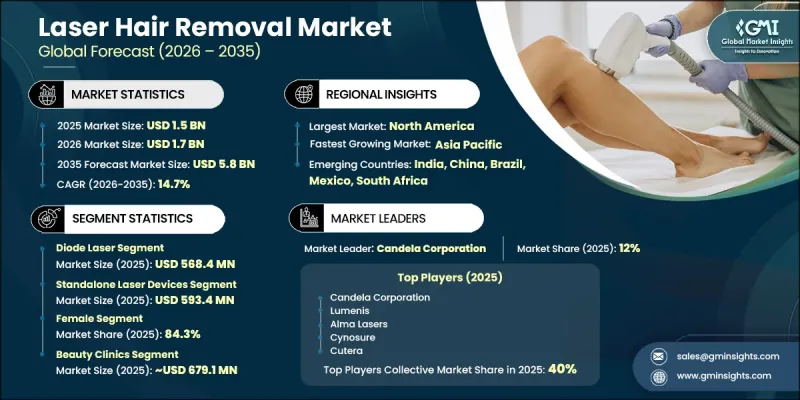
全球雷射除毛市場預計到 2025 年將價值 15 億美元,並將以 14.7% 的複合年成長率成長,到 2035 年達到 58 億美元。
消費者對非侵入性美容手術的需求日益成長,美容雷射技術的不斷進步,以及人們對長期除毛方案的偏好不斷提高,都顯著推動了市場擴張。與侵入性治療相比,各年齡層的消費者越來越傾向於選擇不適感小、恢復時間短、風險低且效果顯著的美容手術。雷射除毛之所以持續走紅,是因為它不僅能提供長期效果,還能維持皮膚質量,並減少傳統除毛方法常見的刺激。人們對整裝儀容、美容和護膚習慣的日益重視,進一步加速了全球需求的成長。數位美容文化的影響、偏好的改變以及人們對美容手術接受度的提高,也推動了雷射除毛服務的普及。此外,雷射技術的便利性、精準性和長期有效性,正促使消費者放棄暫時性的除毛方案,雷射除毛也逐漸成為現代美容行業的首選。
| 市場範圍 | |
|---|---|
| 開始年份 | 2025 |
| 預測期 | 2026-2035 |
| 上市時的市場規模 | 15億美元 |
| 預計金額 | 58億美元 |
| 複合年成長率 | 14.7% |
預計到2025年,二極體雷射市場銷售額將達到5.684億美元。該細分市場的強勁地位主要歸功於其先進的波長技術,使其能夠深入皮膚並極其精準地靶向毛囊。這一特性使得能量能夠高效吸收,同時最大限度地減少對周圍皮膚組織的影響,從而使二極體雷射系統適用於各種膚色和毛髮類型。其有效性、安全性以及可靠的臨床記錄持續推動全球美容診所和皮膚科中心對該技術的廣泛應用。
2025年,獨立式雷射設備市場規模達5.934億美元。這些系統憑藉其高性能、專為除毛療程而設計的專業功能,持續保持強勁的市場需求。獨立式設備因其高效的治療操作、更短的治療時間和穩定的臨床效果,在醫療美容中心、美容院和皮膚科診所中廣受歡迎。服務提供者對營運效率和成本控制的日益重視,進一步推動了該細分市場的成長。與多功能系統相比,獨立式雷射平台通常投資成本更低、維護更簡單、操作和管理更輕鬆,使其成為開展專業美容專案的機構的理想之選。
到2025年,北美雷射除毛市場佔有率將達到40.5%。該地區的消費者越來越傾向於選擇非侵入性美容療程,這些療程不僅能帶來顯著效果,還能最大限度地減少不適感和恢復時間。消費者對先進美容技術的高度認知,以及對美容療程的廣泛接受,持續推動北美市場的擴張。此外,該地區完善的美容醫療基礎設施也為消費者提供了便利,使他們能夠輕鬆獲得先進的雷射治療設備和合格的服務供應商。消費者在整裝儀容、護膚和健康美容服務方面的支出增加,也進一步促進了市場需求的持續成長。
目錄
第1章:調查方法
第2章執行摘要
第3章 行業洞察
- 產業生態系分析
- 影響產業的因素
- 促進因素
- 人們對非侵入性美容手術的興趣日益濃厚
- 美容雷射技術的進步
- 長期解決方案與替代方案的比較
- 擴大醫療水療中心和美容診所網路
- 產業潛在風險與挑戰
- 此手術費用高昂
- 雷射二極體面臨的挑戰
- 市場機遇
- 面向消費市場的家用雷射設備開發
- 促進因素
- 成長潛力分析
- 監理情勢
- 技術展望
- 最新科技趨勢
- 家用雷射和IPL設備
- 符合人體工學的設計與無線設計
- 新興技術
- 人工智慧整合和智慧系統
- 多模態平台的融合
- 最新科技趨勢
- 未來市場趨勢
- 人工智慧和生成式人工智慧對市場的影響
- 價格趨勢分析
- 專利分析
- 波特的分析
- PESTLE分析
第4章 競爭情勢
- 介紹
- 企業市佔率分析
- 世界
- 北美洲
- 歐洲
- 亞太地區
- 企業矩陣分析
- 主要市場公司的競爭分析
- 競爭定位矩陣
- 主要進展
- 併購
- 夥伴關係和聯盟
- 新產品發布
- 業務拓展計劃
第5章 市場估算與預測:依雷射類型分類,2022-2035年
- 二極體雷射
- Nd:YAG雷射(釹釔鋁石榴石雷射)
- 亞歷山大雷射
- 其他雷射類型
第6章 市場估算與預測:依產品類型分類,2022-2035年
- 獨立式雷射裝置
- 多功能雷射裝置
第7章 市場估計與預測:依性別分類,2022-2035年
- 女士
- 男性
第8章 市場估算與預測:依最終用途分類,2022-2035年
- 美容診所
- 皮膚科診所
- 醫療水療中心
- 其他最終用戶
第9章 市場估計與預測:依地區分類,2022-2035年
- 北美洲
- 美國
- 加拿大
- 歐洲
- 德國
- 英國
- 法國
- 西班牙
- 義大利
- 荷蘭
- 亞太地區
- 中國
- 日本
- 印度
- 澳洲
- 韓國
- 拉丁美洲
- 巴西
- 墨西哥
- 阿根廷
- 中東和非洲
- 南非
- 沙烏地阿拉伯
- UAE
第10章:公司簡介
- Asclepion Laser Technologies
- Alma Lasers
- SharpLight Technologies
- Candela Corporation
- Cutera, Inc
- Cynosure
- Fotona
- Lumenis
- InMode Ltd.
- Quanta System
- Sciton
- Venus Concept
- Viora Life
The Global Laser Hair Removal Market was valued at USD 1.5 billion in 2025 and is estimated to grow at a CAGR of 14.7% to reach USD 5.8 billion by 2035.
Rising consumer demand for non-invasive cosmetic treatments, ongoing advancements in aesthetic laser technologies, and the growing preference for long-term hair reduction solutions are significantly contributing to market expansion. Consumers across multiple age groups are increasingly choosing aesthetic procedures that offer effective results with minimal discomfort, limited recovery time, and lower procedural risks compared to invasive cosmetic treatments. Laser hair removal continues to gain popularity due to its ability to deliver long-lasting outcomes while maintaining skin quality and reducing irritation commonly associated with conventional hair removal methods. Increasing awareness regarding personal grooming, beauty enhancement, and skincare routines is further accelerating demand globally. The influence of digital beauty culture, changing lifestyle preferences, and growing acceptance of aesthetic procedures are also supporting wider adoption of laser hair removal services. In addition, the convenience, precision, and long-term efficiency offered by laser technologies are encouraging consumers to shift away from temporary hair removal solutions, positioning laser-based treatments as a preferred option in the modern aesthetic industry.
| Market Scope | |
|---|---|
| Start Year | 2025 |
| Forecast Year | 2026-2035 |
| Start Value | $1.5 Billion |
| Forecast Value | $5.8 Billion |
| CAGR | 14.7% |
The diode laser segment generated USD 568.4 million in 2025. The strong position of this segment is primarily attributed to its advanced wavelength capability, which enables deeper skin penetration and highly accurate targeting of hair follicles. This feature allows efficient energy absorption while minimizing the impact on surrounding skin tissues, making diode laser systems suitable for a broad range of skin tones and hair types. Their effectiveness, safety profile, and reliable clinical performance continue to strengthen their adoption across aesthetic clinics and dermatology centers worldwide.
The standalone laser devices segment accounted for USD 593.4 million in 2025. These systems continue to maintain strong market demand due to their dedicated, performance-focused functionality specifically designed for hair removal treatments. Standalone devices are widely preferred by medical spas, aesthetic centers, and dermatology clinics because they enable efficient treatment delivery, shorter session durations, and consistent clinical outcomes. Growing emphasis on operational efficiency and cost management among service providers is further supporting segment growth. Compared to multifunctional systems, standalone laser platforms generally require lower investment costs, simpler maintenance procedures, and easier operational management, making them highly attractive for specialized aesthetic practices.
North America Laser Hair Removal Market held a 40.5% share in 2025. Consumers throughout the region increasingly favor non-invasive aesthetic procedures that provide noticeable results with minimal discomfort and recovery time. Strong awareness of advanced cosmetic technologies, combined with broad acceptance of aesthetic enhancement treatments, continues to support market expansion across North America. The region also benefits from a well-established aesthetic healthcare infrastructure, allowing consumers convenient access to advanced laser treatment platforms and professionally certified service providers. Rising spending on personal grooming, skincare, and cosmetic wellness services is further contributing to sustained market demand.
Prominent companies operating in the Global Laser Hair Removal Market include Candela Corporation, Cynosure, Quanta System, Cutera, Inc., Venus Concept, Sciton, InMode Ltd., Alma Lasers, Fotona, SharpLight Technologies, Lumenis, Viora Life, and Asclepion Laser Technologies. Companies operating in the laser hair removal market are implementing several strategic initiatives to strengthen their competitive position and expand their market presence. Leading manufacturers are heavily investing in research and development activities to introduce advanced laser technologies with improved safety, treatment speed, and compatibility across different skin types. Many companies are focusing on expanding partnerships with dermatology clinics, medical spas, and aesthetic centers to strengthen distribution networks and increase product adoption. Businesses are also prioritizing product innovation through the development of compact, energy-efficient, and user-friendly laser systems to improve operational efficiency for healthcare providers. In addition, organizations are increasing investments in digital marketing, brand awareness campaigns, and training programs to improve consumer education and practitioner expertise.
Table of Contents
Chapter 1 Research Methodology
- 1.1 Research approach
- 1.2 Quality commitments
- 1.2.1 GMI AI policy & data integrity commitment
- 1.2.1.1 Source consistency protocol
- 1.2.1 GMI AI policy & data integrity commitment
- 1.3 Research trail & confidence scoring
- 1.3.1 Research trail components
- 1.3.2 Scoring components
- 1.4 Data collection
- 1.4.1 Partial list of primary sources
- 1.5 Data mining sources
- 1.5.1 Paid sources
- 1.5.1.1 Sources, by region
- 1.5.1 Paid sources
- 1.6 Base estimates and calculations
- 1.6.1 Base year calculation for any one approach
- 1.7 Forecast model
- 1.7.1 Quantified market impact analysis
- 1.7.1.1 Mathematical impact of growth parameters on forecast
- 1.7.1 Quantified market impact analysis
- 1.8 Research transparency addendum
- 1.8.1 Source attribution framework
- 1.8.2 Quality assurance metrics
- 1.8.3 Our commitment to trust
Chapter 2 Executive Summary
- 2.1 Industry 3600 synopsis
- 2.2 Key market trends
- 2.2.1 Laser Type trends
- 2.2.2 Product Type trends
- 2.2.3 Gender trends
- 2.2.4 End use trends
- 2.2.5 Regional trends
- 2.3 CXO perspectives: Strategic imperatives
Chapter 3 Industry Insights
- 3.1 Industry ecosystem analysis
- 3.2 Industry impact forces
- 3.2.1 Growth drivers
- 3.2.1.1 Increasing preference for non-invasive cosmetic procedures.
- 3.2.1.2 Technological advancements in aesthetic lasers.
- 3.2.1.3 Long-term solution compared to alternative solutions.
- 3.2.1.4 Expansion of medical spa and aesthetic clinic networks
- 3.2.2 Industry pitfalls and challenges
- 3.2.2.1 High cost related to the procedure.
- 3.2.2.2 Complications associated with laser diodes.
- 3.2.3 Market opportunities
- 3.2.3.1 Development of home-use laser devices for consumer markets
- 3.2.1 Growth drivers
- 3.3 Growth potential analysis
- 3.4 Regulatory landscape (Driven by primary research)
- 3.4.1 North America
- 3.4.2 Europe
- 3.4.3 Asia Pacific
- 3.4.4 Latin America
- 3.4.5 Middle East and Africa
- 3.5 Technology landscape (Driven by primary research)
- 3.5.1 Current technological trends
- 3.5.1.1 Home-use laser and IPL devices
- 3.5.1.2 Ergonomic and wireless designs
- 3.5.2 Emerging technologies
- 3.5.2.1 AI integration and smart systems
- 3.5.2.2 Multi-modal platform convergence
- 3.5.1 Current technological trends
- 3.6 Future market trends (Driven by primary research)
- 3.7 Impact of AI and Generative AI on the market (Driven by primary research)
- 3.8 Pricing trend analysis (Driven by primary research)
- 3.9 Patent analysis
- 3.10 Porter's analysis
- 3.11 PESTEL analysis
Chapter 4 Competitive Landscape, 2025
- 4.1 Introduction
- 4.2 Company market share analysis
- 4.2.1 Global
- 4.2.2 North America
- 4.2.3 Europe
- 4.2.4 Asia Pacific
- 4.3 Company matrix analysis
- 4.4 Competitive analysis of major market players
- 4.5 Competitive positioning matrix
- 4.6 Key developments
- 4.6.1 Mergers and acquisitions
- 4.6.2 Partnerships and collaborations
- 4.6.3 New product launches
- 4.6.4 Expansion plans
Chapter 5 Market Estimates and Forecast, By Laser Type, 2022 - 2035 ($ Mn)
- 5.1 Key trends
- 5.2 Diode laser
- 5.3 Nd: YAG laser (Neodymium Yttrium Aluminum Garnet)
- 5.4 Alexandrite laser
- 5.5 Other laser types
Chapter 6 Market Estimates and Forecast, By Product Type, 2022 - 2035 ($ Mn)
- 6.1 Key trends
- 6.2 Standalone laser devices
- 6.3 Multi-functional laser devices
Chapter 7 Market Estimates and Forecast, By Gender, 2022 - 2035 ($ Mn)
- 7.1 Key trends
- 7.2 Female
- 7.3 Male
Chapter 8 Market Estimates and Forecast, By End use, 2022 - 2035 ($ Mn)
- 8.1 Key trends
- 8.2 Beauty clinics
- 8.3 Dermatology clinics
- 8.4 Medical spas
- 8.5 Other end users
Chapter 9 Market Estimates and Forecast, By Region, 2022 - 2035 ($ Mn)
- 9.1 Key trends
- 9.2 North America
- 9.2.1 U.S.
- 9.2.2 Canada
- 9.3 Europe
- 9.3.1 Germany
- 9.3.2 UK
- 9.3.3 France
- 9.3.4 Spain
- 9.3.5 Italy
- 9.3.6 Netherlands
- 9.4 Asia Pacific
- 9.4.1 China
- 9.4.2 Japan
- 9.4.3 India
- 9.4.4 Australia
- 9.4.5 South Korea
- 9.5 Latin America
- 9.5.1 Brazil
- 9.5.2 Mexico
- 9.5.3 Argentina
- 9.6 Middle East and Africa
- 9.6.1 South Africa
- 9.6.2 Saudi Arabia
- 9.6.3 UAE
Chapter 10 Company Profiles
- 10.1 Asclepion Laser Technologies
- 10.2 Alma Lasers
- 10.3 SharpLight Technologies
- 10.4 Candela Corporation
- 10.5 Cutera, Inc
- 10.6 Cynosure
- 10.7 Fotona
- 10.8 Lumenis
- 10.9 InMode Ltd.
- 10.10 Quanta System
- 10.11 Sciton
- 10.12 Venus Concept
- 10.13 Viora Life

 雷射除毛市場規模、佔有率、成長、全球產業分析、區域趨勢及2026-2034年預測。
 雷射除毛市場-2026-2032年全球市場預測
 雷射除毛市場:按雷射類型、產品類型、最終用戶、性別、治療部位、技術、銷售管道和地區分類全球雷射除毛市場規模、佔有率、趨勢和成長分析報告(2026-2034年)攜帶式二極體雷射除毛設備市場:按產品類型、波長、功率、應用、最終用戶和銷售管道的全球預測(2026-2032年)
 雷射除毛市場規模、佔有率及成長分析(依產品類型、性別、年齡層、應用及地區分類)-2026-2033年產業預測
 二極體雷射除毛市場報告:趨勢、預測和競爭分析(至2031年)