


 |
市場調查報告書
商品編碼
2045863
空中起重機及直升機市場機會、成長要素、產業趨勢分析及 2026-2035 年預測。Air Crane Helicopter Market Opportunity, Growth Drivers, Industry Trend Analysis, and Forecast 2026 - 2035 |
||||||

預計到 2025 年,全球空中起重機和直升機市場價值將達到 58 億美元,並預計以 9.3% 的複合年成長率成長,到 2035 年達到 139 億美元。
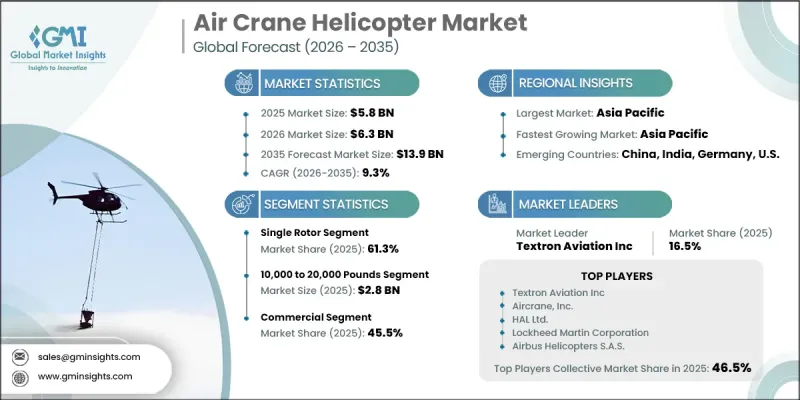
空中起重機和直升機行業的整體成長主要受以下因素驅動:空中消防需求的不斷成長、大規模基礎設施建設中重型直升機部署的擴大,以及公共產業和能源行業維護活動的成長。在緊急應變和災害復原行動中,空中平台的使用日益增多,快速部署和高有效載荷能力至關重要,這也對市場產生了積極影響。各國政府和私人業者正加大直升機現代化改造的投資,以提高營運效率和任務能力。靈活的租賃模式和基於服務的營運結構透過降低擁有成本和提高營運商的便利性,進一步加速了直升機的普及。隨著各行業尋求在惡劣環境下高效運輸超大型設備和材料的方法,對先進重型空中解決方案的需求持續成長。專注於負載容量最佳化、飛行穩定性和運行安全性的技術進步也在推動市場成長。此外,氣候變遷相關緊急情況的日益增加以及基礎設施重建項目的擴展,也為全球空中起重機和直升機市場創造了持續成長的機會。
| 市場範圍 | |
|---|---|
| 開始年份 | 2025 |
| 預測期 | 2026-2035 |
| 上市時的市場規模 | 58億美元 |
| 預計金額 | 139億美元 |
| 複合年成長率 | 9.3% |
由於野火發生頻率和嚴重性持續上升,對空中消防解決方案的需求不斷成長,空中起重機和直升機市場呈現強勁成長動能。大型運輸直升機因其有效載荷大、能夠提供精準的空中消防支援以及在偏遠和難以到達的地區高效作業而備受青睞。隨著快速緊急應變和關鍵基礎設施的早期復原變得日益重要,對高容量空中系統的依賴性也在不斷增強。緊急管理行動整體對高效能重型運輸機的持續需求,並支撐著該產業的長期發展。此外,基礎設施建設活動的活性化、公共產業活動的擴展、災害應變任務的增加以及持續的飛機更新計劃,都為空中起重機和直升機行業的穩步發展做出了貢獻。
預計到2035年,串列旋翼直升機市場將以10%的複合年成長率成長。該市場成長的主要驅動力是市場對更高載重能力、更佳升力平衡以及在重型貨物裝卸和災害救援任務中更高作業效率的需求不斷成長。串列旋翼直升機設計最佳化了重量分佈,使其能夠在複雜的空中作業中更安全地運輸超大型貨物。這些性能優勢正在加速其在嚴苛作業環境中的應用,並增強了該細分市場在全球空中起重機直升機市場中的成長潛力。
預計2026年至2035年間,售價超過2萬英鎊的細分市場將以10.6%的複合年成長率成長。大規模建設項目和災害復原工作中對超重型空中作業的需求不斷成長,推動了這一細分市場的擴張。這些直升機能夠運輸低容量空中平台無法處理的大型機械、基礎設施零件和關鍵設備。它們滿足極其嚴苛作業要求的能力,大大促進了高容量空中起重機直升機在眾多工業領域的快速普及。
預計到2025年,北美空中起重機和直升機市場將佔據35.4%的市場。該地區市場成長的主要驅動力是日益嚴重的野火和氣候相關自然災害。火災季節延長和環境挑戰加劇,使得全部區域對大型艦載空中消防系統的依賴性日益增強。此外,持續投資於公共基礎設施升級、提高電網韌性以及維修老化的基礎設施網路,也支撐了對空中起重機和直升機的需求。隨著對緊急準備和災害應變能力的日益重視,預計未來幾年北美空中起重機和直升機產業將進一步發展壯大。
目錄
第1章:調查方法和範圍
第2章執行摘要
第3章 行業洞察
- 產業生態系分析
- 供應商情況
- 利潤率
- 成本結構
- 每個階段增加的價值
- 影響價值鏈的因素
- 中斷
- 影響產業的因素
- 促進因素
- 對空中消防行動的需求日益成長。
- 基礎設施建設擴張和重型貨物運輸需求增加。
- 擴大在公共產業維護和能源領域的業務。
- 在災害救援和緊急應變中得到更廣泛的應用
- 車輛現代化和商業租賃模式
- 產業潛在風險與挑戰
- 用於空中起重機的直升機運作和維護成本高昂
- 複雜空域環境下的規章制度與運作限制
- 市場機遇
- 從傳統的重型貨物裝卸過渡到專業的航空解決方案
- 擴大跨境合約和季節性部署模式
- 促進因素
- 成長潛力分析
- 監理情勢
- 北美洲
- 歐洲
- 亞太地區
- 拉丁美洲
- 中東和非洲
- 波特的分析
- PESTLE分析
- 技術與創新展望
- 最新科技趨勢
- 新興技術
- 價格趨勢
- 按地區
- 依產品
- 定價策略
- 新興經營模式
- 合規要求
- 專利和智慧財產權分析
第4章 競爭情勢
- 介紹
- 企業市佔率分析
- 按地區
- 北美洲
- 歐洲
- 亞太地區
- 拉丁美洲
- 中東和非洲
- 市場集中度分析
- 按地區
- 主要公司的競爭標竿分析
- 財務績效比較
- 收入
- 利潤率
- R&D
- 產品系列比較
- 產品線寬度
- 科技
- 創新
- 區域擴張比較
- 全球擴張分析
- 服務網路覆蓋
- 按地區分類的市場滲透率
- 競爭定位矩陣
- 領導者
- 挑戰者
- 追蹤者
- 小眾玩家
- 戰略展望矩陣
- 財務績效比較
- 主要進展
- 併購
- 夥伴關係和聯盟
- 技術進步
- 擴張和投資策略
- 數位轉型計劃
- 新興企業競爭公司和新創企業的發展趨勢
第5章 市場估計與預測:依旋翼系統分類,2022-2035年
- 單轉子
- 串聯轉子
第6章 市場估算與預測:依外部負載能力分類,2022-2035年
- 低於 10,000 英鎊
- 10,000英鎊至20,000英鎊
- 超過 20,000 英鎊
第7章 市場估計與預測:依應用領域分類,2022-2035年
- 工業和基礎設施建設
- 空中滅火
- 伐木和林業
- 災害救援和緊急應變
- 軍用重型運輸
第8章 市場估算與預測:依最終使用者分類,2022-2035年
- 商業的
- 政府
- 軍隊
第9章 市場估計與預測:依地區分類,2022-2035年
- 北美洲
- 美國
- 加拿大
- 歐洲
- 德國
- 英國
- 法國
- 西班牙
- 義大利
- 俄羅斯
- 亞太地區
- 中國
- 印度
- 日本
- 澳洲
- 韓國
- 拉丁美洲
- 巴西
- 墨西哥
- 阿根廷
- 中東和非洲
- 南非
- 沙烏地阿拉伯
- UAE
第10章:公司簡介
- 全球主要公司
- Textron Aviation Inc
- Aircrane, Inc.
- HAL Ltd.
- Lockheed Martin Corporation
- Airbus Helicopters SAS
- 該地區的主要公司
- 北美洲
- Columbia Helicopters
- Erickson Incorporated
- KAMAN Corporation
- HeliQwest
- 亞太地區
- Russian Helicopters
- 歐洲
- The Boeing Company
- Middle East &Africa
- High Performance
- Helicopters Corp
- 北美洲
The Global Air Crane Helicopter Market was valued at USD 5.8 billion in 2025 and is estimated to grow at a CAGR of 9.3% to reach USD 13.9 billion by 2035.
Growth across the air crane helicopter industry is driven by rising demand for aerial firefighting operations, increasing deployment of heavy-lift helicopters for large infrastructure developments, and expanding maintenance activities across utility and energy sectors. The market is also benefiting from growing use of aerial platforms in emergency response and disaster recovery operations where rapid deployment and heavy payload capabilities are essential. Governments and private operators are increasingly investing in modernizing helicopter fleets to improve operational efficiency and mission performance. Flexible leasing models and service-based operational frameworks are further encouraging adoption by reducing ownership costs and improving accessibility for operators. Demand for advanced heavy-lift aviation solutions is continuing to rise as industries seek efficient methods for transporting oversized equipment and materials in challenging environments. Technological advancements focused on payload optimization, flight stability, and operational safety are also strengthening market growth. In addition, increasing climate-related emergencies and infrastructure rehabilitation projects are creating sustained opportunities for the global air crane helicopter market.
| Market Scope | |
|---|---|
| Start Year | 2025 |
| Forecast Year | 2026-2035 |
| Start Value | $5.8 Billion |
| Forecast Value | $13.9 Billion |
| CAGR | 9.3% |
The air crane helicopter market is witnessing strong momentum due to the increasing requirement for aerial firefighting solutions as wildfire incidents continue to intensify in frequency and severity. Heavy-lift helicopters are gaining preference because of their ability to carry substantial payloads, deliver accurate aerial suppression support, and operate effectively in remote or inaccessible areas. Rising emphasis on rapid emergency response and faster restoration of critical infrastructure is further increasing dependence on high-capacity aerial systems. Continued demand for efficient heavy-lift aircraft across emergency management operations is supporting long-term industry expansion. In addition, growing infrastructure activities, expanding utility operations, increasing disaster response missions, and ongoing fleet modernization initiatives are collectively contributing to the steady development of the air crane helicopter industry.
The tandem rotor segment is anticipated to register a CAGR of 10% throughout 2035. Segment growth is being supported by increasing demand for improved payload handling capabilities, enhanced lift balance, and greater operational efficiency during heavy-lift and disaster response missions. Tandem rotor helicopter designs provide improved weight distribution and support safer transportation of oversized cargo during complex aerial operations. These performance advantages are accelerating adoption across demanding operational environments and strengthening the segment's growth potential within the global air crane helicopter market.
The above 20,000 pounds segment is projected to grow at a CAGR of 10.6% during 2026-2035. Increasing demand for ultra-heavy-lift aviation operations associated with large-scale construction projects and disaster recovery activities is driving expansion within this category. These helicopters can transport oversized machinery, infrastructure components, and critical equipment that cannot be managed through lower-capacity aerial platforms. Their ability to support highly demanding operational requirements is contributing significantly to the rapid adoption of high-capacity air crane helicopters across multiple industries.
North America Air Crane Helicopter Market accounted for 35.4% share in 2025. Market growth across the region is being fueled by increasing exposure to severe wildfires and climate-related natural disasters. Extended fire seasons and rising environmental challenges are increasing reliance on heavy-lift aerial firefighting systems throughout the region. Demand for air crane helicopters is also being supported by ongoing investments in utility infrastructure upgrades, grid resilience programs, and rehabilitation of aging infrastructure networks. Growing focus on emergency preparedness and disaster response capabilities is expected to further strengthen the North American air crane helicopter industry over the coming years.
Major companies operating in the Global Air Crane Helicopter Market include Airbus Helicopters S.A.S., HAL Ltd., Aircrane, Inc., Columbia Helicopters, Erickson Incorporated, High Performance Helicopters Corp, KAMAN CORPORATION, Lockheed Martin Corporation, Russian Helicopters, HeliQwest, Textron Aviation Inc, and The Boeing Company. Companies active in the air crane helicopter industry are adopting several strategic initiatives to strengthen their market foothold and improve long-term competitiveness. Leading manufacturers are investing in fleet modernization programs focused on improving payload capacity, operational safety, and fuel efficiency. Many companies are also expanding service-based business models and flexible leasing solutions to attract a broader customer base and reduce operational costs for end users. Strategic collaborations with government agencies, emergency response organizations, and infrastructure contractors are helping businesses secure long-term operational contracts. In addition, manufacturers are prioritizing technological advancements related to flight stability, navigation systems, and heavy-lift performance capabilities.
Table of Contents
Chapter 1 Methodology and Scope
- 1.1 Market scope and definition
- 1.2 Research design
- 1.2.1 Research approach
- 1.2.2 Data collection methods
- 1.3 Data mining sources
- 1.3.1 Global
- 1.3.2 Regional/Country
- 1.4 Base estimates and calculations
- 1.4.1 Base year calculation
- 1.4.2 Key trends for market estimation
- 1.5 Primary research and validation
- 1.5.1 Primary sources
- 1.6 Forecast model
- 1.7 Research assumptions and limitations
Chapter 2 Executive Summary
- 2.1 Industry 360° synopsis, 2022 - 2035
- 2.2 Key market trends
- 2.2.1 Rotor system trends
- 2.2.2 External load capacity trends
- 2.2.3 Application trends
- 2.2.4 End-user trends
- 2.2.5 Regional trends
- 2.3 TAM Analysis, 2026-2035
- 2.4 CXO perspectives: Strategic imperatives
Chapter 3 Industry Insights
- 3.1 Industry ecosystem analysis
- 3.1.1 Supplier Landscape
- 3.1.2 Profit Margin
- 3.1.3 Cost structure
- 3.1.4 Value addition at each stage
- 3.1.5 Factor affecting the value chain
- 3.1.6 Disruptions
- 3.2 Industry impact forces
- 3.2.1 Growth drivers
- 3.2.1.1 Rising demand for aerial firefighting operations
- 3.2.1.2 Growth in infrastructure construction and heavy lift requirements
- 3.2.1.3 Expansion of utility maintenance and energy sector activities
- 3.2.1.4 Increased use in disaster relief and emergency response
- 3.2.1.5 Fleet modernization and commercial leasing models
- 3.2.2 Industry pitfalls and challenges
- 3.2.2.1 High operating and maintenance costs of air crane helicopters
- 3.2.2.2 Regulatory and operational constraints in complex airspace environments
- 3.2.3 Market opportunities
- 3.2.3.1 Conversion of legacy heavy-lift operations to specialized aerial solutions
- 3.2.3.2 Growing cross-border contracting and seasonal deployment models
- 3.2.1 Growth drivers
- 3.3 Growth potential analysis
- 3.4 Regulatory landscape
- 3.4.1 North America
- 3.4.2 Europe
- 3.4.3 Asia Pacific
- 3.4.4 Latin America
- 3.4.5 Middle East & Africa
- 3.5 Porter's analysis
- 3.6 PESTEL analysis
- 3.7 Technology and Innovation landscape
- 3.7.1 Current technological trends
- 3.7.2 Emerging technologies
- 3.8 Price trends
- 3.8.1 By region
- 3.8.2 By product
- 3.9 Pricing Strategies
- 3.10 Emerging Business Models
- 3.11 Compliance Requirements
- 3.12 Patent and IP analysis
Chapter 4 Competitive Landscape, 2025
- 4.1 Introduction
- 4.2 Company market share analysis
- 4.2.1 By region
- 4.2.1.1 North America
- 4.2.1.2 Europe
- 4.2.1.3 Asia Pacific
- 4.2.1.4 Latin America
- 4.2.1.5 Middle East & Africa
- 4.2.2 Market concentration analysis
- 4.2.1 By region
- 4.3 Competitive benchmarking of key players
- 4.3.1 Financial performance comparison
- 4.3.1.1 Revenue
- 4.3.1.2 Profit margin
- 4.3.1.3 R&D
- 4.3.2 Product portfolio comparison
- 4.3.2.1 Product range breadth
- 4.3.2.2 Technology
- 4.3.2.3 Innovation
- 4.3.3 Geographic presence comparison
- 4.3.3.1 Global footprint analysis
- 4.3.3.2 Service network coverage
- 4.3.3.3 Market penetration by region
- 4.3.4 Competitive positioning matrix
- 4.3.4.1 Leaders
- 4.3.4.2 Challengers
- 4.3.4.3 Followers
- 4.3.4.4 Niche players
- 4.3.5 Strategic outlook matrix
- 4.3.1 Financial performance comparison
- 4.4 Key developments
- 4.4.1 Mergers and acquisitions
- 4.4.2 Partnerships and collaborations
- 4.4.3 Technological advancements
- 4.4.4 Expansion and investment strategies
- 4.4.5 Digital transformation initiatives
- 4.5 Emerging/ startup competitors landscape
Chapter 5 Market Estimates and Forecast, By Rotor System, 2022 - 2035 (USD Million)
- 5.1 Key trends
- 5.2 Single rotor
- 5.3 Tandem rotor
Chapter 6 Market Estimates and Forecast, By External Load Capacity, 2022 - 2035 (USD Million)
- 6.1 Key trends
- 6.2 Up to 10,000 pounds
- 6.3 10,000 to 20,000 pounds
- 6.4 Above 20,000 pounds
Chapter 7 Market Estimates and Forecast, By Application, 2022 - 2035 (USD Million)
- 7.1 Key trends
- 7.2 Industrial & infrastructure work
- 7.3 Aerial firefighting
- 7.4 Logging & forestry operations
- 7.5 Disaster relief & emergency response
- 7.6 Military heavy-lift operations
Chapter 8 Market Estimates and Forecast, By End-User, 2022 - 2035 (USD Million)
- 8.1 Key trends
- 8.2 Commercial
- 8.3 Government
- 8.4 Military
Chapter 9 Market Estimates and Forecast, By Region, 2022 - 2035 (USD Million)
- 9.1 Key trends
- 9.2 North America
- 9.2.1 U.S.
- 9.2.2 Canada
- 9.3 Europe
- 9.3.1 Germany
- 9.3.2 UK
- 9.3.3 France
- 9.3.4 Spain
- 9.3.5 Italy
- 9.3.6 Russia
- 9.4 Asia Pacific
- 9.4.1 China
- 9.4.2 India
- 9.4.3 Japan
- 9.4.4 Australia
- 9.4.5 South Korea
- 9.5 Latin America
- 9.5.1 Brazil
- 9.5.2 Mexico
- 9.5.3 Argentina
- 9.6 Middle East and Africa
- 9.6.1 South Africa
- 9.6.2 Saudi Arabia
- 9.6.3 UAE
Chapter 10 Company Profiles
- 10.1 Global Key Players
- 10.1.1 Textron Aviation Inc
- 10.1.2 Aircrane, Inc.
- 10.1.3 HAL Ltd.
- 10.1.4 Lockheed Martin Corporation
- 10.1.5 Airbus Helicopters S.A.S.
- 10.2 Regional key players
- 10.2.1 North America
- 10.2.1.1 Columbia Helicopters
- 10.2.1.2 Erickson Incorporated
- 10.2.1.3 KAMAN Corporation
- 10.2.1.4 HeliQwest
- 10.2.2 Asia Pacific
- 10.2.2.1 Russian Helicopters
- 10.2.3 Europe
- 10.2.3.1 The Boeing Company
- 10.2.4 Middle East & Africa
- 10.2.4.1 High Performance
- 10.2.4.2 Helicopters Corp
- 10.2.1 North America


