


 |
市場調查報告書
商品編碼
2045860
適應原飲料市場:商業機會、成長要素、產業趨勢分析及2026-2035年預測Adaptogenic Beverages Market Opportunity, Growth Drivers, Industry Trend Analysis, and Forecast 2026 - 2035 |
||||||

2025年全球適應原飲料市場價值14億美元,預計將以7%的複合年成長率成長,到2035年達到27億美元。
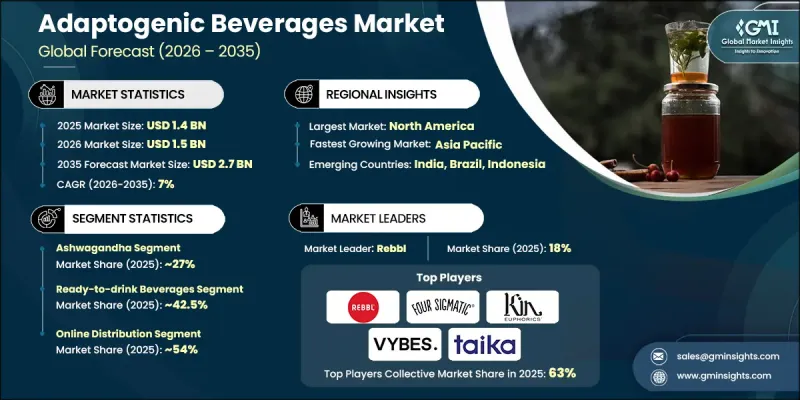
適應原飲料產業的整體成長主要得益於消費者對功能性健康飲料日益成長的偏好,這類飲料有助於集中注意力、放鬆身心和平衡情緒。消費者正積極轉向旨在補充能量和緩解壓力的替代飲料,而無需依賴傳統的含咖啡因或酒精產品。超級市場、專賣店和電商平台貨架空間的擴大進一步增強了全球市場的滲透率。飲料製造商正利用經科學驗證的植物來源和植物性功能化合物,開發兼具健康益處和誘人口感的產品。社群媒體和數位健康趨勢的日益普及顯著提高了消費者的意識,尤其是在追求健康生活方式的年輕一代。產品線的多元化,包括冷萃咖啡、粉狀飲料、健康滋補品和機能飲料,正在開啟傳統消費場景之外的全新消費機會。此外,消費者對低糖、永續來源和潔淨標示飲料的需求不斷成長,也推動了整個市場的創新。適應原飲料產業正從小眾健康類別發展成為融入日常健康和生活方式的主流機能飲料領域。
| 市場範圍 | |
|---|---|
| 開始年份 | 2025 |
| 預測期 | 2026-2035 |
| 上市時的市場規模 | 14億美元 |
| 預計金額 | 27億美元 |
| 複合年成長率 | 7% |
在適應原飲料市場,生產商正日益注重創新成分組合和多功能配方,以實現產品差異化並提升消費者參與度。隨著消費者尋求兼具健康益處和愉悅感官體驗的產品,添加植物來源功能成分的混合植物性飲料正日益受到青睞。該市場的機能飲料形式也呈現顯著成長,包括即飲型(RTD)產品、茶基飲料、咖啡風味健康飲品、冰沙和超級食品果汁。消費者越來越傾向選擇兼具便利性、均衡功能和誘人口感的飲料。人們對整體健康和壓力管理解決方案的日益關注,也持續推動著適應原廠飲料在多個零售通路的需求成長。
預計到2025年,即飲飲料(RTD)市佔率將達到42.5%,並在2035年之前維持14.8%的複合年成長率。消費者對便捷便攜的健康飲品的強勁需求正在推動該細分市場的成長,他們越來越傾向於選擇能夠輕鬆融入忙碌日常生活的機能飲料。儘管即飲飲料仍然是外出飲用的熱門選擇,但以茶和咖啡為基礎的健康飲品也因其兼具熟悉感和功能性而日益受到歡迎。消費者對能夠提升活力、放鬆身心、促進整體健康的飲品的偏好不斷成長,預計將成為即飲飲料整體長期成長的基石。
預計到2025年,線上零售市佔率將達到54%,並在2035年之前以13.9%的複合年成長率成長。線上零售通路的成長主要得益於數位化購物的便利性以及消費者對D2C(直接面對消費者)模式日益成長的偏好。透過利用電子商務平台,品牌可以透過個人化建議、訂閱服務、教育內容和精準的數位行銷策略來增強客戶參與。線上管道也有助於更有效地講述品牌故事並提升透明度,幫助企業建立消費者信任,並建立以健康、壓力管理和健康生活方式為核心的長期關係。
預計北美適應原飲料市場將從2025年的4.98億美元成長到2035年的9.658億美元。這一強勁的區域成長得益於消費者對植物來源健康飲料日益成長的需求,以及零售和線上分銷平台的持續創新。隨著消費者對功能性營養和潔淨標示成分的認知不斷提高,適應原始飲料正日益融入全部區域主流的健康生活方式。超級市場、咖啡館、健康專賣店和電商平台的銷售管道不斷擴大,也促進了市場成長。此外,與健身專業人士和健康倡導者的合作,以及以生活方式為導向的數位化宣傳活動,也幫助品牌提升了消費者對機能飲料產品的認知度和信任度。
目錄
第1章:調查方法和範圍
第2章執行摘要
第3章 行業洞察
- 產業生態系分析
- 供應商情況
- 利潤率
- 每個階段增加的價值
- 影響價值鏈的因素
- 中斷
- 影響產業的因素
- 促進因素
- 消費者對緩解壓力的機能飲料。
- 向心理健康和整體健康過渡
- 植物來源和潔淨標示飲料的成長
- 產業潛在風險與挑戰
- 發展中地區意識水準低
- 有機適應原供應鏈的波動性
- 市場機遇
- 進軍非酒精社交飲料市場
- 適應原萃取技術的進步
- 促進因素
- 成長潛力分析
- 監理情勢
- 北美洲
- 歐洲
- 亞太地區
- 拉丁美洲
- 中東和非洲
- 波特的分析
- PESTLE分析
- 價格趨勢
- 按地區
- 依產品類型
- 未來市場趨勢
- 技術與創新展望
- 最新科技趨勢
- 新興技術
- 專利趨勢
- 貿易統計
- 主要進口國
- 主要出口國
- 永續性和環境方面
- 永續計劃
- 減少廢棄物策略
- 生產中的能源效率
- 具有環保意識的舉措
- 考慮碳足跡
第4章 競爭情勢
- 介紹
- 企業市佔率分析
- 按地區
- 北美洲
- 歐洲
- 亞太地區
- LATAM
- 中東和非洲
- 按地區
- 企業矩陣分析
- 主要市場公司的競爭分析
- 競爭定位矩陣
- 主要進展
- 併購
- 夥伴關係和聯盟
- 新產品發布
- 業務拓展計劃
第5章 市場估算與預測:依產品類型分類,2022-2035年
- 睡茄
- 菇
- 聖羅勒
- 瑪卡
- 薰衣草
- 其他
第6章 市場估價與預測:依飲料類型分類,2022-2035年
- 即飲飲料
- 紅茶底
- 冰沙和果汁
- 咖啡基料
- 其他
第7章 市場估價與預測:依通路分類,2022-2035年
- 線上
- 離線
第8章 市場估計與預測:依地區分類,2022-2035年
- 北美洲
- 美國
- 加拿大
- 歐洲
- 德國
- 英國
- 法國
- 西班牙
- 義大利
- 其他歐洲國家
- 亞太地區
- 中國
- 印度
- 日本
- 澳洲
- 韓國
- 其他亞太國家
- 拉丁美洲
- 巴西
- 墨西哥
- 阿根廷
- 其他拉丁美洲國家
- 中東和非洲
- 沙烏地阿拉伯
- 南非
- UAE
- 其他中東和非洲國家
第9章:公司簡介
- Rebbl
- Four Sigmatic
- Kin Euphorics
- SOM Sleep
- Vybes
- Taika
- Hiyo
- Moment
- Mayawell
- Clevr Blends
- Odyssey Elixir
- Kuli Kuli
- Sunwink
The Global Adaptogenic Beverages Market was valued at USD 1.4 billion in 2025 and is estimated to grow at a CAGR of 7% to reach USD 2.7 billion by 2035.
Growth across the adaptogenic beverages industry is fueled by increasing consumer preference for functional wellness drinks that support focus, relaxation, and emotional balance. Consumers are actively shifting toward beverage alternatives designed to deliver energy and stress management benefits without relying on traditional caffeinated or alcoholic products. Expanding shelf presence across supermarkets, specialty retail stores, and e-commerce platforms is further strengthening market penetration worldwide. Beverage manufacturers are enhancing formulations through scientifically supported botanical ingredients and plant-based functional compounds that combine wellness benefits with appealing taste profiles. The growing influence of social media and digital wellness trends is significantly increasing consumer awareness, particularly among younger demographics seeking healthier lifestyle choices. Product diversification across cold brews, powdered beverage mixes, wellness tonics, and functional drink formats is also broadening consumption occasions beyond conventional settings. In addition, rising consumer demand for low-sugar, sustainably sourced, and clean-label beverages is encouraging innovation throughout the market. The adaptogenic beverages sector continues to evolve from a niche wellness category into a mainstream functional beverage segment integrated into everyday health and lifestyle routines.
| Market Scope | |
|---|---|
| Start Year | 2025 |
| Forecast Year | 2026-2035 |
| Start Value | $1.4 Billion |
| Forecast Value | $2.7 Billion |
| CAGR | 7% |
Manufacturers operating in the adaptogenic beverages market are increasingly focusing on innovative ingredient combinations and multifunctional formulations to improve product differentiation and consumer engagement. Blended botanical beverages featuring plant-based functional ingredients are gaining popularity as consumers seek products that combine wellness support with enjoyable sensory experiences. The market is also witnessing strong expansion in functional beverage formats, including ready-to-drink products, tea-based beverages, coffee-inspired wellness drinks, smoothies, and superfood juices. Consumers are increasingly drawn toward beverages that deliver convenience, balanced functionality, and appealing flavor profiles in a single product. Growing interest in holistic wellness and stress management solutions continues to support demand for adaptogenic beverage products across multiple retail channels.
Ready-to-drink beverages segment accounted for 42.5% share in 2025 and is expected to grow at a CAGR of 14.8% through 2035. Strong demand for convenient and portable wellness drinks is driving growth within this segment, as consumers increasingly prefer functional beverages that fit into busy daily routines. The ready-to-drink category remains highly popular for on-the-go consumption, while tea-based blends and coffee-inspired wellness beverages continue gaining traction due to their combination of familiar consumption habits and added functional benefits. Growing preference for beverages that support energy, relaxation, and overall wellness is expected to sustain long-term growth across the ready-to-drink segment.
The online distribution segment held a 54% share in 2025 and is projected to grow at a CAGR of 13.9% through 2035. Growth within online retail channels is being driven by increasing consumer preference for digital shopping convenience and direct-to-consumer purchasing models. E-commerce platforms allow brands to strengthen customer engagement through personalized recommendations, subscription-based services, educational content, and targeted digital marketing strategies. Online channels also support stronger brand storytelling and transparency, helping companies build consumer trust and establish long-term relationships focused on wellness, stress management, and healthy lifestyle adoption.
North America Adaptogenic Beverages Market is expected to grow from USD 498 million in 2025 to USD 965.8 million by 2035. Strong regional growth is being supported by rising consumer demand for plant-based wellness beverages and continued innovation across retail and online distribution platforms. Adaptogenic drinks have become increasingly integrated into mainstream health and wellness routines throughout the region, supported by growing consumer awareness regarding functional nutrition and clean-label ingredients. Expanding availability across supermarkets, cafes, specialty wellness stores, and e-commerce platforms is also contributing to market expansion. In addition, collaborations with fitness professionals, wellness advocates, and lifestyle-focused digital campaigns are helping brands strengthen visibility and improve consumer confidence in functional beverage products.
Major companies operating in the Global Adaptogenic Beverages Market include Rebbl, Four Sigmatic, Kin Euphorics, SOM Sleep, Vybes, Taika, Hiyo, Moment, Mayawell, Clevr Blends, Odyssey Elixir, Kuli Kuli, and Sunwink. Companies active in the adaptogenic beverages industry are implementing multiple strategies to strengthen their market position and expand consumer reach. Leading brands are investing heavily in product innovation by developing multifunctional beverages that combine botanical ingredients, wellness support, and appealing flavor profiles. Many companies are also focusing on clean-label formulations, low-sugar products, and sustainably sourced ingredients to align with evolving consumer preferences. Strategic partnerships with retailers, wellness influencers, and digital marketing platforms are helping brands improve visibility and strengthen customer engagement. In addition, businesses are expanding online distribution capabilities through subscription services and direct-to-consumer sales models to enhance brand loyalty and recurring purchases.
Table of Contents
Chapter 1 Methodology & Scope
- 1.1 Market scope and definition
- 1.2 Research design
- 1.2.1 Research approach
- 1.2.2 Data collection methods
- 1.3 Data mining sources
- 1.3.1 Global
- 1.3.2 Regional/Country
- 1.4 Base estimates and calculations
- 1.4.1 Base year calculation
- 1.4.2 Key trends for market estimation
- 1.5 Primary research and validation
- 1.5.1 Primary sources
- 1.6 Forecast model
- 1.7 Research assumptions and limitations
Chapter 2 Executive Summary
- 2.1 Industry 360° synopsis
- 2.2 Key market trends
- 2.2.1 Regional
- 2.2.2 Product Type
- 2.2.3 Beverages Type
- 2.2.4 Distribution Channel
- 2.3 TAM Analysis, 2026-2035
- 2.4 CXO perspectives: Strategic imperatives
- 2.4.1 Executive decision points
- 2.4.2 Critical success factors
- 2.5 Future Outlook and Strategic Recommendations
Chapter 3 Industry Insights
- 3.1 Industry ecosystem analysis
- 3.1.1 Supplier landscape
- 3.1.2 Profit margin
- 3.1.3 Value addition at each stage
- 3.1.4 Factor affecting the value chain
- 3.1.5 Disruptions
- 3.2 Industry impact forces
- 3.2.1 Growth drivers
- 3.2.1.1 Rising demand for stress-relief functional drinks
- 3.2.1.2 Shift toward mental wellness and holistic health
- 3.2.1.3 Growth of plant-based and clean-label beverages
- 3.2.2 Industry pitfalls and challenges
- 3.2.2.1 Limited awareness in developing regions
- 3.2.2.2 Supply chain volatility for organic adaptogens
- 3.2.3 Market opportunities
- 3.2.3.1 Expansion into no-alcohol social beverage space
- 3.2.3.2 Technological advances in adaptogenic extraction
- 3.2.1 Growth drivers
- 3.3 Growth potential analysis
- 3.4 Regulatory landscape
- 3.4.1 North America
- 3.4.2 Europe
- 3.4.3 Asia Pacific
- 3.4.4 Latin America
- 3.4.5 Middle East & Africa
- 3.5 Porter's analysis
- 3.6 PESTEL analysis
- 3.7 Price trends
- 3.7.1 By region
- 3.7.2 By Product type
- 3.8 Future market trends
- 3.9 Technology and Innovation landscape
- 3.9.1 Current technological trends
- 3.9.2 Emerging technologies
- 3.10 Patent Landscape
- 3.11 Trade statistics (HS code)
- 3.11.1 Major importing countries
- 3.11.2 Major exporting countries
- 3.12 Sustainability and environmental aspects
- 3.12.1 Sustainable practices
- 3.12.2 Waste reduction strategies
- 3.12.3 Energy efficiency in production
- 3.12.4 Eco-friendly initiatives
- 3.13 Carbon footprint consideration
Chapter 4 Competitive Landscape, 2025
- 4.1 Introduction
- 4.2 Company market share analysis
- 4.2.1 By region
- 4.2.1.1 North America
- 4.2.1.2 Europe
- 4.2.1.3 Asia Pacific
- 4.2.1.4 LATAM
- 4.2.1.5 MEA
- 4.2.1 By region
- 4.3 Company matrix analysis
- 4.4 Competitive analysis of major market players
- 4.5 Competitive positioning matrix
- 4.6 Key developments
- 4.6.1 Mergers & acquisitions
- 4.6.2 Partnerships & collaborations
- 4.6.3 New Product Launches
- 4.6.4 Expansion Plans
Chapter 5 Market Estimates and Forecast, By Product Type, 2022-2035 (USD Billion) (Kilo Tons)
- 5.1 Key trends
- 5.2 Ashwagandha
- 5.3 Mushrooms
- 5.4 Holy basil
- 5.5 Maca
- 5.6 Lavender
- 5.7 Others
Chapter 6 Market Estimates and Forecast, By Beverages Type, 2022-2035 (USD Billion) (Kilo Tons)
- 6.1 Key trends
- 6.2 Ready-to-drink
- 6.3 Tea-based
- 6.4 Smoothies & juices
- 6.5 Coffee-based
- 6.6 Others
Chapter 7 Market Estimates and Forecast, By Distribution Channel, 2022-2035 (USD Billion) (Kilo Tons)
- 7.1 Key trends
- 7.2 Online
- 7.3 Offline
Chapter 8 Market Estimates and Forecast, By Region, 2022-2035 (USD Billion) (Kilo Tons)
- 8.1 Key trends
- 8.2 North America
- 8.2.1 U.S.
- 8.2.2 Canada
- 8.3 Europe
- 8.3.1 Germany
- 8.3.2 UK
- 8.3.3 France
- 8.3.4 Spain
- 8.3.5 Italy
- 8.3.6 Rest of Europe
- 8.4 Asia Pacific
- 8.4.1 China
- 8.4.2 India
- 8.4.3 Japan
- 8.4.4 Australia
- 8.4.5 South Korea
- 8.4.6 Rest of Asia Pacific
- 8.5 Latin America
- 8.5.1 Brazil
- 8.5.2 Mexico
- 8.5.3 Argentina
- 8.5.4 Rest of Latin America
- 8.6 Middle East and Africa
- 8.6.1 Saudi Arabia
- 8.6.2 South Africa
- 8.6.3 UAE
- 8.6.4 Rest of Middle East and Africa
Chapter 9 Company Profiles
- 9.1 Rebbl
- 9.2 Four Sigmatic
- 9.3 Kin Euphorics
- 9.4 SOM Sleep
- 9.5 Vybes
- 9.6 Taika
- 9.7 Hiyo
- 9.8 Moment
- 9.9 Mayawell
- 9.10 Clevr Blends
- 9.11 Odyssey Elixir
- 9.12 Kuli Kuli
- 9.13 Sunwink


