

 |
市場調查報告書
商品編碼
2045850
華夫餅機市場機會、成長要素、產業趨勢分析及2026-2035年預測Waffle Maker Market Opportunity, Growth Drivers, Industry Trend Analysis, and Forecast 2026 - 2035 |
||||||

2025 年全球華夫餅機市場價值為 2.627 億美元,預計到 2035 年將以 5.7% 的複合年成長率成長至 4.526 億美元。
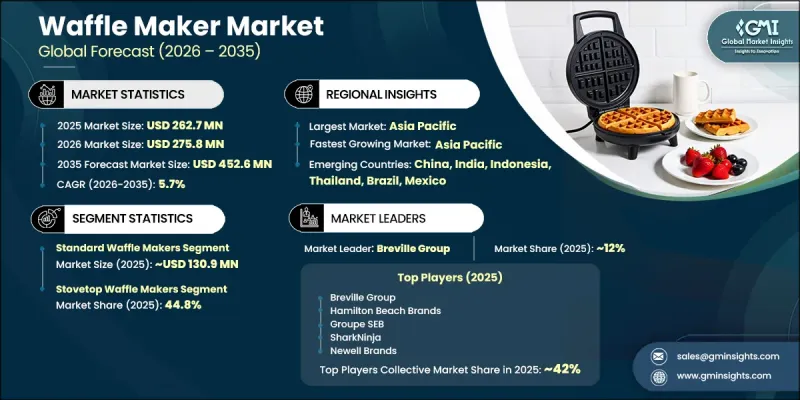
由於消費者對便利廚房電器的興趣日益濃厚、自製早餐越來越受歡迎以及對小型烹飪解決方案的需求不斷成長,華夫餅機市場正蓬勃發展。已開發國家和新興國家的消費者都在擴大將現代烹飪電器融入日常生活,這將支撐市場的長期成長。家庭烹飪文化的興起和飲食習慣的改變也進一步推動了華夫餅機在家庭中的普及。諸如改進的加熱系統、溫度控制、不沾塗層和多功能烹飪功能等技術進步,提高了產品的效率和便利性。可支配收入的增加以及對快速高效烹飪電器的日益偏好,也促進了產品需求的成長。此外,都市化的加快以及現代零售和電子商務管道的擴張,使得全球消費者更容易購買到華夫餅機,從而進一步增強了華夫餅機在多個地區的市場滲透率。
| 市場範圍 | |
|---|---|
| 開始年份 | 2025 |
| 預測期 | 2026-2035 |
| 上市時的市場規模 | 2.627億美元 |
| 預測金額 | 4.526億美元 |
| 複合年成長率 | 5.7% |
華夫餅機市場持續受惠於消費者對多功能便利家用電器日益成長的需求,這些電器能夠縮短烹飪時間。消費者越來越青睞能夠在家中提供餐廳級用餐體驗的廚房電器。現代華夫餅機在設計上增強了安全性能、提高了能源效率並簡化了操作,以滿足不斷變化的消費者期望。製造商也致力於打造緊湊美觀的產品設計,以適應現代廚房空間和生活方式。智慧廚房和多功能烹飪電器的普及正在推動整個市場的產品創新。此外,線上零售平台透過提供豐富的產品選擇、極具競爭力的價格以及直接面對消費者的銷售方式,顯著提高了產品知名度和客戶覆蓋範圍。
預計到2025年,標準華夫餅機市場規模將達到1.309億美元,並在2026年至2035年間以5.5%的複合年成長率成長。由於消費者對傳統華夫餅機的熟悉度高,且對傳統華夫餅烹飪方法的廣泛支持,這一細分市場持續推動華夫餅機市場的發展。標準華夫餅機通常用於製作質地和外觀均勻的經典華夫餅,深受家庭用戶的喜愛。消費者傾向於使用這類產品來製作日常早餐,並將其作為便利的家庭餐解決方案。商用餐飲服務商也使用標準華夫餅機來實現高效穩定的烹飪效果。此外,標準華夫餅機相對實惠的價格使其能夠被各個收入階層的消費者所接受,從而促進了該細分市場的持續強勁需求。烹飪性能、耐用性和清潔便利性方面的不斷改進,也進一步提升了標準華夫餅機在全球範圍內的受歡迎程度。
預計到2025年,爐灶式華夫餅機市佔率將達到44.8%,並在2035年之前以5.5%的複合年成長率成長。由於消費者對傳統烹飪方式和非電動產品的偏好日益成長,該細分市場仍佔據重要地位。爐灶式華夫餅機在重視手工烹飪方式的地區以及追求成本績效烹飪設備的消費者中尤其受歡迎。與電動華夫餅機相比,其較低的初始成本使其成為注重預算的消費者的理想選擇。消費者也高度重視其耐用性、便攜性和與現有廚房設備的兼容性。此外,戶外烹飪愛好者和追求輕量烹飪設備的消費者也持續推動該細分市場的需求。操作簡單和產品使用壽命長進一步提升了爐灶式華夫餅機在住宅和休閒場所的吸引力。
美國華夫餅機市場預計到2025年將達到6,430萬美元,2026年至2035年的複合年成長率(CAGR)為6.1%。消費者對便利早餐烹飪解決方案的強勁偏好,以及家用電器的普及,持續推動美國市場的成長。美國根深蒂固的家庭烹飪文化也帶來了對專業廚房電器的穩定需求。消費者越來越傾向於購買能夠節省時間、提升烹飪便利性和食品品質的電器。此外,酒店業也持續推動產品需求,因為住宿設施提供者優先考慮提升烹飪解決方案以改善客戶服務。包括實體店和電商平台在內的廣泛零售分銷網路,進一步提高了產品的供應量,從而支持了華夫餅機市場在全美範圍內的持續擴張。
目錄
第1章:調查方法和範圍
第2章執行摘要
第3章 行業洞察
- 產業生態系分析
- 供應商情況
- 利潤率
- 每個階段增加的價值
- 影響價值鏈的因素
- 影響產業的因素
- 促進因素
- 早餐文化的傳播和家庭烹飪的趨勢
- 電子商務和線上零售通路的擴張
- 新興市場可支配所得增加
- 產業潛在風險與挑戰
- 與多功能廚房電器的競爭
- 原料成本波動與供應鏈問題
- 機會
- 拓展線上零售與電子商務平台
- 新興市場的擴張與都市化
- 促進因素
- 成長潛力分析
- 未來市場趨勢
- 技術與創新展望
- 最新科技趨勢
- 新興技術
- 價格分析
- 對過去價格趨勢的分析
- 依球員類型分類的定價策略(高級球員、超值球員、成本加成球員)
- 監理情勢
- 標準和合規要求
- 區域監理框架
- 認證標準
- 波特的分析
- PESTLE分析
- 貿易數據分析
- 進出口量及進口額趨勢
- 主要貿易路線及關稅的影響
- HS編碼分類及貿易流量分析
- 人工智慧和生成式人工智慧對市場的影響
- 利用人工智慧改造現有經營模式
- 按細分市場分類的生成式人工智慧用例和部署藍圖
- 風險、限制和監管考量
- 目前分銷基礎設施和通路滲透情況
- 按地區與業態(現代零售與傳統零售)分類的通路覆蓋率
- 缺乏最後一公里基礎設施和不斷變化的管道
- 消費者購買行為分析
- 都市區和農村地區的購買模式
- 基於收入的細分和可負擔的價格
- 品牌偏好:全球品牌 vs. 本地品牌
- 線上線下購買流程
第4章 競爭情勢
- 介紹
- 企業市佔率分析
- 按地區
- 企業矩陣分析
- 主要市場公司的競爭分析
- 競爭定位矩陣
- 主要進展
- 併購
- 夥伴關係和聯盟
- 新產品發布
- 業務拓展計劃
第5章 市場估算與預測:依產品類型分類,2022-2035年
- 標準華夫餅機
- 比利時華夫餅機
- 迷你華夫餅機
- 多功能華夫餅機
- 其他
第6章 市場估算與預測:依動力來源,2022-2035年
- 電動華夫餅機
- 爐灶用華夫餅機
- 其他(電池供電等)
第7章 市場估計與預測:依動力來源,2022-2035年
- 電動華夫餅機
- 爐灶用華夫餅機
- 其他(電池供電等)
第8章 市場估算與預測:依價格區間分類,2022-2035年
- 低的
- 中等的
- 高的
第9章 市場估價與預測:依最終用戶分類,2022-2035年
- 住宅
- 商業的
- 露營和戶外活動
第10章 市場估價與預測:依通路分類,2022-2035年
- 線上
- 離線
第11章 市場估價與預測:按地區分類,2022-2035年
- 北美洲
- 美國
- 加拿大
- 歐洲
- 德國
- 英國
- 法國
- 義大利
- 西班牙
- 亞太地區
- 中國
- 日本
- 印度
- 澳洲
- 韓國
- 拉丁美洲
- 巴西
- 墨西哥
- 阿根廷
- 中東和非洲
- 南非
- 沙烏地阿拉伯
- UAE
第12章:公司簡介
- Top Global Player
- Breville Group
- Hamilton Beach Brands
- Newell Brands
- SharkNinja
- Stanley Black &Decker
- Whirlpool Corporation
- The Middleby Corporation
- Groupe SEB
- Regional Player
- Krups
- T-fal
- Conair Corporation
- National Presto Industries
- All-Clad
- Calphalon
- 新興企業
- Storebound
- Edgecraft Corporation
- The Metal Ware Corporation
- Waring Commercial
- Bella
- Nostalgia Products
- Salton
- Holstein Housewares
- CucinaPro
The Global Waffle Maker Market was valued at USD 262.7 million in 2025 and is estimated to grow at a CAGR of 5.7% to reach USD 452.6 million by 2035.
The market is gaining momentum due to rising consumer interest in convenient kitchen appliances, growing popularity of homemade breakfast preparation, and increasing demand for compact cooking solutions. Consumers across both developed and emerging economies are increasingly incorporating modern cooking appliances into their daily routines, supporting long-term market growth. The expanding culture of home-based meal preparation and changing food consumption habits are further encouraging the adoption of waffle makers across households. Technological improvements, including enhanced heating systems, adjustable temperature controls, non-stick cooking surfaces, and multifunctional cooking capabilities, are improving product efficiency and user convenience. Growing disposable income levels and rising preference for quick and efficient cooking appliances are also contributing to product demand. In addition, increasing urbanization and the expansion of modern retail and e-commerce channels are making waffle makers more accessible to consumers worldwide, further strengthening market penetration across multiple regions.
| Market Scope | |
|---|---|
| Start Year | 2025 |
| Forecast Year | 2026-2035 |
| Start Value | $262.7 Million |
| Forecast Value | $452.6 Million |
| CAGR | 5.7% |
The waffle maker industry continues to benefit from increasing consumer demand for appliances that simplify meal preparation while offering versatility and convenience. Consumers are showing greater preference for kitchen equipment capable of delivering restaurant-style food experiences within home environments. Modern waffle makers are being designed with improved safety features, energy-efficient operations, and user-friendly functionality to meet evolving consumer expectations. Manufacturers are also focusing on compact and aesthetically appealing product designs that align with modern kitchen spaces and lifestyle preferences. The rising trend of smart kitchens and multifunctional cooking appliances is encouraging product innovation across the market. In addition, online retail platforms are significantly improving product visibility and customer reach by offering wider product selections, competitive pricing, and direct-to-consumer purchasing options.
The standard waffle makers segment generated USD 130.9 million in 2025 and is anticipated to grow at a CAGR of 5.5% from 2026 to 2035. The segment continues to lead the waffle maker market due to strong consumer familiarity and widespread preference for traditional waffle preparation methods. Standard waffle makers are commonly used for preparing classic-style waffles with consistent texture and appearance, making them highly popular among households. Consumers prefer these products for regular breakfast preparation and convenient family meal solutions. Commercial food service operators also rely on standard waffle makers for efficient and uniform food preparation. In addition, the relatively affordable pricing of standard models supports broader adoption across multiple consumer income groups, helping maintain strong demand within the segment. Continuous product enhancements related to cooking performance, durability, and ease of cleaning are further strengthening the popularity of standard waffle makers worldwide.
The stovetop waffle makers segment accounted for 44.8% share in 2025 and is projected to grow at a CAGR of 5.5% through 2035. The segment maintains a significant presence due to increasing consumer preference for traditional cooking techniques and products that do not rely on electricity. Stovetop waffle makers are particularly favored in regions where consumers prioritize manual cooking methods or seek cost-effective kitchen tools. The lower upfront cost of stovetop models compared to electric alternatives makes them attractive among budget-conscious buyers. Consumers also appreciate their durability, portability, and compatibility with existing kitchen setups. In addition, outdoor cooking enthusiasts and consumers seeking lightweight cooking appliances continue to contribute to segment demand. The simplicity of operation and long product lifespan further enhance the appeal of stovetop waffle makers across both residential and recreational usage environments.
U.S. Waffle Maker Market was valued at USD 64.3 million in 2025 and is estimated to register a CAGR of 6.1% from 2026 to 2035. Strong consumer preference for convenient breakfast preparation solutions, combined with widespread household appliance ownership, continues to support market growth across the United States. The country maintains a well-established culture of home cooking, which contributes to consistent demand for specialized kitchen appliances. Consumers are increasingly investing in appliances that save time while improving cooking convenience and food quality. In addition, the hospitality sector continues to contribute to product demand as accommodation providers prioritize enhanced food preparation solutions for customer services. The presence of extensive retail distribution networks, including physical stores and digital commerce platforms, further strengthens product accessibility and supports continued expansion of the waffle maker market throughout the country.
Major companies operating in the Global Waffle Maker Market include All-Clad, Bella, Breville Group, Calphalon, Conair Corporation, CucinaPro, Edgecraft Corporation, Groupe SEB, Hamilton Beach Brands, Holstein Housewares, Krups, National Presto Industries, Newell Brands, Nostalgia Products, Salton, SharkNinja, Stanley Black & Decker, Storebound, T-fal, The Metal Ware Corporation, The Middleby Corporation, Waring Commercial, and Whirlpool Corporation. Companies operating in the waffle maker market are implementing several strategic initiatives to strengthen their competitive position and expand market presence. Manufacturers are heavily investing in product innovation, focusing on advanced heating technologies, multifunctional cooking capabilities, and energy-efficient appliance designs to improve customer satisfaction. Many companies are also emphasizing compact product formats and premium aesthetics to align with modern kitchen trends and evolving consumer lifestyles. Strategic partnerships with retail distributors and expansion of e-commerce sales channels are helping brands improve customer reach across domestic and international markets. In addition, companies are adopting competitive pricing strategies and launching products across multiple price categories to target a broader consumer base.
Table of Contents
Chapter 1 Methodology and Scope
- 1.1 Market scope and definition
- 1.2 Research design
- 1.2.1 Research approach
- 1.2.2 Data collection methods
- 1.3 Data mining sources
- 1.3.1 Global
- 1.3.2 Regional/Country
- 1.4 Base estimates and calculations
- 1.4.1 Base year calculation
- 1.4.2 Key trends for market estimation
- 1.5 Primary research and validation
- 1.5.1 Primary sources
- 1.6 Forecast model
- 1.7 Research assumptions and limitations
Chapter 2 Executive Summary
- 2.1 Industry 360° synopsis
- 2.2 Key market trends
- 2.2.1 Regional
- 2.2.2 Product Type
- 2.2.3 Power Source
- 2.2.4 Capacity
- 2.2.5 Price Range
- 2.2.6 End-User
- 2.2.7 Distribution channel
Chapter 3 Industry Insights
- 3.1 Industry ecosystem analysis
- 3.1.1 Supplier landscape
- 3.1.2 Profit margin
- 3.1.3 Value addition at each stage
- 3.1.4 Factor affecting the value chain
- 3.2 Industry impact forces
- 3.2.1 Growth drivers
- 3.2.1.1 Growing breakfast culture and home cooking trends
- 3.2.1.2 Expansion of e-commerce and online retail channels
- 3.2.1.3 Rising disposable incomes in emerging markets
- 3.2.2 Industry pitfalls & challenges
- 3.2.2.1 Competition from multi-functional kitchen appliances
- 3.2.2.2 Fluctuating raw material costs and supply chain issues
- 3.2.3 Opportunities
- 3.2.3.1 Growing online retail and e-commerce platforms
- 3.2.3.2 Expansion in emerging markets and urbanization
- 3.2.1 Growth drivers
- 3.3 Growth potential analysis
- 3.4 Future market trends
- 3.5 Technology and innovation landscape
- 3.5.1 Current technological trends
- 3.5.2 Emerging technologies
- 3.6 Pricing Analysis (Driven by Primary Research)
- 3.6.1 Historical Price Trend Analysis (Driven by Primary Research)
- 3.6.2 Pricing Strategy by Player Type (Premium/Value/Cost-plus) (Driven by Primary Research)
- 3.7 Regulatory landscape
- 3.7.1 Standards and compliance requirements
- 3.7.2 Regional regulatory frameworks
- 3.7.3 Certification standards
- 3.8 Porter's analysis
- 3.9 PESTEL analysis
- 3.10 Trade Data Analysis (Driven by Primary Research)
- 3.10.1 Import/Export Volume & Value Trends (Driven by Primary Research)
- 3.10.2 Key Trade Corridors & Tariff Impact (Driven by Primary Research)
- 3.10.3 HS Code Classification & Trade Flow Analysis
- 3.11 Impact of AI & Generative AI on the Market
- 3.11.1 AI-Driven Disruption of Existing Business Models
- 3.11.2 GenAI Use Cases & Adoption Roadmap by Segment
- 3.11.3 Risks, Limitations & Regulatory Considerations
- 3.12 Distribution Infrastructure & Channel Penetration Landscape (Driven by Primary Research)
- 3.12.1 Channel Coverage by Region & Format (Modern vs. Traditional Trade) (Driven by Primary Research)
- 3.12.2 Last-Mile Infrastructure Gaps & Emerging Channel Shifts (Driven by Primary Research)
- 3.13 Consumer Buying Behavior Analysis
- 3.13.1 Urban vs. Rural Purchasing Patterns
- 3.13.2 Income-Based Segmentation & Affordability
- 3.13.3 Brand Preference: Global vs. Local
- 3.13.4 Online vs. Offline Purchase Journey
Chapter 4 Competitive Landscape, 2025
- 4.1 Introduction
- 4.2 Company market share analysis
- 4.2.1 By region
- 4.2.1.1 North America
- 4.2.1.2 Europe
- 4.2.1.3 Asia Pacific
- 4.2.1.4 Latin America
- 4.2.1.5 Middle East and Africa
- 4.2.1 By region
- 4.3 Company matrix analysis
- 4.4 Competitive analysis of major market players
- 4.5 Competitive positioning matrix
- 4.6 Key developments
- 4.6.1 Mergers & acquisitions
- 4.6.2 Partnerships & collaborations
- 4.6.3 New product launches
- 4.6.4 Expansion plans
Chapter 5 Market Estimates & Forecast, By Product Type, 2022 - 2035, (USD Million) (Thousand Units)
- 5.1 Key trends
- 5.2 Standard waffle makers
- 5.3 Belgian waffle makers
- 5.4 Mini waffle makers
- 5.5 Multi-purpose waffle makers
- 5.6 Others
Chapter 6 Market Estimates & Forecast, By Power source, 2022 - 2035, (USD Million) (Thousand Units)
- 6.1 Key trends
- 6.2 Electric waffle makers
- 6.3 Stovetop waffle makers
- 6.4 Others (battery-operated, etc.)
Chapter 7 Market Estimates & Forecast, By Power source, 2022 - 2035, (USD Million) (Thousand Units)
- 7.1 Key trends
- 7.2 Electric waffle makers
- 7.3 Stovetop waffle makers
- 7.4 Others (battery-operated, etc.)
Chapter 8 Market Estimates & Forecast, By Price Range, 2022 - 2035, (USD Million) (Thousand Units)
- 8.1 Key trends
- 8.2 Low
- 8.3 Mid
- 8.4 High
Chapter 9 Market Estimates & Forecast, By End-User, 2022 - 2035, (USD Million) (Thousand Units)
- 9.1 Key trends
- 9.2 Residential
- 9.3 Commercial
- 9.4 Camping/outdoor use
Chapter 10 Market Estimates & Forecast, By Distribution Channel, 2022 - 2035, (USD Million) (Thousand Units)
- 10.1 Key trends
- 10.2 Online
- 10.3 Offline
Chapter 11 Market Estimates and Forecast, By Region, 2022 - 2035 (USD Million) (Thousand Units)
- 11.1 Key trends
- 11.2 North America
- 11.2.1 U.S.
- 11.2.2 Canada
- 11.3 Europe
- 11.3.1 Germany
- 11.3.2 UK
- 11.3.3 France
- 11.3.4 Italy
- 11.3.5 Spain
- 11.4 Asia Pacific
- 11.4.1 China
- 11.4.2 Japan
- 11.4.3 India
- 11.4.4 Australia
- 11.4.5 South Korea
- 11.5 Latin America
- 11.5.1 Brazil
- 11.5.2 Mexico
- 11.5.3 Argentina
- 11.6 Middle East and Africa
- 11.6.1 South Africa
- 11.6.2 Saudi Arabia
- 11.6.3 UAE
Chapter 12 Company Profiles
- 12.1 Top Global Player
- 12.1.1 Breville Group
- 12.1.2 Hamilton Beach Brands
- 12.1.3 Newell Brands
- 12.1.4 SharkNinja
- 12.1.5 Stanley Black & Decker
- 12.1.6 Whirlpool Corporation
- 12.1.7 The Middleby Corporation
- 12.1.8 Groupe SEB
- 12.2 Regional Player
- 12.2.1 Krups
- 12.2.2 T-fal
- 12.2.3 Conair Corporation
- 12.2.4 National Presto Industries
- 12.2.5 All-Clad
- 12.2.6 Calphalon
- 12.3 Emerging Players
- 12.3.1 Storebound
- 12.3.2 Edgecraft Corporation
- 12.3.3 The Metal Ware Corporation
- 12.3.4 Waring Commercial
- 12.3.5 Bella
- 12.3.6 Nostalgia Products
- 12.3.7 Salton
- 12.3.8 Holstein Housewares
- 12.3.9 CucinaPro

 華夫餅機市場:按操作方式、材質、電源、產品類型、最終用戶和分銷管道分類-2026-2032年全球市場預測
 華夫餅機市場 - 全球產業規模、佔有率、趨勢、機會及預測(按類型、最終用戶、銷售管道、地區和競爭格局分類,2021-2031年)
 華夫餅機市場規模、佔有率和成長分析(按產品類型、材質、容量、驅動機制、最終用戶和地區分類)—產業預測,2026-2033年
 全球華夫餅機市場
 全球格子鬆餅機市場評估:依類型、最終用戶、價格區間、通路、地區、機會和預測(2018-2032)
 全球華夫餅機市場:產業分析、規模、佔有率、成長、趨勢和預測(2025-2032 年)