

 |
市場調查報告書
商品編碼
2045829
飯店特許經營市場機會、成長要素、產業趨勢分析及2026-2035年預測Hotel Franchise Market Opportunity, Growth Drivers, Industry Trend Analysis, and Forecast 2026 - 2035 |
||||||

預計到 2025 年,全球飯店特許經營市場價值將達到 423 億美元,年複合成長率為 8.3%,到 2035 年將達到 936 億美元。
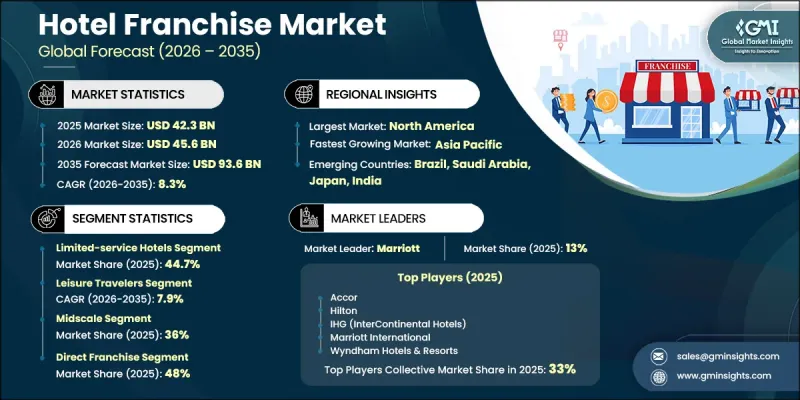
國內旅遊業的活性化和短期休閒旅遊的日益普及,為全球酒店特許經營行業提供了強勁的成長動力。注重性價比的旅客對經濟型住宿設施的需求不斷成長,推動了經濟型和中檔酒店特許經營模式的快速擴張。同時,商務旅行和企業活動的穩定復甦,顯著提升了酒店入住運轉率和特許經營收入,尤其是在大都會圈和商業中心地區。飯店營運商正擴大採用人工智慧收益管理系統和數位化賓客互動平台等先進技術,以最佳化定價策略、提升客戶體驗和營運效率。此外,市場正明顯轉向輕資產經營模式,飯店品牌更注重特許經營和管理協議,而非直接擁有物業。同時,永續發展措施正成為一項重要的競爭優勢,飯店品牌正大力投資於節能基礎設施、環保營運和綠色認證飯店開發,以增強客戶吸引力並實現長期盈利。
| 市場範圍 | |
|---|---|
| 開始年份 | 2025 |
| 預測期 | 2026-2035 |
| 上市時的市場規模 | 423億美元 |
| 預測市場規模 | 936億美元 |
| 複合年成長率 | 8.3% |
預計到2025年,有限服務型飯店市佔率將達到44.7%,並在2026年至2035年間以8.1%的複合年成長率成長。這類飯店主要針對尋求短期住宿的旅客,提供價格實惠、設施簡單、服務簡單的住宿設施選擇。有限服務型飯店通常精簡客房,減少餐飲選擇,且不具備大規模休閒或會議設施。其經濟高效的商業模式以及滿足預算有限旅客需求的能力,持續推動該細分市場在國內外市場的強勁成長。
預計到2025年,休閒旅行者市場將佔市場佔有率的52%,並在2035年之前以7.9%的複合年成長率成長。休閒旅客在整個旅遊、度假村和假日酒店市場中持續發揮至關重要的作用,推動著市場需求。家庭、情侶和獨自旅行者越來越傾向於選擇舒適且價格適中的住宿設施,既要方便快捷,又要能提供豐富的旅行體驗。為了提高運轉率,飯店加盟商正在推出個人化旅遊套餐、季節性促銷活動、會員獎勵計劃以及以體驗為中心的飯店服務,以滿足消費者不斷變化的休閒旅行和度假住宿需求。
美國酒店特許經營市場預計到2025年將達到147億美元,並在2026年至2035年間以7.3%的複合年成長率成長。由於美國品牌酒店高度集中、國內旅遊業穩定以及商務旅行需求強勁,該國仍然是北美酒店特許經營行業的主要驅動力。儘管擴張機會依然巨大,尤其是在經濟型、中檔和精選服務型酒店領域,但高檔和豪華品牌仍專注於向主要城市和度假區擴張。此外,受遠距辦公興起和商務旅行時間延長導致對長住住宿設施需求增加的推動,飯店特許經營商正優先考慮兼顧價格實惠和便利性的靈活住宿理念。
目錄
第1章:調查方法
第2章執行摘要
第3章:行業洞察
- 工業生態系分析
- 供應商情況
- 利潤率
- 成本結構
- 每個階段增加的價值
- 影響價值鏈的因素
- 中斷
- 影響產業的因素
- 促進因素
- 國內旅遊需求不斷成長
- 廉價旅行的成長
- 國際酒店品牌擴張
- 商務旅行增加
- 產業潛在風險與挑戰
- 監管許可的複雜性
- 激烈的競爭
- 市場機遇
- 區域城市的發展
- 生活風格酒店品牌的擴張
- 數位預訂的普及
- 長期住宿需求增加
- 促進因素
- 成長潛力分析
- 技術與創新展望
- 最新科技趨勢
- 新技術
- 成本細分分析
- 監理情勢
- 北美洲
- 聯邦貿易委員會(FTC)
- 美國司法部反壟斷司
- 歐洲
- 歐盟委員會(國內貿易總司)
- 歐洲旅遊委員會(ETC)
- 亞太地區
- 相當於中國文化和旅遊部/國家旅遊局的機構
- 印度旅遊部
- 拉丁美洲
- 巴西旅遊部(Ministerio do Turismo)
- 墨西哥旅遊局(SECTUR)
- 中東和非洲
- 杜拜經濟與旅遊局(DET)
- 觀光部
- 北美洲
- 波特的分析
- PESTLE分析
- 價格分析
- 對過去價格趨勢的分析
- 根據參與企業的類型(高階、價值、成本加成)所製定的定價策略
- 專利分析
- 人工智慧和生成式人工智慧對市場的影響
- 利用人工智慧改造現有經營模式
- 基於細分市場的生成式人工智慧的應用案例和部署藍圖
- 風險、限制和監管考量
- 永續性和環境方面
- 永續發展計劃
- 減少廢棄物策略
- 生產中的能源效率
- 環保舉措
- 考慮碳足跡
- 預測假設和情境分析
- 基本案例:驅動複合年成長率的關鍵宏觀經濟與產業變量
- 樂觀情境:宏觀經濟與產業的利多因素
- 悲觀情景:宏觀經濟放緩或產業逆風
第4章 競爭情勢
- 介紹
- 企業市佔率分析
- 北美洲
- 歐洲
- 亞太地區
- 拉丁美洲
- 中東和非洲
- 主要市場公司的競爭分析
- 競爭定位矩陣
- 併購
- 夥伴關係和聯盟
- 新產品發布
- 業務拓展計劃及資金籌措
第5章 市場估價與預測:依物業類型分類,2022-2035年
- 全方位服務飯店
- 限量服務飯店
- 長期住宿飯店
- 精選服務飯店
第6章 市場估計與預測:依產業鏈價值分類,2022-2035年
- 奢華
- 高級場所
- 高級
- 中高階
- 中檔
- 經濟
第7章 市場估計與預測:依客戶分類,2022-2035年
- 商務旅客
- 休閒旅客
- 團體大會
- 長期住客
第8章 市場估算與預測:依特許經營模式分類,2022-2035年
- 直接特許經營
- 管理特許經營
- 轉換特許經營
- 總特許經營權/區域開發特許經營權
第9章 市場估計與預測:依地區分類,2022-2035年
- 北美洲
- 美國
- 加拿大
- 歐洲
- 德國
- 英國
- 法國
- 義大利
- 西班牙
- 俄羅斯
- 荷蘭
- 亞太地區
- 中國
- 印度
- 日本
- 韓國
- 澳洲
- 越南
- 印尼
- 拉丁美洲
- 巴西
- 墨西哥
- 阿根廷
- 中東和非洲
- 南非
- 沙烏地阿拉伯
- 阿拉伯聯合大公國
第10章:公司簡介
- 世界公司
- Accor
- Choice Hotels
- Hilton
- Hyatt Hotels
- IHG(InterContinental Hotels)
- Jin Jiang
- MarrIoTt
- Wyndham
- 當地公司
- Best Western Hotels & Resorts
- H World(Huazhu)
- Louvre Hotels
- Melia Hotels
- Minor Hotels
- Radisson Hotel
- Shangri-La Hotels and Resorts
- Whitbread(Premier Inn)
- 新興企業
- Banyan Tree
- Magnuson Hotels
- OYO Hotels & Homes
- Sonesta International Hotels
The Global Hotel Franchise Market was valued at USD 42.3 billion in 2025 and is estimated to grow at a CAGR of 8.3% to reach USD 93.6 billion by 2035.
Rising domestic tourism activity and the growing popularity of short leisure travel are creating strong momentum for the hotel franchise industry worldwide. Increasing demand for affordable accommodations among cost-conscious travelers is encouraging rapid expansion of economy and midscale hotel franchise models. At the same time, the steady recovery of business travel and corporate events is contributing significantly to occupancy rates and franchise revenues, particularly across metropolitan and commercial destinations. Hotel operators are increasingly adopting advanced technologies such as AI-enabled revenue management systems and digital guest engagement platforms to improve pricing strategies, customer experiences, and operational efficiency. The market is also witnessing a strong transition toward asset-light business models, where hospitality brands focus more on franchise agreements and management contracts instead of direct property ownership. In addition, sustainability initiatives are becoming a major competitive advantage, with hospitality brands investing heavily in energy-efficient infrastructure, environmentally responsible operations, and green-certified hotel developments to strengthen customer appeal and long-term profitability.
| Market Scope | |
|---|---|
| Start Year | 2025 |
| Forecast Year | 2026-2035 |
| Start Value | $42.3 Billion |
| Forecast Value | $93.6 Billion |
| CAGR | 8.3% |
The limited-service hotels segment accounted for 44.7% share in 2025 and is projected to grow at a CAGR of 8.1% between 2026 and 2035. These hotels primarily focus on offering affordable accommodations with essential amenities and simplified services for travelers seeking short-term stays. Limited-service properties generally provide streamlined room offerings and minimal dining options while avoiding extensive recreational or conference facilities. Their cost-effective business structure and ability to cater to budget-conscious travelers continue to support strong segment expansion across domestic and international markets.
The leisure travelers segment held a 52% share in 2025 and is anticipated to grow at a CAGR of 7.9% through 2035. Leisure travelers continue to play a crucial role in driving demand across tourism destinations, resort locations, and vacation-focused hospitality markets. Families, couples, and solo travelers are increasingly seeking comfortable yet affordable accommodation options that combine convenience with enhanced travel experiences. To strengthen occupancy levels, hotel franchise operators are introducing personalized travel packages, seasonal promotions, loyalty rewards, and experience-focused hospitality services that align with changing consumer expectations for recreational travel and holiday stays.
U.S. Hotel Franchise Market generated USD 14.7 billion in 2025 and is expected to witness a CAGR of 7.3% from 2026 to 2035. The country remains the leading contributor to the North American hotel franchise industry due to its strong concentration of branded hotel properties, consistent domestic tourism activity, and stable corporate travel demand. Expansion opportunities remain particularly strong within the economy, midscale, and select-service hotel categories, while upscale and luxury brands continue focusing on premium urban centers and resort destinations. Additionally, growing demand for extended-stay accommodations, supported by remote working trends and long-duration business assignments, is encouraging hotel franchise operators to prioritize flexible lodging concepts that combine affordability with enhanced guest convenience.
Key companies operating in the Global Hotel Franchise Market include Accor, Hyatt Hotels, Wyndham Hotels & Resorts, Marriott, Hilton, Choice Hotels, H World, InterContinental Hotels (IHG), Best Western Hotels & Resorts, Radisson Hotels, NH Hotel, and Melia Hotels. Companies operating in the hotel franchise market are focusing on multiple growth strategies to strengthen their market presence and competitive positioning. Major hospitality brands are expanding their franchise portfolios across economy, midscale, luxury, and extended-stay categories to target diverse traveler preferences. Companies are increasingly investing in digital transformation, including AI-powered pricing systems, mobile booking platforms, smart room technologies, and personalized customer engagement tools to improve operational efficiency and guest satisfaction. Strategic partnerships, franchise agreements, and global expansion initiatives are helping brands increase their geographical reach and accelerate property development. Sustainability initiatives such as green building certifications, energy-efficient operations, and eco-friendly hospitality solutions are also becoming key priorities.
Table of Contents
Chapter 1 Methodology
- 1.1 Research approach
- 1.2 Quality Commitments
- 1.2.1 GMI AI policy & data integrity commitment
- 1.2.1.1 Source consistency protocol
- 1.2.1 GMI AI policy & data integrity commitment
- 1.3 Research Trail & Confidence Scoring
- 1.3.1 Research Trail Components
- 1.3.2 Scoring Components
- 1.4 Data Collection
- 1.4.1 Partial list of primary sources
- 1.5 Data mining sources
- 1.5.1 Paid sources
- 1.5.1.1 Sources, by region
- 1.5.1 Paid sources
- 1.6 Base estimates and calculations
- 1.6.1 Base year calculation
- 1.7 Forecast model
- 1.7.1 Quantified market impact analysis
- 1.7.1.1 Mathematical impact of growth parameters on forecast
- 1.7.1 Quantified market impact analysis
- 1.8 Research transparency addendum
- 1.8.1 Source attribution framework
- 1.8.2 Quality assurance metrics
- 1.8.3 Our commitment to trust
Chapter 2 Executive Summary
- 2.1 Industry 360° synopsis
- 2.2 Key market trends
- 2.2.1 Regional
- 2.2.2 Property type
- 2.2.3 Customer
- 2.2.4 Chain value
- 2.2.5 Franchise model
- 2.3 TAM analysis, 2026-2035
- 2.4 CXO perspectives: Strategic imperatives
Chapter 3 Industry Insights
- 3.1 Industry ecosystem analysis
- 3.1.1 Supplier landscape
- 3.1.2 Profit margin
- 3.1.3 Cost structure
- 3.1.4 Value addition at each stage
- 3.1.5 Factor affecting the value chain
- 3.1.6 Disruptions
- 3.2 Industry impact forces
- 3.2.1 Growth drivers
- 3.2.1.1 Rising domestic tourism demand
- 3.2.1.2 Growth in budget travel
- 3.2.1.3 Expansion of international hotel brands
- 3.2.1.4 Increasing business travel activities
- 3.2.2 Industry pitfalls and challenges
- 3.2.2.1 Regulatory licensing complexities
- 3.2.2.2 Intense pricing competition
- 3.2.3 Market opportunities
- 3.2.3.1 Growth in secondary cities
- 3.2.3.2 Expansion of lifestyle hotel brands
- 3.2.3.3 Rising digital booking adoption
- 3.2.3.4 Increasing extended-stay demand
- 3.2.1 Growth drivers
- 3.3 Growth potential analysis
- 3.4 Technology and innovation landscape
- 3.4.1 Current technological trends
- 3.4.2 Emerging technologies
- 3.5 Cost breakdown analysis
- 3.6 Regulatory landscape
- 3.6.1 North America
- 3.6.1.1 Federal Trade Commission (FTC)
- 3.6.1.2 U.S. Department of Justice (DOJ) - Antitrust Division
- 3.6.2 Europe
- 3.6.2.1 European Commission (DG GROW)
- 3.6.2.2 European Travel Commission (ETC)
- 3.6.3 Asia Pacific
- 3.6.3.1 Ministry of Culture and Tourism (China) / National Tourism Administration equivalents
- 3.6.3.2 Ministry of Tourism (India)
- 3.6.4 Latin America
- 3.6.4.1 Brazilian Ministry of Tourism (Ministerio do Turismo)
- 3.6.4.2 Secretaria de Turismo (SECTUR - Mexico)
- 3.6.5 Middle East & Africa
- 3.6.5.1 Dubai Department of Economy and Tourism (DET)
- 3.6.5.2 Saudi Ministry of Tourism
- 3.6.1 North America
- 3.7 Porter's analysis
- 3.8 PESTEL analysis
- 3.9 Pricing analysis (Driven by Primary Research)
- 3.9.1 Historical price trend analysis
- 3.9.2 Pricing strategy by player type (premium / value / cost-plus)
- 3.10 Patent analysis (Driven by Primary Research)
- 3.11 Impact of AI & Generative AI on the Market
- 3.11.1 AI-driven disruption of existing business models
- 3.11.2 Gen AI use cases & adoption roadmap by segment
- 3.11.3 Risks, limitations & regulatory considerations
- 3.12 Sustainability and environmental aspects
- 3.12.1 Sustainable practices
- 3.12.2 Waste reduction strategies
- 3.12.3 Energy efficiency in production
- 3.12.4 Eco-friendly initiatives
- 3.12.5 Carbon footprint considerations
- 3.13 Forecast assumptions & scenario analysis (Driven by primary research)
- 3.13.1 Base Case - key macro & industry variables driving CAGR
- 3.13.2 Optimistic Scenarios - Favorable macro and industry tailwinds
- 3.13.3 Pessimistic Scenario - Macroeconomic slowdown or industry headwinds
Chapter 4 Competitive Landscape, 2025
- 4.1 Introduction
- 4.2 Company market share analysis
- 4.2.1 North America
- 4.2.2 Europe
- 4.2.3 Asia Pacific
- 4.2.4 LATAM
- 4.2.5 MEA
- 4.3 Competitive analysis of major market players
- 4.4 Competitive positioning matrix
- 4.5 Key developments
- 4.5.1 Mergers & acquisitions
- 4.5.2 Partnerships & collaborations
- 4.5.3 New product launches
- 4.5.4 Expansion plans and funding
Chapter 5 Market Estimates & Forecast, By Property Type, 2022 - 2035 ($Mn)
- 5.1 Key trends
- 5.2 Full-service hotels
- 5.3 Limited-service hotels
- 5.4 Extended-stay hotels
- 5.5 Select-service hotels
Chapter 6 Market Estimates & Forecast, By Chain Value, 2022 - 2035 ($Mn)
- 6.1 Key trends
- 6.2 Luxury
- 6.3 Upper Upscale
- 6.4 Upscale
- 6.5 Upper Midscale
- 6.6 Midscale
- 6.7 Economy
Chapter 7 Market Estimates & Forecast, By Customer, 2022 - 2035 ($Mn)
- 7.1 Key trends
- 7.2 Business travelers
- 7.3 Leisure travelers
- 7.4 Group/Convention
- 7.5 Extended-stay guests
Chapter 8 Market Estimates & Forecast, By Franchise Model, 2022 - 2035 ($Mn)
- 8.1 Key trends
- 8.2 Direct franchise
- 8.3 Management franchise
- 8.4 Conversion franchise
- 8.5 Master franchise / Area development franchise
Chapter 9 Market Estimates & Forecast, By Region, 2022 - 2035 ($Mn)
- 9.1 Key trends
- 9.2 North America
- 9.2.1 U.S.
- 9.2.2 Canada
- 9.3 Europe
- 9.3.1 Germany
- 9.3.2 UK
- 9.3.3 France
- 9.3.4 Italy
- 9.3.5 Spain
- 9.3.6 Russia
- 9.3.7 Netherlands
- 9.4 Asia Pacific
- 9.4.1 China
- 9.4.2 India
- 9.4.3 Japan
- 9.4.4 South Korea
- 9.4.5 Australia
- 9.4.6 Vietnam
- 9.4.7 Indonesia
- 9.5 Latin America
- 9.5.1 Brazil
- 9.5.2 Mexico
- 9.5.3 Argentina
- 9.6 MEA
- 9.6.1 South Africa
- 9.6.2 Saudi Arabia
- 9.6.3 UAE
Chapter 10 Company Profiles
- 10.1 Global players
- 10.1.1 Accor
- 10.1.2 Choice Hotels
- 10.1.3 Hilton
- 10.1.4 Hyatt Hotels
- 10.1.5 IHG (InterContinental Hotels)
- 10.1.6 Jin Jiang
- 10.1.7 Marriott
- 10.1.8 Wyndham
- 10.2 Regional players
- 10.2.1 Best Western Hotels & Resorts
- 10.2.2 H World (Huazhu)
- 10.2.3 Louvre Hotels
- 10.2.4 Melia Hotels
- 10.2.5 Minor Hotels
- 10.2.6 Radisson Hotel
- 10.2.7 Shangri-La Hotels and Resorts
- 10.2.8 Whitbread (Premier Inn)
- 10.3 Emerging players
- 10.3.1 Banyan Tree
- 10.3.2 Magnuson Hotels
- 10.3.3 OYO Hotels & Homes
- 10.3.4 Sonesta International Hotels

 城市門房服務市場預測至2034年-按服務類型、客戶類型、交付方式、技術整合和區域分類的全球分析
 濱水酒店市場規模、佔有率和成長分析:按酒店類型、住宿設施類型、預訂管道、應用、最終用戶和地區分類-2026-2033年產業預測
 飯店、度假村和郵輪市場-2026-2032年全球市場預測海灘酒店市場:按類型、服務類別、所有權類型、旅客類型和預訂管道分類-2026-2032年全球市場預測
 全球海灘酒店市場規模、佔有率、趨勢和成長分析報告(2026-2034)
 門房服務市場規模、佔有率和成長分析:按服務類型、服務模式、客戶類型、交付管道、最終用途和地區分類-2026-2033年產業預測
 海灘飯店市集:依住宿設施類型、服務類型、預訂管道和地區分類長住飯店市場:2026-2032年全球市場預測(依服務水準、入住時長、設施、房型、最終用戶及預訂管道分類)門房服務市場:按服務類型、服務等級、交付模式、訂閱模式和最終用戶分類-2026-2032年全球市場預測精品酒店市場:2026-2032年全球市場預測(按酒店類型、規模、遊客類型和預訂類型分類)