


 |
市場調查報告書
商品編碼
2045820
顆粒狀生物炭市場機會、成長要素、產業趨勢分析及2026-2035年預測Granular Biochar Market Opportunity, Growth Drivers, Industry Trend Analysis, and Forecast 2026 - 2035 |
||||||

2025年全球顆粒狀生物炭市場規模預估為9,740萬美元,預估至2035年將達3.208億美元,年複合成長率為12.7%。
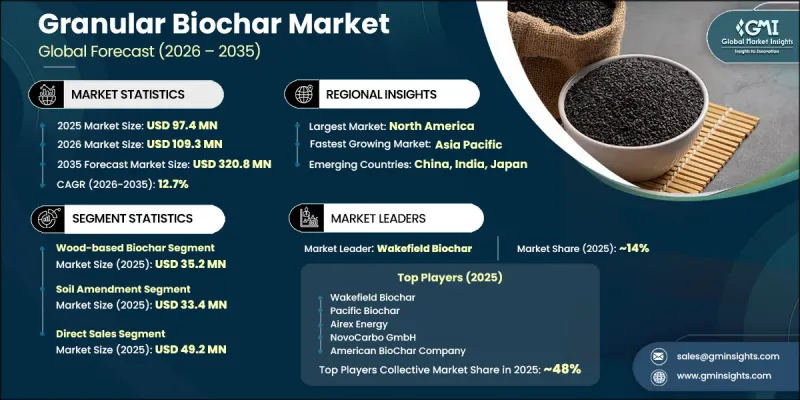
永續農業實踐的日益普及在加速顆粒狀生物炭產業發展方面發揮著重要作用。農民們正擴大將生物炭納入其長期土壤管理策略,以應對土壤品質退化、過度依賴化學肥料以及農業生產力下降等挑戰。生物炭因其能夠改善土壤狀況(例如增強養分維持、促進水分管理和增強微生物活性)而備受青睞。人們對再生農業和環保耕作技術的日益關注也進一步推動了市場擴張。此外,自願碳市場的建立也為顆粒狀生物炭生產商創造了新的成長機會。生物炭作為一種有效的碳封存材料正日益受到認可,這促使各組織將其納入碳移除舉措並產生經認證的排碳權。這種結合產品商業化和排碳權產生的雙重收益模式正在吸引更多投資,並推動全球顆粒狀生物炭市場產能的提升。
| 市場範圍 | |
|---|---|
| 開始年份 | 2025 |
| 預測期 | 2026-2035 |
| 上市時的市場規模 | 9740萬美元 |
| 預計金額 | 3.208億美元 |
| 複合年成長率 | 12.7% |
預計到2025年,木質生物炭市場規模將達3,520萬美元。產業內的產品需求受多種因素影響,例如原料供應、生產效率以及終端用途的性能要求。木質生物炭憑藉其穩定的碳組成、高度多孔的結構以及能夠支持持續的大規模生產,持續保持著強勁的市場地位。這些特性使其非常適合需要長期土壤改良和高效儲存碳的農業和環境應用。
預計到2025年,直銷市場規模將達到4,920萬美元。顆粒狀生物炭市場的分銷管道趨勢主要受客製化產品解決方案、大批量處理能力以及供應商與終端用戶之間緊密合作的需求所驅動。對於需要技術支援、規格客製化和應用指導的工業設施、農業企業和碳管理專案而言,銷售管道仍然至關重要。這種銷售模式使製造商能夠保持價格穩定,確保產品品質標準,並透過客製化服務和專家解決方案建立長期的業務關係。
預計2025年,北美顆粒狀生物炭市場規模將達3,510萬美元。美國佔據該地區市場最大佔有率,這主要得益於人們對土壤健康改善和碳封存實踐的日益重視。有利於氣候友善農業發展和永續土地管理舉措的政策框架也為市場成長提供了支撐。生物炭在再生農業系統和排碳權計畫中的應用日益廣泛,進一步推動了全部區域生物炭的需求。此外,熱解技術的不斷進步以及完善的研發體系,使得新興生產商和大型生產商都能加速商業化進程,並擴大北美顆粒狀生物炭產業的產能。
目錄
第1章:調查方法和範圍
第2章執行摘要
第3章 行業洞察
- 產業生態系分析
- 供應商情況
- 利潤率
- 每個階段增加的價值
- 影響價值鏈的因素
- 中斷
- 影響產業的因素
- 促進因素
- 對永續農業和土壤健康解決方案的需求日益成長
- 自願碳市場的擴張和對碳排放權的需求
- 人們對循環經濟和有效利用廢棄物。
- 產業潛在風險與挑戰
- 生產設備的初始投資相對較高。
- 新興市場終端用戶意識較低
- 市場機遇
- 與可再生能源和生質燃料生產的融合
- 開發高附加價值利基應用
- 促進因素
- 成長潛力分析
- 監理情勢
- 波特的分析
- PESTLE分析
- 價格趨勢
- 按地區
- 依產品類型
- 未來市場趨勢
- 技術與創新展望
- 最新科技趨勢
- 新興技術
- 專利趨勢
- 貿易統計(註:僅提供主要國家的貿易統計)
- 主要進口國
- 主要出口國
- 永續性和環境方面
- 永續計劃
- 減少廢棄物策略
- 生產中的能源效率
- 具有環保意識的舉措
- 考慮碳足跡
第4章 競爭情勢
- 介紹
- 企業市佔率分析
- 按地區
- 北美洲
- 歐洲
- 亞太地區
- LATAM
- 中東和非洲
- 按地區
- 企業矩陣分析
- 主要市場公司的競爭分析
- 競爭定位矩陣
- 主要進展
- 併購
- 夥伴關係和聯盟
- 新產品發布
- 業務拓展計劃
第5章 市場估計與預測:依類型分類,2022-2035年
- 木質生物炭
- 鋸末和木屑
- 疏伐木材和伐木剩餘物
- 木材加工廢棄物
- 利用農業廢棄物製成的生物炭
- 作物殘茬(玉米秸稈和葉子、小麥秸稈)
- 稻殼和稻田廢棄物
- 堅果殼和水果種子
- 畜禽糞便製成的生物炭
- 家禽糞便
- 牛和牛的糞便
- 豬糞
- 其他
- 生物固形物和污水污泥
- 能源作物
- 城市有機廢棄物
第6章 市場估計與預測:依通路分類,2022-2035年
- 直銷
- 銷售代理商和批發商
- 線上零售商
第7章 市場估計與預測:依地區分類,2022-2035年
- 北美洲
- 美國
- 加拿大
- 歐洲
- 德國
- 英國
- 法國
- 西班牙
- 義大利
- 其他歐洲國家
- 亞太地區
- 中國
- 印度
- 日本
- 澳洲
- 韓國
- 其他亞太國家
- 拉丁美洲
- 巴西
- 墨西哥
- 阿根廷
- 其他拉丁美洲國家
- 中東和非洲
- 沙烏地阿拉伯
- 南非
- UAE
- 其他中東和非洲國家
第8章:公司簡介
- Airex Energy
- American BioChar Company
- ArSta Eco Pvt Ltd.
- Carbo Culture
- Carbon Gold Ltd.
- Carbofex Ltd.
- CharGrow USA
- NextChar
- NovoCarbo GmbH
- Oregon Biochar Solutions
- Pacific Biochar Benefit Corporation
- PYREG GmbH
- Sonnenerde GmbH
- Vedic Orgo LLP
- Wakefield Biochar
The Global Granular Biochar Market was valued at USD 97.4 million in 2025 and is estimated to grow at a CAGR of 12.7% to reach USD 320.8 million by 2035.
Rising adoption of sustainable agricultural practices is playing a major role in accelerating the growth of the granular biochar industry. Farmers are increasingly incorporating biochar into long-term soil management strategies to address declining soil quality, excessive chemical dependency, and reduced agricultural productivity. The material is gaining strong demand due to its ability to improve nutrient retention, support moisture management, and enhance soil conditions that promote healthier microbial activity. Growing interest in regenerative farming methods and environmentally responsible cultivation techniques is further contributing to market expansion. In addition, the development of voluntary carbon markets is creating new growth opportunities for granular biochar manufacturers. Biochar is increasingly recognized as an effective carbon sequestration material, encouraging organizations to integrate it into carbon dioxide removal initiatives to generate certified carbon credits. This dual-revenue model, combining product commercialization with carbon credit generation, is attracting higher investments and supporting production capacity expansion across the global granular biochar market.
| Market Scope | |
|---|---|
| Start Year | 2025 |
| Forecast Year | 2026-2035 |
| Start Value | $97.4 Million |
| Forecast Value | $320.8 Million |
| CAGR | 12.7% |
The wood-based biochar segment accounted for USD 35.2 million in 2025. Product demand within the industry is influenced by factors such as raw material availability, manufacturing efficiency, and performance requirements across end-use applications. Wood-derived biochar continues to maintain a strong market position due to its stable carbon composition, highly porous structure, and ability to support consistent large-scale production. These characteristics make it highly suitable for agricultural and environmental applications that require long-lasting soil enhancement and efficient carbon storage performance.
The direct sales segment was valued at USD 49.2 million in 2025. Distribution channel dynamics in the granular biochar market are largely influenced by the need for customized product solutions, large-volume handling capabilities, and strong engagement between suppliers and end users. Direct sales channels remain essential for industrial facilities, agricultural operators, and carbon management projects that require technical support, tailored specifications, and application-based guidance. This sales approach allows manufacturers to maintain pricing consistency, ensure product quality standards, and establish long-term business relationships through customized service offerings and specialized solutions.
North America Granular Biochar Market generated USD 35.1 million in 2025. The United States accounted for the largest share within the regional market due to growing awareness surrounding soil health improvement and carbon sequestration practices. Market growth is being supported by favorable policy frameworks focused on climate-conscious agricultural development and sustainable land management initiatives. Increasing integration of biochar into regenerative agriculture systems and carbon credit programs is further driving product demand across the region. In addition, ongoing advancements in pyrolysis technologies and the presence of a well-established research and development ecosystem are enabling both emerging and large-scale manufacturers to accelerate commercialization efforts and expand production capabilities within the North American granular biochar industry.
Key participants operating in the Global Granular Biochar Market include Airex Energy, American BioChar Company, ArSta Eco Pvt Ltd., Carbo Culture, Carbon Gold Ltd., Carbofex Ltd., CharGrow USA, NextChar, NovoCarbo GmbH, Oregon Biochar Solutions, Pacific Biochar Benefit Corporation, PYREG GmbH, Sonnenerde GmbH, Vedic Orgo LLP, and Wakefield Biochar. Companies operating in the granular biochar market are adopting several strategic initiatives to strengthen their market presence and improve long-term competitiveness. Manufacturers are focusing on expanding production capacity and investing in advanced pyrolysis technologies to enhance product quality and operational efficiency. Strategic collaborations with agricultural organizations, carbon credit platforms, and research institutions are helping companies broaden their customer base and improve product adoption. Many market participants are also prioritizing sustainability-focused branding to align with rising environmental awareness among consumers and businesses. In addition, companies are increasing investments in research and development activities to create application-specific biochar products with improved soil enhancement and carbon sequestration performance.
Table of Contents
Chapter 1 Methodology & Scope
- 1.1 Market scope and definition
- 1.2 Research design
- 1.2.1 Research approach
- 1.2.2 Data collection methods
- 1.3 Data mining sources
- 1.3.1 Global
- 1.3.2 Regional/Country
- 1.4 Base estimates and calculations
- 1.4.1 Base year calculation
- 1.4.2 Key trends for market estimation
- 1.5 Primary research and validation
- 1.5.1 Primary sources
- 1.6 Forecast model
- 1.7 Research assumptions and limitations
Chapter 2 Executive Summary
- 2.1 Industry 360° synopsis
- 2.2 Key market trends
- 2.2.1 Regional
- 2.2.2 Product Type
- 2.2.3 Application
- 2.2.4 Distribution Channel
- 2.3 TAM Analysis, 2026-2035
- 2.4 CXO perspectives: Strategic imperatives
- 2.4.1 Executive decision points
- 2.4.2 Critical success factors
- 2.5 Future Outlook and strategic recommendations
Chapter 3 Industry Insights
- 3.1 Industry ecosystem analysis
- 3.1.1 Supplier Landscape
- 3.1.2 Profit Margin
- 3.1.3 Value addition at each stage
- 3.1.4 Factor affecting the value chain
- 3.1.5 Disruptions
- 3.2 Industry impact forces
- 3.2.1 Growth drivers
- 3.2.1.1 Growing demand for sustainable agriculture & soil health solutions
- 3.2.1.2 Expansion of voluntary carbon markets & CDR credit demand
- 3.2.1.3 Increasing focus on circular economy & waste valorization
- 3.2.2 Industry pitfalls and challenges
- 3.2.2.1 High initial capital investment for production facilities
- 3.2.2.2 Limited awareness among end-users in emerging markets
- 3.2.3 Market opportunities
- 3.2.3.1 Integration with renewable energy & biofuel production
- 3.2.3.2 Development of high-value niche applications
- 3.2.1 Growth drivers
- 3.3 Growth potential analysis
- 3.4 Regulatory landscape
- 3.4.1 North America
- 3.4.2 Europe
- 3.4.3 Asia Pacific
- 3.4.4 Latin America
- 3.4.5 Middle East & Africa
- 3.5 Porter's analysis
- 3.6 PESTEL analysis
- 3.6.1 Technology and innovation landscape
- 3.6.2 Current technological trends
- 3.6.3 Emerging technologies
- 3.7 Price trends
- 3.7.1 By region
- 3.7.2 By product type
- 3.8 Future market trends
- 3.9 Technology and Innovation Landscape
- 3.9.1 Current technological trends
- 3.9.2 Emerging technologies
- 3.10 Patent Landscape
- 3.11 Trade statistics (HS code) (Note: the trade statistics will be provided for key countries only)
- 3.11.1 Major importing countries
- 3.11.2 Major exporting countries
- 3.12 Sustainability and environmental aspects
- 3.12.1 Sustainable practices
- 3.12.2 Waste reduction strategies
- 3.12.3 Energy efficiency in production
- 3.12.4 Eco-friendly initiatives
- 3.13 Carbon Footprint Considerations
Chapter 4 Competitive Landscape, 2025
- 4.1 Introduction
- 4.2 Company market share analysis
- 4.2.1 By region
- 4.2.1.1 North America
- 4.2.1.2 Europe
- 4.2.1.3 Asia Pacific
- 4.2.1.4 LATAM
- 4.2.1.5 MEA
- 4.2.1 By region
- 4.3 Company matrix analysis
- 4.4 Competitive analysis of major market players
- 4.5 Competitive positioning matrix
- 4.6 Key developments
- 4.6.1 Mergers & acquisitions
- 4.6.2 Partnerships & collaborations
- 4.6.3 New product launches
- 4.6.4 Expansion plans
Chapter 5 Market Estimates and Forecast, By Type, 2022 - 2035 (USD Million) (Kilo Tons)
- 5.1 Key trends
- 5.2 Wood-based biochar
- 5.2.1 Sawdust & wood chips
- 5.2.2 Forest thinnings & logging residues
- 5.2.3 Wood manufacturing waste
- 5.3 Agricultural waste-based biochar
- 5.3.1 Crop residues (corn stover, wheat straw)
- 5.3.2 Rice husks & paddy waste
- 5.3.3 Nut shells & fruit pits
- 5.4 Animal manure-based biochar
- 5.4.1 Poultry litter
- 5.4.2 Cattle & dairy manure
- 5.4.3 Swine waste
- 5.5 Others
- 5.5.1 Biosolids & sewage sludge
- 5.5.2 Purpose-grown energy crops
- 5.5.3 Urban organic waste
Chapter 6 Market Estimates and Forecast, By Distribution Channel, 2022 - 2035 (USD Million) (Kilo Tons)
- 6.1 Key trends
- 6.2 Direct Sales
- 6.3 Distributors and Wholesalers
- 6.4 Online Retailers
Chapter 7 Market Estimates and Forecast, By Region, 2022 - 2035 (USD Million) (Kilo Tons)
- 7.1 Key trends
- 7.2 North America
- 7.2.1 U.S.
- 7.2.2 Canada
- 7.3 Europe
- 7.3.1 Germany
- 7.3.2 UK
- 7.3.3 France
- 7.3.4 Spain
- 7.3.5 Italy
- 7.3.6 Rest of Europe
- 7.4 Asia Pacific
- 7.4.1 China
- 7.4.2 India
- 7.4.3 Japan
- 7.4.4 Australia
- 7.4.5 South Korea
- 7.4.6 Rest of Asia Pacific
- 7.5 Latin America
- 7.5.1 Brazil
- 7.5.2 Mexico
- 7.5.3 Argentina
- 7.5.4 Rest of Latin America
- 7.6 Middle East and Africa
- 7.6.1 Saudi Arabia
- 7.6.2 South Africa
- 7.6.3 UAE
- 7.6.4 Rest of Middle East and Africa
Chapter 8 Company Profiles
- 8.1 Airex Energy
- 8.2 American BioChar Company
- 8.3 ArSta Eco Pvt Ltd.
- 8.4 Carbo Culture
- 8.5 Carbon Gold Ltd.
- 8.6 Carbofex Ltd.
- 8.7 CharGrow USA
- 8.8 NextChar
- 8.9 NovoCarbo GmbH
- 8.10 Oregon Biochar Solutions
- 8.11 Pacific Biochar Benefit Corporation
- 8.12 PYREG GmbH
- 8.13 Sonnenerde GmbH
- 8.14 Vedic Orgo LLP
- 8.15 Wakefield Biochar
