

 |
市場調查報告書
商品編碼
2045816
木製玩具市場機會、成長要素、產業趨勢分析及2026-2035年預測Wooden Toy Market Opportunity, Growth Drivers, Industry Trend Analysis, and Forecast 2026 - 2035 |
||||||

2025年全球木製玩具市場價值為312億美元,預計到2035年將以6%的複合年成長率成長至571億美元。
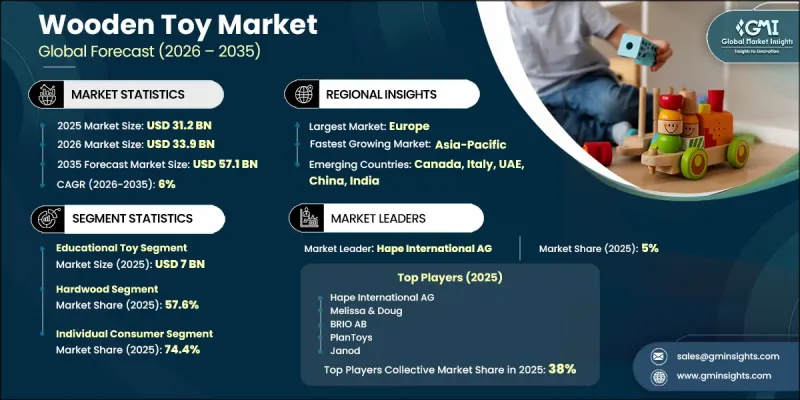
人們日益認知到傳統玩具對兒童發展的益處,這是推動全球市場成長的主要動力。家長們越來越傾向於選擇木製玩具,因為它們經久耐用、安全可靠,並且能夠鼓勵孩子互動式和發揮想像力的遊戲,而無需依賴電子螢幕或電子設備。消費者環保意識的增強也推動了對採用可再生和永續材料製成的環保玩具的需求。木製玩具因其使用壽命長而廣受認可,對於尋求塑膠製品耐用替代品的家庭來說,它們是一項極具吸引力的投資。人們對兒童發展、創造力和體驗式學習的日益關注,進一步促進了木製玩具在住宅和教育機構中的普及。教育機構和托幼機構擴大使用木製玩具來支持兒童的認知發展、運動技能發展和問題解決能力。此外,對國際安全認證和無毒生產流程的日益重視,也增強了消費者對高品質木製玩具的信心。對永續、安全且注重兒童發展的玩具產品的需求不斷成長,持續為全球木製玩具產業創造強勁的成長機會。
| 市場範圍 | |
|---|---|
| 開始年份 | 2025 |
| 預測期 | 2026-2035 |
| 上市時的市場規模 | 312億美元 |
| 預測金額 | 571億美元 |
| 複合年成長率 | 6% |
預計到2025年,益智玩具市場規模將達到70億美元,成為木製玩具市場的主要類別之一。益智木製玩具因其能夠支持幼兒早期學習和發展活動而持續獲得消費者的青睞。旨在提升認知能力、協調能力和問題解決能力的益智玩具產品,正日益受到家長和教育機構的青睞,成為他們尋求寓教於樂的兒童學習方案的首選。這些玩具不僅有助於培養創造力、空間感知能力、手眼協調和邏輯思考能力等重要技能,還能促進互動遊戲體驗。益智木製玩具經久耐用、用途廣泛,適用於不同年齡層和各種學習環境,可重複使用。隨著家庭學習和幼兒教育計畫的普及,全球市場對益智木製玩具的需求也持續成長。
預計到2025年,硬木玩具市佔率將達到57.6%,這主要得益於其卓越的強度、耐用性和高品質的表面處理。硬木因其極高的抗磨損性,能夠經受反覆把玩和長期使用,因此在玩具製造領域備受青睞。採用優質硬木製作的木製玩具不僅安全性更高、結構更穩定,而且隨著時間的推移,表面劣化的風險也更低。此外,製造商也青睞硬木,因為它能夠展現精細的細節,提供光滑的表面,並能長期維持產品品質。消費者對高品質和可傳承玩具的偏好日益成長,進一步推動了對硬木木製玩具的需求。同時,使用無毒塗料、天然油和兒童安全塗料,在確保符合兒童產品嚴格安全標準的同時,也持續提升了產品的吸引力。
美國木製玩具市佔率高達75.3%,預計2025年市場規模將達65.1億美元。消費者對永續產品、兒童發展益處以及環保意識的日益增強,持續推動全美木製玩具市場的成長。中高所得家庭可支配所得的增加,促使他們增加對高階益智玩具和環保玩具的支出。零售商和電商平台正大幅拓展木製玩具的供應,以滿足消費者對安全永續產品日益成長的需求。此外,美國嚴格的產品安全法規也增強了消費者對木製玩具品質和可靠性的信心,從而促進了市場發展。同時,精品店和線上零售通路對手工和特色玩具的需求不斷成長,也為全美各地的高階木製玩具製造商創造了新的機會。
目錄
第1章:調查方法
第2章執行摘要
第3章 行業洞察
- 產業生態系分析
- 影響價值鏈的因素
- 利潤率分析
- 中斷
- 前景
- 製造商
- 中斷
- 供應商情況
- 主要新聞和舉措
- 監理情勢
- 歐盟玩具安全指令 (2009/48/EC) 和 EN 71 標準
- 美國 CPSIA 和 ASTM F963 合規性要求
- ISO 8124 國際標準
- 化學物質法規(REACH,65號提案)
- 影響因素
- 促進因素
- 日益增強的環保意識
- 對教育價值的認可
- 注重品質
- 產業潛在風險與挑戰
- 高價位範圍
- 與電子玩具的競爭
- 機會
- 客製化和個人化
- 與教育機構建立合作關係
- 促進因素
- 2025年價格分析
- 2022-2025年歷史價格趨勢分析
- 依球員類型分類的定價策略(高級球員、超值球員、成本加成球員)
- 區域價格波動分析
- 原物料成本對價格的影響
- 消費者購買行為分析
- 人口趨勢
- 影響購買決策的因素
- 消費者產品採納
- 首選分銷管道
- 成長潛力分析
- 波特的分析
- PESTLE分析
- 貿易數據分析
- 進出口量及進口額趨勢
- 主要貿易路線及關稅的影響
- 出口目的地分析
- 原物料進口來源分析
- 人工智慧和生成式人工智慧對市場的影響
- 利用人工智慧改造現有經營模式
- 按細分市場分類的生成式人工智慧用例和部署藍圖
- 風險、限制和監管考量
- 目前分銷基礎設施和通路滲透情況
- 按地區與業態(現代零售與傳統零售)分類的通路覆蓋率
- 缺乏最後一公里基礎設施和不斷變化的管道
第4章 競爭情勢
- 介紹
- 企業市佔率分析
- 競爭定位矩陣
- 戰略展望矩陣
第5章 市場估算與預測:依產品類型分類,2022-2035年
- 主要趨勢
- 益智玩具
- 組裝玩具
- 音樂玩具
- 遊戲玩具
- 玩偶和微縮模型
- 玩具車
- 角色扮演玩具
第6章 市場估計與預測:依價格分類,2022-2035年
- 主要趨勢
- 低的
- 中等的
- 高的
第7章 市場估計與預測:依年齡層別分類,2022-2035年
- 主要趨勢
- 1歲以下
- 1-3歲
- 3-5歲
- 5-12歲
- 12歲以上
第8章 市場估算與預測:依木材類型分類,2022-2035年
- 主要趨勢
- 針葉樹
- 闊葉樹
第9章 市場估計與預測:依最終用途分類,2022-2035年
- 個人
- 商業的
第10章 市場估價與預測:依通路分類,2022-2035年
- 線上
- 電子商務網站
- 公司網站
- 離線
- 大賣場和超級市場
- 百貨公司
- 專賣店
- 其他零售店
第11章 市場估價與預測:按地區分類,2022-2035年
- 北美洲
- 美國
- 加拿大
- 歐洲
- 德國
- 英國
- 法國
- 義大利
- 西班牙
- 亞太地區
- 中國
- 印度
- 日本
- 韓國
- 澳洲
- 拉丁美洲
- 巴西
- 墨西哥
- 阿根廷
- 中東和非洲
- UAE
- 沙烏地阿拉伯
- 南非
第12章:公司簡介
- 世界公司
- Hape International AG
- Melissa & Doug
- BRIO AB
- PlanToys
- Janod
- KidKraft
- EverEarth
- The Manhattan Toy Company
- 當地公司
- Le Toy Van
- Sevi
- TickiT
- Tidlo
- Vilac
- Voila Toys
- Wonderworld Toys
- Wooden Story
- 新興企業
- Grimm's Spiel und Holz Design
- Tender Leaf Toys
- Goki Toys
The Global Wooden Toy Market was valued at USD 31.2 billion in 2025 and is estimated to grow at a CAGR of 6% to reach USD 57.1 billion by 2035.
Rising awareness regarding the developmental benefits of traditional toys is significantly contributing to market growth worldwide. Parents are increasingly choosing wooden toys because of their durability, safety, and ability to encourage interactive and imaginative play without reliance on digital screens or electronic features. Growing environmental awareness among consumers is also driving demand for eco-friendly toys manufactured using renewable and sustainable raw materials. Wooden toys are widely recognized for their long product lifespan, making them attractive investments for families seeking durable alternatives to plastic-based products. Increasing focus on child development, creativity, and hands-on learning experiences is further supporting adoption across residential and educational settings. Educational institutions and childcare centers are increasingly utilizing wooden toys to support cognitive growth, motor skill development, and problem-solving abilities. In addition, rising emphasis on international safety certifications and non-toxic manufacturing practices is strengthening consumer confidence in premium-quality wooden toys. Expanding demand for sustainable, safe, and development-focused play products continues to create strong growth opportunities for the global wooden toy industry.
| Market Scope | |
|---|---|
| Start Year | 2025 |
| Forecast Year | 2026-2035 |
| Start Value | $31.2 Billion |
| Forecast Value | $57.1 Billion |
| CAGR | 6% |
The educational toys segment generated USD 7 billion in 2025, making it the leading category within the wooden toy market. Educational wooden toys continue to gain strong consumer preference due to their ability to support early childhood learning and developmental activities. Products designed for cognitive learning, coordination improvement, and problem-solving exercises are increasingly adopted by parents and educational institutions seeking engaging learning solutions for children. These toys support the development of essential skills related to creativity, spatial awareness, hand-eye coordination, and logical thinking while encouraging interactive play experiences. The durability and versatility of educational wooden toys allow repeated long-term use across multiple age groups and learning environments. Their growing integration into home learning activities and early childhood education programs continues to strengthen demand across global markets.
The hardwood segment accounted for 57.6% share in 2025 owing to its superior strength, durability, and premium finish quality. Hardwood materials are widely preferred in toy manufacturing because they offer enhanced resistance to damage caused by repeated handling and extended usage. Wooden toys manufactured using high-quality hardwood materials provide improved safety, structural stability, and reduced risk of surface deterioration over time. Manufacturers also favor hardwood because it supports precise detailing, smooth finishing, and long-lasting product quality. The growing preference for premium and heirloom-quality toys among consumers is further increasing demand for hardwood-based wooden toys. In addition, the use of non-toxic coatings, natural oils, and child-safe finishing materials continues to improve product appeal while maintaining compliance with strict safety standards for children's products.
U.S. Wooden Toy Market held a 75.3% share, generating USD 6.51 billion in 2025. Strong consumer awareness regarding sustainable products, child development benefits, and environmentally responsible purchasing behavior continues to support market growth across the country. Rising disposable income levels among middle- and upper-income households are encouraging higher spending on premium educational toys and eco-friendly play products. Retailers and e-commerce platforms are significantly expanding their wooden toy portfolios to meet increasing consumer demand for safe and sustainable alternatives. The U.S. market also benefits from stringent product safety regulations that strengthen consumer confidence in wooden toy quality and reliability. In addition, increasing demand for artisan-crafted and specialty toys through boutique stores and online retail channels is creating new opportunities for premium wooden toy manufacturers across the country.
Major companies operating in the Global Wooden Toy Market include Wonderworld Toys, Wooden Story, Melissa & Doug, Hape International AG, Le Toy Van, Tender Leaf Toys, KidKraft, PlanToys, Grimm's Spiel und Holz Design, BRIO AB, Janod, Voila Toys, Sevi, TickiT, The Manhattan Toy Company, EverEarth, Vilac, and Tidlo. Companies operating in the wooden toy market are focusing heavily on sustainable manufacturing practices, premium product development, and educational innovation to strengthen their competitive position. Manufacturers are increasingly utilizing certified sustainable wood, non-toxic coatings, and eco-friendly packaging materials to appeal to environmentally conscious consumers. Businesses are also expanding educational product portfolios that support creativity, problem-solving, and developmental learning activities for children across different age groups. Strategic collaborations with educational institutions, specialty retailers, and online marketplaces are helping brands improve product visibility and market reach.
Table of Contents
Chapter 1 Research Methodology
- 1.1 Research approach
- 1.2 Quality Commitments
- 1.2.1 GMI AI policy & data integrity commitment
- 1.2.1.1 Source consistency protocol
- 1.2.1 GMI AI policy & data integrity commitment
- 1.3 Research Trail & Confidence Scoring
- 1.3.1 Research Trail Components
- 1.3.2 Scoring Components
- 1.4 Data Collection
- 1.4.1 Partial list of primary sources
- 1.5 Data mining sources
- 1.5.1 Paid sources
- 1.5.1.1 Sources, by region
- 1.5.1 Paid sources
- 1.6 Base estimates and calculations
- 1.6.1 Base year calculation for any one approach
- 1.7 Forecast model
- 1.7.1 Quantified market impact analysis
- 1.7.1.1 Mathematical impact of growth parameters on forecast
- 1.7.1 Quantified market impact analysis
- 1.8 Research transparency addendum
- 1.8.1 Source attribution framework
- 1.8.2 Quality assurance metrics
- 1.8.3 Our commitment to trust
Chapter 2 Executive Summary
- 2.1 Industry 360° synopsis, 2022 - 2035
- 2.2 Key market trends
- 2.2.1 Regional trends
- 2.2.2 Product type trends
- 2.2.3 Price trends
- 2.2.4 Age group trends
- 2.2.5 Wood type trends
- 2.2.6 End use trends
- 2.2.7 Distribution channel trends
Chapter 3 Industry Insights
- 3.1 Industry ecosystem analysis
- 3.1.1 Factor affecting the value chain
- 3.1.2 Profit margin analysis
- 3.1.3 Disruptions
- 3.1.4 Future outlook
- 3.1.5 Manufacturers
- 3.1.6 Distributors
- 3.2 Supplier landscape
- 3.3 Key news & initiatives
- 3.4 Regulatory landscape
- 3.4.1 EU Toy Safety Directive (2009/48/EC) & EN 71 Standards
- 3.4.2 U.S. CPSIA & ASTM F963 Compliance Requirements
- 3.4.3 ISO 8124 International Standards
- 3.4.4 Chemical Restrictions (REACH, Prop 65)
- 3.5 Impact forces
- 3.5.1 Growth drivers
- 3.5.1.1 Growing Environmental consciousness
- 3.5.1.2 Educational benefits recognition
- 3.5.1.3 Premium quality preference
- 3.5.2 Industry pitfalls & challenges
- 3.5.2.1 Higher price points
- 3.5.2.2 Competition from electronic toys
- 3.5.3 Opportunities
- 3.5.3.1 Customization and personalization
- 3.5.3.2 Educational institution partnerships
- 3.5.1 Growth drivers
- 3.6 Pricing analysis, 2025 (driven by primary research)
- 3.6.1 Historical price trend analysis (2022-2025)
- 3.6.2 Pricing strategy by player type (premium/value/cost-plus)
- 3.6.3 Regional price variation analysis
- 3.6.4 Impact of raw material costs on pricing
- 3.7 Consumer buying behavior analysis
- 3.7.1 Demographic trends
- 3.7.2 Factors affecting buying decisions
- 3.7.3 Consumer product adoption
- 3.7.4 Preferred distribution channel
- 3.8 Growth potential analysis
- 3.9 Porter's analysis
- 3.10 PESTEL analysis
- 3.11 Trade data analysis (driven by paid data base)
- 3.11.1 Import/export volume & value trends
- 3.11.2 Key trade corridors & tariff impact
- 3.11.3 Export destination analysis
- 3.11.4 Import source analysis for raw materials
- 3.12 Impact of AI & generative AI on the market
- 3.12.1 AI-driven disruption of existing business models
- 3.12.2 GenAI use cases & adoption roadmap by segment
- 3.12.3 Risks, limitations & regulatory considerations
- 3.13 Distribution infrastructure & channel penetration landscape (driven by primary research)
- 3.13.1 Channel coverage by region & format (modern vs. Traditional trade)
- 3.13.2 Last-mile infrastructure gaps & emerging channel shifts
Chapter 4 Competitive Landscape, 2025
- 4.1 Introduction
- 4.2 Company market share analysis
- 4.3 Competitive positioning matrix
- 4.4 Strategic outlook matrix
Chapter 5 Market Estimates & Forecast, By Product Type, 2022-2035 (USD Billion) (Million Units)
- 5.1 Key Trends
- 5.2 Educational toy
- 5.3 Construction toy
- 5.4 Musical toy
- 5.5 Game toy
- 5.6 Doll & miniature
- 5.7 Automotive toy
- 5.8 Pretended play toy
Chapter 6 Market Estimates & Forecast, By Price, 2022-2035 (USD Billion) (Million Units)
- 6.1 Key Trends
- 6.2 Low
- 6.3 Medium
- 6.4 High
Chapter 7 Market Estimates & Forecast, By Age Group, 2022-2035 (USD Billion) (Million Units)
- 7.1 Key Trends
- 7.2 Below 1 Yrs.
- 7.3 Age 1- 3
- 7.4 Age 3- 5
- 7.5 Age 5- 12
- 7.6 Age 12+
Chapter 8 Market Estimates & Forecast, By Wood Type, 2022 - 2035, (USD Billion) (Million Units)
- 8.1 Key Trends
- 8.2 Softwood
- 8.3 Hardwood
Chapter 9 Market Estimates & Forecast, By End Use, 2022 - 2035, (USD Billion) (Million Units)
- 9.1 Key trends
- 9.2 Individual
- 9.3 Commercial
Chapter 10 Market Estimates & Forecast, By Distribution Channel, 2022 - 2035, (USD Billion) (Million Units)
- 10.1 Key trends
- 10.2 Online
- 10.2.1 E-commerce website
- 10.2.2 Company owned website
- 10.3 Offline
- 10.3.1 Hypermarket/supermarket
- 10.3.2 Departmental stores
- 10.3.3 Specialized stores
- 10.3.4 Other retail stores
Chapter 11 Market Estimates & Forecast, By Region, 2022 - 2035, (USD Billion) (Million Units)
- 11.1 Key trends
- 11.2 North America
- 11.2.1 U.S.
- 11.2.2 Canada
- 11.3 Europe
- 11.3.1 Germany
- 11.3.2 U.K.
- 11.3.3 France
- 11.3.4 Italy
- 11.3.5 Spain
- 11.4 Asia Pacific
- 11.4.1 China
- 11.4.2 India
- 11.4.3 Japan
- 11.4.4 South Korea
- 11.4.5 Australia
- 11.5 Latin America
- 11.5.1 Brazil
- 11.5.2 Mexico
- 11.5.3 Argentina
- 11.6 MEA
- 11.6.1 UAE
- 11.6.2 Saudi Arabia
- 11.6.3 South Africa
Chapter 12 Company Profiles (Business Overview, Financial Data, Product Landscape, Strategic Outlook, SWOT Analysis)
- 12.1 Global players
- 12.1.1 Hape International AG
- 12.1.2 Melissa & Doug
- 12.1.3 BRIO AB
- 12.1.4 PlanToys
- 12.1.5 Janod
- 12.1.6 KidKraft
- 12.1.7 EverEarth
- 12.1.8 The Manhattan Toy Company
- 12.2 Regional players
- 12.2.1 Le Toy Van
- 12.2.2 Sevi
- 12.2.3 TickiT
- 12.2.4 Tidlo
- 12.2.5 Vilac
- 12.2.6 Voila Toys
- 12.2.7 Wonderworld Toys
- 12.2.8 Wooden Story
- 12.3 Emerging players
- 12.3.1 Grimm's Spiel und Holz Design
- 12.3.2 Tender Leaf Toys
- 12.3.3 Goki Toys

 全球木製玩具市場規模、佔有率、趨勢和成長分析報告(2026-2034年)
 木製玩具市場-全球產業規模、佔有率、趨勢、機會、預測:按類型、木材類型、銷售管道、地區和競爭格局分類,2021-2031年
 全球木製玩具市場