

 |
市場調查報告書
商品編碼
2045815
木製家具市場商機、成長要素、產業趨勢分析及2026-2035年預測。Wooden Furniture Market Opportunity, Growth Drivers, Industry Trend Analysis, and Forecast 2026 - 2035 |
||||||

預計到 2025 年,全球木製家具市場價值將達到 4,175 億美元,並預計以 4.9% 的複合年成長率成長,到 2035 年達到 6,685 億美元。
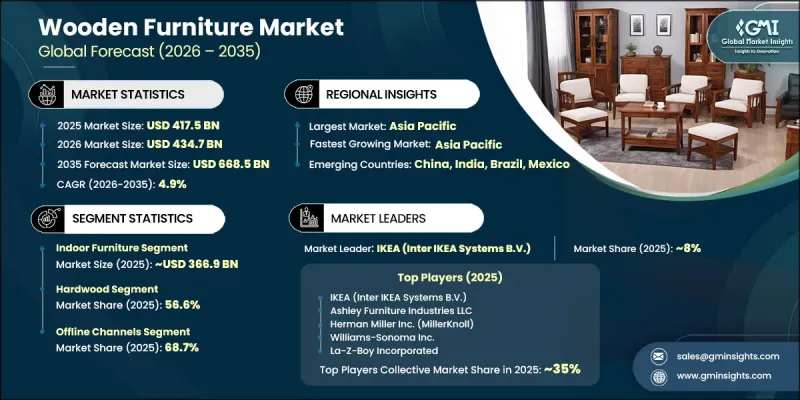
受快速都市化、可支配收入成長以及全球住宅和商業建設活動持續成長的推動,木製家具市場持續擴張。房地產開發的增加顯著提升了對新家具和更換家具的需求。消費者越來越青睞兼具耐用性、永續性和美觀性的產品,這使得木製家具成為全球市場的首選。木製品的天然美感、使用壽命長和環保特性進一步強化了這個趨勢。人們對永續採購實踐的日益關注也推動了對負責任生產的家具的需求。在住宅環境中,木製家具為客廳和臥室增添了溫馨舒適感;而在辦公室和零售店等商業環境中,它則有助於提升功能性設計,並創造更宜人的環境。飯店和餐廳等餐飲基礎設施的擴張進一步推動了對高階木製家具解決方案的需求,這些解決方案能夠提升室內設計品質和顧客體驗。
| 市場範圍 | |
|---|---|
| 開始年份 | 2025 |
| 預測期 | 2026-2035 |
| 上市時的市場規模 | 4175億美元 |
| 預測市場規模 | 6685億美元 |
| 複合年成長率 | 4.9% |
預計到2025年,室內家具市場規模將達到3,669億美元,並在2035年之前以4.8%的複合年成長率成長。由於其在住宅和商業領域的廣泛應用,該細分市場持續推動成長。室內木製家具包括臥室家具、客廳套裝、餐廳家具、辦公家具、儲物櫃和櫥櫃等產品。住宅建設活動的擴張和住宅翻新項目的增加是持續推動市場需求的因素。由於其功能性和設計美感,室內木製家具在公司辦公室、飯店和零售商店等商業場所也廣泛使用。木材的高度適應性使製造商能夠生產從經典設計到現代美學等各種風格的產品,這進一步支撐了市場需求的穩定性。
預計到2025年,硬木家具市場佔有率將達到56.6%,並在2026年至2035年間以5.4%的複合年成長率成長。硬木憑藉其卓越的強度、耐用性和高檔外觀,仍然是最受歡迎的材料類別。常見的硬木種類因其耐磨性和長使用壽命而被廣泛用於製造高品質家具。這些材料尤其適用於桌椅等常用家具。獨特的天然木紋和豐富的色彩提升了硬木家具的視覺吸引力,使其在住宅和商業室內設計中都廣受歡迎。
美國木製家具市場預計到2025年將達到9,14億美元,並在2035年之前以4.9%的複合年成長率成長。活躍的住宅、不斷成長的房屋翻新支出以及商業房地產開發的穩步擴張支撐了市場成長。新建住宅和二手住宅銷售也進一步推動了市場需求。隨著遠距辦公和混合辦公模式的普及,包括木製辦公桌和儲物方案在內的家庭辦公家具需求不斷成長。消費者對高品質、耐用性和永續性產品的追求持續推動著市場擴張。此外,電子商務平台的蓬勃發展提高了產品供應,使家具品牌能夠觸及全國更廣泛的客戶群。
目錄
第1章:調查方法和範圍
第2章執行摘要
第3章:行業洞察
- 工業生態系分析
- 供應商情況
- 利潤率
- 每個階段增加的價值
- 影響價值鏈的因素
- 影響產業的因素
- 促進因素
- 都市化和可支配所得的成長
- 房地產和酒店業的擴張
- 消費者越來越偏好選擇永續和環保產品。
- 產業潛在風險與挑戰
- 原物料價格波動與供應鏈中斷
- 替代材料與合成家具之間的競爭
- 機會
- 拓展電子商務與線上家具零售
- 對訂製和手工家具的需求日益成長。
- 促進因素
- 成長潛力分析
- 未來市場趨勢
- 技術與創新展望
- 最新科技趨勢
- 新技術
- 價格趨勢
- 對過去價格趨勢的分析
- 根據參與企業的類型(高階、價值、成本加成)所製定的定價策略
- 監理情勢
- 標準和合規要求
- 區域監理框架
- 認證標準
- 波特的分析
- PESTLE分析
- 貿易數據分析
- 進出口量及進口額趨勢
- 主要貿易路線及關稅的影響
- 區域貿易平衡與自給率
- 人工智慧和生成式人工智慧對市場的影響
- 利用人工智慧改造現有經營模式
- 基於細分市場的生成式人工智慧的應用案例和部署藍圖
- 風險、限制和監管考量
- 生產能力和生產情況
- 設備產能:按地區和主要生產商分類
- 運轉率和擴張計劃
第4章 競爭情勢
- 介紹
- 企業市佔率分析
- 按地區
- 企業矩陣分析
- 主要市場公司的競爭分析
- 競爭定位矩陣
- 併購
- 夥伴關係和聯盟
- 新產品發布
- 業務拓展計劃
第5章:木製家具市場,依產品類型分類的估算與預測,2022-2035年
- 室內家具
- 戶外家具
第6章:木製家具市場估價與預測:依木材類型分類,2022-2035年
- 闊葉樹
- 針葉樹
第7章:木製家具市場,按價格分類的估算和預測,2022-2035年
- 低的
- 中等的
- 高的
第8章:木製家具市場估價與預測:依應用領域分類,2022-2035年
- 住宅
- 襯墊傢俱
- 無軟墊家具及廚房
- 臥室
- 廚房櫥櫃
- 飯廳
- 其他
- 商業的
- 商務辦公室
- 教育
- 衛生保健
- 飯店業
- 其他
第9章:木製家具市場估價與預測:依通路分類,2022-2035年
- 線上
- 電子商務網站
- 企業網站
- 離線
- 專賣店
- 大型零售商店
- 其他(室內用品等)
第10章 市場估價與預測:依地區分類,2022-2035年
- 北美洲
- 美國
- 加拿大
- 歐洲
- 德國
- 英國
- 法國
- 義大利
- 西班牙
- 亞太地區
- 中國
- 日本
- 印度
- 澳洲
- 韓國
- 拉丁美洲
- 巴西
- 墨西哥
- 阿根廷
- 中東和非洲
- 南非
- 沙烏地阿拉伯
- 阿拉伯聯合大公國
第11章:公司簡介
- Top Global Player
- IKEA(Inter IKEA Systems BV)
- Ashley Furniture Industries LLC
- Herman Miller Inc.(MillerKnoll)
- Williams-Sonoma Inc.
- Ethan Allen Interiors Inc.
- Natuzzi SpA
- Haworth Inc.
- Regional Player
- La-Z-Boy Incorporated
- Godrej & Boyce(Godrej Interio)
- Nowy Styl Group
- Bassett Furniture Industries Inc.
- Hooker Furniture Corporation
- 新興企業
- Flexsteel Industries Inc.
- Kimball International Inc.
- Nobilia-Werke GmbH
The Global Wooden Furniture Market was valued at USD 417.5 billion in 2025 and is estimated to grow at a CAGR of 4.9% to reach USD 668.5 billion by 2035.
The market is experiencing expansion driven by rapid urbanization, rising disposable incomes, and continuous growth in residential and commercial construction activities worldwide. Increasing real estate development is significantly boosting demand for both new and replacement furniture. Consumers are showing a stronger preference for products that combine durability, sustainability, and visual appeal, positioning wooden furniture as a preferred choice across global markets. The natural aesthetics, long lifespan, and eco-friendly nature of wood-based products are further strengthening adoption trends. Rising awareness of sustainable sourcing practices is also encouraging demand for responsibly manufactured furniture. In residential settings, wooden furniture enhances interior warmth and comfort in living spaces and bedrooms, while in commercial environments such as offices and retail spaces, it supports functional design and creates a more welcoming atmosphere. Expanding hospitality infrastructure, including hotels and restaurants, is further supporting demand for premium wooden furniture solutions that enhance interior design quality and customer experience.
| Market Scope | |
|---|---|
| Start Year | 2025 |
| Forecast Year | 2026-2035 |
| Start Value | $417.5 Billion |
| Forecast Value | $668.5 Billion |
| CAGR | 4.9% |
The indoor furniture segment generated USD 366.9 billion in 2025 and is expected to grow at a CAGR of 4.8% through 2035. This segment continues to dominate the market due to its extensive use across residential and commercial applications. Indoor wooden furniture includes products such as bedroom furnishings, living room setups, dining arrangements, office interiors, storage units, and cabinets. Growing residential construction activity and rising home renovation projects are key contributors to sustained demand. Commercial spaces such as corporate offices, hospitality establishments, and retail outlets continue to rely on indoor wooden furniture for both functionality and design appeal. The adaptability of wood allows manufacturers to produce diverse styles, ranging from classic designs to modern aesthetics, further supporting consistent market demand.
The hardwood segment held a 56.6% share in 2025 and is projected to grow at a CAGR of 5.4% between 2026 and 2035. Hardwood remains the most preferred material category due to its superior strength, durability, and premium appearance. Common hardwood varieties are widely used in the production of high-quality furniture due to their resistance to wear and long service life. These materials are especially suitable for frequently used furniture items such as tables and seating solutions. Distinct natural grain patterns and rich tones enhance the visual appeal of hardwood furniture, making it highly desirable in both residential and commercial interiors.
U.S. Wooden Furniture Market was valued at USD 91.4 billion in 2025 and is forecast to grow at a CAGR of 4.9% through 2035. Market growth is supported by strong housing activity, rising renovation spending, and steady expansion in commercial real estate development. Demand is further driven by new residential construction and existing home sales. The growing adoption of remote and hybrid working models has increased demand for home office furniture, including wooden desks and storage solutions. Consumer inclination toward premium, durable, and sustainable products continues to support market expansion. Additionally, the growth of e-commerce platforms is improving product accessibility and enabling furniture brands to reach wider consumer bases across the country.
Major players operating in the Global Wooden Furniture Industry include IKEA (Inter IKEA Systems B.V.), Ashley Furniture Industries LLC, Godrej & Boyce (Godrej Interio), Ethan Allen Interiors Inc., La-Z-Boy Incorporated, Bassett Furniture Industries Inc., Herman Miller Inc. (MillerKnoll), Hooker Furniture Corporation, Flexsteel Industries Inc., Williams-Sonoma Inc., Haworth Inc., Natuzzi S.p.A., Kimball International Inc., Nobilia-Werke GmbH, and Nowy Styl Group. Companies in the wooden furniture market are increasingly focusing on sustainable sourcing of raw materials and certified wood procurement to strengthen brand credibility. Many manufacturers are expanding product portfolios with modular and multifunctional furniture designs to meet evolving consumer space optimization needs. Digital transformation through e-commerce expansion and direct-to-consumer platforms is improving market reach and sales efficiency. Strategic collaborations with real estate developers and hospitality chains are supporting large-scale project-based demand. Firms are also investing in advanced woodworking technologies and automation to enhance production efficiency and design precision.
Table of Contents
Chapter 1 Methodology and Scope
- 1.1 Market scope and definition
- 1.2 Research design
- 1.2.1 Research approach
- 1.2.2 Data collection methods
- 1.3 Data mining sources
- 1.3.1 Global
- 1.3.2 Regional/Country
- 1.4 Base estimates and calculations
- 1.4.1 Base year calculation
- 1.4.2 Key trends for market estimation
- 1.5 Primary research and validation
- 1.5.1 Primary sources
- 1.6 Forecast model
- 1.7 Research assumptions and limitations
Chapter 2 Executive Summary
- 2.1 Industry 360° synopsis
- 2.2 Key market trends
- 2.2.1 Regional
- 2.2.2 Product Type
- 2.2.3 Wood Type
- 2.2.4 Price
- 2.2.5 Application
- 2.2.6 Distribution Channel
Chapter 3 Industry Insights
- 3.1 Industry ecosystem analysis
- 3.1.1 Supplier landscape
- 3.1.2 Profit margin
- 3.1.3 Value addition at each stage
- 3.1.4 Factor affecting the value chain
- 3.2 Industry impact forces
- 3.2.1 Growth drivers
- 3.2.1.1 Growing urbanization and rising disposable incomes
- 3.2.1.2 Expansion of real estate and hospitality industries
- 3.2.1.3 Rising preference for sustainable and eco-friendly products
- 3.2.2 Industry pitfalls & challenges
- 3.2.2.1 Fluctuating raw material costs and supply chain disruptions
- 3.2.2.2 Competition from alternative materials and synthetic furniture
- 3.2.3 Opportunities
- 3.2.3.1 Growing e-commerce and online furniture retail
- 3.2.3.2 Increasing demand for customized and artisanal furniture
- 3.2.1 Growth drivers
- 3.3 Growth potential analysis
- 3.4 Future market trends
- 3.5 Technology and innovation landscape
- 3.5.1 Current technological trends
- 3.5.2 Emerging technologies
- 3.6 Price trends
- 3.6.1 Historical Price Trend Analysis (Driven by Primary Research)
- 3.6.2 Pricing Strategy by Player Type (Premium/Value/Cost-plus) (Driven by Primary Research)
- 3.7 Regulatory landscape
- 3.7.1 Standards and compliance requirements
- 3.7.2 Regional regulatory frameworks
- 3.7.3 Certification standards
- 3.8 Porter's analysis
- 3.9 PESTEL analysis
- 3.10 Trade Data Analysis (Driven by Primary Research)
- 3.10.1 Import/Export Volume & Value Trends (Driven by Primary Research)
- 3.10.2 Key Trade Corridors & Tariff Impact (Driven by Primary Research)
- 3.10.3 Regional Trade Balances & Self-Sufficiency Levels
- 3.11 Impact of AI & Generative AI on the Market
- 3.11.1 AI-Driven Disruption of Existing Business Models
- 3.11.2 GenAI Use Cases & Adoption Roadmap by Segment
- 3.11.3 Risks, Limitations & Regulatory Considerations
- 3.12 Capacity & Production Landscape (Driven by Primary Research)
- 3.12.1 Installed Capacity by Region & Key Producer (Driven by Primary Research)
- 3.12.2 Capacity Utilization Rates & Expansion Pipelines (Driven by Primary Research)
Chapter 4 Competitive Landscape, 2025
- 4.1 Introduction
- 4.2 Company market share analysis
- 4.2.1 By region
- 4.2.1.1 North America
- 4.2.1.2 Europe
- 4.2.1.3 Asia Pacific
- 4.2.1.4 Latin America
- 4.2.1.5 Middle East and Africa
- 4.2.1 By region
- 4.3 Company matrix analysis
- 4.4 Competitive analysis of major market players
- 4.5 Competitive positioning matrix
- 4.6 Key developments
- 4.6.1 Mergers & acquisitions
- 4.6.2 Partnerships & collaborations
- 4.6.3 New product launches
- 4.6.4 Expansion plans
Chapter 5 Wooden Furniture Market Estimates & Forecast, By Product Type , 2022-2035 (USD Billion) (Thousand Units)
- 5.1 Key trends
- 5.2 Indoor Furniture
- 5.3 Outdoor Furniture
Chapter 6 Wooden Furniture Market Estimates & Forecast, By Wood Type, 2022-2035 (USD Billion) (Thousand Units)
- 6.1 Key trends
- 6.2 Hardwood
- 6.3 Softwood
Chapter 7 Wooden Furniture Market Estimates & Forecast, By Price 2022-2035 (USD Billion) (Thousand Units)
- 7.1 Key trends
- 7.2 Low
- 7.3 Medium
- 7.4 High
Chapter 8 Wooden Furniture Market Estimates & Forecast, By Application 2022-2035 (USD Billion) (Thousand Units)
- 8.1 Key trends
- 8.2 Residential
- 8.2.1 Upholstered furniture
- 8.2.2 Non-upholstered furniture Kitchen
- 8.2.3 Bedroom
- 8.2.4 Kitchen cabinet
- 8.2.5 Dining room
- 8.2.6 Others
- 8.3 Commercial
- 8.3.1 Business/office
- 8.3.2 Educational
- 8.3.3 Healthcare
- 8.3.4 Hospitality
- 8.3.5 Others
Chapter 9 Wooden Furniture Market Estimates & Forecast, By Distribution Channel, 2022-2035 (USD Billion) (Thousand Units)
- 9.1 Key trends
- 9.2 Online
- 9.2.1 E-Commerce Sites
- 9.2.2 Company Websites
- 9.3 Offline
- 9.3.1 Specialty Stores
- 9.3.2 Mega Retail Stores
- 9.3.3 Others (Home Decor etc.)
Chapter 10 Market Estimates and Forecast, By Region, 2022 - 2035 (USD Billion) (Thousand Units)
- 10.1 Key trends
- 10.2 North America
- 10.2.1 U.S.
- 10.2.2 Canada
- 10.3 Europe
- 10.3.1 Germany
- 10.3.2 UK
- 10.3.3 France
- 10.3.4 Italy
- 10.3.5 Spain
- 10.4 Asia Pacific
- 10.4.1 China
- 10.4.2 Japan
- 10.4.3 India
- 10.4.4 Australia
- 10.4.5 South Korea
- 10.5 Latin America
- 10.5.1 Brazil
- 10.5.2 Mexico
- 10.5.3 Argentina
- 10.6 Middle East and Africa
- 10.6.1 South Africa
- 10.6.2 Saudi Arabia
- 10.6.3 UAE
Chapter 11 Company Profiles
- 11.1 Top Global Player
- 11.1.1 IKEA (Inter IKEA Systems B.V.)
- 11.1.2 Ashley Furniture Industries LLC
- 11.1.3 Herman Miller Inc. (MillerKnoll)
- 11.1.4 Williams-Sonoma Inc.
- 11.1.5 Ethan Allen Interiors Inc.
- 11.1.6 Natuzzi S.p.A.
- 11.1.7 Haworth Inc.
- 11.2 Regional Player
- 11.2.1 La-Z-Boy Incorporated
- 11.2.2 Godrej & Boyce (Godrej Interio)
- 11.2.3 Nowy Styl Group
- 11.2.4 Bassett Furniture Industries Inc.
- 11.2.5 Hooker Furniture Corporation
- 11.3 Emerging Players
- 11.3.1 Flexsteel Industries Inc.
- 11.3.2 Kimball International Inc.
- 11.3.3 Nobilia-Werke GmbH


