

 |
市場調查報告書
商品編碼
2045814
地板清潔設備市場機會、成長要素、產業趨勢分析及2026-2035年預測。Floor Cleaning Equipment Market Opportunity, Growth Drivers, Industry Trend Analysis, and Forecast 2026 - 2035 |
||||||

2025年全球地面清潔設備市場價值為270億美元,預計2035年將以6.3%的複合年成長率成長至496億美元。
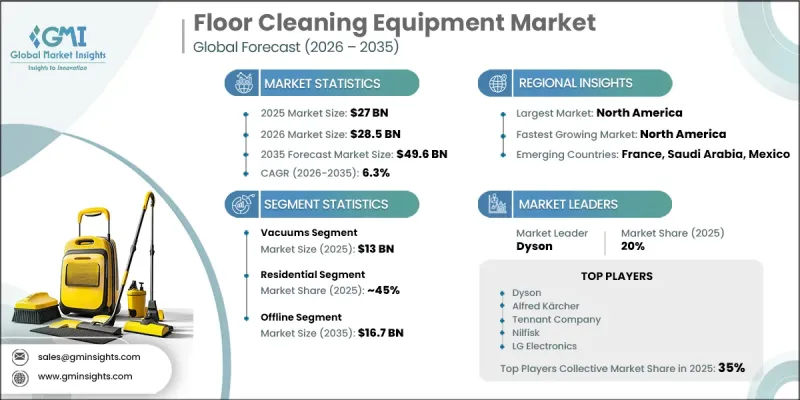
人們對住宅、商業和公共場所的衛生和公共衛生日益關注,並持續推動市場擴張。消費者越來越重視更乾淨的生活和職場環境,促使他們採用先進的地面清潔技術。企業也越來越重視衛生標準,以提升職場安全、服務品質和客戶滿意度,這推動了清潔方式從人工清潔轉向自動化清潔系統的轉變。在家庭層面,生活方式的改變、健康意識的增強以及對更清潔室內環境的需求,都推動了對高效易用清潔設備的需求。消費者擴大投資於能夠最大限度減少過敏原、改善衛生狀況並減輕體力勞動負擔的最新地面護理產品。這種對自動化、高性能清潔系統的日益成長的偏好,正在改變全球的清潔方式,並支撐著整個地面清潔設備產業的持續需求。
| 市場範圍 | |
|---|---|
| 開始年份 | 2025 |
| 預測期 | 2026-2035 |
| 上市時的市場規模 | 270億美元 |
| 預計金額 | 496億美元 |
| 複合年成長率 | 6.3% |
預計到2025年,吸塵器市場規模將達到130億美元。由於吸塵器能夠有效率地清除各種地面上的污垢、灰塵和過敏原,因此仍然是日常地面清潔的必備工具。與傳統清潔方法相比,吸塵器系統憑藉其密封過濾器和吸塵器收集機制,擁有更強大的顆粒物捕獲能力。其在維持室內環境清潔方面的卓越功效,鞏固了其在住宅和商用市場的地位。人們對便利、快速、高效清潔解決方案的需求不斷成長,進一步推動了吸塵器的普及。吸塵器能夠清潔難以觸及的角落,並提升室內環境的清潔度,這些優勢持續推動全球市場對吸塵器的需求。
預計到2025年,住宅領域將佔據45%的市場。都市化加快、可支配收入增加以及人們對家居清潔意識的提高是推動該領域成長的關鍵因素。消費者擴大購買吸塵器、蒸汽清潔器、拖把和小型洗地機等地面清潔設備,以簡化清潔工作並提高效率。都市區住宅趨勢和日益繁忙的生活方式也推動了對節省空間、輕巧且多功能清潔產品的需求。技術創新正在顯著改變住宅清潔領域,無線操作、鋰離子電池技術、機器人清潔系統和智慧導航功能對消費者極具吸引力。機器人吸塵器和拖把的組合產品因其自動化清潔的便利性和與智慧家庭技術的整合而越來越受歡迎,尤其是在中高所得家庭中。
北美地面清潔設備市場佔據78.5%的市場佔有率,預計2025年市場規模將達到65億美元。在美國,由於商業基礎設施發達以及人們對清潔標準的嚴格要求,對地面清潔設備的需求仍然強勁。各行各業的商業設施都在持續大力投資先進的地面維護設備,以保持衛生環境並提高營運效率。人們對自動化、勞動力最佳化和持續清潔性能的日益關注,正在加速美國市場對技術先進的地面清潔系統的採用。積極投資於設施維護解決方案的文化以及大規模商業區的廣泛存在,進一步鞏固了美國在北美地面清潔設備行業的主導地位。
目錄
第1章:調查方法和範圍
第2章執行摘要
第3章:行業洞察
- 工業生態系分析
- 供應商情況
- 利潤率
- 每個階段增加的價值
- 影響價值鏈的因素
- 影響產業的因素
- 促進因素
- 人們越來越關注衛生和清潔問題
- 技術進步
- 從人工清潔過渡到機械化清潔
- 產業潛在風險與挑戰
- 高昂的維護和營運成本
- 與傳統清潔方法的競爭
- 機會
- 機器人和自動化系統的快速普及
- 對醫療保健公共部門的需求不斷成長
- 促進因素
- 成長潛力分析
- 未來市場趨勢
- 技術與創新展望
- 最新科技趨勢
- 新技術
- 價格趨勢
- 按地區
- 依設備類型
- 監理框架
- 標準和合規要求
- 區域監理框架
- 北美(OSHA、EPA 標準)
- 歐洲(CE標誌、歐盟指令)
- 亞太地區(區域差異)
- 新興市場
- 認證標準(ISO、LEED、BREEAM)
- 關於環境和永續性的法規
- 安全和人體工學標準
- 價格分析
- 對過去價格趨勢的分析
- 根據參與企業的類型(高階、價值、成本加成)所製定的定價策略
- 價格因設備類型而異
- 不同地區之間的價格差異
- 總擁有成本 (TCO) 建模
- 初始資本投資分析
- 營運成本和能源成本
- 維護和零件更換成本
- 勞動效率對總擁有成本的影響
- 五年總擁有成本比較:人工操作 vs. 自動化操作 vs. 機器人操作
- 貿易資料分析(84798999)
- 進出口量及進口額趨勢
- 主要貿易路線及關稅的影響
- 按設備類型分類的貿易趨勢
- 區域貿易平衡分析
- 人工智慧和生成式人工智慧對市場的影響
- 利用人工智慧改造現有經營模式
- 基於細分市場的生成式人工智慧的應用案例和部署藍圖
- 預測性維護和減少停機時間
- 自動駕駛和通道最佳化
- 即時效能監控與分析
- 智慧藥物分發和資源最佳化
- 風險、限制和監管考量
- 基礎架構和部署狀態
- 按地區和購買者群體分類的採用率和滲透率
- 基礎設施投資的可擴展性限制和趨勢
第4章 競爭情勢
- 介紹
- 企業市佔率分析
- 按地區
- 企業矩陣分析
- 主要市場公司的競爭分析
- 競爭定位矩陣
- 併購
- 夥伴關係和聯盟
- 新產品發布
- 業務拓展計劃
第5章 市場估算與預測:依設備類型分類,2022-2035年
- 洗滌器
- 搭乘用式洗滌器
- 手推式洗地機
- 清掃機
- 吸塵器
- 立式吸塵器
- 臥式吸塵器
- 背包式吸塵器
- 機器人吸塵器
- 消失者
- 磨床
- 提取機
- 其他(落地式烘乾機)
第6章 市場估計與預測:依技術分類,2022-2035年
- 手動/傳統
- 自動化/機器人
- 支援物聯網的智慧型設備
第7章 市場估計與預測:依應用領域分類,2022-2035年
- 住宅
- 商業的
- 飯店及餐飲業
- 辦公室
- 其他
- 產業
第8章 市場估計與預測:依價格分類,2022-2035年
- 低的
- 中等的
- 高的
第9章 市場估價與預測:依通路分類,2022-2035年
- 線上
- 電子商務
- 品牌官方網站
- 離線
- 超級市場
- 專賣店
- 其他(百貨公司等)
第10章 市場估價與預測:依地區分類,2022-2035年
- 北美洲
- 美國
- 加拿大
- 歐洲
- 德國
- 英國
- 法國
- 義大利
- 西班牙
- 亞太地區
- 中國
- 日本
- 印度
- 澳洲
- 韓國
- 拉丁美洲
- 巴西
- 墨西哥
- 阿根廷
- 中東和非洲
- 南非
- 沙烏地阿拉伯
- 阿拉伯聯合大公國
第11章:公司簡介
- 世界公司
- Alfred Karcher
- Tennant Company
- Nilfisk
- Dyson
- BSH Home Appliances
- LG Electronics
- Panasonic
- 當地公司
- Hako GmbH
- Comac SpA
- Fimap SpA
- Tacony Corporation
- Solenis
- RCM SpA
- Dulevo Fayat Group
- 新興企業
- Factory Cat
- Minuteman International
- Cleanfix AG
- Ghibli
- Adiatek Srl
- Haier
- Midea America Corp.
The Global Floor Cleaning Equipment Market was valued at USD 27 billion in 2025 and is estimated to grow at a CAGR of 6.3% to reach USD 49.6 billion by 2035.
Growing attention toward hygiene and sanitation across residential, commercial, and public environments continues to accelerate market expansion. Consumers are placing greater emphasis on maintaining cleaner living and working spaces, leading to increased adoption of advanced floor-cleaning technologies. Businesses are prioritizing sanitation standards to improve workplace safety, operational quality, and customer perception, thereby encouraging the transition from labor-intensive cleaning practices to equipment-based cleaning systems. At the household level, evolving lifestyles, rising health awareness, and the need for cleaner indoor environments are driving demand for efficient and easy-to-use cleaning equipment. Consumers are increasingly investing in modern floor care products that minimize allergens, improve hygiene, and reduce manual effort. This growing preference for automated and high-performance cleaning systems is reshaping cleaning habits worldwide and supporting sustained demand across the floor cleaning equipment industry.
| Market Scope | |
|---|---|
| Start Year | 2025 |
| Forecast Year | 2026-2035 |
| Start Value | $27 Billion |
| Forecast Value | $49.6 Billion |
| CAGR | 6.3% |
The vacuum cleaners segment accounted for USD 13 billion in 2025. These products remain an essential part of routine floor maintenance due to their ability to efficiently eliminate dirt, dust particles, and allergens from multiple flooring surfaces. Compared to conventional cleaning methods, vacuum systems provide stronger particle containment through sealed filtration and suction-based collection mechanisms. Their effectiveness in maintaining cleaner indoor environments has strengthened their position in both residential and commercial applications. The growing preference for convenient, fast, and highly efficient cleaning solutions has further increased the popularity of vacuum cleaners. Their capability to clean hard-to-reach spaces and support improved indoor cleanliness continues to drive widespread product adoption across global markets.
The residential sector held a 45% share in 2025. Rising urbanization levels, higher disposable income, and stronger awareness regarding household cleanliness are major factors supporting segment growth. Consumers are increasingly purchasing floor cleaning equipment such as vacuum cleaners, steam cleaning systems, mops, and compact floor scrubbers to simplify cleaning activities and improve efficiency. Urban housing trends and increasingly busy lifestyles are also encouraging demand for space-saving, lightweight, and multifunctional cleaning products. Technological innovations have significantly transformed the residential cleaning landscape, with cordless operation, lithium-ion battery technology, robotic cleaning systems, and smart navigation capabilities becoming highly attractive among consumers. Robotic vacuum and mop combinations are particularly gaining traction among middle- and upper-income households because they offer automated cleaning convenience and integration with connected home technologies.
North America Floor Cleaning Equipment Market held a 78.5% share, generating USD 6.5 billion in 2025. The country continues to experience strong demand for floor cleaning machinery due to its extensive commercial infrastructure and strict expectations surrounding cleanliness standards. Commercial establishments across multiple industries continue to invest heavily in advanced floor maintenance equipment to maintain hygienic environments and improve operational efficiency. The growing focus on automation, labor optimization, and consistent cleaning performance has accelerated the adoption of technologically advanced floor cleaning systems throughout the U.S. market. The country's strong investment culture in facility maintenance solutions and widespread presence of large-scale commercial spaces continue to reinforce its leadership position within the North American floor cleaning equipment industry.
Key companies operating in the Global Floor Cleaning Equipment Market include Alfred Karcher, Tennant Company, Nilfisk, Dyson, BSH Home Appliances, LG Electronics, and Panasonic. Prominent regional participants include Hako GmbH, Comac S.p.A., Fimap S.p.A., Tacony Corporation, Solenis, RCM S.p.A., and Dulevo Fayat Group. Emerging companies participating in the market include Factory Cat, Minuteman International, Cleanfix AG, Ghibli, Adiatek S.r.l., Haier, and Midea America Corp. Companies operating in the floor cleaning equipment market are actively implementing several growth strategies to strengthen their market position and expand customer reach. Manufacturers are focusing heavily on product innovation by introducing robotic cleaning systems, cordless technologies, energy-efficient machines, and smart-enabled devices with automated navigation capabilities. Many companies are increasing investments in research and development to improve cleaning performance, battery life, and user convenience. Strategic partnerships, mergers, and acquisitions are also being used to broaden product portfolios and strengthen regional distribution networks. In addition, manufacturers are expanding their presence in emerging economies through local partnerships and targeted marketing initiatives.
Table of Contents
Chapter 1 Methodology and Scope
- 1.1 Market scope and definition
- 1.2 Research design
- 1.2.1 Research approach
- 1.2.2 Data collection methods
- 1.3 Data mining sources
- 1.3.1 Global
- 1.3.2 Regional/Country
- 1.4 Base estimates and calculations
- 1.4.1 Base year calculation
- 1.4.2 Key trends for market estimation
- 1.5 Primary research and validation
- 1.5.1 Primary sources
- 1.6 Forecast model
- 1.7 Research assumptions and limitations
Chapter 2 Executive Summary
- 2.1 Industry 360° synopsis
- 2.2 Key market trends
- 2.2.1 Regional
- 2.2.2 Equipment type
- 2.2.3 Technology
- 2.2.4 Application
- 2.2.5 Price
- 2.2.6 Distribution channel
Chapter 3 Industry Insights
- 3.1 Industry ecosystem analysis
- 3.1.1 Supplier landscape
- 3.1.2 Profit margin
- 3.1.3 Value addition at each stage
- 3.1.4 Factor affecting the value chain
- 3.2 Industry impact forces
- 3.2.1 Growth drivers
- 3.2.1.1 Rising focus on hygiene & cleanliness
- 3.2.1.2 Technological advancements
- 3.2.1.3 Shift from manual to mechanized cleaning
- 3.2.2 Industry pitfalls & challenges
- 3.2.2.1 High maintenance & operational costs
- 3.2.2.2 Competition with traditional cleaning methods
- 3.2.3 Opportunities
- 3.2.3.1 Rapid adoption of robotic & automated systems
- 3.2.3.2 Growing demand in healthcare & institutional sectors
- 3.2.1 Growth drivers
- 3.3 Growth potential analysis
- 3.4 Future market trends
- 3.5 Technology and innovation landscape
- 3.5.1 Current technological trends
- 3.5.2 Emerging technologies
- 3.6 Price trends
- 3.6.1 By region
- 3.6.2 By equipment type
- 3.7 Regulatory framework
- 3.7.1 Standards & compliance requirements
- 3.7.2 Regional regulatory frameworks
- 3.7.2.1 North america (osha, epa standards)
- 3.7.2.2 Europe (ce marking, eu directives)
- 3.7.2.3 Asia pacific (regional variations)
- 3.7.2.4 Emerging markets
- 3.7.3 Certification standards (iso, leed, breeam)
- 3.7.4 Environmental & sustainability regulations
- 3.7.5 Safety & ergonomics standards
- 3.8 Pricing analysis
- 3.8.1 Historical price trend analysis (driven by primary research)
- 3.8.2 Pricing strategy by player type (premium / value / cost-plus)
- 3.8.3 Price variation by equipment type
- 3.8.4 Regional price differentials
- 3.8.5 Total cost of ownership (tco) modeling [solution core]
- 3.8.5.1 Upfront capital investment analysis
- 3.8.5.2 Operational & energy costs
- 3.8.5.3 Maintenance & parts replacement costs
- 3.8.5.4 Labor efficiency impact on tco
- 3.8.5.5 5-year tco comparison: manual vs automated vs robotic
- 3.9 Trade data analysis (driven by paid data base) (84798999)
- 3.9.1 Import/export volume & value trends
- 3.9.2 Key trade corridors & tariff impact
- 3.9.3 Trade flow by equipment type
- 3.9.4 Regional trade balance analysis
- 3.10 Impact of AI & generative AI on the market
- 3.10.1 AI-driven disruption of existing business models
- 3.10.2 GenAI use cases & adoption roadmap by segment
- 3.10.2.1 Predictive maintenance & downtime reduction
- 3.10.2.2 Autonomous navigation & route optimization
- 3.10.2.3 Real-time performance monitoring & analytics
- 3.10.2.4 Smart chemical dispensing & resource optimization
- 3.10.3 Risks, limitations & regulatory considerations
- 3.11 Infrastructure & deployment landscape (driven by primary research)
- 3.11.1 Deployment penetration by region & buyer segment
- 3.11.2 Scalability constraints & infrastructure investment trends
Chapter 4 Competitive Landscape, 2025
- 4.1 Introduction
- 4.2 Company market share analysis
- 4.2.1 By region
- 4.2.1.1 North America
- 4.2.1.2 Europe
- 4.2.1.3 Asia Pacific
- 4.2.1.4 Latin America
- 4.2.1.5 Middle East and Africa
- 4.2.1 By region
- 4.3 Company matrix analysis
- 4.4 Competitive analysis of major market players
- 4.5 Competitive positioning matrix
- 4.6 Key developments
- 4.6.1 Mergers & acquisitions
- 4.6.2 Partnerships & collaborations
- 4.6.3 New product launches
- 4.6.4 Expansion plans
Chapter 5 Market Estimates and Forecast, By Equipment Type, 2022 - 2035 (USD Billion) (Thousand Units)
- 5.1 Key trends
- 5.2 Scrubbers
- 5.2.1 Ride-on scrubbers
- 5.2.2 Walk-behind scrubbers
- 5.3 Sweepers
- 5.4 Vacuums
- 5.4.1 Upright vacuums
- 5.4.2 Canister vacuums
- 5.4.3 Backpack vacuums
- 5.4.4 Robotic vacuums
- 5.5 Burnishers
- 5.6 Polishers
- 5.7 Extractors
- 5.8 Others (Floor Dryers)
Chapter 6 Market Estimates and Forecast, By Technology, 2022 - 2035 (USD Billion) (Thousand Units)
- 6.1 Key trends
- 6.2 Manual/traditional
- 6.3 Automated/robotic
- 6.4 IoT-enabled smart equipment
Chapter 7 Market Estimates and Forecast, By Application, 2022 - 2035 (USD Billion) (Thousand Units)
- 7.1 Key trends
- 7.2 Residential
- 7.3 Commercial
- 7.3.1 Hotels & hospitality
- 7.3.2 Offices
- 7.3.3 Others
- 7.4 Industrial
Chapter 8 Market Estimates and Forecast, By Price, 2022 - 2035 (USD Billion) (Thousand Units)
- 8.1 Key trends
- 8.2 Low
- 8.3 Medium
- 8.4 High
Chapter 9 Market Estimates and Forecast, By Distribution Channel, 2022 - 2035 (USD Billion) (Thousand Units)
- 9.1 Key trends
- 9.2 Online
- 9.2.1 E-commerce
- 9.2.2 Brand websites
- 9.3 Offline
- 9.3.1 Supermarkets
- 9.3.2 Specialty stores
- 9.3.3 Others (Departmental stores, etc.)
Chapter 10 Market Estimates and Forecast, By Region, 2022 - 2035 (USD Billion) (Thousand Units)
- 10.1 Key trends
- 10.2 North America
- 10.2.1 U.S.
- 10.2.2 Canada
- 10.3 Europe
- 10.3.1 Germany
- 10.3.2 UK
- 10.3.3 France
- 10.3.4 Italy
- 10.3.5 Spain
- 10.4 Asia Pacific
- 10.4.1 China
- 10.4.2 Japan
- 10.4.3 India
- 10.4.4 Australia
- 10.4.5 South Korea
- 10.5 Latin America
- 10.5.1 Brazil
- 10.5.2 Mexico
- 10.5.3 Argentina
- 10.6 Middle East and Africa
- 10.6.1 South Africa
- 10.6.2 Saudi Arabia
- 10.6.3 UAE
Chapter 11 Company Profiles
- 11.1 Global players
- 11.1.1 Alfred Karcher
- 11.1.2 Tennant Company
- 11.1.3 Nilfisk
- 11.1.4 Dyson
- 11.1.5 BSH Home Appliances
- 11.1.6 LG Electronics
- 11.1.7 Panasonic
- 11.2 Regional players
- 11.2.1 Hako GmbH
- 11.2.2 Comac S.p.A.
- 11.2.3 Fimap S.p.A.
- 11.2.4 Tacony Corporation
- 11.2.5 Solenis
- 11.2.6 RCM S.p.A.
- 11.2.7 Dulevo Fayat Group
- 11.3 Emerging players
- 11.3.1 Factory Cat
- 11.3.2 Minuteman International
- 11.3.3 Cleanfix AG
- 11.3.4 Ghibli
- 11.3.5 Adiatek S.r.l.
- 11.3.6 Haier
- 11.3.7 Midea America Corp.

 家用清潔機器人市場預測至2034年:按產品類型、技術、分銷管道、最終用戶和地區分類的全球分析
 地板墊市場-2026-2032年全球市場預測
 2026-2030年全球地面吸塵器市場
 地板清潔設備市場-全球產業規模、佔有率、趨勢、機會和預測:按產品類型、應用、分銷管道、地區和競爭格局分類,2021-2031年地板拋光服務市場:按服務類型、地板材料、合約類型、服務提供者、價格範圍、最終用戶分類,全球預測(2026-2032年)家用地面清潔設備市場:依產品類型、操作方式、應用和分銷管道分類-2026-2032年全球預測AI Ultra 二合一掃拖機器人市場:按連接方式、導航技術、地板類型、價格範圍、最終用戶和分銷管道分類的全球預測(2026-2032 年)
 2026-2030年全球地板墊市場地面清潔設備市場依產品類型、操作方式、動力來源、通路和最終用戶分類,全球預測(2026-2032年)
 磨床市場機會、成長要素、產業趨勢分析及預測(2026年至2035年)