


 |
市場調查報告書
商品編碼
2045813
臨床溝通與協作市場機會、成長要素、產業趨勢分析及2026-2035年預測Clinical Communication and Collaboration Market Opportunity, Growth Drivers, Industry Trend Analysis, and Forecast 2026 - 2035 |
||||||

2025 年全球臨床溝通與協作市場價值 28 億美元,預計到 2035 年將以 13.5% 的複合年成長率成長至 99 億美元。
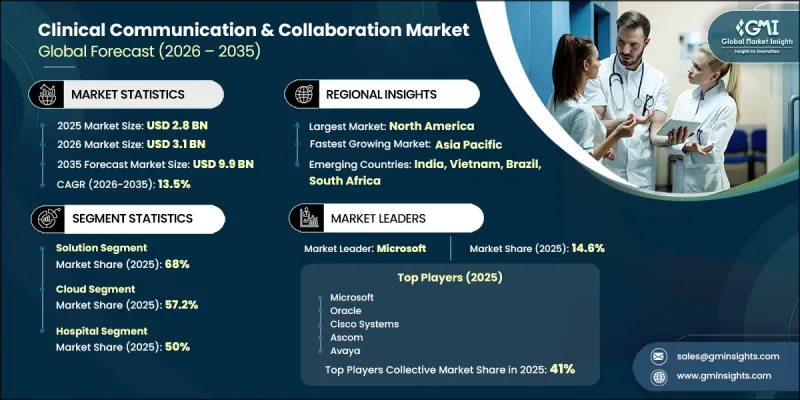
隨著醫療系統將快速協作、即時資訊交流和工作流程效率提升列為優先事項,市場呈現出強勁的成長動能。醫療服務提供者正迅速以安全、整合的數位平台取代過時的通訊方式,以支援醫療團隊之間的無縫協作。對資料安全和合規性的日益重視是推動市場成長的主要動力,尤其是在醫療機構採用符合 HIPAA 標準的通訊系統的情況下。政府主導的醫療數位化計畫也在加速這一進程,此外,各地為增強互通性和擴大電子健康記錄 (EHR) 整合所做的努力也在促進市場擴張。
| 市場範圍 | |
|---|---|
| 開始年份 | 2025 |
| 預測期 | 2026-2035 |
| 上市時的市場規模 | 28億美元 |
| 預計金額 | 99億美元 |
| 複合年成長率 | 13.5% |
人工智慧 (AI) 和分析技術的進步正在推動更智慧的工作流程和決策支持,顯著改善臨床溝通平台。 AI 驅動的警報管理系統能夠根據優先順序和可用性,將緊急更新通知給相關負責人,從而減輕醫護人員的通知負擔。這些功能縮短了反應時間,減少了患者照護的延遲。同時,遠距遠端醫療服務和行動醫療解決方案的擴展,將臨床溝通延伸到傳統醫院環境之外,提高了所有醫療機構的可近性和照護連續性。
預計到2025年,解決方案細分市場將佔據68%的市場佔有率,並在2035年之前以12.9%的複合年成長率成長。此細分市場的成長主要得益於安全通訊系統的廣泛應用,這些系統能夠實現臨床團隊間的即時溝通、護理協調和警報管理。醫院正擴大採用整合通訊工具來取代舊有系統和分散的工作流程。隨著醫療機構致力於減輕臨床醫生的工作負擔並提高回應準確率,工作流程最佳化和警報管理解決方案的應用正在迅速擴展。這些平台透過與醫院資訊系統的整合進一步增強,從而實現高效的跨部門升級和協調的護理服務。
預計到2025年,雲端解決方案市佔率將達到57.2%,並在2035年之前以15.8%的複合年成長率成長。由於其可擴展性、成本效益以及支援跨分散式醫療網路進行即時協作的能力,雲端解決方案正成為臨床通訊系統的首選模式。雲端原生平台能夠實現醫療團隊之間的無縫通訊、警報和協作,同時支援與臨床數據系統的整合。醫療服務供應商正在加速向雲端解決方案遷移,以降低基礎設施成本、縮短引進週期並實現持續更新。人工智慧 (AI) 和跨站點通訊功能的整合進一步推動了雲端系統在現代醫療生態系統中的普及。
預計到2025年,中國臨床溝通與協作市場將佔據40%的市場佔有率,市場規模達2.588億美元。中國市場成長的主要驅動力是醫療產業的大規模轉型以及高患者量醫院環境中對高效溝通日益成長的需求。主要城市的醫療機構正擴大採用先進的通訊系統,以加強急診、加護病房和專科治療團隊之間的協調。國內技術供應商也透過支援醫療IT基礎設施和實現醫院網路間的安全資料交換,為市場擴張做出貢獻。
目錄
第1章:調查方法
第2章執行摘要
第3章:行業洞察
- 工業生態系分析
- 供應商情況
- 利潤率分析
- 成本結構
- 每個階段增加的價值
- 影響價值鏈的因素
- 中斷
- 影響產業的因素
- 促進因素
- 人們越來越關注改善患者照護和安全。
- 科技進步的加速
- 對即時通訊的需求日益成長
- 安全通訊的需求日益成長
- 產業潛在風險與挑戰
- 監理合規的複雜性
- 標準化通訊協定和缺乏互通性
- 市場機遇
- 遠端醫療和遠端患者監護的擴展
- 雲端解決方案的廣泛應用
- 人工智慧驅動的臨床溝通工具的出現
- 促進因素
- 成長潛力分析
- 技術與創新展望
- 最新科技趨勢
- 新技術
- 價格分析
- 對過去價格趨勢的分析
- 定價策略:按業務類型分類
- 監理情勢
- 北美洲
- HIPAA 和 HITECH 法案(隱私和安全)
- FDA醫療設備法規(SaMD - 軟體即醫療設備)
- ONC互通性與《治癒法案》最終規則
- 加拿大健康資訊保護法(PIPEDA 和 PHIPA)
- 歐洲
- 歐盟醫療設備法規(MDR)
- 健康數據和生物識別資訊符合GDPR的要求
- 歐洲健康資料空間(EHDS)互通性標準
- 德國未來醫院法案 (KHZG) 和 DiGA 框架
- 亞太地區
- 中國個人資訊保護法(PIPL)
- 中國網路安全法(CSL)和資料安全法(DSL)
- 印度醫療保健領域的數位資訊安全法案 (DISHA)
- 日本下一代醫療保健法
- 韓國個人資訊保護法(PIPA)
- 拉丁美洲
- 巴西通用資料保護法(LGPD)
- 墨西哥聯邦個人資料保護法(LFPDPPP)
- 阿根廷個人資料保護法(第25.326號法律)
- 區域衛生資訊標準和互通性(RACSEL)
- 中東和非洲
- 2019年阿拉伯聯合大公國聯邦第2號法律(健康資料法)
- 沙烏地阿拉伯的資料醫療保健隱私和管治(SDAIA)
- 南非個人資料保護法(POPIA)
- 北美洲
- 波特的分析
- PESTLE分析
- 專利分析
- 成本細分分析
- 人工智慧和生成式人工智慧對市場的影響
- 利用人工智慧改造現有經營模式
- 基於細分市場的生成式人工智慧的應用案例和部署藍圖
- 風險、限制和監管考量
- 永續性和環境方面
- 永續發展計劃
- 減少廢棄物策略
- 生產中的能源效率
- 環保舉措
- 考慮碳足跡
- 預測假設和情境分析
- 基本案例:驅動複合年成長率的關鍵宏觀經濟與產業變量
- 樂觀情境:宏觀經濟與產業的利多因素
- 悲觀情景:宏觀經濟放緩或產業逆風
第4章 競爭情勢
- 介紹
- 企業市佔率分析
- 北美洲
- 歐洲
- 亞太地區
- 拉丁美洲
- 中東和非洲
- 主要市場公司的競爭分析
- 競爭定位矩陣
- 併購
- 夥伴關係和聯盟
- 新產品發布
- 業務拓展計劃及資金籌措
- 按公司規模進行基準測試
- 排名分類標準與遴選標準
- 按銷售額、地區和創新能力分類的層級定位矩陣。
第5章 市場估計與預測:依組件分類,2022-2035年
- 解決方案
- 安全通訊平台
- 電子健康紀錄(EHR)系統
- 遠端醫療平台
- 協作護理平台
- 其他
- 服務
- 專業服務
- 託管服務
第6章 市場估計與預測:依發展階段分類,2022-2035年
- 雲
- 現場
第7章 市場估計與預測:依最終用途分類,2022-2035年
- 醫院
- 小規模醫院
- 中型醫院
- 大型醫院
- 臨床檢查室
- 醫生
- 其他
第8章 市場估計與預測:依地區分類,2022-2035年
- 北美洲
- 美國
- 加拿大
- 歐洲
- 德國
- 英國
- 法國
- 義大利
- 西班牙
- 俄羅斯
- 挪威
- 荷蘭
- 瑞典
- 亞太地區
- 中國
- 印度
- 日本
- 澳洲
- 韓國
- 新加坡
- 泰國
- 印尼
- 越南
- 拉丁美洲
- 巴西
- 墨西哥
- 阿根廷
- 中東和非洲
- 南非
- 沙烏地阿拉伯
- 阿拉伯聯合大公國
- 土耳其
第9章:公司簡介
- 世界公司
- Microsoft
- Oracle
- Cisco Systems
- IBM
- Google Cloud
- NEC
- Avaya
- Ascom
- Epic Systems
- TigerConnect
- 當地公司
- PerfectServe
- Imprivata
- Pulsara
- Spok
- OnPage
- Medsphere Systems
- Halo Health Systems(symplr)
- Vocera Communications(Stryker)
- Hillrom & Welch Allyn(Baxter)
- Voalte(Baxter)
- TNS(AGNITY)
- 新興企業/顛覆者
- Baidu
- Huawei Technologies
- HiRain Technologies
- Horizon Robotics
- Joyson Electronics
- NavInfo
- Neusoft
- ThunderSoft
- Visteon
The Global Clinical Communication & Collaboration Market was valued at USD 2.8 billion in 2025 and is estimated to grow at a CAGR of 13.5% to reach USD 9.9 billion by 2035.
The market is gaining strong momentum as healthcare systems prioritize faster coordination, real-time information exchange, and improved workflow efficiency across clinical environments. Healthcare providers are rapidly replacing outdated communication methods with secure, integrated digital platforms that support seamless collaboration among care teams. Growing emphasis on data security and regulatory compliance is a major growth catalyst, particularly as healthcare organizations adopt HIPAA-compliant communication systems. Government-led healthcare digitalization programs are also accelerating adoption, alongside efforts in multiple regions to strengthen interoperability and expand electronic health record integration.
| Market Scope | |
|---|---|
| Start Year | 2025 |
| Forecast Year | 2026-2035 |
| Start Value | $2.8 Billion |
| Forecast Value | $9.9 Billion |
| CAGR | 13.5% |
Advancements in artificial intelligence and analytics are significantly enhancing clinical communication platforms by enabling smarter workflows and improved decision support. AI-driven alert management systems are helping healthcare professionals reduce notification overload by directing urgent updates to the right personnel based on priority and availability. These capabilities improve response time and reduce delays in patient care delivery. At the same time, the expansion of telehealth services and mobile-enabled healthcare solutions is extending clinical communication beyond traditional hospital environments, increasing accessibility and continuity of care across care settings.
The solution segment accounted for a 68% share in 2025 and is expected to grow at a CAGR of 12.9% through 2035. This segment leads the market due to widespread adoption of secure messaging systems that enable real-time communication, care coordination, and alert management across clinical teams. Hospitals are increasingly implementing integrated communication tools to replace legacy systems and fragmented workflows. Workflow optimization and alarm management solutions witness strong uptake as healthcare facilities aim to reduce clinician workload and improve response accuracy. These platforms are further enhanced by integration with hospital information systems, enabling streamlined escalation and coordinated care delivery across departments.
The cloud-based segment held a 57.2% share in 2025 and is forecast to grow at a CAGR of 15.8% through 2035. Cloud deployment is becoming the preferred model for clinical communication systems due to its scalability, cost efficiency, and ability to support real-time collaboration across distributed healthcare networks. Cloud-native platforms enable seamless messaging, alert distribution, and coordination between care teams while supporting integration with clinical data systems. Healthcare providers are increasingly shifting to cloud-based solutions to reduce infrastructure costs, accelerate deployment cycles, and enable continuous updates. The integration of artificial intelligence and cross-facility communication capabilities further strengthens the adoption of cloud-based systems across modern healthcare ecosystems.
China Clinical Communication & Collaboration Market held a 40% share in 2025, generating USD 258.8 million. Market growth in the country is strongly supported by large-scale healthcare digitalization and rising demand for efficient communication across high-volume hospital environments. Major urban healthcare institutions are increasingly adopting advanced communication systems to enhance coordination between emergency care units, intensive care departments, and specialized treatment teams. Domestic technology providers are also contributing to market expansion by supporting healthcare IT infrastructure and enabling secure data exchange across hospital networks.
Major players operating in the Global Clinical Communication & Collaboration Industry include Cisco Systems, Epic Systems, Imprivata, Microsoft, Oracle, Avaya, Ascom, Spok, PerfectServe, and TigerConnect. Healthcare companies are focusing on strengthening their market position through integration of artificial intelligence and automation into communication platforms to improve workflow efficiency and clinical decision support. They are also investing in cloud-based architectures to ensure scalability, interoperability, and cost efficiency across healthcare networks. Strategic partnerships with hospitals and health systems are helping expand deployment across large care ecosystems. Vendors are enhancing cybersecurity capabilities to meet strict regulatory requirements and build trust among healthcare providers. Continuous product innovation is also a key focus, particularly in developing advanced alert management and real-time messaging features. Additionally, companies are expanding globally through acquisitions and collaborations, while improving interoperability with electronic health record systems to create unified digital healthcare environments.
Table of Contents
Chapter 1 Methodology
- 1.1 Research approach
- 1.2 Quality Commitments
- 1.2.1 GMI AI policy & data integrity commitment
- 1.2.1.1 Source consistency protocol
- 1.2.1 GMI AI policy & data integrity commitment
- 1.3 Research Trail & Confidence Scoring
- 1.3.1 Research Trail Components
- 1.3.2 Scoring Components
- 1.4 Data Collection
- 1.4.1 Partial list of primary sources
- 1.5 Data mining sources
- 1.5.1 Paid sources
- 1.5.1.1 Sources, by region
- 1.5.1 Paid sources
- 1.6 Base estimates and calculations
- 1.6.1 Base year calculation for any one approach
- 1.7 Forecast model
- 1.7.1 Quantified market impact analysis
- 1.7.1.1 Mathematical impact of growth parameters on forecast
- 1.7.1 Quantified market impact analysis
- 1.8 Research transparency addendum
- 1.8.1 Source attribution framework
- 1.8.2 Quality assurance metrics
- 1.8.3 Our commitment to trust
Chapter 2 Executive Summary
- 2.1 Industry 360° synopsis, 2022 - 2035
- 2.2 Key market trends
- 2.2.1 Regional
- 2.2.2 Component
- 2.2.3 Deployment
- 2.2.4 End-use
- 2.3 TAM Analysis, 2026-2035
- 2.4 CXO perspectives: Strategic imperatives
Chapter 3 Industry Insights
- 3.1 Industry ecosystem analysis
- 3.1.1 Supplier landscape
- 3.1.2 Profit margin analysis
- 3.1.3 Cost structure
- 3.1.4 Value addition at each stage
- 3.1.5 Factor affecting the value chain
- 3.1.6 Disruptions
- 3.2 Industry impact forces
- 3.2.1 Growth drivers
- 3.2.1.1 Increased emphasis on enhanced patient care and safety
- 3.2.1.2 Rise in technology advancements
- 3.2.1.3 Rising demand for real-time communication
- 3.2.1.4 Rising demand for secure messaging
- 3.2.2 Industry pitfalls and challenges
- 3.2.2.1 Regulatory compliance complexity
- 3.2.2.2 Lack of standardized communication protocols and interoperability
- 3.2.3 Market opportunities
- 3.2.3.1 Expansion of telehealth and remote patient monitoring
- 3.2.3.2 Growing adoption of cloud-based solutions
- 3.2.3.3 Emergence of AI-driven clinical communication tools
- 3.2.1 Growth drivers
- 3.3 Growth potential analysis
- 3.4 Technology and innovation landscape
- 3.4.1 Current technological trends
- 3.4.2 Emerging technologies
- 3.5 Pricing Analysis (Driven by primary research)
- 3.5.1 Historical Price Trend Analysis
- 3.5.2 Pricing Strategy by Player Type
- 3.6 Regulatory landscape
- 3.6.1 North America
- 3.6.1.1 HIPAA and HITECH Act (Privacy and Security)
- 3.6.1.2 FDA Medical Device Regulation (SaMD - Software as a Medical Device)
- 3.6.1.3 ONC Interoperability and Cures Act Final Rule
- 3.6.1.4 Canada Health Information Acts (PIPEDA and PHIPA)
- 3.6.2 Europe
- 3.6.2.1 EU Medical Device Regulation (MDR)
- 3.6.2.2 GDPR Health Data and Biometric Compliance
- 3.6.2.3 European Health Data Space (EHDS) Interoperability Standards
- 3.6.2.4 Germany Hospital Future Act (KHZG) and DiGA Framework
- 3.6.3 Asia Pacific
- 3.6.3.1 China Personal Information Protection Law (PIPL)
- 3.6.3.2 China Cybersecurity Law (CSL) and Data Security Law (DSL)
- 3.6.3.3 India Digital Information Security in Healthcare Act (DISHA)
- 3.6.3.4 Japan Next-Generation Medical Care Act
- 3.6.3.5 South Korea Personal Information Protection Act (PIPA)
- 3.6.4 Latin America
- 3.6.4.1 Brazil General Personal Data Protection Act (LGPD)
- 3.6.4.2 Mexico Federal Law on Protection of Personal Data (LFPDPPP)
- 3.6.4.3 Argentina Personal Data Protection Act (Law 25.326)
- 3.6.4.4 Regional Health Information Standards and Interoperability (RACSEL)
- 3.6.5 Middle East & Africa
- 3.6.5.1 UAE Federal Law No. 2 of 2019 (Health Data Law)
- 3.6.5.2 Saudi Arabia Data Healthcare Privacy and Governance (SDAIA)
- 3.6.5.3 South Africa Protection of Personal Information Act (POPIA)
- 3.6.1 North America
- 3.7 Porter's analysis
- 3.8 PESTEL analysis
- 3.9 Patent analysis (Driven by primary research)
- 3.10 Cost breakdown analysis
- 3.11 Impact of AI & Generative AI on the Market
- 3.11.1 AI-driven disruption of existing business models
- 3.11.2 Gen AI use cases & adoption roadmap by segment
- 3.11.3 Risks, limitations & regulatory considerations
- 3.12 Sustainability and environmental aspects
- 3.12.1 Sustainable practices
- 3.12.2 Waste reduction strategies
- 3.12.3 Energy efficiency in production
- 3.12.4 Eco-friendly Initiatives
- 3.12.5 Carbon footprint considerations
- 3.13 Forecast assumptions & scenario analysis (Driven by Primary Research)
- 3.13.1 Base Case- Key Macro & Industry Variables Driving CAGR
- 3.13.2 Optimistic Scenarios- Favorable macro and industry tailwinds
- 3.13.3 Pessimistic Scenario - Macroeconomic slowdown or industry headwinds
Chapter 4 Competitive Landscape, 2025
- 4.1 Introduction
- 4.2 Company market share analysis
- 4.2.1 North America
- 4.2.2 Europe
- 4.2.3 Asia Pacific
- 4.2.4 LATAM
- 4.2.5 MEA
- 4.3 Competitive analysis of major market players
- 4.4 Competitive positioning matrix
- 4.5 Key developments
- 4.5.1 Mergers & acquisitions
- 4.5.2 Partnerships & collaborations
- 4.5.3 New Product Launches
- 4.5.4 Expansion Plans and funding
- 4.6 Company tier benchmarking
- 4.6.1 Tier classification criteria & qualifying thresholds
- 4.6.2 Tier positioning matrix by revenue, geography & innovation
Chapter 5 Market Estimates & Forecast, By Component, 2022 - 2035 (USD Mn)
- 5.1 Key trends
- 5.2 Solution
- 5.2.1 Secure Messaging Platform
- 5.2.2 Electronic Health Record (EHR) Systems
- 5.2.3 Telehealth Platform
- 5.2.4 Collaborative Care Platforms
- 5.2.5 Others
- 5.3 Services
- 5.3.1 Professional service
- 5.3.2 Managed service
Chapter 6 Market Estimates & Forecast, By Deployment, 2022 - 2035 (USD Mn)
- 6.1 Key trends
- 6.2 Cloud
- 6.3 On-premise
Chapter 7 Market Estimates & Forecast, By End-use, 2022 - 2035 (USD Mn)
- 7.1 Key trends
- 7.2 Hospital
- 7.2.1 Small Hospitals
- 7.2.2 Medium Hospitals
- 7.2.3 Large Hospitals
- 7.3 Clinical Labs
- 7.4 Physicians
- 7.5 Others
Chapter 8 Market Estimates & Forecast, By Region, 2022 - 2035 (USD Mn)
- 8.1 Key trends
- 8.2 North America
- 8.2.1 US
- 8.2.2 Canada
- 8.3 Europe
- 8.3.1 Germany
- 8.3.2 UK
- 8.3.3 France
- 8.3.4 Italy
- 8.3.5 Spain
- 8.3.6 Russia
- 8.3.7 Norway
- 8.3.8 Netherlands
- 8.3.9 Sweden
- 8.4 Asia Pacific
- 8.4.1 China
- 8.4.2 India
- 8.4.3 Japan
- 8.4.4 Australia
- 8.4.5 South Korea
- 8.4.6 Singapore
- 8.4.7 Thailand
- 8.4.8 Indonesia
- 8.4.9 Vietnam
- 8.5 Latin America
- 8.5.1 Brazil
- 8.5.2 Mexico
- 8.5.3 Argentina
- 8.6 MEA
- 8.6.1 South Africa
- 8.6.2 Saudi Arabia
- 8.6.3 UAE
- 8.6.4 Turkey
Chapter 9 Company Profiles
- 9.1 Global Players
- 9.1.1 Microsoft
- 9.1.2 Oracle
- 9.1.3 Cisco Systems
- 9.1.4 IBM
- 9.1.5 Google Cloud
- 9.1.6 NEC
- 9.1.7 Avaya
- 9.1.8 Ascom
- 9.1.9 Epic Systems
- 9.1.10 TigerConnect
- 9.2 Regional Players
- 9.2.1 PerfectServe
- 9.2.2 Imprivata
- 9.2.3 Pulsara
- 9.2.4 Spok
- 9.2.5 OnPage
- 9.2.6 Medsphere Systems
- 9.2.7 Halo Health Systems (symplr)
- 9.2.8 Vocera Communications (Stryker)
- 9.2.9 Hillrom & Welch Allyn (Baxter)
- 9.2.10 Voalte (Baxter)
- 9.2.11 TNS (AGNITY)
- 9.3 Emerging Players / Disruptors
- 9.3.1 Baidu
- 9.3.2 Huawei Technologies
- 9.3.3 HiRain Technologies
- 9.3.4 Horizon Robotics
- 9.3.5 Joyson Electronics
- 9.3.6 NavInfo
- 9.3.7 Neusoft
- 9.3.8 ThunderSoft
- 9.3.9 Visteon

 臨床溝通與協作市場預測至2034年-全球分析(按組件、部署模式、通訊方法、技術、應用、最終用戶與地區分類)
 2026年全球電子處方平台市場報告
 臨床溝通與協作市場:2026-2032年全球市場預測(依產品、類型、最終用戶及企業規模分類)臨床溝通軟體市場:按組件、溝通類型、部署模式、最終用戶和組織規模分類-2026年至2032年全球市場預測
 臨床溝通與協作市場分析及預測(至2035年):依類型、產品、服務、技術、組件、應用、部署、最終使用者、功能及解決方案分類
 全球臨床溝通與協作市場規模、佔有率、趨勢及成長分析報告(2026-2034)智慧床邊互動終端市場:按組件、連接方式、收入模式、應用和最終用戶分類,全球預測(2026-2032)2025年全球臨床溝通與協作市場報告2025年全球臨床溝通與協作軟體市場報告
 全球臨床溝通與協作市場:成長、未來展望與競爭分析(2025-2033)