


 |
市場調查報告書
商品編碼
2045804
起重機租賃市場機會、成長要素、產業趨勢分析及2026-2035年預測。Crane Rental Market Opportunity, Growth Drivers, Industry Trend Analysis, and Forecast 2026 - 2035 |
||||||

預計到 2025 年,全球起重機租賃市場價值將達到 197 億美元,並預計以 8.7% 的複合年成長率成長,到 2035 年達到 444 億美元。
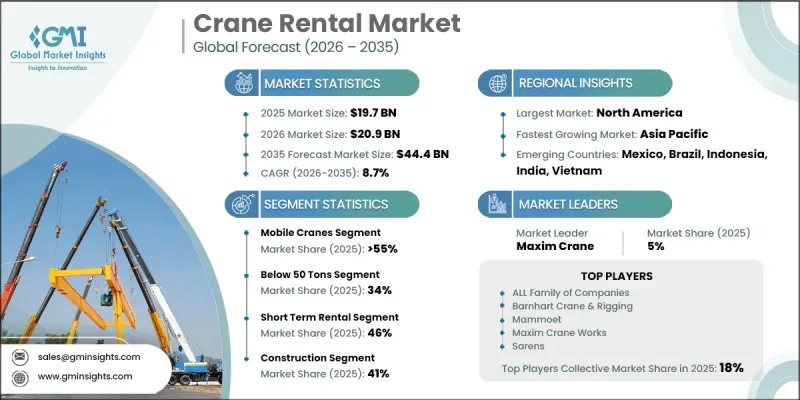
大規模基礎設施建設項目的快速擴張正顯著推動全球對起重機租賃服務的需求。包括高速公路、鐵路走廊、港口、商業建築和工業設施在內的建設活動日益增多,對無需大量資本投入的重型起重設備產生了強勁的需求。政府和私人開發商擴大選擇租賃起重機解決方案,以提高營運效率、降低設備擁有成本並縮短專案工期。都市化和智慧城市建設的推進也促使移動式起重機和塔式起重機在人口稠密的都市區得到更廣泛的應用,因為在這些地區,柔軟性和快速移動性至關重要。此外,能源、採礦和工業領域的業務擴張也推動了對煉油廠維修、設備安裝和大規模工業專案等專用起重設備的需求。遠端資訊處理、遠距離診斷、節能系統和混合動力起重機等技術進步進一步提高了營運效率,並支持了全球市場的成長。
| 市場範圍 | |
|---|---|
| 開始年份 | 2025 |
| 預測期 | 2026-2035 |
| 初始市場規模 | 197億美元 |
| 預計金額 | 444億美元 |
| 複合年成長率 | 8.7% |
預計到2025年,移動式起重機市佔率將達到55%,並在2026年至2035年間以8.3%的複合年成長率成長。全球範圍內持續的城市改造和基礎設施現代化項目推動了對移動式起重機的需求不斷成長。遠端資訊處理整合、混合動力推進系統和遠端監控等先進技術正在提升起重機的效率、安全性和永續性。此外,緊湊型起重機設計使其能夠輕鬆部署在空間有限的擁擠都市區建築工地,進一步加速了該細分市場在快速發展地區的成長。
預計到2025年,50噸以下起重機的市佔率將達到34%,並在2035年之前以7.7%的複合年成長率成長。由於其機動性和對狹小作業場所的適應性,此載重範圍的起重機在公共產業、維護作業和城市建設項目中備受關注。為滿足日益嚴格的排放氣體法規,電動和混合動力起重設備的需求不斷成長,進一步推動了該細分市場的整體需求。對於在人口密集的大都會圈進行短期基礎設施維修和建設專案的中小型承包商而言,租賃服務尤其有利。
預計到2025年,美國起重機租賃市場規模將達60億美元。推動美國市場成長的主要因素是交通基礎設施現代化計畫投資的增加,包括高速公路、橋樑和公共基礎設施維修。配備遠端資訊處理技術的起重機和自動化起重系統的廣泛應用,提高了建築工地的營運效率。建築公司越來越依賴租賃車輛來保持柔軟性並降低設備擁有成本。此外,包括風能和大型太陽能發電廠在內的可再生能源項目,也對用於設備組裝和能源基礎設施部署的重型起重機解決方案產生了顯著需求。
目錄
第1章:調查方法
第2章執行摘要
第3章:行業洞察
- 工業生態系分析
- 供應商情況
- 利潤率
- 成本結構
- 每個階段增加的價值
- 影響價值鏈的因素
- 中斷
- 影響產業的因素
- 促進因素
- 基礎建設開發投資
- 都市化和智慧城市項目
- 石油、天然氣和採礦活動的擴張
- 擴大可再生能源項目
- 產業潛在風險與挑戰
- 經濟和外匯波動
- 監管和政治不確定性
- 市場機遇
- 租賃而非購買設備的需求日益成長。
- 起重機作業中的技術整合
- 官民合作關係(PPP)專案的成長
- 向區域城市和新興城市擴張
- 促進因素
- 成長潛力分析
- 技術與創新展望
- 最新科技趨勢
- 新技術
- 價格分析
- 對過去價格趨勢的分析
- 根據參與企業的類型(高階、價值、成本加成)所製定的定價策略
- 監理情勢
- 波特的分析
- PESTLE分析
- 成本細分分析
- 專利分析
- 貿易數據分析
- 進出口量及進口額趨勢
- 主要貿易路線及關稅的影響
- 人工智慧和生成式人工智慧對市場的影響
- 利用人工智慧改造現有經營模式
- 基於細分市場的生成式人工智慧的應用案例和部署藍圖
- 風險、限制和監管考量
- 永續性和環境方面
- 永續發展計劃
- 減少廢棄物策略
- 生產中的能源效率
- 環保舉措
- 考慮碳足跡
- 預測假設和情境分析
- 基本案例:驅動複合年成長率的關鍵宏觀經濟與產業變量
- 樂觀情境:宏觀經濟與產業的利多因素
- 悲觀情景:宏觀經濟放緩或產業逆風
第4章 競爭情勢
- 介紹
- 企業市佔率分析
- 北美洲
- 歐洲
- 亞太地區
- 拉丁美洲
- 中東和非洲
- 主要市場公司的競爭分析
- 競爭定位矩陣
- 併購
- 夥伴關係和聯盟
- 新產品發布
- 業務拓展計劃及資金籌措
第5章 市場估計與預測:依類型分類,2022-2035年
- 移動式起重機
- 車載起重機
- 用於崎嶇地形的起重機
- 全地形起重機
- 浮體式起重機
- 甲板起重機
- 固定式起重機
- 塔式起重機
- 水平式粗吊機
- 錘頭起重機
- 高架起重機
- 橋式起重機和架空起重機
- 懸臂起重機
- 履帶式起重機
- 船舶和海上起重機
第6章 市場估計與預測:依負載容量,2022-2035年
- 50噸或以下
- 50-150噸
- 150-300噸
- 超過300噸
第7章 市場估計與預測:依租賃期限分類,2022-2035年
- 短期租賃
- 長期租賃
- 企劃為基礎的租賃
第8章 市場估算與預測:依最終用途分類,2022-2035年
- 建造
- 採礦和鑽探
- 石油和天然氣
- 電能
- 製造業
- 交通基礎設施
- 公共產業
- 其他
第9章 市場估計與預測:依地區分類,2022-2035年
- 北美洲
- 美國
- 加拿大
- 歐洲
- 德國
- 英國
- 法國
- 義大利
- 西班牙
- 北歐的
- 俄羅斯
- 波蘭
- 羅馬尼亞
- 亞太地區
- 中國
- 印度
- 日本
- 韓國
- 澳洲和紐西蘭
- 越南
- 印尼
- 菲律賓
- 拉丁美洲
- 巴西
- 墨西哥
- 阿根廷
- 中東和非洲
- 南非
- 沙烏地阿拉伯
- 阿拉伯聯合大公國
第10章:公司簡介
- 世界公司
- ALL集團
- Barnhart
- Liebherr
- Mammoet
- Maxim
- Sarens
- Tadano
- TNT Crane & Rigging
- XCMG Group
- Zoomlion Heavy Industry
- 當地公司
- Ainscough Crane Hire
- Al Faris Group
- ALL Erection & Crane Rental
- Bigge Crane and Rigging
- Maxim Crane Works
- Tat Hong
- 新興企業
- Lampson International
- Palfinger AG
- Sanghvi Movers
- Sany Heavy Industry
The Global Crane Rental Market was valued at USD 19.7 billion in 2025 and is estimated to grow at a CAGR of 8.7% to reach USD 44.4 billion by 2035.
Rapid growth in large-scale infrastructure development projects is significantly driving demand for crane rental services across the world. Increasing construction activities involving highways, rail corridors, ports, commercial buildings, and industrial facilities are creating strong requirements for heavy lifting equipment without the burden of high capital investment. Governments and private developers are increasingly opting for rental crane solutions to improve operational efficiency, reduce equipment ownership costs, and accelerate project completion timelines. Rising urbanization and expansion of smart city developments are also contributing to higher deployment of mobile and tower cranes across densely populated urban environments, where flexibility and quick mobility are essential. In addition, expansion across the energy, mining, and industrial sectors is strengthening demand for specialized lifting equipment used in refinery upgrades, equipment installation, and large-scale industrial projects. Technological advancements, including telematics, remote diagnostics, fuel-efficient systems, and hybrid-powered cranes, are further improving operational productivity and supporting market growth globally.
| Market Scope | |
|---|---|
| Start Year | 2025 |
| Forecast Year | 2026-2035 |
| Start Value | $19.7 Billion |
| Forecast Value | $44.4 Billion |
| CAGR | 8.7% |
The mobile cranes segment accounted for 55% share in 2025 and is expected to grow at a CAGR of 8.3% from 2026 to 2035. Demand for mobile cranes continues to increase due to ongoing urban redevelopment and infrastructure modernization projects worldwide. Advanced technologies such as telematics integration, hybrid propulsion systems, and remote monitoring capabilities are improving crane efficiency, operational safety, and sustainability. Compact crane designs are also enabling easier deployment across congested urban construction sites with limited operational space, further accelerating segment growth across rapidly developing regions.
The below 50 tons segment held a 34% share in 2025 and is anticipated to grow at a CAGR of 7.7% through 2035. Cranes within this lifting capacity range are gaining significant traction across utility work, maintenance activities, and urban construction projects due to their maneuverability and suitability for confined job sites. Increasing preference for electric and hybrid lifting equipment to meet tightening emission standards is further supporting demand across this segment. Rental availability is particularly benefiting small and mid-sized contractors handling short-duration infrastructure repair and construction projects in highly populated metropolitan areas.
U.S. Crane Rental Market reached USD 6 billion in 2025. Market growth in the country is being supported by rising investments in transportation infrastructure modernization projects, including highways, bridges, and public utility upgrades. Growing adoption of telematics-enabled cranes and automated lifting systems is improving operational efficiency across construction sites. Contractors are increasingly relying on rental fleets to maintain flexibility and reduce equipment ownership costs. In addition, renewable energy projects involving wind and utility-scale solar installations are generating substantial demand for heavy-lift crane solutions required for equipment assembly and energy infrastructure deployment.
Major companies operating in the Global Crane Rental Market include Sanghvi Movers, Barnhart Crane & Rigging, Liebherr Rental, Sarens, Tat Hong, Maxim Crane Works, ALL Family of Companies, TNT Crane & Rigging, and Mammoet. Companies in the crane rental market are focusing on fleet modernization, geographic expansion, and technology integration to strengthen their competitive position. Leading providers are investing in advanced cranes equipped with telematics, remote diagnostics, hybrid power systems, and automated safety features to improve operational efficiency and reduce downtime. Businesses are also expanding rental fleets with high-capacity and compact cranes to meet growing demand from infrastructure, energy, and urban construction projects. Strategic partnerships with construction firms and industrial operators are helping rental companies secure long-term contracts and improve market penetration. In addition, companies are emphasizing digital fleet management platforms, predictive maintenance solutions, and operator training programs to enhance customer satisfaction and operational reliability.
Table of Contents
Chapter 1 Methodology
- 1.1 Research approach
- 1.2 Quality commitments
- 1.3 GMI AI policy & data integrity commitment
- 1.4 Research trail & confidence scoring
- 1.4.1 Research trail components
- 1.4.2 Scoring components
- 1.5 Data collection
- 1.5.1 Partial list of primary sources
- 1.6 Data mining sources
- 1.6.1 Paid sources
- 1.7 Base estimates and calculations
- 1.7.1 Base year calculation
- 1.8 Forecast model
- 1.9 Research transparency addendum
Chapter 2 Executive Summary
- 2.1 Industry 360° synopsis
- 2.2 Key market trends
- 2.2.1 Regional
- 2.2.2 Type
- 2.2.3 Load capacity
- 2.2.4 Rental duration
- 2.2.5 End use
- 2.3 TAM analysis, 2026-2035
- 2.4 CXO perspectives: Strategic imperatives
Chapter 3 Industry Insights
- 3.1 Industry ecosystem analysis
- 3.1.1 Supplier landscape
- 3.1.2 Profit margin
- 3.1.3 Cost structure
- 3.1.4 Value addition at each stage
- 3.1.5 Factor affecting the value chain
- 3.1.6 Disruptions
- 3.2 Industry impact forces
- 3.2.1 Growth drivers
- 3.2.1.1 Infrastructure development investments
- 3.2.1.2 Urbanization and smart city projects
- 3.2.1.3 Growth in oil & gas and mining activities
- 3.2.1.4 Expansion of renewable energy projects
- 3.2.2 Industry pitfalls and challenges
- 3.2.2.1 Economic and currency volatility
- 3.2.2.2 Regulatory and political uncertainty
- 3.2.3 Market opportunities
- 3.2.3.1 Rising demand for equipment leasing over ownership
- 3.2.3.2 Technological integration in crane operations
- 3.2.3.3 Growth in public-private partnership (PPP) projects
- 3.2.3.4 Expansion in secondary and emerging cities
- 3.2.1 Growth drivers
- 3.3 Growth potential analysis
- 3.4 Technology and innovation landscape
- 3.4.1 Current technological trends
- 3.4.2 Emerging technologies
- 3.5 Pricing analysis (Driven by Primary Research)
- 3.5.1 Historical price trend analysis
- 3.5.2 Pricing strategy by player type (premium / value / cost-plus)
- 3.6 Regulatory landscape
- 3.6.1 North America
- 3.6.2 Europe
- 3.6.3 Asia Pacific
- 3.6.4 Latin America
- 3.6.5 Middle East & Africa
- 3.7 Porter's analysis
- 3.8 PESTEL analysis
- 3.9 Cost breakdown analysis
- 3.10 Patent analysis (Driven by Primary Research)
- 3.11 Trade data analysis (Driven by paid database)
- 3.11.1 Import/export volume & value trends
- 3.11.2 Key trade corridors & tariff impact
- 3.12 Impact of AI & Generative AI on the Market
- 3.12.1 AI-driven disruption of existing business models
- 3.12.2 Gen AI use cases & adoption roadmap by segment
- 3.12.3 Risks, limitations & regulatory considerations
- 3.13 Sustainability and environmental aspects
- 3.13.1 Sustainable practices
- 3.13.2 Waste reduction strategies
- 3.13.3 Energy efficiency in production
- 3.13.4 Eco-friendly initiatives
- 3.13.5 Carbon footprint considerations
- 3.14 Forecast assumptions & scenario analysis (Driven by primary research)
- 3.14.1 Base Case - key macro & industry variables driving CAGR
- 3.14.2 Optimistic Scenarios - Favorable macro and industry tailwinds
- 3.14.3 Pessimistic Scenario - Macroeconomic slowdown or industry headwinds
Chapter 4 Competitive Landscape, 2025
- 4.1 Introduction
- 4.2 Company market share analysis
- 4.2.1 North America
- 4.2.2 Europe
- 4.2.3 Asia Pacific
- 4.2.4 LATAM
- 4.2.5 MEA
- 4.3 Competitive analysis of major market players
- 4.4 Competitive positioning matrix
- 4.5 Key developments
- 4.5.1 Mergers & acquisitions
- 4.5.2 Partnerships & collaborations
- 4.5.3 New product launches
- 4.5.4 Expansion plans and funding
Chapter 5 Market Estimates & Forecast, By Type, 2022 - 2035 ($Mn, Units)
- 5.1 Key trends
- 5.2 Mobile cranes
- 5.2.1 Truck-mounted cranes
- 5.2.2 Rough terrain cranes
- 5.2.3 All-terrain cranes
- 5.2.4 Floating cranes
- 5.2.5 Carry deck cranes
- 5.3 Fixed cranes
- 5.3.1 Tower cranes
- 5.3.2 Level luffing cranes
- 5.3.3 Hammerhead cranes
- 5.3.4 Gantry cranes
- 5.3.5 Bridge/overhead cranes
- 5.3.6 Jib cranes
- 5.4 Crawler cranes
- 5.5 Marine and offshore cranes
Chapter 6 Market Estimates & Forecast, By Load capacity, 2022 - 2035 ($Mn, Units)
- 6.1 Key trends
- 6.2 Below 50 tons
- 6.3 50-150 tons
- 6.4 150-300 tons
- 6.5 Above 300 tons
Chapter 7 Market Estimates & Forecast, By Rental duration, 2022 - 2035 ($Mn)
- 7.1 Key trends
- 7.2 Short term rental
- 7.3 Long-term rental
- 7.4 Project-based rental
Chapter 8 Market Estimates & Forecast, By End Use, 2022 - 2035 ($Mn, Units)
- 8.1 Key trends
- 8.2 Construction
- 8.3 Mining and excavation
- 8.4 Oil & gas
- 8.5 Power & energy
- 8.6 Manufacturing
- 8.7 Transportation & infrastructure
- 8.8 Utilities
- 8.9 Others
Chapter 9 Market Estimates & Forecast, By Region, 2022 - 2035 ($Mn, Units)
- 9.1 Key trends
- 9.2 North America
- 9.2.1 U.S.
- 9.2.2 Canada
- 9.3 Europe
- 9.3.1 Germany
- 9.3.2 UK
- 9.3.3 France
- 9.3.4 Italy
- 9.3.5 Spain
- 9.3.6 Nordics
- 9.3.7 Russia
- 9.3.8 Poland
- 9.3.9 Romania
- 9.4 Asia Pacific
- 9.4.1 China
- 9.4.2 India
- 9.4.3 Japan
- 9.4.4 South Korea
- 9.4.5 ANZ
- 9.4.6 Vietnam
- 9.4.7 Indonesia
- 9.4.8 Philippines
- 9.5 Latin America
- 9.5.1 Brazil
- 9.5.2 Mexico
- 9.5.3 Argentina
- 9.6 MEA
- 9.6.1 South Africa
- 9.6.2 Saudi Arabia
- 9.6.3 UAE
Chapter 10 Company Profiles
- 10.1 Global players
- 10.1.1 ALL Family of Companies
- 10.1.2 Barnhart
- 10.1.3 Liebherr
- 10.1.4 Mammoet
- 10.1.5 Maxim
- 10.1.6 Sarens
- 10.1.7 Tadano
- 10.1.8 TNT Crane & Rigging
- 10.1.9 XCMG Group
- 10.1.10 Zoomlion Heavy Industry
- 10.2 Regional players
- 10.2.1 Ainscough Crane Hire
- 10.2.2 Al Faris Group
- 10.2.3 ALL Erection & Crane Rental
- 10.2.4 Bigge Crane and Rigging
- 10.2.5 Maxim Crane Works
- 10.2.6 Tat Hong
- 10.3 Emerging players
- 10.3.1 Lampson International
- 10.3.2 Palfinger AG
- 10.3.3 Sanghvi Movers
- 10.3.4 Sany Heavy Industry

 起重機租賃市場:2026-2032年全球市場預測(按起重機類型、租賃期限、起重機能力、應用和最終用戶產業分類)
 全球起重機租賃市場:按類型、起重能力、最終用途產業和地區分類-預測至2031年
 起重機租賃市場:依起重機類型、服務類型和地區分類。
 2026年全球起重機租賃市場報告
 起重機租賃市場規模、佔有率和成長分析(按產品、應用、計劃週期和地區分類)—產業預測(2026-2033 年)
 2026-2032 年起重機租賃市場(按類型、起重能力、最終用戶和地區分類)
 起重機出租市場,規模,趨勢,產業分析報告:各類型,起重能力,各最終用途產業,各地區 - 市場預測 2025年~2034年