


 |
市場調查報告書
商品編碼
2045788
吉貝素市場機會、成長要素、產業趨勢分析及2026-2035年預測Gibberellins Market Opportunity, Growth Drivers, Industry Trend Analysis, and Forecast 2026 - 2035 |
||||||

2025 年全球吉貝素市值為 8.722 億美元,預計到 2035 年將以 10% 的複合年成長率成長至 20 億美元。
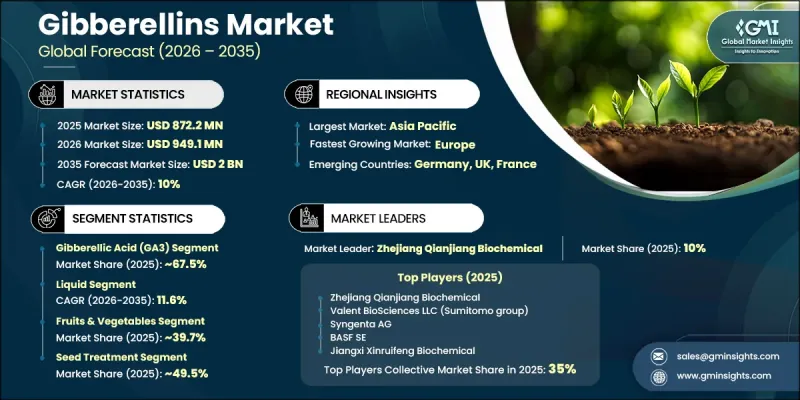
吉貝素是一種植物生長激素,在調節植物發育的各個階段(包括莖伸長、種子萌發和開花)中發揮著至關重要的作用。這些荷爾蒙既由植物天然產生,也有商業性生產用於農業用途。在農業領域,吉貝素被廣泛用於提高作物產量、改善果實品質、促進植物生長和提高種子萌發率。常見的施用方法包括種子處理和葉面噴布,用於最佳化植物在各個生長階段的發育。在全球農業系統中,吉貝素市場的企業在提高農業效率和作物品質方面持續發揮至關重要的作用。人口成長推動了全球糧食需求的成長,加劇了農業生產力的壓力,促使農民採用吉貝素等植物生長調節劑來提高作物產量。此外,永續農業實踐的日益普及也推動了市場成長,因為植物生長調節劑為提高農業產量提供了一種環境友善解決方案。
| 市場範圍 | |
|---|---|
| 開始年份 | 2025 |
| 預測期 | 2026-2035 |
| 初始市場規模 | 8.722億美元 |
| 預測金額 | 20億美元 |
| 複合年成長率 | 10% |
預計到2025年,吉貝素(GA3)市佔率將達到67.5%,並在2035年之前維持10.1%的複合年成長率。 GA3因其在多種園藝和農作物中展現出的卓越功效而持續佔據市場主導地位。該化合物因其促進細胞增殖、支持植物均勻生長以及提高作物整體產量和品質的能力而廣受認可。其穩定的性能特徵和與多種施用技術的兼容性,極大地促進了其在農業領域的廣泛應用。對提高作物效率和改善生產穩定性的日益重視,進一步推動了對GA3製劑的需求。
預計到2025年,蔬果市場將佔據39.7%的市場佔有率,到2035年將以10.7%的複合年成長率成長。該領域的強勁需求主要源於高價值園藝生產整體對提高作物品質、增強果實大小一致性和有效生長管理的需求。吉貝素被廣泛用於促進開花、提高坐果率以及在各個生長週期中維持穩定的農業產量。對高品質農產品和提高農業生產力的日益重視,進一步加速了植物生長調節劑在果蔬種植的應用。
預計到2025年,北美吉貝素市佔率將達到32.5% 。全部區域市場擴張的驅動力主要來自先進農業實踐、可控作物管理技術的日益普及以及對高品質農產品需求的成長。該地區對精密農業和永續農業生產力的高度重視,也推動了先進吉貝素製劑的快速應用。此外,對現代農業技術和改進作物管理系統的持續投資,也為吉貝素產業在北美的擴張創造了有利環境。
目錄
第1章:調查方法和範圍
第2章執行摘要
第3章 行業洞察
- 產業生態系分析
- 供應商情況
- 利潤率
- 每個階段增加的價值
- 影響價值鏈的因素
- 中斷
- 影響產業的因素
- 促進因素
- 全球對糧食需求的不斷成長,推動了提高農業生產力的必要性。
- 永續農業實踐的日益普及推動了吉貝素的使用。
- 生物技術的進步正在推動新型吉貝素製劑的研發。
- 產業潛在風險與挑戰
- 監管限制給吉貝素在農業的應用帶來了挑戰。
- 由於吉貝素可能被過度使用,引發了環境方面的擔憂。
- 市場機遇
- 開發生物基和環境友善吉貝素製劑
- 農業部門正向新興市場擴張。
- 促進因素
- 成長潛力分析
- 監理情勢
- 北美洲
- 歐洲
- 亞太地區
- 拉丁美洲
- 中東和非洲
- 波特的分析
- PESTLE分析
- 價格趨勢
- 按地區
- 按類型
- 未來市場趨勢
- 技術與創新展望
- 最新科技趨勢
- 新興技術
- 專利趨勢
- 貿易統計
- 主要進口國
- 主要出口國
- 永續性和環境方面
- 永續計劃
- 減少廢棄物策略
- 生產中的能源效率
- 具有環保意識的舉措
- 考慮碳足跡
第4章 競爭情勢
- 介紹
- 企業市佔率分析
- 按地區
- 北美洲
- 歐洲
- 亞太地區
- LATAM
- 中東和非洲
- 按地區
- 企業矩陣分析
- 主要市場公司的競爭分析
- 競爭定位矩陣
- 主要進展
- 併購
- 夥伴關係和聯盟
- 新產品發布
- 業務拓展計劃
第5章 市場估計與預測:依類型分類,2022-2035年
- 吉貝素(GA3)
- 吉貝素A4/A7
第6章 市場估計與預測:依形式分類,2022-2035年
- 液體
- 粉末
- 顆粒
第7章 市場估計與預測:依作物類型分類,2022-2035年
- 水果和蔬菜
- 糧食
- 甘蔗
- 觀賞植物和花卉栽培
- 其他作物
第8章 市場估計與預測:依應用領域分類,2022-2035年
- 種子處理
- 葉面噴布
第9章 市場估計與預測:依地區分類,2022-2035年
- 北美洲
- 美國
- 加拿大
- 歐洲
- 德國
- 英國
- 法國
- 西班牙
- 義大利
- 其他歐洲國家
- 亞太地區
- 中國
- 印度
- 日本
- 澳洲
- 韓國
- 其他亞太國家
- 拉丁美洲
- 巴西
- 墨西哥
- 阿根廷
- 其他拉丁美洲國家
- 中東和非洲
- 沙烏地阿拉伯
- 南非
- UAE
- 其他中東和非洲國家
第10章:公司簡介
- Valent BioSciences LLC
- Nufarm Limited
- Syngenta AG
- BASF SE
- Sumitomo Chemical Co., Ltd.
- Zhejiang Qianjiang Biochemical
- Jiangxi Xinruifeng Biochemical
- Sichuan Lomon Bio Technology
- Jiangsu Fengyuan Bioengineering
- Awiner Biotech Co., Ltd.
- Hefei TNJ Chemical Industry
- Hangzhou Tianlong Biotechnology
- Zhejiang Rayfull Chemicals
- Hi Field AG. Chem India
The Global Gibberellins Market was valued at USD 872.2 million in 2025 and is estimated to grow at a CAGR of 10% to reach USD 2 billion by 2035.
Gibberellins are a category of plant growth hormones that play a critical role in regulating various stages of plant development, including stem growth, seed germination, and flowering processes. These hormones are naturally produced by plants and can also be commercially manufactured for agricultural applications. The agricultural industry widely utilizes gibberellins to improve crop productivity, enhance fruit quality, stimulate plant growth, and support more effective seed germination. Application methods commonly include seed treatment and foliar spraying to optimize plant development during different growth stages. Companies operating in the gibberellins market continue to play an essential role in improving agricultural efficiency and crop quality across global farming systems. Rising global food demand driven by population growth is creating increasing pressure on agricultural productivity, encouraging farmers to adopt plant growth regulators such as gibberellins to improve crop performance. In addition, the growing popularity of sustainable farming practices is further supporting market growth as plant growth regulators offer environmentally responsible solutions for enhancing agricultural output.
| Market Scope | |
|---|---|
| Start Year | 2025 |
| Forecast Year | 2026-2035 |
| Start Value | $872.2 Million |
| Forecast Value | $2 Billion |
| CAGR | 10% |
The gibberellic acid (GA3) segment held a 67.5% share in 2025 and is expected to register a CAGR of 10.1% through 2035. GA3 continues to maintain a strong position within the market due to its proven effectiveness across a broad range of horticultural and agricultural crops. The compound is widely recognized for its ability to stimulate cell expansion, support uniform plant development, and improve overall crop yield and quality. Its stable performance characteristics and compatibility with multiple application techniques have contributed significantly to its widespread adoption throughout the agricultural sector. The focus on maximizing crop efficiency and improving production consistency continues to strengthen demand for GA3-based formulations.
The fruits and vegetables segment accounted for 39.7% share in 2025 and is anticipated to grow at a CAGR of 10.7% by 2035. Strong demand within this segment is primarily driven by the need for improved crop quality, enhanced size consistency, and effective growth management across high-value horticultural production. Gibberellins are extensively utilized to support flowering, improve fruit setting, and maintain consistent agricultural output throughout varying cultivation cycles. Increasing emphasis on premium-quality produce and higher agricultural productivity is further accelerating the use of plant growth regulators in the cultivation of fruits and vegetables.
North America Gibberellins Market held a 32.5% share in 2025. Market expansion throughout the region is being supported by advanced agricultural practices, increasing adoption of controlled crop management technologies, and rising demand for high-quality agricultural produce. The region's strong focus on precision farming techniques and sustainable agricultural productivity is encouraging rapid adoption of advanced gibberellin formulations. In addition, ongoing investments in modern farming technologies and improved crop management systems continue to create favorable conditions for the expansion of the gibberellins industry across North America.
Key companies operating in the Global Gibberellins Market include Syngenta AG, BASF SE, Valent BioSciences LLC, Nufarm Limited, Sumitomo Chemical Co., Ltd., Zhejiang Qianjiang Biochemical, Jiangxi Xinruifeng Biochemical, Sichuan Lomon Bio Technology, Jiangsu Fengyuan Bioengineering, Awiner Biotech Co., Ltd., Hefei TNJ Chemical Industry, Hangzhou Tianlong Biotechnology, Zhejiang Rayfull Chemicals, and Hi Field AG. Chem India. Companies operating in the gibberellins market are implementing multiple strategic initiatives to strengthen their market position and expand their global reach. Manufacturers are increasing investments in research and development to create advanced plant growth regulator formulations with higher efficiency and improved crop compatibility. Many companies are focusing on expanding production capabilities and strengthening distribution networks to meet rising global agricultural demand. Strategic partnerships with agricultural cooperatives, distributors, and farming organizations are helping businesses improve product accessibility and customer engagement. In addition, market participants are emphasizing sustainable and environmentally responsible product development to align with growing demand for eco-friendly farming solutions.
Table of Contents
Chapter 1 Methodology & Scope
- 1.1 Market scope and definition
- 1.2 Research design
- 1.2.1 Research approach
- 1.2.2 Data collection methods
- 1.3 Data mining sources
- 1.3.1 Global
- 1.3.2 Regional/Country
- 1.4 Base estimates and calculations
- 1.4.1 Base year calculation
- 1.4.2 Key trends for market estimation
- 1.5 Primary research and validation
- 1.5.1 Primary sources
- 1.6 Forecast model
- 1.7 Research assumptions and limitations
Chapter 2 Executive Summary
- 2.1 Industry 360° synopsis
- 2.2 Key market trends
- 2.2.1 Regional
- 2.2.2 Type
- 2.2.3 Form
- 2.2.4 Crop type
- 2.2.5 Application
- 2.3 TAM Analysis, 2026-2035
- 2.4 CXO perspectives: Strategic imperatives
- 2.4.1 Executive decision points
- 2.4.2 Critical success factors
- 2.5 Future Outlook and Strategic Recommendations
Chapter 3 Industry Insights
- 3.1 Industry ecosystem analysis
- 3.1.1 Supplier landscape
- 3.1.2 Profit margin
- 3.1.3 Value addition at each stage
- 3.1.4 Factor affecting the value chain
- 3.1.5 Disruptions
- 3.2 Industry impact forces
- 3.2.1 Growth drivers
- 3.2.1.1 Increasing global food demand propels the need for higher agricultural productivity
- 3.2.1.2 Growing adoption of sustainable farming practices favors gibberellins usage
- 3.2.1.3 Advances in biotechnology drive the development of new gibberellin formulations
- 3.2.2 Industry pitfalls and challenges
- 3.2.2.1 Regulatory restrictions pose challenges for gibberellins use in agriculture
- 3.2.2.2 Environmental concerns arise from potential overuse of gibberellins
- 3.2.3 Market opportunities
- 3.2.3.1 Development of bio-based & eco-friendly gibberellin formulations
- 3.2.3.2 Expansion into emerging markets with growing agricultural sectors
- 3.2.1 Growth drivers
- 3.3 Growth potential analysis
- 3.4 Regulatory landscape
- 3.4.1 North America
- 3.4.2 Europe
- 3.4.3 Asia Pacific
- 3.4.4 Latin America
- 3.4.5 Middle East & Africa
- 3.5 Porter's analysis
- 3.6 PESTEL analysis
- 3.7 Price trends
- 3.7.1 By region
- 3.7.2 By type
- 3.8 Future market trends
- 3.9 Technology and Innovation landscape
- 3.9.1 Current technological trends
- 3.9.2 Emerging technologies
- 3.10 Patent Landscape
- 3.11 Trade statistics (HS code)
- 3.11.1 Major importing countries
- 3.11.2 Major exporting countries
- 3.12 Sustainability and environmental aspects
- 3.12.1 Sustainable practices
- 3.12.2 Waste reduction strategies
- 3.12.3 Energy efficiency in production
- 3.12.4 Eco-friendly initiatives
- 3.13 Carbon footprint consideration
Chapter 4 Competitive Landscape, 2025
- 4.1 Introduction
- 4.2 Company market share analysis
- 4.2.1 By region
- 4.2.1.1 North America
- 4.2.1.2 Europe
- 4.2.1.3 Asia Pacific
- 4.2.1.4 LATAM
- 4.2.1.5 MEA
- 4.2.1 By region
- 4.3 Company matrix analysis
- 4.4 Competitive analysis of major market players
- 4.5 Competitive positioning matrix
- 4.6 Key developments
- 4.6.1 Mergers & acquisitions
- 4.6.2 Partnerships & collaborations
- 4.6.3 New Product Launches
- 4.6.4 Expansion Plans
Chapter 5 Market Estimates and Forecast, By Type, 2022-2035 (USD Million) (Kilo Tons)
- 5.1 Key trends
- 5.2 Gibberellic Acid (GA3)
- 5.3 Gibberellins A4/A7
Chapter 6 Market Estimates and Forecast, By Form, 2022-2035 (USD Million) (Kilo Tons)
- 6.1 Key trends
- 6.2 Liquid
- 6.3 Powder
- 6.4 Granules
Chapter 7 Market Estimates and Forecast, By Crop type, 2022-2035 (USD Million) (Kilo Tons)
- 7.1 Key trends
- 7.2 Fruits & Vegetables
- 7.3 Cereals & Grains
- 7.4 Sugarcane
- 7.5 Ornamental Plants & Floriculture
- 7.6 Other Crops
Chapter 8 Market Estimates and Forecast, By Application, 2022-2035 (USD Million) (Kilo Tons)
- 8.1 Key trends
- 8.2 Seed Treatment
- 8.3 Foliar Spray
Chapter 9 Market Estimates and Forecast, By Region, 2022-2035 (USD Million) (Kilo Tons)
- 9.1 Key trends
- 9.2 North America
- 9.2.1 U.S.
- 9.2.2 Canada
- 9.3 Europe
- 9.3.1 Germany
- 9.3.2 UK
- 9.3.3 France
- 9.3.4 Spain
- 9.3.5 Italy
- 9.3.6 Rest of Europe
- 9.4 Asia Pacific
- 9.4.1 China
- 9.4.2 India
- 9.4.3 Japan
- 9.4.4 Australia
- 9.4.5 South Korea
- 9.4.6 Rest of Asia Pacific
- 9.5 Latin America
- 9.5.1 Brazil
- 9.5.2 Mexico
- 9.5.3 Argentina
- 9.5.4 Rest of Latin America
- 9.6 Middle East and Africa
- 9.6.1 Saudi Arabia
- 9.6.2 South Africa
- 9.6.3 UAE
- 9.6.4 Rest of Middle East and Africa
Chapter 10 Company Profiles
- 10.1 Valent BioSciences LLC
- 10.2 Nufarm Limited
- 10.3 Syngenta AG
- 10.4 BASF SE
- 10.5 Sumitomo Chemical Co., Ltd.
- 10.6 Zhejiang Qianjiang Biochemical
- 10.7 Jiangxi Xinruifeng Biochemical
- 10.8 Sichuan Lomon Bio Technology
- 10.9 Jiangsu Fengyuan Bioengineering
- 10.10 Awiner Biotech Co., Ltd.
- 10.11 Hefei TNJ Chemical Industry
- 10.12 Hangzhou Tianlong Biotechnology
- 10.13 Zhejiang Rayfull Chemicals
- 10.14 Hi Field AG. Chem India


