


 |
市場調查報告書
商品編碼
2045756
2026 年至 2035 年住宅過濾器市場的商業機會、成長要素、產業趨勢分析與預測。Residential Filters Market Opportunity, Growth Drivers, Industry Trend Analysis, and Forecast 2026 - 2035 |
||||||

全球住宅過濾器市場預計到 2025 年價值 160 億美元,預計到 2035 年將達到 255 億美元,年複合成長率為 4.8%。
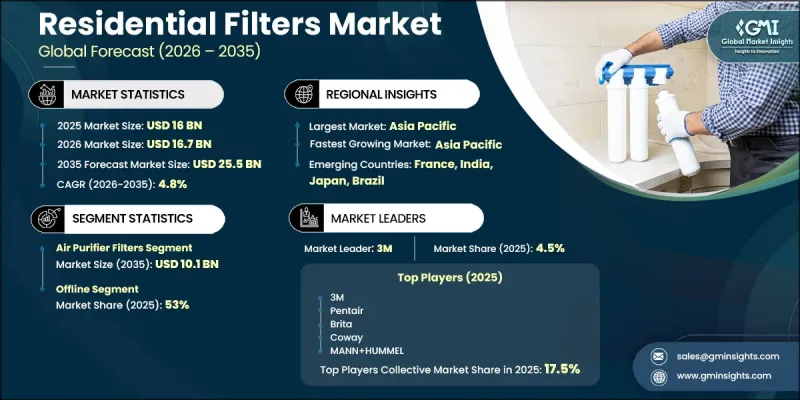
尤其是在開發中國家人口稠密的都市區,人們對環境問題和空氣品質惡化的日益關注正在推動市場穩定成長。隨著人們對污染暴露及其對室內居住環境長期影響的認知不斷提高,越來越多的家庭開始採用先進的過濾系統。加之人們對呼吸系統健康和福祉的日益重視,消費者更加重視清潔安全的室內環境。支持提高空氣品質標準和規範消費品中有害物質的法律體制也在加速高效過濾解決方案的普及。同時,發展中國家可支配收入的成長使更多家庭能夠投資購買先進的家用電器,包括多層和高性能過濾系統。這種轉變為全球製造商開闢了新的區域成長機會。消費者對健康生活方式日益成長的偏好,加上過濾效率技術的進步,正在推動市場滲透,並支撐著整個住宅領域的長期持續需求。
| 市場範圍 | |
|---|---|
| 開始年份 | 2025 |
| 預測期 | 2026-2035 |
| 上市時的市場規模 | 160億美元 |
| 預計金額 | 255億美元 |
| 複合年成長率 | 4.8% |
預計到2025年,空氣清淨機濾芯市場規模將達61億美元,2035年將達到101億美元。該細分市場持續推動市場成長,因為它直接解決了室內空氣品質問題,而室內空氣品質問題正日益成為家庭健康的重要考量。與主要保護機械設備的傳統暖通空調(HVAC)過濾系統不同,空氣清淨機濾芯的設計旨在透過去除敏感室內環境中的空氣污染物來改善個人健康。獨立式空氣清淨機日益普及,無需結構改造或大規模安裝即可提供靈活且以用戶為中心的過濾,這進一步鞏固了該細分市場的主導地位。對特定室內空氣淨化解決方案的持續成長需求,也將持續推動該品類的強勁成長。
2025年,線下通路將佔據53%的市場。實體零售通路將繼續保持主導地位,因為消費者更傾向於在購買過濾系統之前親自體驗和評估產品,並獲得專家建議。消費者在購買此類產品時往往非常謹慎,他們希望親身驗證產品品質並獲得專家指導。店內支援在清楚解釋績效評估和效率指標等技術規格方面發揮至關重要的作用,幫助消費者做出明智的選擇,並提升傳統零售業態的重要性。
到2025年,美國住宅過濾器市佔率將達到77.6%。這一強勁的市場趨勢主要得益於人們對室內空氣品質日益成長的關注,以及暖通空調系統在獨棟住宅和多用戶住宅中的廣泛應用。隨著過敏、氣喘和其他呼吸系統疾病病例的增加,越來越多的家庭開始採用先進的空氣和水過濾系統,將其作為日常健康管理的一部分。嚴格的建築法規、節能住宅維修以及持續的更換需求,都進一步推動了市場的穩定成長。此外,成熟的製造商、完善的分銷網路以及智慧家庭技術的日益普及,也進一步鞏固了美國在該領域的領先地位。
目錄
第1章:調查方法和範圍
第2章執行摘要
第3章:行業洞察
- 工業生態系分析
- 供應商情況
- 利潤率
- 每個階段增加的價值
- 影響價值鏈的因素
- 影響產業的因素
- 促進因素
- 人們對健康和環境的日益關注
- 都市化和人口成長
- 過濾技術創新
- 產業潛在風險與挑戰
- 高昂的初始投資成本
- 維護和營運成本
- 機會
- 對智慧互聯過濾解決方案的需求日益成長
- 擴大應用範圍,重點關注健康和永續性
- 促進因素
- 成長潛力分析
- 監理框架
- 關鍵市場趨勢與顛覆性因素
- 價格分析
- 對過去價格趨勢的分析
- 根據參與企業的類型(高階、價值、成本加成)所製定的定價策略
- 未來市場趨勢
- 貿易數據分析
- 進出口量及進口額趨勢
- 主要貿易路線及關稅的影響
- 人工智慧和生成式人工智慧對市場的影響
- 利用人工智慧改造現有經營模式
- 基於細分市場的生成式人工智慧的應用案例和部署藍圖
- 風險、限制和監管考量
- 波特的分析
- PESTLE分析
- 生產能力和生產情況
- 設備產能:按地區和主要生產商分類
- 運轉率和擴張計劃
第4章 競爭情勢
- 介紹
- 企業市佔率分析
- 按地區
- 企業矩陣分析
- 主要市場公司的競爭分析
- 競爭定位矩陣
- 併購
- 夥伴關係和聯盟
- 新產品發布
- 業務拓展計劃
第5章 市場估計與預測:依類型分類,2022-2035年
- 主要趨勢
- 暖通空調過濾器
- 水過濾器
- 空氣清淨機濾芯
- 爐過濾器
- 抽油煙機過濾器
- 其他
第6章 市場估計與預測:依過濾介質,2022-2035年
- 玻璃纖維
- 活性碳
- HEPA
- 靜電
- 褶皺紙/聚酯
- UV
- 陶瓷製品
- 其他(棉質、網狀等)
第7章 市場估算與預測:依效率水準分類,2022-2035年
- MERV 1~4
- MERV 6-10
- MERV 10-13
- MERV 14-16
- MERV 17~20
第8章 市場估計與預測:依應用領域分類,2022-2035年
- 空氣過濾
- 水過濾
- 其他(冷藏庫、洗衣機等)
第9章 市場估價與預測:依通路分類,2022-2035年
- 線上
- 電子商務網站
- 企業網站
- 離線
- 超級市場/大賣場
- 專賣店
- 其他
第10章 市場估價與預測:依地區分類,2022-2035年
- 北美洲
- 美國
- 加拿大
- 歐洲
- 德國
- 英國
- 法國
- 義大利
- 西班牙
- 亞太地區
- 中國
- 印度
- 日本
- 韓國
- 澳洲
- 拉丁美洲
- 巴西
- 墨西哥
- 其他拉丁美洲國家
- 中東和非洲
- 阿拉伯聯合大公國
- 沙烏地阿拉伯
- 南非
- 其他中東和非洲國家
第11章:公司簡介
- 世界公司
- 3M
- AO Smith
- BWT
- Culligan
- Freudenberg Filtration
- MANN+HUMMEL
- Pentair
- 當地公司
- Brita
- Camfil
- Coway
- Daikin
- Donaldson
- Livpure
- Parker Hannifin
- 新興企業
- Aquasana
- Berkey/New Millennium
- Clean-Link Filtration
- Filterbuy
- FilterTime
- Waterdrop
- ZeroWater
The Global Residential Filters Market was valued at USD 16 billion in 2025 and is estimated to grow at a CAGR of 4.8% to reach USD 25.5 billion by 2035.
The market is gaining steady traction due to increasing environmental concerns and worsening air quality conditions, particularly in densely populated urban regions across developing economies. Households are increasingly adopting advanced filtration systems as awareness grows around pollution exposure and its long-term impact on indoor living conditions. Rising attention to respiratory health and wellness has further encouraged consumers to prioritize cleaner and safer indoor environments. Regulatory frameworks supporting improved air quality standards and restrictions on harmful substances in consumer products are also accelerating the adoption of high-efficiency filtration solutions. In parallel, rising disposable incomes in developing regions are enabling more households to invest in advanced home appliances, including multi-layer and high-performance filtration systems. This shift is opening new geographic growth opportunities for global manufacturers. Growing consumer preference for healthier lifestyles, combined with technological improvements in filtration efficiency, is strengthening overall market penetration and supporting sustained long-term demand across residential applications.
| Market Scope | |
|---|---|
| Start Year | 2025 |
| Forecast Year | 2026-2035 |
| Start Value | $16 Billion |
| Forecast Value | $25.5 Billion |
| CAGR | 4.8% |
The air purifier filters segment generated USD 6.1 billion in 2025 and is projected to reach USD 10.1 billion by 2035. This segment continues to lead the market as it directly addresses indoor air quality concerns that are increasingly central to household health priorities. Air purifier filters are designed specifically to enhance personal well-being by removing airborne pollutants in sensitive indoor environments, differentiating them from conventional HVAC filtration systems that primarily protect mechanical equipment. The growing popularity of standalone air purification devices has further reinforced segment dominance, as these systems provide flexible, user-focused filtration without requiring structural modifications or large-scale installation. Rising demand for targeted indoor air cleaning solutions continues to support the strong growth trajectory of this category.
The offline distribution channel accounted for a 53% share in 2025. Physical retail channels continue to maintain a leading position as consumers prefer hands-on evaluation and professional consultation before purchasing filtration systems. Buying decisions in this category are highly considered, with customers seeking to physically assess product quality and receive expert guidance. In-store assistance plays a crucial role in simplifying technical specifications such as performance ratings and efficiency metrics, helping consumers make informed choices and strengthening the relevance of traditional retail formats.
U.S. Residential Filters Market held a 77.6% share in 2025 Strong market performance in the country is supported by high awareness of indoor air quality and widespread use of HVAC systems in both single-family and multi-unit housing. Increasing cases of allergies, asthma, and other respiratory conditions have encouraged households to adopt advanced air and water filtration systems as part of routine health management. Strict building regulations, energy-efficient housing upgrades, and consistent replacement demand are further contributing to steady market expansion. Additionally, the presence of established manufacturers, robust distribution networks, and rising integration of smart home technologies continue to reinforce the country's leadership position.
Major players operating in the Global Residential Filters Industry include Culligan, Brita, Camfil, 3M, Coway, Donaldson, Pentair, Daikin, Aquasana, MANN+HUMMEL, A.O. Smith, Parker Hannifin, ZeroWater, Waterdrop, BWT, Berkey, Filterbuy, Clean-Link Filtration, Livpure, Freudenberg Filtration, and FilterTime. Companies in the residential filters market are actively strengthening their competitive position through product innovation focused on higher filtration efficiency and longer service life. Many players are expanding smart filtration solutions integrated with IoT-based monitoring for real-time air and water quality tracking. Strategic partnerships with retail distributors and e-commerce platforms are improving product accessibility and market reach. Manufacturers are also investing in advanced materials and nanotechnology-based filtration media to enhance performance standards. Geographic expansion into high-growth emerging markets is supporting revenue diversification. In addition, firms are focusing on brand differentiation through certifications, sustainability claims, and premium product lines.
Table of Contents
Chapter 1 Methodology & Scope
- 1.1 Research approach
- 1.2 Quality Commitments
- 1.3 GMI AI policy & data integrity commitment
- 1.3.1 Source consistency protocol
- 1.4 Research Trail & Confidence Scoring
- 1.4.1 Research Trail Components
- 1.4.2 Scoring Components
- 1.5 Data Collection
- 1.5.1 Partial list of primary sources
- 1.6 Data mining sources
- 1.7 Paid sources
- 1.7.1 Sources, by region
- 1.8 Base estimates and calculations
- 1.8.1 Base year calculation for any one approach
- 1.9 Forecast model
- 1.9.1 Quantified market impact analysis
- 1.9.1.1 Mathematical impact of growth parameters on forecast
- 1.9.1 Quantified market impact analysis
- 1.10 Research transparency addendum
- 1.10.1 Source attribution framework
- 1.10.2 Quality assurance metrics
- 1.10.3 Our commitment to trust
Chapter 2 Executive Summary
- 2.1 Industry 360° synopsis, 2022 - 2035
- 2.2 Key market trends
- 2.2.1 Regional
- 2.2.2 Type
- 2.2.3 Filter media
- 2.2.4 Efficiency
- 2.2.5 Application
- 2.2.6 Distribution channel
Chapter 3 Industry Insights
- 3.1 Industry ecosystem analysis
- 3.1.1 Supplier landscape
- 3.1.2 Profit margin
- 3.1.3 Value addition at each stage
- 3.1.4 Factor affecting the value chain
- 3.2 Industry impact forces
- 3.2.1 Growth drivers
- 3.2.1.1 Rising awareness of health and environmental concerns
- 3.2.1.2 Urbanization and population growth
- 3.2.1.3 Innovations in filtration technologies
- 3.2.2 Industry pitfalls & challenges
- 3.2.2.1 High initial investment costs
- 3.2.2.2 Maintenance and operational costs
- 3.2.3 Opportunities
- 3.2.3.1 Growing demand for smart and connected filtration solutions
- 3.2.3.2 Rising health and sustainability-driven adoption
- 3.2.1 Growth drivers
- 3.3 Growth potential analysis
- 3.4 Regulatory framework
- 3.5 Major market trends and disruptions
- 3.6 Pricing Analysis (driven by primary research)
- 3.6.1 Historical price trend analysis (driven by primary research)
- 3.6.2 Pricing strategy by player type (premium / value / cost-plus) (driven by primary research)
- 3.7 Future market trends
- 3.8 Trade data analysis (driven by paid database) (HS Code 84212120)
- 3.8.1 Import/export volume & value trends (driven by primary research)
- 3.8.2 Key trade corridors & tariff impact (driven by primary research)
- 3.9 Impact of AI & Generative AI on the Market
- 3.9.1 AI-driven disruption of existing business models
- 3.9.2 Gen-AI use cases & adoption roadmap by segment
- 3.9.3 Risks, limitations & regulatory considerations
- 3.10 Porter's analysis
- 3.11 PESTEL analysis
- 3.12 Capacity & production landscape (driven by primary research)
- 3.12.1 Installed capacity by region & key producer (driven by primary research)
- 3.12.2 Capacity utilization rates & expansion pipelines (driven by primary research)
Chapter 4 Competitive Landscape, 2025
- 4.1 Introduction
- 4.2 Company market share analysis
- 4.2.1 By region
- 4.2.1.1 North America
- 4.2.1.2 Europe
- 4.2.1.3 Asia Pacific
- 4.2.1.4 Latin America
- 4.2.1.5 Middle East and Africa
- 4.2.1 By region
- 4.3 Company matrix analysis
- 4.4 Competitive analysis of major market players
- 4.5 Competitive positioning matrix
- 4.6 Key developments
- 4.6.1 Mergers & acquisitions
- 4.6.2 Partnerships & collaborations
- 4.6.3 New product launches
- 4.6.4 Expansion plans
Chapter 5 Market Estimates & Forecast, By Type, 2022-2035 (USD Billion) (Thousand Units)
- 5.1 Key Trends
- 5.2 HVAC filters
- 5.3 Water filters
- 5.4 Air purifier filters
- 5.5 Furnace filters
- 5.6 Range hood filters
- 5.7 Others
Chapter 6 Market Estimates & Forecast, By Filter Media, 2022 - 2035, (USD Billion) (Thousand Units)
- 6.1 Key trends
- 6.2 Fiberglass
- 6.3 Activated carbon
- 6.4 HEPA
- 6.5 Electrostatic
- 6.6 Pleated paper/polyester
- 6.7 UV
- 6.8 Ceramic
- 6.9 Others (cotton, mesh, etc.)
Chapter 7 Market Estimates & Forecast, By Efficiency, 2022 - 2035, (USD Billion) (Thousand Units)
- 7.1 Key trends
- 7.2 MERV 1-4
- 7.3 MERV 6-10
- 7.4 MERV 10-13
- 7.5 MERV 14-16
- 7.6 MERV 17-20
Chapter 8 Market Estimates & Forecast, By Application, 2022 - 2035, (USD Billion) (Thousand Units)
- 8.1 Key trends
- 8.2 Air filtration
- 8.3 Water filtration
- 8.4 Others (refrigeration, washing machine, etc.)
Chapter 9 Market Estimates & Forecast, By Distribution Channel, 2022 - 2035, (USD Billion) (Thousand Units)
- 9.1 Key trends
- 9.2 Online
- 9.2.1 E-commerce website
- 9.2.2 Company website
- 9.3 Offline
- 9.3.1 Supermarkets/ hypermarkets
- 9.3.2 Specialty stores
- 9.3.3 Others
Chapter 10 Market Estimates & Forecast, By Region, 2022 - 2035, (USD Billion) (Units)
- 10.1 Key trends
- 10.2 North America
- 10.2.1 U.S.
- 10.2.2 Canada
- 10.3 Europe
- 10.3.1 Germany
- 10.3.2 U.K.
- 10.3.3 France
- 10.3.4 Italy
- 10.3.5 Spain
- 10.4 Asia Pacific
- 10.4.1 China
- 10.4.2 India
- 10.4.3 Japan
- 10.4.4 South Korea
- 10.4.5 Australia
- 10.5 Latin America
- 10.5.1 Brazil
- 10.5.2 Mexico
- 10.5.3 Rest of Latin America
- 10.6 MEA
- 10.6.1 UAE
- 10.6.2 Saudi Arabia
- 10.6.3 South Africa
- 10.6.4 Rest of MEA
Chapter 11 Company Profiles (Business Overview, Financial Data, Product Landscape, Strategic Outlook, SWOT Analysis)
- 11.1 Global Companies
- 11.1.1 3M
- 11.1.2 A.O. Smith
- 11.1.3 BWT
- 11.1.4 Culligan
- 11.1.5 Freudenberg Filtration
- 11.1.6 MANN+HUMMEL
- 11.1.7 Pentair
- 11.2 Regional Companies
- 11.2.1 Brita
- 11.2.2 Camfil
- 11.2.3 Coway
- 11.2.4 Daikin
- 11.2.5 Donaldson
- 11.2.6 Livpure
- 11.2.7 Parker Hannifin
- 11.3 Emerging Companies
- 11.3.1 Aquasana
- 11.3.2 Berkey/New Millennium
- 11.3.3 Clean-Link Filtration
- 11.3.4 Filterbuy
- 11.3.5 FilterTime
- 11.3.6 Waterdrop
- 11.3.7 ZeroWater

 側流過濾器市場規模、佔有率和成長分析:按過濾器類型、應用、流量、最終用戶、安裝類型、分銷管道和地區分類—產業預測(2026-2033 年)
 可清洗過濾器市場規模、佔有率和成長分析:按過濾器類型、過濾材料、應用、最終用戶、分銷管道和地區分類-2026-2033年產業預測
 空調過濾網市場規模、佔有率和成長分析:按材料、過濾類型、過濾等級、應用、最終用戶和地區分類-2026-2033年產業預測
 面板式過濾器市場-2026-2032年全球市場預測
 過濾器套件市場規模、佔有率和成長分析:按產品類型、應用、最終用戶、銷售管道、濾材和地區分類-2026-2033年產業預測空氣過濾器市場:按類型、濾材類型、材料、過濾機制、銷售管道、使用者類型和最終用途分類-全球預測,2026-2032年
 住宅過濾器市場規模、佔有率和成長分析:按產品類型、技術、分銷管道、最終用戶、更換和地區分類-2026-2033年產業預測
 2026-2030年全球暖通空調空氣濾清器市場
 住宅陶瓷過濾器市場 - 全球產業規模、佔有率、趨勢、機會、預測:按長度、產品、地區和競爭格局分類,2021-2031年
 空氣過濾器市場規模、佔有率和成長分析:按過濾器類型、最終用戶和地區分類-2026-2033年產業預測