


 |
市場調查報告書
商品編碼
2045748
金屬氫化物市場機會、成長要素、產業趨勢分析及2026-2035年預測Metal Hydride Market Opportunity, Growth Drivers, Industry Trend Analysis, and Forecast 2026 - 2035 |
||||||

預計到 2025 年,全球金屬氫化物市場價值將達到 44 億美元,並有望以 7% 的複合年成長率成長,到 2035 年達到 90 億美元。
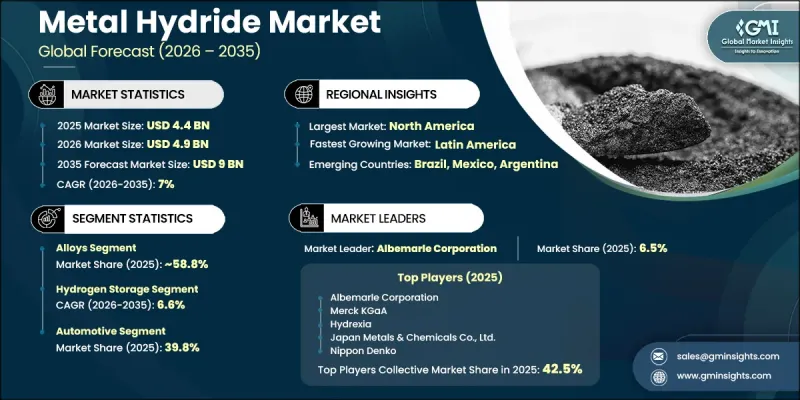
隨著人們對永續能源基礎設施的日益關注,能夠實現安全緊湊型儲氫的技術應用正在加速發展。金屬氫化物能夠在可控條件下儲存和釋放氫氣,在支持高密度儲氫和運行安全方面發揮至關重要的作用。它們能夠在廣泛的溫度和壓力環境下工作,使其非常適合現代能源應用。這些材料被廣泛應用於各個行業,用於支援儲能、溫度控管和高效能傳輸。對清潔能源計劃及其相關政策框架的投資增加,進一步推動了市場擴張。隨著各產業持續優先考慮低排放技術和可再生能源的整合,在創新、性能效率和應用範圍不斷擴大的推動下,全球金屬氫化物市場預計將保持穩定成長。
| 市場範圍 | |
|---|---|
| 開始年份 | 2025 |
| 預測期 | 2026-2035 |
| 上市時的市場規模 | 44億美元 |
| 預計金額 | 90億美元 |
| 複合年成長率 | 7% |
預計到2025年,合金材料市佔率將達到58.8%,並在2035年之前以6.9%的複合年成長率成長。該細分市場憑藉其卓越的吸氫性能和即使反覆使用也能保持穩定性能的能力,保持著主導地位。這些材料因其耐用性、成本效益以及在各種應用中保持穩定運行的能力而廣受歡迎。其熱穩定性和高效的儲氫能力也使其能夠滿足嚴苛的工業需求。
預計到2025年,汽車領域將佔據39.8%的市場佔有率,並在2026年至2035年間以6.8%的複合年成長率成長。該領域的主導地位歸功於氫能在交通運輸領域的日益普及。金屬氫化物提供了一種安全且高效的儲氫方式,有助於開發更乾淨的旅遊解決方案。將其整合到先進系統中,將提高能源效率並滿足長期性能要求。
預計到2025年,北美金屬氫化物市場佔有率將達到35%,反映出該地區強勁的成長動能。這一成長主要得益於氫能基礎設施投資的增加以及政府對推廣清潔能源技術的支持。學術機構和產業相關人員共同支持的持續研發活動,正在推動技術進步和市場擴張。減少排放和擴大可再生能源應用的努力,也進一步刺激了全部區域的需求。
目錄
第1章:調查方法和範圍
第2章執行摘要
第3章:行業洞察
- 工業生態系分析
- 供應商情況
- 利潤率
- 每個階段增加的價值
- 影響價值鏈的因素
- 中斷
- 影響產業的因素
- 促進因素
- 產業潛在風險與挑戰
- 市場機遇
- 成長潛力分析
- 監理情勢
- 北美洲
- 歐洲
- 亞太地區
- 拉丁美洲
- 中東和非洲
- 波特的分析
- PESTLE分析
- 價格趨勢
- 按地區
- 按類型
- 未來市場趨勢
- 技術與創新展望
- 最新科技趨勢
- 新技術
- 專利趨勢
- 貿易統計
- 主要進口國
- 主要出口國
- 永續性和環境方面
- 永續發展計劃
- 減少廢棄物策略
- 生產中的能源效率
- 環保舉措
- 考慮碳足跡
第4章 競爭情勢
- 介紹
- 企業市佔率分析
- 按地區
- 北美洲
- 歐洲
- 亞太地區
- 拉丁美洲
- 中東和非洲
- 按地區
- 企業矩陣分析
- 主要市場公司的競爭分析
- 競爭定位矩陣
- 併購
- 夥伴關係和聯盟
- 新產品發布
- 業務拓展計劃
第5章 市場估計與預測:依類型分類,2022-2035年
- 合金
- 複雜的
- 其他
第6章 市場估計與預測:依應用領域分類,2022-2035年
- 氫氣儲存
- 鎳氫電池
- 燃料電池
- 熱泵
- 熱能儲存
- 氫氣壓縮機
- 其他
第7章 市場估計與預測:依最終用戶分類,2022-2035年
- 車
- 航太
- 工業應用
- 儲能
- 其他
第8章 市場估計與預測:依地區分類,2022-2035年
- 北美洲
- 美國
- 加拿大
- 歐洲
- 德國
- 英國
- 法國
- 西班牙
- 義大利
- 其他歐洲國家
- 亞太地區
- 中國
- 印度
- 日本
- 澳洲
- 韓國
- 其他亞太國家
- 拉丁美洲
- 巴西
- 墨西哥
- 阿根廷
- 其他拉丁美洲國家
- 中東和非洲
- 沙烏地阿拉伯
- 南非
- 阿拉伯聯合大公國
- 其他中東和非洲國家
第9章:公司簡介
- Albemarle Corporation
- GKN Hydrogen
- HBank Technology
- Hydrexia
- Japan Metals & Chemicals(JMC)
- Merck KGaA
- Mitsui Mining & Smelting
- Nippon Denko
- Otto Chemie Pvt Ltd
- Santa Cruz BIoTechnology
- Santoku Corporation
The Global Metal Hydride Market was valued at USD 4.4 billion in 2025 and is estimated to grow at a CAGR of 7% to reach USD 9 billion by 2035.
Increasing focus on sustainable energy infrastructure is accelerating the adoption of technologies that enable safe and compact hydrogen storage. Metal hydrides play a critical role by allowing hydrogen to be stored and released under controlled conditions, supporting high storage density and operational safety. Their ability to function across varying temperature and pressure environments makes them highly suitable for modern energy applications. These materials are widely utilized across multiple industries, supporting energy storage, thermal management, and efficient energy transfer. Growing investments in clean energy initiatives and supportive policy frameworks are further strengthening market expansion. As industries continue to prioritize low-emission technologies and renewable energy integration, the global metal hydride market is expected to maintain steady growth driven by innovation, performance efficiency, and increasing adoption across diverse applications.
| Market Scope | |
|---|---|
| Start Year | 2025 |
| Forecast Year | 2026-2035 |
| Start Value | $4.4 Billion |
| Forecast Value | $9 Billion |
| CAGR | 7% |
The alloys segment accounted for 58.8% share in 2025 and is expected to grow at a CAGR of 6.9% through 2035. This segment maintains a leading position due to its strong hydrogen absorption capabilities and reliable performance over repeated usage cycles. These materials are widely preferred for their durability, cost efficiency, and ability to support consistent operation across various applications. Their thermal stability and effective hydrogen storage capacity make them suitable for demanding industrial requirements.
The automotive segment held 39.8% share in 2025 and is projected to grow at a CAGR of 6.8% from 2026 to 2035. This segment leads due to the increasing adoption of hydrogen-based technologies within the transportation sector. Metal hydrides provide a safe and efficient method for storing hydrogen, supporting the development of cleaner mobility solutions. Their integration into advanced systems enhances energy efficiency and supports long-term performance requirements.
North America Metal Hydride Market accounted for 35% share in 2025, reflecting strong regional growth. Expansion in this region is driven by increasing investment in hydrogen infrastructure and supportive government initiatives promoting clean energy technologies. Ongoing research and development activities, supported by both academic institutions and industry players, are contributing to technological advancements and market expansion. Efforts to reduce emissions and enhance renewable energy adoption continue to reinforce demand across the region.
Key companies operating in the Global Metal Hydride Market include Albemarle Corporation, GKN Hydrogen, HBank Technology, Hydrexia, Japan Metals & Chemicals (JMC), Merck KGaA, Mitsui Mining & Smelting, Nippon Denko, Otto Chemie Pvt Ltd, Santa Cruz Biotechnology, and Santoku Corporation. Companies in the Metal Hydride Market are strengthening their position through continuous innovation, strategic partnerships, and expansion initiatives. Organizations are investing in research and development to enhance hydrogen storage efficiency and improve material performance. Many players are focusing on developing advanced alloys and optimized solutions to meet evolving industry requirements. Expansion of production capabilities and global distribution networks is helping companies reach a wider customer base. Strategic collaborations with energy and technology firms are supporting the development of integrated solutions. Additionally, companies are aligning their offerings with sustainability goals, emphasizing efficiency, durability, and cost-effectiveness to maintain competitiveness in a rapidly evolving market landscape.
The Global Metal Hydride Market was valued at USD 4.4 billion in 2025 and is estimated to grow at a CAGR of 7% to reach USD 9 billion by 2035.
Increasing focus on sustainable energy infrastructure is accelerating the adoption of technologies that enable safe and compact hydrogen storage. Metal hydrides play a critical role by allowing hydrogen to be stored and released under controlled conditions, supporting high storage density and operational safety. Their ability to function across varying temperature and pressure environments makes them highly suitable for modern energy applications. These materials are widely utilized across multiple industries, supporting energy storage, thermal management, and efficient energy transfer. Growing investments in clean energy initiatives and supportive policy frameworks are further strengthening market expansion. As industries continue to prioritize low-emission technologies and renewable energy integration, the global metal hydride market is expected to maintain steady growth driven by innovation, performance efficiency, and increasing adoption across diverse applications.
The alloys segment accounted for 58.8% share in 2025 and is expected to grow at a CAGR of 6.9% through 2035. This segment maintains a leading position due to its strong hydrogen absorption capabilities and reliable performance over repeated usage cycles. These materials are widely preferred for their durability, cost efficiency, and ability to support consistent operation across various applications. Their thermal stability and effective hydrogen storage capacity make them suitable for demanding industrial requirements.
The automotive segment held 39.8% share in 2025 and is projected to grow at a CAGR of 6.8% from 2026 to 2035. This segment leads due to the increasing adoption of hydrogen-based technologies within the transportation sector. Metal hydrides provide a safe and efficient method for storing hydrogen, supporting the development of cleaner mobility solutions. Their integration into advanced systems enhances energy efficiency and supports long-term performance requirements.
North America Metal Hydride Market accounted for 35% share in 2025, reflecting strong regional growth. Expansion in this region is driven by increasing investment in hydrogen infrastructure and supportive government initiatives promoting clean energy technologies. Ongoing research and development activities, supported by both academic institutions and industry players, are contributing to technological advancements and market expansion. Efforts to reduce emissions and enhance renewable energy adoption continue to reinforce demand across the region.
Key companies operating in the Global Metal Hydride Market include Albemarle Corporation, GKN Hydrogen, HBank Technology, Hydrexia, Japan Metals & Chemicals (JMC), Merck KGaA, Mitsui Mining & Smelting, Nippon Denko, Otto Chemie Pvt Ltd, Santa Cruz Biotechnology, and Santoku Corporation. Companies in the Metal Hydride Market are strengthening their position through continuous innovation, strategic partnerships, and expansion initiatives. Organizations are investing in research and development to enhance hydrogen storage efficiency and improve material performance. Many players are focusing on developing advanced alloys and optimized solutions to meet evolving industry requirements. Expansion of production capabilities and global distribution networks is helping companies reach a wider customer base. Strategic collaborations with energy and technology firms are supporting the development of integrated solutions. Additionally, companies are aligning their offerings with sustainability goals, emphasizing efficiency, durability, and cost-effectiveness to maintain competitiveness in a rapidly evolving market landscape.
Table of Contents
Chapter 1 Methodology & Scope
- 1.1 Market scope and definition
- 1.2 Research design
- 1.2.1 Research approach
- 1.2.2 Data collection methods
- 1.3 Data mining sources
- 1.3.1 Global
- 1.3.2 Regional/Country
- 1.4 Base estimates and calculations
- 1.4.1 Base year calculation
- 1.4.2 Key trends for market estimation
- 1.5 Primary research and validation
- 1.5.1 Primary sources
- 1.6 Forecast model
- 1.7 Research assumptions and limitations
Chapter 2 Executive Summary
- 2.1 Industry 360° synopsis
- 2.2 Key market trends
- 2.2.1 Type
- 2.2.2 Application
- 2.2.3 End use
- 2.2.4 Regional
- 2.3 TAM Analysis, 2026-2035
- 2.4 CXO perspectives: Strategic imperatives
- 2.4.1 Executive decision points
Chapter 3 Industry Insights
- 3.1 Industry ecosystem analysis
- 3.1.1 Supplier landscape
- 3.1.2 Profit margin
- 3.1.3 Value addition at each stage
- 3.1.4 Factor affecting the value chain
- 3.1.5 Disruptions
- 3.2 Industry impact forces
- 3.2.1 Growth drivers
- 3.2.2 Industry pitfalls and challenges
- 3.2.3 Market opportunities
- 3.3 Growth potential analysis
- 3.4 Regulatory landscape
- 3.4.1 North America
- 3.4.2 Europe
- 3.4.3 Asia Pacific
- 3.4.4 Latin America
- 3.4.5 Middle East & Africa
- 3.5 Porter's analysis
- 3.6 PESTEL analysis
- 3.7 Price trends
- 3.7.1 By region
- 3.7.2 By type
- 3.8 Future market trends
- 3.9 Technology and Innovation landscape
- 3.9.1 Current technological trends
- 3.9.2 Emerging technologies
- 3.10 Patent Landscape
- 3.11 Trade statistics (HS code)
- 3.11.1 Major importing countries
- 3.11.2 Major exporting countries
- 3.12 Sustainability and environmental aspects
- 3.12.1 Sustainable practices
- 3.12.2 Waste reduction strategies
- 3.12.3 Energy efficiency in production
- 3.12.4 Eco-friendly initiatives
- 3.13 Carbon footprint consideration
Chapter 4 Competitive Landscape, 2025
- 4.1 Introduction
- 4.2 Company market share analysis
- 4.2.1 By region
- 4.2.1.1 North America
- 4.2.1.2 Europe
- 4.2.1.3 Asia Pacific
- 4.2.1.4 LATAM
- 4.2.1.5 MEA
- 4.2.1 By region
- 4.3 Company matrix analysis
- 4.4 Competitive analysis of major market players
- 4.5 Competitive positioning matrix
- 4.6 Key developments
- 4.6.1 Mergers & acquisitions
- 4.6.2 Partnerships & collaborations
- 4.6.3 New Product Launches
- 4.6.4 Expansion Plans
Chapter 5 Market Estimates and Forecast, By Type, 2022-2035 (USD Billion) (Kilo Tons)
- 5.1 Key trends
- 5.2 Alloys
- 5.3 Complexes
- 5.4 Others
Chapter 6 Market Estimates and Forecast, By Application, 2022-2035 (USD Billion) (Kilo Tons)
- 6.1 Key trends
- 6.2 Hydrogen storage
- 6.3 NiMH batteries
- 6.4 Fuel cells
- 6.5 Heat pumps
- 6.6 Thermal storage
- 6.7 Hydrogen compressors
- 6.8 Others
Chapter 7 Market Estimates and Forecast, By End User, 2022-2035 (USD Billion) (Kilo Tons)
- 7.1 Key trends
- 7.2 Automotive
- 7.3 Aerospace
- 7.4 Industrial applications
- 7.5 Energy storage
- 7.6 Others
Chapter 8 Market Estimates and Forecast, By Region, 2022-2035 (USD Billion) (Kilo Tons)
- 8.1 Key trends
- 8.2 North America
- 8.2.1 U.S.
- 8.2.2 Canada
- 8.3 Europe
- 8.3.1 Germany
- 8.3.2 UK
- 8.3.3 France
- 8.3.4 Spain
- 8.3.5 Italy
- 8.3.6 Rest of Europe
- 8.4 Asia Pacific
- 8.4.1 China
- 8.4.2 India
- 8.4.3 Japan
- 8.4.4 Australia
- 8.4.5 South Korea
- 8.4.6 Rest of Asia Pacific
- 8.5 Latin America
- 8.5.1 Brazil
- 8.5.2 Mexico
- 8.5.3 Argentina
- 8.5.4 Rest of Latin America
- 8.6 Middle East and Africa
- 8.6.1 Saudi Arabia
- 8.6.2 South Africa
- 8.6.3 UAE
- 8.6.4 Rest of Middle East and Africa
Chapter 9 Company Profiles
- 9.1 Albemarle Corporation
- 9.2 GKN Hydrogen
- 9.3 HBank Technology
- 9.4 Hydrexia
- 9.5 Japan Metals & Chemicals (JMC)
- 9.6 Merck KGaA
- 9.7 Mitsui Mining & Smelting
- 9.8 Nippon Denko
- 9.9 Otto Chemie Pvt Ltd
- 9.10 Santa Cruz Biotechnology
- 9.11 Santoku Corporation


