


 |
市場調查報告書
商品編碼
2045735
自動卸貨卡車市場機會、成長要素、產業趨勢分析及2026-2035年預測Dump Truck Market Opportunity, Growth Drivers, Industry Trend Analysis, and Forecast 2026 - 2035 |
||||||

2025 年全球自動卸貨卡車市場價值為 227 億美元,預計到 2035 年將達到 787 億美元,年複合成長率為 13.4%。
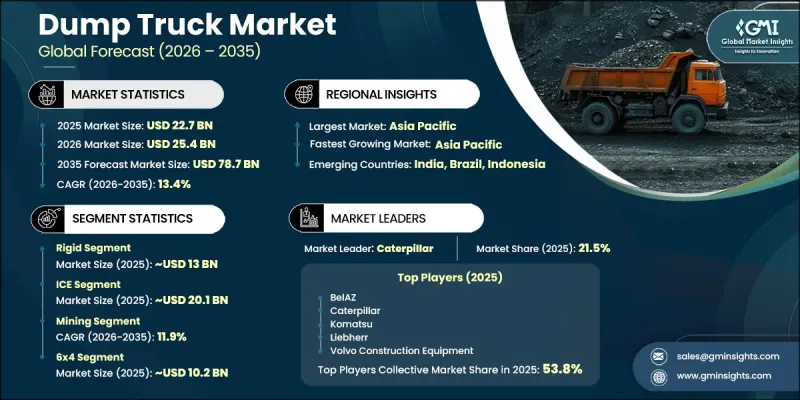
全球建築和採礦活動的強勁成長顯著推動了各行業對自動卸貨卡車的需求成長。基礎設施建設、大規模鑽探項目和礦產開採活動的持續投入,也為重型運輸設備創造了穩定的市場需求。此外,市場正轉向高價值的電動、混合動力和自動自動卸貨卡車,這些車型的平均售價高於傳統的內燃機車型。在對自動化和營運效率日益成長的關注推動下,製造商正在推出配備智慧導航系統、感測器、攝影機和人工智慧軟體的先進自動駕駛技術。這些新一代車輛能夠提高礦場和建築工地的安全性,減少運作,並提高物料運輸效率。此外,更嚴格的排放氣體法規和不斷提高的企業永續發展目標,也加速了低排放氣體和零排放自動卸貨卡車的普及。預計2026年至2029年間政府對公共基礎建設項目的投入增加,也將支持短期內全球市場的擴張。
| 市場範圍 | |
|---|---|
| 開始年份 | 2025 |
| 預測期 | 2026-2035 |
| 上市時的市場規模 | 227億美元 |
| 預測市場規模 | 787億美元 |
| 複合年成長率 | 13.4% |
在先進運輸技術和車輛現代化改造投資不斷增加的推動下,自動卸貨卡車產業正經歷快速變革。建築承包商和礦業營運商擴大採用智慧自動化設備,以提高生產效率,同時減少對勞動力的依賴和營運風險。自動駕駛運輸系統正成為製造商的重要收入來源,並透過軟體升級、改造和長期服務合約不斷提升其價值。同時,隨著營運商尋求能夠適應計劃充電週期並減少排放氣體的環境永續運輸解決方案,電氣化趨勢正在重塑產品開發策略。電池技術、車輛互聯和預測維修系統的進步進一步推動了市場轉型。在惡劣的運作環境下,對高效物料運輸的需求日益成長,也推動了全球對技術先進的自動卸貨卡車的採用。
預計到2025年,鉸接式自動卸貨卡車市佔率將達到42.9%,2035年將維持14.4%的複合年成長率。隨著建築和礦業公司優先考慮提高車輛在崎嶇地形和狹窄作業場所的機動性、牽引性能和作業效率,該細分市場展現出強勁的成長勢頭。電動鉸接式自動卸貨卡車的商業化進一步推動了該細分市場的成長,製造商不斷推出先進的運輸解決方案,以延長車輛正常運作並永續性。
預計礦業公司板塊將實現最快成長,2026年至2035年的複合年成長率將達到11.9%。由於需要在惡劣條件下持續運輸礦石、表土和廢棄物,礦業對自動卸貨卡車的需求持續成長。採礦專案通常涉及較長的運作週期和設備的高強度使用,因此對耐用運輸機械的需求也持續不斷。此外,全球對關鍵礦物和金屬的需求不斷成長,正在加速採礦活動,進一步增強了全部區域大負載容量自動卸貨卡車的需求。
美國自動卸貨卡車市場預計到2025年將達到47億美元,並在2026年至2035年間以13.2%的複合年成長率成長。這一成長主要得益於聯邦政府在公路、橋樑、貨運鐵路系統和城市發展項目等方面的大規模基礎設施投資。建設活動的擴張帶動了對能夠支援整個基礎設施供應鏈物料運輸的重型運輸設備的需求成長。此外,日益嚴格的排放氣體法規促使製造商開發更清潔、更節能的自動卸貨卡車技術,包括電動驅動和低排放氣體汽車平臺。
目錄
第1章:調查方法
第2章執行摘要
第3章:行業洞察
- 工業生態系分析
- 供應商情況
- 利潤率
- 成本結構
- 每個階段增加的價值
- 影響價值鏈的因素
- 中斷
- 影響產業的因素
- 促進因素
- 全球基礎設施發展與都市化
- 採礦活動的擴張和對重要礦產的需求
- 擴大可再生能源和金屬開採項目
- 大規模建築和採石活動的擴張
- 產業潛在風險與挑戰
- 電動卡車和自動駕駛卡車需要大量資金投入
- 促進要素和技術人員長期人手不足
- 市場機遇
- 新興國家的基礎建設熱潮
- 政府對零排放設備的獎勵
- 稀土元素和鋰礦開採計畫的擴張
- 促進因素
- 技術與創新展望
- 最新科技趨勢
- 柴油-電力動力傳動系統技術
- 先進的液壓控制系統
- 新技術
- 氫燃料電池動力傳動系統技術
- 全固態電池技術
- 完全整合的遠端和自主採礦作業
- 最新科技趨勢
- 成長潛力分析
- 價格分析
- 對過去價格趨勢的分析
- 根據參與企業的類型(高階、價值、成本加成)所製定的定價策略
- 監理情勢
- 北美洲
- 美國-《清潔空氣法》(CAA)
- 美國環保署第四階段排放氣體法規
- 加拿大 - 加拿大環境保護法
- 歐洲
- 歐盟第五階段排放氣體標準
- 英國-非道路移動機械的排放氣體標準
- 亞太地區
- 中國—中國第四版非道路車輛排放氣體標準
- 印度 - Bharat Stage V CEV排放氣體法規
- 拉丁美洲
- 巴西 - PROCONVE MAR-1排放氣體標準
- 墨西哥 - NOM-044-SEMARNAT 大型車輛排放氣體法規
- 中東和非洲
- 南非 - 國家環境管理空氣品質法
- 海灣合作理事會(GCC)柴油排放氣體法規
- 北美洲
- 波特的分析
- PESTLE分析
- 貿易數據分析
- 進出口量及進口額趨勢
- 主要貿易路線及關稅的影響
- 生產能力和生產情況
- 設備產能:按地區和主要生產商分類
- 運轉率和擴張計劃
- 成本細分分析
- 原料和零件成本
- 人事費用和組裝成本
- 引擎和推進系統的成本
- 間接成本和設施成本
- 合規、檢查和認證成本
- 專利分析
- 永續性和環境方面
- 永續發展計劃
- 減少廢棄物策略
- 生產中的能源效率
- 環保舉措
- 考慮碳足跡
- 人工智慧和生成式人工智慧對市場的影響
- 利用人工智慧改造現有經營模式
- 基於細分市場的生成式人工智慧的應用案例和部署藍圖
- 風險、限制和監管考量
- 電氣化和能源轉型的影響
- 電池技術進步與成本曲線
- 礦山和建築工地充電基礎建設
- 總擁有成本
- 電網容量和可再生能源併網
- 預測假設和情境分析
- 基本案例:驅動複合年成長率的關鍵宏觀經濟與產業變量
- 樂觀情境:宏觀經濟與產業的利多因素
- 悲觀情景:宏觀經濟放緩或產業逆風
第4章 競爭情勢
- 介紹
- 企業市佔率分析
- 北美洲
- 歐洲
- 亞太地區
- 拉丁美洲
- 中東和非洲
- 主要市場公司的競爭分析
- 競爭定位矩陣
- 併購
- 夥伴關係和聯盟
- 新產品發布
- 業務拓展計劃及資金籌措
- 按公司規模進行基準測試
- 排名分類標準與選擇標準
- 按銷售額、地區和創新能力分類的層級定位矩陣。
第5章 市場估算與預測:依卡車分類,2022-2035年
- 關節
- 50噸或以下
- 超過50噸
- 單一單元
- 50噸或以下
- 50-100噸
- 101-200噸
- 201-300噸
- 超過300噸
第6章 市場估價與預測:依車軸分類,2022-2035年
- 4x2
- 4x4
- 6x4
- 6x6
- 8x4
- 其他
第7章 市場估計與預測:依促進因素分類,2022-2035年
- 內燃機(ICE)
- 電的
- 混合
第8章 市場估算與預測:依所有權類型分類,2022-2035年
- 礦業公司
- 租賃公司
- 其他
第9章 市場估計與預測:依應用領域分類,2022-2035年
- 建造
- 礦業
- 其他
第10章 市場估價與預測:依通路分類,2022-2035年
- 直銷
- 銷售代理商/經銷商
第11章 市場估價與預測:按地區分類,2022-2035年
- 北美洲
- 美國
- 加拿大
- 歐洲
- 德國
- 英國
- 法國
- 義大利
- 西班牙
- 俄羅斯
- 波蘭
- 瑞典
- 挪威
- 亞太地區
- 中國
- 印度
- 日本
- 澳洲
- 印尼
- 韓國
- 泰國
- 越南
- 菲律賓
- 拉丁美洲
- 巴西
- 墨西哥
- 阿根廷
- 中東和非洲
- 南非
- 沙烏地阿拉伯
- 阿拉伯聯合大公國
第12章:公司簡介
- 世界公司
- Caterpillar
- Komatsu
- Volvo Construction Equipment
- Hitachi Construction Machinery
- Liebherr
- BelAZ
- Bell Equipment
- Terex
- SANY
- XCMG
- HD Hyundai
- John Deere
- 當地公司
- BEML
- SINOTRUK
- FAW Trucks
- Dongfeng Motor
- Ashok Leyland
- Tata Motors
- 新興企業
- Epiroc
- LGMG
The Global Dump Truck Market was valued at USD 22.7 billion in 2025 and is estimated to grow at a CAGR of 13.4% to reach USD 78.7 billion by 2035.
Strong growth in construction and mining activities worldwide is significantly contributing to the rising demand for dump trucks across multiple industries. Increasing investments in infrastructure development, large-scale excavation projects, and mineral extraction activities are creating sustained demand for heavy-duty hauling equipment. In addition, the market is witnessing a shift toward high-value electric, hybrid, and autonomous dump trucks, which command higher average selling prices compared to conventional internal combustion engine models. Growing focus on automation and operational efficiency is encouraging manufacturers to introduce advanced autonomous hauling technologies equipped with intelligent navigation systems, sensors, cameras, and AI-powered software. These next-generation vehicles are improving workplace safety, reducing operational downtime, and enhancing material transportation efficiency across mining and construction sites. Furthermore, stricter emission standards and rising corporate sustainability goals are accelerating the adoption of low-emission and zero-emission dump trucks. Increasing government funding for public infrastructure projects between 2026 and 2029 is also expected to support near-term market expansion globally.
| Market Scope | |
|---|---|
| Start Year | 2025 |
| Forecast Year | 2026-2035 |
| Start Value | $22.7 Billion |
| Forecast Value | $78.7 Billion |
| CAGR | 13.4% |
The dump truck industry is evolving rapidly with growing investments in advanced hauling technologies and fleet modernization initiatives. Construction contractors and mining operators are increasingly adopting intelligent and automated equipment to improve productivity while reducing labor dependency and operational risks. Autonomous haulage systems are becoming an important revenue stream for manufacturers, extending value creation through software upgrades, retrofits, and long-term service contracts. At the same time, electrification trends are reshaping product development strategies as operators seek environmentally sustainable transportation solutions capable of supporting planned charging cycles and lower emissions. Advancements in battery technologies, vehicle connectivity, and predictive maintenance systems are further supporting market transformation. Rising demand for efficient material transportation in harsh operating conditions is also strengthening the adoption of technologically advanced dump trucks worldwide.
The articulated dump trucks segment accounted for 42.9% share in 2025 and is anticipated to register a CAGR of 14.4% through 2035. The segment is gaining significant traction as contractors and mining companies prioritize enhanced maneuverability, traction performance, and operational efficiency across rough terrains and confined worksites. The commercialization of electric articulated dump trucks is further supporting segment growth as manufacturers continue introducing advanced hauling solutions capable of delivering extended operational runtime and improved sustainability performance.
The mining segment is expected to witness the fastest growth at a CAGR of 11.9% between 2026 and 2035. Demand for dump trucks within mining operations continues to rise due to the constant requirement for transporting ore, overburden, and waste materials in challenging environments. Mining projects typically involve extended operational cycles and intensive equipment utilization, creating consistent demand for durable hauling machinery. In addition, growing global demand for critical minerals and metals is accelerating mining activities, which is further strengthening the requirement for high-capacity dump trucks across major mining regions.
U.S. Dump Truck Market reached USD 4.7 billion in 2025 and is projected to grow at a CAGR of 13.2% during 2026-2035. Growth in the country is driven by large-scale federal infrastructure investments focused on highways, bridges, freight rail systems, and urban development projects. Expanding construction activities are increasing demand for heavy-duty hauling equipment capable of supporting material transportation across infrastructure supply chains. Additionally, evolving emission regulations are encouraging manufacturers to develop cleaner and more energy-efficient dump truck technologies, including electric-powered and low-emission vehicle platforms.
Major companies operating in the Global Dump Truck Market include BelAZ, Bell Equipment, Caterpillar, Hitachi Construction Machinery, Komatsu, LGMG, Liebherr, SANY, Volvo Construction Equipment, and XCMG. Companies operating in the dump truck market are focusing heavily on technological innovation, electrification, and automation to strengthen their competitive position and expand market presence. Leading manufacturers are investing in research and development to introduce autonomous hauling systems, intelligent fleet management solutions, and energy-efficient vehicle platforms that improve productivity and operational safety. Many companies are also prioritizing the development of electric and hybrid dump trucks to meet evolving emission regulations and sustainability goals across the mining and construction industries. Strategic collaborations with mining operators, infrastructure contractors, and technology providers are helping manufacturers accelerate product deployment and expand service capabilities. In addition, businesses are strengthening aftermarket services, predictive maintenance solutions, and retrofit offerings to build long-term customer relationships while improving recurring revenue opportunities across global construction and mining operations.
Table of Contents
Chapter 1 Methodology
- 1.1 Research approach
- 1.2 Quality Commitments
- 1.2.1 GMI AI policy & data integrity commitment
- 1.3 Research Trail & Confidence Scoring
- 1.3.1 Research Trail Components
- 1.3.2 Scoring Components
- 1.4 Data Collection
- 1.5 Data mining sources
- 1.5.1 Paid sources
- 1.6 Base estimates and calculations
- 1.6.1 Base year calculation
- 1.7 Forecast model
- 1.7.1 Quantified market impact analysis
- 1.8 Research transparency addendum
- 1.8.1 Source attribution framework
- 1.8.2 Quality assurance metrics
- 1.8.3 Our commitment to trust
Chapter 2 Executive Summary
- 2.1 Industry 360° synopsis
- 2.2 Key market trends
- 2.2.1 Regional
- 2.2.2 Truck
- 2.2.3 Axle
- 2.2.4 Propulsion
- 2.2.5 Ownership Model
- 2.2.6 Application
- 2.2.7 Distribution Channel
- 2.3 TAM analysis, 2026-2035
- 2.4 CXO perspectives: Strategic imperatives
Chapter 3 Industry Insights
- 3.1 Industry ecosystem analysis
- 3.1.1 Supplier landscape
- 3.1.2 Profit margin
- 3.1.3 Cost structure
- 3.1.4 Value addition at each stage
- 3.1.5 Factor affecting the value chain
- 3.1.6 Disruptions
- 3.2 Industry impact forces
- 3.2.1 Growth drivers
- 3.2.1.1 Global Infrastructure Development & Urbanization
- 3.2.1.2 Expanding Mining Activities & Critical Mineral Demand
- 3.2.1.3 Expansion of Renewable Energy & Metal Extraction Projects
- 3.2.1.4 Growth in Large-Scale Construction & Quarrying Activities
- 3.2.2 Industry pitfalls and challenges
- 3.2.2.1 High Capital Expenditure for Electric & Autonomous Trucks
- 3.2.2.2 Persistent Labor Shortages in Driver & Technician Roles
- 3.2.3 Market opportunities
- 3.2.3.1 Emerging Markets Infrastructure Boom
- 3.2.3.2 Government Incentives for Zero-Emission Equipment
- 3.2.3.3 Expansion of Rare Earth & Lithium Mining Projects
- 3.2.1 Growth drivers
- 3.3 Technology and innovation landscape
- 3.3.1 Current technological trends
- 3.3.1.1 Diesel-Electric Powertrain Technology
- 3.3.1.2 Advanced Hydraulic Control Systems
- 3.3.2 Emerging technologies
- 3.3.2.1 Hydrogen Fuel Cell Powertrain Technology
- 3.3.2.2 Solid-State Battery Technology
- 3.3.2.3 Fully Integrated Remote & Autonomous Mining Operations
- 3.3.1 Current technological trends
- 3.4 Growth potential analysis
- 3.5 Pricing Analysis (Driven by Primary Research)
- 3.5.1 Historical Price Trend Analysis
- 3.5.2 Pricing Strategy by Player Type (Premium / Value / Cost-plus)
- 3.6 Regulatory landscape
- 3.6.1 North America
- 3.6.1.1 US - U.S. Clean Air Act (CAA)
- 3.6.1.2 US - EPA Tier 4 Emission Regulations
- 3.6.1.3 Canada - Canadian Environmental Protection Act
- 3.6.2 Europe
- 3.6.2.1 EU - European Union Stage V Emission Standards
- 3.6.2.2 UK - Non-Road Mobile Machinery Emission Standards
- 3.6.3 Asia Pacific
- 3.6.3.1 China - China IV non-road emission standards
- 3.6.3.2 India - Bharat Stage V CEV Emission Norms
- 3.6.4 LATAM
- 3.6.4.1 Brazil - PROCONVE MAR-1 Emission Standards
- 3.6.4.2 Mexico - NOM-044-SEMARNAT Heavy Vehicle Emission Rules
- 3.6.5 MEA
- 3.6.5.1 South Africa - National Environmental Management Air Quality Act
- 3.6.5.2 GCC - GCC Diesel Emission Regulations
- 3.6.1 North America
- 3.7 Porter's analysis
- 3.8 PESTEL analysis
- 3.9 Trade Data Analysis (Driven by Paid Database)
- 3.9.1 Import/Export Volume & Value Trends
- 3.9.2 Key Trade Corridors & Tariff Impact
- 3.10 Capacity & Production Landscape (Driven by Primary Research)
- 3.10.1 Installed Capacity by Region & Key Producer
- 3.10.2 Capacity Utilization Rates & Expansion Pipelines
- 3.11 Cost breakdown analysis
- 3.11.1 Raw Materials & Components Costs
- 3.11.2 Labor & Assembly Costs
- 3.11.3 Engine & Propulsion System Costs
- 3.11.4 Overhead & Facility Costs
- 3.11.5 Compliance, Testing & Certification Costs
- 3.12 Patent analysis (Driven by Primary Research)
- 3.13 Sustainability and environmental aspects
- 3.13.1 Sustainable Practices
- 3.13.2 Waste Reduction Strategies
- 3.13.3 Energy Efficiency in Production
- 3.13.4 Eco-friendly Initiatives
- 3.13.5 Carbon Footprint Considerations
- 3.14 Impact of AI & generative AI on the market
- 3.14.1 AI-driven disruption of existing business models
- 3.14.2 GenAI use cases & adoption roadmap by segment
- 3.14.3 Risks, limitations & regulatory considerations
- 3.15 Electrification & energy transition impact
- 3.15.1 Battery technology advancements & cost curves
- 3.15.2 Charging infrastructure deployment in mining & construction sites
- 3.15.3 Total cost of ownership
- 3.15.4 Grid capacity & renewable energy integration
- 3.16 Forecast assumptions & scenario analysis (Driven by Primary Research)
- 3.16.1 Base Case- Key Macro & Industry Variables Driving CAGR
- 3.16.2 Optimistic Scenarios- Favorable macro and industry tailwinds
- 3.16.3 Pessimistic Scenario - Macroeconomic slowdown or industry headwinds
Chapter 4 Competitive Landscape, 2025
- 4.1 Introduction
- 4.2 Company market share analysis
- 4.2.1 North America
- 4.2.2 Europe
- 4.2.3 Asia Pacific
- 4.2.4 LATAM
- 4.2.5 MEA
- 4.3 Competitive analysis of major market players
- 4.4 Competitive positioning matrix
- 4.5 Key developments
- 4.5.1 Mergers & acquisitions
- 4.5.2 Partnerships & collaborations
- 4.5.3 New product launches
- 4.5.4 Expansion plans and funding
- 4.6 Company tier benchmarking
- 4.6.1 Tier classification criteria & qualifying thresholds
- 4.6.2 Tier positioning matrix by revenue, geography & innovation
Chapter 5 Market Estimates and Forecast, By Truck, 2022 - 2035 ($ Mn, Units)
- 5.1 Key trends
- 5.2 Articulated
- 5.2.1 Below 50 Metric Tons
- 5.2.2 50 Metric Tons and above
- 5.3 Rigid
- 5.3.1 Below 50 metric tons
- 5.3.2 50 to 100 metric tons
- 5.3.3 101 - 200 metric tons
- 5.3.4 201 - 300 metric tons
- 5.3.5 Above 300 metric tons
Chapter 6 Market Estimates and Forecast, By Axle, 2022 - 2035 ($ Mn, Units)
- 6.1 Key trends
- 6.2 4x2
- 6.3 4x4
- 6.4 6x4
- 6.5 6x6
- 6.6 8x4
- 6.7 Others
Chapter 7 Market Estimates and Forecast, By Propulsion, 2022 - 2035 ($ Mn, Units)
- 7.1 Key trends
- 7.2 Internal Combustion Engine (ICE)
- 7.3 Electric
- 7.4 Hybrid
Chapter 8 Market Estimates and Forecast, By Ownership Model, 2022 - 2035 ($ Mn, Units)
- 8.1 Key trends
- 8.2 Mining companies
- 8.3 Rental / leasing companies
- 8.4 Others
Chapter 9 Market Estimates and Forecast, By Application, 2022 - 2035 ($ Mn, Units)
- 9.1 Key trends
- 9.2 Construction
- 9.3 Mining
- 9.4 Others
Chapter 10 Market Estimates and Forecast, By Distribution Channel, 2022 - 2035 ($ Mn, Units)
- 10.1 Key trends
- 10.2 Direct Sales
- 10.3 Distributors/Dealers
Chapter 11 Market Estimates & Forecast, By Region, 2022 - 2035 ($Mn, Units)
- 11.1 Key trends
- 11.2 North America
- 11.2.1 US
- 11.2.2 Canada
- 11.3 Europe
- 11.3.1 Germany
- 11.3.2 UK
- 11.3.3 France
- 11.3.4 Italy
- 11.3.5 Spain
- 11.3.6 Russia
- 11.3.7 Poland
- 11.3.8 Sweden
- 11.3.9 Norway
- 11.4 Asia Pacific
- 11.4.1 China
- 11.4.2 India
- 11.4.3 Japan
- 11.4.4 Australia
- 11.4.5 Indonesia
- 11.4.6 South Korea
- 11.4.7 Thailand
- 11.4.8 Vietnam
- 11.4.9 Philippines
- 11.5 Latin America
- 11.5.1 Brazil
- 11.5.2 Mexico
- 11.5.3 Argentina
- 11.6 MEA
- 11.6.1 South Africa
- 11.6.2 Saudi Arabia
- 11.6.3 UAE
Chapter 12 Company Profiles
- 12.1 Global players
- 12.1.1 Caterpillar
- 12.1.2 Komatsu
- 12.1.3 Volvo Construction Equipment
- 12.1.4 Hitachi Construction Machinery
- 12.1.5 Liebherr
- 12.1.6 BelAZ
- 12.1.7 Bell Equipment
- 12.1.8 Terex
- 12.1.9 SANY
- 12.1.10 XCMG
- 12.1.11 HD Hyundai
- 12.1.12 John Deere
- 12.2 Regional players
- 12.2.1 BEML
- 12.2.2 SINOTRUK
- 12.2.3 FAW Trucks
- 12.2.4 Dongfeng Motor
- 12.2.5 Ashok Leyland
- 12.2.6 Tata Motors
- 12.3 Emerging players
- 12.3.1 Epiroc
- 12.3.2 LGMG

 電動自動卸貨卡車市場機會、成長要素、產業趨勢分析及2026-2035年預測
 自動卸貨卡車市場 - 全球產業規模、佔有率、趨勢、機會、預測:按車輛類型、尺寸、應用、地區和競爭格局分類,2021-2031年
 自動卸貨卡車市場規模、佔有率和趨勢分析報告:按車輛類型、負載容量、車軸配置、動力方式、應用領域、地區和細分市場預測(2026-2033 年)
 自動卸貨卡車車廂市場:按自動卸貨卡車類型、負載容量、機構、車架材料、最終用途行業和地區分類
 2026年全球自動卸貨卡車市場報告
 鉸接式自動卸貨卡車市場:依驅動系統、負載容量、應用及銷售管道分類-2026-2032年全球市場預測自動卸貨卡車市場:按負載容量、推進系統和應用分類的全球預測,2026-2032年自動卸貨卡車市場:按車輛類型、負載容量、燃料類型、應用、最終用戶和分銷管道分類-2026-2032年全球預測
 自卸車車廂市場規模、佔有率、成長及全球產業分析:按類型、應用和地區分類的洞察,2026-2034 年預測2026年全球鉸接式自動卸貨卡車輪胎市場報告