


 |
市場調查報告書
商品編碼
2045700
氫動力飛機市場:商業機會、成長要素、產業趨勢分析及2026-2035年預測Hydrogen Aircraft Market Opportunity, Growth Drivers, Industry Trend Analysis, and Forecast 2026 - 2035 |
||||||

全球氫動力飛機市場預計到 2025 年將價值 9.345 億美元,預計到 2035 年將達到 169 億美元,年複合成長率為 33.6%。
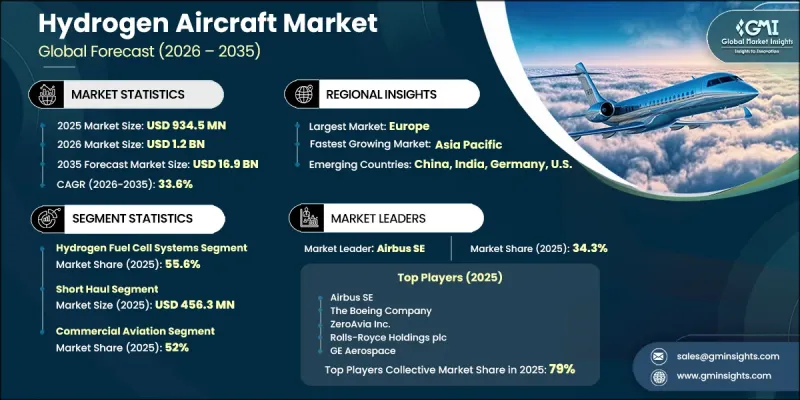
隨著航空業相關人員加強推進航空運輸脫碳並減少對傳統噴射機燃料的依賴,氫能航空產業正蓬勃發展。氫氣源自風能和太陽能等再生能源來源,作為實現零排放航空的突破性解決方案,正日益受到關注。燃料電池系統和氫動力推進技術研發投入的增加,正加速市場發展。雖然初期部署預計將集中在短途和區域航線,但隨著能量密度和儲能技術的進步,氫能航空預計最終將應用於長程航線。國際航空相關人員之間日益密切的合作,進一步推動了創新和實用化。對永續航空解決方案日益成長的需求,促使飛機製造商和技術開發商探索下一代推進系統。特別是,燃料電池效率、混合動力推進系統和輕型飛機設計方面的持續技術進步,正在塑造動力來源航空的未來,並強化其在全球向低碳空中運輸轉型中的作用。
| 市場範圍 | |
|---|---|
| 開始年份 | 2025 |
| 預測期 | 2026-2035 |
| 初始市場規模 | 9.345億美元 |
| 預測市場規模 | 169億美元 |
| 複合年成長率 | 33.6% |
預計到2035年,氫燃料內燃機市場將以34.4%的複合年成長率成長。該領域正逐漸成為現有飛機機隊脫碳的過渡解決方案,其原理是改造傳統渦輪系統使其能夠運作氫燃料。研發工作主要集中在提高燃油效率、增強溫度控管以及減少排放氣體,以確保其在短程和中程飛機上的實用化。活性化的研發活動正在推動燃燒性能的提升以及與現有航空基礎設施的整合,預計未來幾年其應用將加速發展。
預計2035年,中程航線市場將以34.5%的複合年成長率成長。中程航線為氫動力飛機的應用提供了巨大的機遇,可透過將燃料電池與傳統引擎系統結合的混合動力推進配置來實現。飛機製造商正在積極開發先進的推進架構,將燃料電池和能源儲存系統整合在一起,以在保持有效載荷效率的同時延長航程。這些研發旨在支援合規性並提高營運效率,同時也將推動氫動力飛機逐步擴展到短程航線以外的應用領域。
預計到2025年,北美氫動力飛機市佔率將達到32.7%。這一區域成長主要得益於主要航太製造商的存在、強大的研發能力以及政府對清潔航空技術日益成長的支持。對氫動力推進系統投資的增加以及產業相關人員與政府機構之間合作的加強,進一步加速了市場發展。該地區持續受益於系統性的資金籌措舉措和以創新為導向的項目,這些舉措和項目旨在支持先進的航太技術和永續航空解決方案。
目錄
第1章:調查方法和範圍
第2章執行摘要
第3章 行業洞察
- 產業生態系分析
- 供應商情況
- 利潤率
- 成本結構
- 每個階段增加的價值
- 影響價值鏈的因素
- 中斷
- 影響產業的因素
- 促進因素
- 對永續航空的需求日益成長
- 民眾對環保旅遊的需求
- 公司間在氫氣生產上的合作
- 降低長期營運成本
- 來自可再生能源領域的支持
- 產業潛在風險與挑戰
- 與現有飛機的兼容性
- 氫氣供應鏈的不足之處
- 市場機遇
- 區域氫能基礎設施的擴建
- 下一代燃料電池的開發
- 促進因素
- 成長潛力分析
- 監理情勢
- 波特的分析
- PESTLE分析
- 技術與創新展望
- 最新科技趨勢
- 新興技術
- 新興經營模式
- 合規要求
- 國防預算分析
- 全球國防費用趨勢
- 國防預算的區域分配
- 北美洲
- 歐洲
- 亞太地區
- 中東和非洲
- 拉丁美洲
- 主要國防現代化項目
- 2025-2034年預算預測
- 對工業成長的影響
- 各國國防預算
- 分段式國防預算分配
- 人員
- 運作/維護
- 採購
- 研究、開發、測試和評估
- 基礎設施和建築
- 技術與創新
- 供應鏈韌性
- 地緣政治分析
- 勞動力分析
- 數位轉型
- 併購和策略聯盟的趨勢
- 風險評估與管理
- 2022-2025年主要合約採購
第4章 競爭情勢
- 介紹
- 企業市佔率分析
- 按地區
- 市場集中度分析
- 主要公司的競爭標竿分析
- 財務績效比較
- 收入
- 利潤率
- R&D
- 產品系列比較
- 產品線寬度
- 科技
- 創新
- 區域擴張比較
- 全球擴張分析
- 服務網路覆蓋
- 按地區分類的市場滲透率
- 競爭定位矩陣
- 領導者
- 挑戰者
- 追蹤者
- 小眾玩家
- 戰略展望矩陣
- 財務績效比較
- 主要進展
- 併購
- 夥伴關係和聯盟
- 技術進步
- 擴張和投資策略
- 數位轉型計劃
- 新興企業競爭公司和新創企業的發展趨勢
第5章 市場估算與預測:依驅動技術分類,2022-2035年
- 氫燃料電池系統
- 質子交換膜燃料電池
- 固體氧化物燃料電池
- 氫燃燒引擎
- 改良燃氣渦輪機引擎
- 混合燃燒系統
第6章 市場估算與預測:飛機航程細分,2022-2035年
- 短程航線
- 中距離
- 長途路線
第7章 市場估計與預測:依平台類型分類,2022-2035年
- 支線飛機和窄體飛機
- 寬體飛機
- 公務機
- 城市空中運輸和空中計程車
- 無人機
第8章 市場估計與預測:依應用領域分類,2022-2035年
- 商業航空
- 定期客運航空公司
- 包機
- 貨運航空公司
- 專用貨運飛機
- 綜合物流營運
- 軍事/國防航空
- 運輸/物流
- 偵察/監視
- 通用航空和公務航空
- 公務機
- 空中計程車服務
第9章 市場估計與預測:依地區分類,2022-2035年
- 北美洲
- 美國
- 加拿大
- 歐洲
- 德國
- 英國
- 法國
- 西班牙
- 義大利
- 俄羅斯
- 其他歐洲國家
- 亞太地區
- 中國
- 印度
- 日本
- 澳洲
- 韓國
- 其他亞太國家
- 拉丁美洲
- 巴西
- 墨西哥
- 阿根廷
- 其他拉丁美洲國家
- 中東和非洲
- 南非
- 沙烏地阿拉伯
- UAE
- 其他中東和非洲國家
第10章:公司簡介
- 全球主要公司
- Airbus SE
- The Boeing Company
- GE Aerospace
- Rolls-Royce Holdings plc
- Pratt & Whitney
- GKN Aerospace
- Parker Aerospace
- 該地區的主要公司
- ElringKlinger AG
- PowerCell Sweden AB
- Intelligent Energy
- Aeristech Ltd.
- 小眾玩家/顛覆者
- ZeroAvia Inc.
- H2FLY GmbH
- JetZero Inc.
- Joby Aviation
- Cranfield Aerospace Solutions Ltd.
- Stralis Aircraft
The Global Hydrogen Aircraft Market was valued at USD 934.5 million in 2025 and is estimated to grow at a CAGR of 33.6% to reach USD 16.9 billion by 2035.
The hydrogen aircraft industry is gaining momentum as aviation stakeholders intensify efforts to decarbonize air transport and reduce reliance on conventional jet fuel. Hydrogen derived from renewable energy sources such as wind and solar is increasingly being viewed as a transformative solution for achieving zero-emission aviation. Growing investments in research and development of fuel cell systems and hydrogen propulsion technologies are accelerating market progress. Early-stage adoption is expected to concentrate on short-haul and regional aviation routes, while long-term advancements are expected to enable scalability into long-haul operations as energy density and storage technologies improve. Expanding collaboration across international aviation stakeholders is further supporting innovation and commercialization pathways. Rising demand for sustainable aviation solutions is also pushing aircraft manufacturers and technology developers to explore next-generation propulsion systems. Continuous technological advancements, particularly in fuel cell efficiency, hybrid propulsion systems, and lightweight aircraft design, are shaping the future of hydrogen-powered aviation and strengthening its role in the global transition toward low-carbon air mobility.
| Market Scope | |
|---|---|
| Start Year | 2025 |
| Forecast Year | 2026-2035 |
| Start Value | $934.5 Million |
| Forecast Value | $16.9 Billion |
| CAGR | 33.6% |
The hydrogen combustion engines segment is projected to grow at a CAGR of 34.4% through 2035. This segment is emerging as a transitional solution for decarbonizing existing aircraft fleets by adapting conventional turbine systems to operate using hydrogen fuel. Development efforts are focused on improving fuel efficiency, enhancing thermal management, and reducing emissions to ensure commercial feasibility for short- and medium-range aircraft applications. Increasing R&D activity is helping refine combustion performance while supporting integration with existing aviation infrastructure, which is expected to accelerate adoption in the coming years.
The medium-haul segment is expected to grow at a CAGR of 34.5% through 2035. Medium-distance aviation routes present strong opportunities for hydrogen adoption through hybrid propulsion configurations that combine fuel cells with conventional engine systems. Aircraft manufacturers are actively developing advanced propulsion architectures that integrate fuel cells and energy storage systems to extend operational range while maintaining payload efficiency. These developments aim to support regulatory compliance and operational efficiency while enabling the gradual expansion of hydrogen-powered aviation beyond short-haul applications.
North America Hydrogen Aircraft Market accounted for 32.7% share in 2025. Regional growth is supported by the presence of leading aerospace manufacturers, strong research and development capabilities, and increasing government support for clean aviation technologies. Expanding investment in hydrogen propulsion systems and growing collaboration between industry participants and public agencies are further accelerating market development. The region continues to benefit from structured funding initiatives and innovation-focused programs that support advanced aerospace technologies and sustainable aviation solutions.
Key companies operating in the Global Hydrogen Aircraft Market include Airbus SE, The Boeing Company, GE Aerospace, Rolls-Royce Holdings plc, Pratt & Whitney, GKN Aerospace, Intelligent Energy, and ElringKlinger AG. Companies operating in the hydrogen aircraft industry are adopting multiple strategic initiatives to strengthen their market position and accelerate commercialization. Leading players are increasing investments in fuel cell research, hydrogen propulsion systems, and lightweight aircraft design technologies to improve efficiency and performance. Strategic collaborations between aircraft manufacturers, energy providers, and technology developers are supporting faster innovation and shared development of hydrogen infrastructure. Firms are also focusing on hybrid propulsion systems that integrate hydrogen fuel cells with conventional engines to enable phased adoption across aviation segments. Expansion of pilot projects, demonstration aircraft programs, and long-term testing initiatives helps validate performance under real operating conditions.
Table of Contents
Chapter 1 Methodology and Scope
- 1.1 Market scope and definition
- 1.2 Research design
- 1.2.1 Research approach
- 1.2.2 Data collection methods
- 1.3 Data mining sources
- 1.3.1 Global
- 1.3.2 Regional/Country
- 1.4 Base estimates and calculations
- 1.4.1 Base year calculation
- 1.4.2 Key trends for market estimation
- 1.5 Primary research and validation
- 1.5.1 Primary sources
- 1.6 Forecast model
- 1.7 Research assumptions and limitations
Chapter 2 Executive Summary
- 2.1 Industry 360° synopsis, 2022 - 2035
- 2.2 Key market trends
- 2.2.1 Propulsion technology trends
- 2.2.2 Aircraft range trends
- 2.2.3 Platform type trends
- 2.2.4 Application trends
- 2.2.5 Regional trends
- 2.3 TAM Analysis, 2026-2035
- 2.4 CXO perspectives: Strategic imperatives
Chapter 3 Industry Insights
- 3.1 Industry ecosystem analysis
- 3.1.1 Supplier Landscape
- 3.1.2 Profit Margin
- 3.1.3 Cost structure
- 3.1.4 Value addition at each stage
- 3.1.5 Factor affecting the value chain
- 3.1.6 Disruptions
- 3.2 Industry impact forces
- 3.2.1 Growth drivers
- 3.2.1.1 Growing demand for sustainable aviation
- 3.2.1.2 Public demand for eco-friendly travel
- 3.2.1.3 Collaboration between companies for manufacturing of hydrogen
- 3.2.1.4 Cost saving over long-term operations
- 3.2.1.5 Support from renewable energy sector
- 3.2.2 Industry pitfalls and challenges
- 3.2.2.1 Compatibility with existing aircrafts
- 3.2.2.2 Insufficient hydrogen supply chain
- 3.2.3 Market opportunities
- 3.2.3.1 Expansion of regional hydrogen infrastructure
- 3.2.3.2 Next-generation fuel-cell development
- 3.2.1 Growth drivers
- 3.3 Growth potential analysis
- 3.4 Regulatory landscape
- 3.4.1 North America
- 3.4.2 Europe
- 3.4.3 Asia Pacific
- 3.4.4 Latin America
- 3.4.5 Middle East & Africa
- 3.5 Porter's analysis
- 3.6 PESTEL analysis
- 3.7 Technology and Innovation landscape
- 3.7.1 Current technological trends
- 3.7.2 Emerging technologies
- 3.8 Emerging business models
- 3.9 Compliance requirements
- 3.10 Defense budget analysis
- 3.11 Global defense spending trends
- 3.12 Regional defense budget allocation
- 3.12.1 North America
- 3.12.2 Europe
- 3.12.3 Asia Pacific
- 3.12.4 Middle East and Africa
- 3.12.5 Latin America
- 3.13 Key defense modernization programs
- 3.14 Budget forecast (2025-2034)
- 3.14.1 Impact on industry growth
- 3.14.2 Defense budgets by country
- 3.14.3 Defense budget allocation by segment
- 3.14.3.1 Personnel
- 3.14.3.2 Operations and maintenance
- 3.14.3.3 Procurement
- 3.14.3.4 Research, development, test and evaluation
- 3.14.3.5 Infrastructure and construction
- 3.14.3.6 Technology and innovation
- 3.15 Supply chain resilience
- 3.16 Geopolitical analysis
- 3.17 Workforce analysis
- 3.18 Digital transformation
- 3.19 Mergers, acquisitions, and strategic partnerships landscape
- 3.20 Risk assessment and management
- 3.21 Major contract awards (2022-2025)
Chapter 4 Competitive Landscape, 2025
- 4.1 Introduction
- 4.2 Company market share analysis
- 4.2.1 By region
- 4.2.1.1 North America
- 4.2.1.2 Europe
- 4.2.1.3 Asia Pacific
- 4.2.1.4 Latin America
- 4.2.1.5 Middle East & Africa
- 4.2.2 Market concentration analysis
- 4.2.1 By region
- 4.3 Competitive benchmarking of key players
- 4.3.1 Financial performance comparison
- 4.3.1.1 Revenue
- 4.3.1.2 Profit margin
- 4.3.1.3 R&D
- 4.3.2 Product portfolio comparison
- 4.3.2.1 Product range breadth
- 4.3.2.2 Technology
- 4.3.2.3 Innovation
- 4.3.3 Geographic presence comparison
- 4.3.3.1 Global footprint analysis
- 4.3.3.2 Service network coverage
- 4.3.3.3 Market penetration by region
- 4.3.4 Competitive positioning matrix
- 4.3.4.1 Leaders
- 4.3.4.2 Challengers
- 4.3.4.3 Followers
- 4.3.4.4 Niche players
- 4.3.5 Strategic outlook matrix
- 4.3.1 Financial performance comparison
- 4.4 Key developments
- 4.4.1 Mergers and acquisitions
- 4.4.2 Partnerships and collaborations
- 4.4.3 Technological advancements
- 4.4.4 Expansion and investment strategies
- 4.4.5 Digital transformation initiatives
- 4.5 Emerging/ startup competitors landscape
Chapter 5 Market Estimates and Forecast, By Propulsion Technology, 2022 - 2035 (USD Million)
- 5.1 Key trends
- 5.2 Hydrogen fuel cell systems
- 5.2.1 Proton exchange membrane fuel cells
- 5.2.2 Solid oxide fuel cells
- 5.3 Hydrogen combustion engines
- 5.3.1 Modified gas turbine engines
- 5.3.2 Hybrid combustion systems
Chapter 6 Market Estimates and Forecast, By Aircraft Range, 2022 - 2035 (USD Million)
- 6.1 Key trends
- 6.2 Short haul
- 6.3 Medium haul
- 6.4 Long haul
Chapter 7 Market Estimates and Forecast, By Platform Type, 2022 - 2035 (USD Million)
- 7.1 Key trends
- 7.2 Regional & narrow body aircraft
- 7.3 Wide body aircraft
- 7.4 Business jets
- 7.5 Urban air mobility & air taxis
- 7.6 Unmanned aerial vehicles
Chapter 8 Market Estimates and Forecast, By Application, 2022 - 2035 (USD Million)
- 8.1 Key trends
- 8.2 Commercial aviation
- 8.2.1 Scheduled passenger airlines
- 8.2.2 Charter services
- 8.3 Cargo & freight aviation
- 8.3.1 Dedicated cargo aircraft
- 8.3.2 Integrated logistics operations
- 8.4 Military & defense aviation
- 8.4.1 Transport & logistics
- 8.4.2 Reconnaissance & surveillance
- 8.5 General & business aviation
- 8.5.1 Business jets
- 8.5.2 Air taxi services
Chapter 9 Market Estimates and Forecast, By Region, 2022 - 2035 (USD Million)
- 9.1 Key trends
- 9.2 North America
- 9.2.1 U.S.
- 9.2.2 Canada
- 9.3 Europe
- 9.3.1 Germany
- 9.3.2 UK
- 9.3.3 France
- 9.3.4 Spain
- 9.3.5 Italy
- 9.3.6 Russia
- 9.3.7 Rest of Europe
- 9.4 Asia Pacific
- 9.4.1 China
- 9.4.2 India
- 9.4.3 Japan
- 9.4.4 Australia
- 9.4.5 South Korea
- 9.4.6 Rest of Asia Pacific
- 9.5 Latin America
- 9.5.1 Brazil
- 9.5.2 Mexico
- 9.5.3 Argentina
- 9.5.4 Rest of Latin America
- 9.6 Middle East and Africa
- 9.6.1 South Africa
- 9.6.2 Saudi Arabia
- 9.6.3 UAE
- 9.6.4 Rest of Middle East & Africa
Chapter 10 Company Profiles
- 10.1 Global Key Players
- 10.1.1 Airbus SE
- 10.1.2 The Boeing Company
- 10.1.3 GE Aerospace
- 10.1.4 Rolls-Royce Holdings plc
- 10.1.5 Pratt & Whitney
- 10.1.6 GKN Aerospace
- 10.1.7 Parker Aerospace
- 10.2 Regional key players
- 10.2.1 ElringKlinger AG
- 10.2.2 PowerCell Sweden AB
- 10.2.3 Intelligent Energy
- 10.2.4 Aeristech Ltd.
- 10.3 Niche Players/Disruptors
- 10.3.1 ZeroAvia Inc.
- 10.3.2 H2FLY GmbH
- 10.3.3 JetZero Inc.
- 10.3.4 Joby Aviation
- 10.3.5 Cranfield Aerospace Solutions Ltd.
- 10.3.6 Stralis Aircraft

 氫動力飛機市場-2026-2032年全球市場預測
 氫動力飛機市場規模、佔有率、成長及全球產業分析:按類型、應用和地區分類的洞察,2026-2034年預測
 2026年全球氫動力飛機市場報告
 氫動力飛機市場:依技術、航程、整合階段及區域分類
 氫動力飛機市場-全球產業規模、佔有率、趨勢、機會和預測:按動力源類型、航程類型、應用類型、地區和競爭格局分類,2021-2031年
 氫動力飛機市場分析及2034年預測:類型、技術、零件、應用、材料類型、製程、最終用戶、階段、設備、模式
 氫動力飛機市場規模、佔有率及成長分析(依動力來源、載客量、航程、平台、技術及地區)-產業預測,2025-2032
 氫飛機市場規模、佔有率、趨勢分析報告:按平台、按距離、按技術、按應用、按地區、細分市場預測,2024-2030 年