


 |
市場調查報告書
商品編碼
2045691
軟組織修復市場:商業機會、成長要素、產業趨勢分析及2026-2035年預測Soft Tissue Repair Market Opportunity, Growth Drivers, Industry Trend Analysis, and Forecast 2026 - 2035 |
||||||

全球軟組織修復市場預計到 2025 年價值 164 億美元,預計到 2035 年將以 5.8% 的複合年成長率成長至 292 億美元。
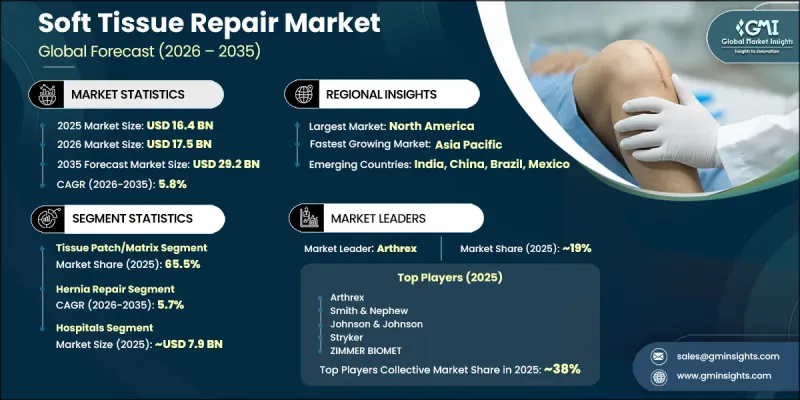
市場成長主要受運動相關損傷和創傷的增加以及全球醫療系統對微創手術日益成長的偏好所驅動。臨床醫師對早期療育和先進重組技術的認知不斷提高,進一步推動了這些技術在各個外科領域的應用。此外,體育運動參與度的提高,尤其是在年輕一代中,導致韌帶、肌腱和肌肉損傷的增加,從而支撐了對修復解決方案的需求。對醫療基礎設施建設的持續投資,尤其是在新興經濟體,擴大了先進外科上的照護的覆蓋範圍,並改善了治療效果。再生醫學、生物製藥和植入技術的不斷進步,提高了癒合效率和患者康復時間,也對市場產生了積極影響。醫療保健支出的成長,以及老年人口的增加(老年人易患退化性軟組織疾病),進一步推動了全球市場的長期擴張。
| 市場範圍 | |
|---|---|
| 開始年份 | 2025 |
| 預測期 | 2026-2035 |
| 上市時的市場規模 | 164億美元 |
| 預測金額 | 292億美元 |
| 複合年成長率 | 5.8% |
預計到2035年,疝氣修補市場規模將達99億美元。這一成長主要受全球疝氣患者數量增加以及已開發國家和開發中國家醫療系統中腹部手術數量上升的推動。網片材料的不斷改進,以及微創手術技術的日益普及,正在改善手術效果並加速患者康復。這些進步進一步刺激了醫院和專業手術機構對該領域的需求。
截至2025年,醫院市場規模將達到79億美元,並持續維持其作為市場領先終端用戶類別的地位。這一主導地位主要歸功於醫院環境中所進行的大量手術,包括創傷治療、重組手術和疝氣修補術。先進的手術基礎設施、專業的醫療團隊以及種類齊全的軟組織修復產品,持續支撐著醫院系統的高利用率。
美國軟組織修復市場預計到2025年將達到57億美元,預計在2026年至2035年間以5.2%的複合年成長率成長。推動美國市場成長的主要因素包括慢性疾病負擔加重、運動傷害增加以及與老齡化相關的肌肉骨骼退化性疾病發生率上升。人口老化導致韌帶斷裂、肌腱損傷和疝氣等疾病的盛行率增加,這些疾病都需要手術修復。同時,人們參與運動和身體活動的增加也導致受傷病例不斷增多,進一步推動了醫療機構對先進修復解決方案的需求。
目錄
第1章:調查方法
第2章執行摘要
第3章 行業洞察
- 產業生態系分析
- 影響產業的因素
- 促進因素
- 運動傷害和創傷病例增加
- 微創手術技術的廣泛應用
- 技術進步
- 整形外科疾病盛行率增加
- 產業潛在風險與挑戰
- 軟組織修復手術高成本
- 嚴格的法規結構
- 機會
- 擴大醫療基礎設施和外科手術能力
- 促進因素
- 成長潛力分析
- 監理情勢
- 技術與創新展望
- 最新科技趨勢
- 新興技術
- 未來市場趨勢
- 人工智慧和生成式人工智慧對市場的影響
- 消費者洞察
- 價格趨勢分析
- 投資情勢
- 管道分析
- 波特的分析
- PESTLE分析
第4章 競爭情勢
- 介紹
- 企業矩陣分析
- 企業市佔率分析
- 世界
- 北美洲
- 歐洲
- 亞太地區
- LAMEA
- 主要市場公司的競爭分析
- 競爭定位矩陣
- 主要進展
- 併購
- 夥伴關係和聯盟
- 新產品發布
- 業務拓展計劃
第5章 市場估價與預測:依產品分類,2022-2035年
- 組織補片/基質
- 複合網格
- 生物衍生網
- 同種異體移植
- 異質骨移植
- 組織固定裝置
- 縫合錨釘
- 縫合線
- 阻斷式骨釘
- 其他組織固定裝置
第6章 市場估計與預測:依應用領域分類,2022-2035年
- 疝氣修補術
- 整形外科
- 皮膚修復
- 硬腦膜修復
- 其他用途
第7章 市場估計與預測:依最終用途分類,2022-2035年
- 醫院
- 門診手術中心
- 診所
第8章 市場估計與預測:依地區分類,2022-2035年
- 北美洲
- 美國
- 加拿大
- 歐洲
- 德國
- 英國
- 法國
- 西班牙
- 義大利
- 荷蘭
- 亞太地區
- 中國
- 日本
- 印度
- 澳洲
- 韓國
- 拉丁美洲
- 巴西
- 墨西哥
- 阿根廷
- 中東和非洲
- 南非
- 沙烏地阿拉伯
- UAE
第9章:公司簡介
- ANIKA
- Arthrex
- Baxter
- Coloplast
- CONMED
- CryoLife
- INTEGRA
- Johnson & Johnson
- Medprin
- Medtronic
- Smith & Nephew
- Stryker
- ZIMMER BIOMET
The Global Soft Tissue Repair Market was valued at USD 16.4 billion in 2025 and is estimated to grow at a CAGR of 5.8% to reach USD 29.2 billion by 2035.
Market growth is shaped by a rising number of sports-related injuries and trauma cases, alongside the increasing preference for minimally invasive surgical procedures across healthcare systems worldwide. Growing clinical awareness around early intervention and advanced reconstruction methods is further strengthening adoption across surgical specialties. In addition, expanding participation in athletic activities, particularly among younger demographics, is contributing to a higher incidence of ligament, tendon, and muscle injuries, thereby supporting demand for repair solutions. Continuous investments in healthcare infrastructure development, especially across emerging economies, are also enhancing access to advanced surgical care and improving treatment outcomes. The market also benefits from ongoing advancements in regenerative medicine, biologics, and implant technologies that improve healing efficiency and patient recovery timelines. Rising healthcare expenditure, coupled with a growing aging population more prone to degenerative soft tissue conditions, is further reinforcing long-term market expansion across global regions.
| Market Scope | |
|---|---|
| Start Year | 2025 |
| Forecast Year | 2026-2035 |
| Start Value | $16.4 Billion |
| Forecast Value | $29.2 Billion |
| CAGR | 5.8% |
The hernia repair segment is expected to reach USD 9.9 billion by 2035. This growth is primarily supported by the increasing global prevalence of hernia conditions and the rising number of abdominal surgical procedures across both developed and developing healthcare systems. Continuous improvements in mesh materials, along with the wider adoption of minimally invasive surgical approaches, are enhancing procedural outcomes and encouraging faster patient recovery. These advancements are further strengthening demand within the segment across hospital and specialty surgical settings.
The hospitals segment accounted for USD 7.9 billion in 2025, maintaining its position as the leading end-user category in the market. This dominance is attributed to the high volume of surgical procedures conducted in hospital environments, including trauma care, reconstructive surgeries, and hernia repair operations. The availability of advanced surgical infrastructure, specialized medical teams, and access to a wide range of soft tissue repair products continues to support strong utilization levels within hospital systems.
U.S. Soft Tissue Repair Market was valued at USD 5.7 billion in 2025, and is expected to grow at a CAGR of 5.2% from 2026 to 2035. Growth in the country is driven by a rising burden of chronic disorders, an increasing number of sports injuries, and higher incidence of age-related musculoskeletal degeneration. The expanding elderly population is contributing to a greater prevalence of conditions such as ligament tears, tendon injuries, and hernias, all of which require surgical repair interventions. At the same time, widespread participation in sports and physical activities is generating a steady flow of injury cases, further supporting demand for advanced repair solutions across healthcare facilities.
Key companies operating in the Global Soft Tissue Repair Market include ANIKA, Arthrex, Baxter, Coloplast, CONMED, CryoLife, INTEGRA, Johnson & Johnson, Medprin, Medtronic, Smith & Nephew, Stryker, and ZIMMER BIOMET. Companies in the soft tissue repair market are increasingly focusing on product innovation through next-generation biomaterials, regenerative medicine platforms, and advanced surgical implants designed to enhance healing efficiency and tissue integration. They are strengthening their market position by investing in minimally invasive and arthroscopic repair solutions that reduce recovery time and improve clinical outcomes. Strategic collaborations with hospitals and research institutions accelerate clinical validation and product adoption. Firms are also expanding geographically through distribution partnerships in emerging healthcare markets. Continuous R&D spending is enabling the development of bioresorbable meshes and enhanced fixation systems. Additionally, companies are prioritizing surgeon training programs, regulatory approvals, and cost-effective product portfolios to improve accessibility and strengthen long-term market penetration.
Table of Contents
Chapter 1 Research Methodology
- 1.1 Research approach
- 1.2 Quality commitments
- 1.2.1 GMI AI policy & data integrity commitment
- 1.2.1.1 Source consistency protocol
- 1.2.1 GMI AI policy & data integrity commitment
- 1.3 Research trail & confidence scoring
- 1.3.1 Research trail components
- 1.3.2 Scoring components
- 1.4 Data collection
- 1.4.1 Partial list of primary sources
- 1.5 Data mining sources
- 1.5.1 Paid sources
- 1.5.1.1 Sources, by region
- 1.5.1 Paid sources
- 1.6 Base estimates and calculations
- 1.6.1 Base year calculation
- 1.7 Forecast model
- 1.7.1 Quantified market impact analysis
- 1.7.1.1 Mathematical impact of growth parameters on forecast
- 1.7.1 Quantified market impact analysis
- 1.8 Research transparency addendum
- 1.8.1 Source attribution framework
- 1.8.2 Quality assurance metrics
- 1.8.3 Our commitment to trust
Chapter 2 Executive Summary
- 2.1 Industry 360° synopsis
- 2.2 Key market trends
- 2.2.1 Regional trends
- 2.2.2 Product trends
- 2.2.3 Application trends
- 2.2.4 End use trends
- 2.3 CXO perspectives: Strategic imperatives
Chapter 3 Industry Insights
- 3.1 Industry ecosystem analysis
- 3.2 Industry impact forces
- 3.2.1 Growth drivers
- 3.2.1.1 Increasing incidence of sports injuries and trauma cases
- 3.2.1.2 Growing adoption of minimally invasive surgical techniques
- 3.2.1.3 Technological advancements
- 3.2.1.4 Rising prevalence of orthopedic conditions
- 3.2.2 Industry pitfalls and challenges
- 3.2.2.1 High cost of soft tissue repair procedures
- 3.2.2.2 Stringent regulatory framework
- 3.2.3 Opportunities
- 3.2.3.1 Expansion of healthcare infrastructure and surgical capabilities
- 3.2.1 Growth drivers
- 3.3 Growth potential analysis
- 3.4 Regulatory landscape
- 3.4.1 North America
- 3.4.2 Europe
- 3.4.3 Asia Pacific
- 3.4.4 Latin America
- 3.4.5 MEA
- 3.5 Technology and innovation landscape (Driven by Primary Research)
- 3.5.1 Current technological trends
- 3.5.2 Emerging technologies
- 3.6 Future market trends (Driven by Primary Research)
- 3.7 Impact of AI & Generative AI on the Market (Driven by Primary Research)
- 3.8 Consumer insights
- 3.9 Pricing trend analysis
- 3.10 Investment landscape (Driven by Primary Research)
- 3.11 Pipeline analysis (Driven by Primary Research)
- 3.12 Porter's analysis
- 3.13 PESTEL analysis
Chapter 4 Competitive Landscape, 2025
- 4.1 Introduction
- 4.2 Company matrix analysis
- 4.3 Company market share analysis (Driven by Primary Research)
- 4.3.1 Global
- 4.3.2 North America
- 4.3.3 Europe
- 4.3.4 Asia Pacific
- 4.3.5 LAMEA
- 4.4 Competitive analysis of major market players
- 4.5 Competitive positioning matrix
- 4.6 Key developments
- 4.6.1 Mergers & acquisitions
- 4.6.2 Partnerships & collaborations
- 4.6.3 New product launches
- 4.6.4 Expansion plans
Chapter 5 Market Estimates and Forecast, By Product, 2022 - 2035 ($ Mn)
- 5.1 Key trends
- 5.2 Tissue patch/Matrix
- 5.2.1 Synthetic mesh
- 5.2.2 Biologic mesh
- 5.2.2.1 Allograft
- 5.2.2.2 Xenograft
- 5.3 Tissue fixation devices
- 5.3.1 Suture anchors
- 5.3.2 Sutures
- 5.3.3 Interference screws
- 5.3.4 Other tissue fixation devices
Chapter 6 Market Estimates and Forecast, By Application, 2022 - 2035 ($ Mn)
- 6.1 Key trends
- 6.2 Hernia repair
- 6.3 Orthopedic
- 6.4 Skin repair
- 6.5 Dural repair
- 6.6 Other applications
Chapter 7 Market Estimates and Forecast, By End Use, 2022 - 2035 ($ Mn)
- 7.1 Key trends
- 7.2 Hospitals
- 7.3 Ambulatory surgical centers
- 7.4 Clinics
Chapter 8 Market Estimates and Forecast, By Region, 2022 - 2035 ($ Mn)
- 8.1 Key trends
- 8.2 North America
- 8.2.1 U.S.
- 8.2.2 Canada
- 8.3 Europe
- 8.3.1 Germany
- 8.3.2 UK
- 8.3.3 France
- 8.3.4 Spain
- 8.3.5 Italy
- 8.3.6 Netherlands
- 8.4 Asia Pacific
- 8.4.1 China
- 8.4.2 Japan
- 8.4.3 India
- 8.4.4 Australia
- 8.4.5 South Korea
- 8.5 Latin America
- 8.5.1 Brazil
- 8.5.2 Mexico
- 8.5.3 Argentina
- 8.6 MEA
- 8.6.1 South Africa
- 8.6.2 Saudi Arabia
- 8.6.3 UAE
Chapter 9 Company Profiles
- 9.1 ANIKA
- 9.2 Arthrex
- 9.3 Baxter
- 9.4 Coloplast
- 9.5 CONMED
- 9.6 CryoLife
- 9.7 INTEGRA
- 9.8 Johnson & Johnson
- 9.9 Medprin
- 9.10 Medtronic
- 9.11 Smith & Nephew
- 9.12 Stryker
- 9.13 ZIMMER BIOMET

 全球組織重組市場規模、佔有率、趨勢和成長分析報告(2026-2034)
 軟組織修復市場:依產品類型、損傷類型、應用和最終用戶分類-2026-2032年全球市場預測
 軟組織修復市場規模、佔有率、趨勢和預測:按產品、應用、最終用途和地區分類,2026-2034年
 心血管和軟組織修復貼片市場規模、佔有率和成長分析:按材料、應用、產品類型、最終用戶和地區分類-2026-2033年產業預測
 軟組織修復市場:按產品類型、應用、最終用戶和地區分類
 全球牙科軟組織創傷護理市場:市場規模、佔有率和趨勢分析(2026-2032 年)神經導管、敷料、防護裝置、帽蓋和連接器市場(按產品類型、材料、應用、最終用戶和技術分類),全球預測,2026-2032年
 軟組織增強與再生市場規模、佔有率及成長分析:依產品類型、聚合物類型、應用、最終用戶與地區分類-2026-2033年產業預測
 軟組織重組設備市場規模、佔有率和成長分析:按產品類型、應用、最終用戶和地區分類-2026-2033年產業預測
 2026年全球心血管和軟組織修復補片市場報告