

 |
市場調查報告書
商品編碼
2045687
2026 年至 2035 年衝浪裝備的市場機會、成長要素、產業趨勢與預測。Surfing Equipment Market Opportunity, Growth Drivers, Industry Trend Analysis, and Forecast 2026 - 2035 |
||||||

2025年全球衝浪裝備市場價值41億美元,預計2035年將以5.3%的複合年成長率成長至69億美元。
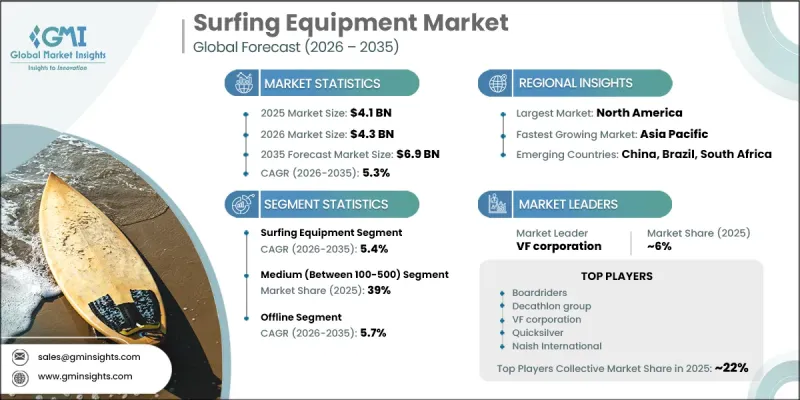
人們對沿海旅遊和探險類休閒活動的興趣日益濃厚,持續推動全球衝浪裝備產業的成長。越來越多的遊客參與衝浪體驗和租賃衝浪裝備,顯著提升了成熟和新興衝浪勝地的產品需求。衝浪正日益融入積極的生活方式、健康和戶外健身文化,超越了單純的休閒。人們對衝浪身心健康益處的認知不斷提高,吸引了更廣泛的消費群體,包括初學者、休閒愛好者和健身達人。參與人數的增加促使製造商和零售商推出創新、高性能的產品,以滿足不同消費者的技能水平和偏好。企業也致力於先進的產品設計、輕量化材料和更高的耐用性,以提升使用者體驗。衝浪旅遊的持續成長,以及水上運動作為一種生活方式的日益普及,預計將推動全球衝浪裝備市場實現長期持續成長。
| 市場範圍 | |
|---|---|
| 開始年份 | 2025 |
| 預測期 | 2026-2035 |
| 上市時的市場規模 | 41億美元 |
| 預計金額 | 69億美元 |
| 複合年成長率 | 5.3% |
預計到2025年,衝浪裝備市場規模將達到31億美元,並在2026年至2035年間以5.4%的複合年成長率成長。這一強勁的市場主導地位主要得益於衝浪運動作為競技和休閒活動的日益普及。衝浪板、潛水衣、腳蹼、防滑墊及相關配件等必備產品,由於頻繁的更換需求以及消費者對個性化客製化的日益成長的需求,繼續佔據著整體市場銷售的顯著佔有率。衝浪作為一項競技運動在全球範圍內日益受到認可,並在國際平台上越來越受歡迎,這進一步加速了對高品質、高性能裝備的需求。此外,產品技術和材料的不斷創新也推動了消費者對旨在提升性能、舒適度和耐用性的先進衝浪裝備的興趣。
預計到2025年,價格在100美元至500美元之間的中檔產品將佔據39%的市場佔有率。由於其在價格、品質和產品性能方面實現了完美的平衡,該品類持續保持強勁的市場需求。這個品類主要包括初學者和中級衝浪者的中階衝浪產品和配件,他們追求的是可靠的裝備,而非價格昂貴的專業級產品。該品類的消費者優先考慮成本績效高、經久耐用且性能穩定的產品,因此,此價格區間在全球衝浪界廣受歡迎。
美國衝浪裝備市場預計到2025年將達到10億美元,並在2026年至2035年間以5.6%的複合年成長率成長。美國仍然是衝浪裝備最成熟的市場之一,這得益於消費者的高度參與、成熟的衝浪生態系統以及對高性能裝備的持續需求。眾多業內知名品牌和大規模的戶外休閒基本客群持續支撐著市場的穩定成長。美國消費者越來越傾向於技術先進、性能卓越的產品,這推動了高階和中階高級產品產品類型的強勁產生收入。此外,廣泛的零售網路,包括專賣店和品牌自營零售店,也為市場發展提供了助力,這些管道提供產品客製化、技術支援和更優質的客戶參與。
目錄
第1章:調查方法和範圍
第2章執行摘要
第3章 行業洞察
- 產業生態系分析
- 原物料供應商
- 製造業
- 配送/物流
- 零售和直接面對消費者的銷售模式
- 售後服務及維修網路
- 各階段的利潤率
- 每個階段增加的價值
- 影響價值鏈的因素
- 影響產業的因素
- 促進因素
- 沿海旅遊和探險旅遊蓬勃發展。
- 人們對健身和健康的興趣日益濃厚
- 向環保永續材料過渡
- 新興市場可支配所得增加
- 產業潛在風險與挑戰
- 高昂的初始設備成本阻礙了市場滲透。
- 初學者學習曲線與安全問題
- 市場機遇
- 智慧科技與穿戴式裝置的融合
- 設備租賃和訂閱經濟的成長
- 進入新興市場
- 直接面對消費者(D2C)電子商務的成長
- 促進因素
- 成長潛力分析
- 監理情勢
- 全球安全和品質標準
- 影響製造業和材料的環境法規
- 進出口法規和關稅結構
- 巴西的法規結構
- 衝浪裝備的進口關稅和附加稅
- 消費者保護條例
- 沿海零售企業的環境合規性
- 體育用品零售商的營業註冊和許可要求
- 關鍵市場趨勢與顛覆性因素
- 技術與創新展望
- 最新科技趨勢
- 新興技術
- 2025年價格分析
- 對過去價格趨勢的分析
- 依球員類型分類的定價策略(高級球員、超值球員、成本加成球員)
- 按滑板運動類別進行價格分析
- 風箏衝浪裝備的價格範圍
- 衝浪裝備的價格範圍與利潤率分析
- 趴板衝浪裝備價格範圍及利潤率分析
- 區域品牌定位和定價
- 未來市場趨勢
- 波特的分析
- PESTLE分析
- 供應鏈分析
- 原物料採購狀況
- 製造地分析
- 物流及配送網路
- 供應鏈韌性與風險緩解
- 貿易數據分析
- 進出口量及進口額趨勢
- 主要貿易路線及關稅的影響
- 按產品類型的貿易趨勢
- 設備和機械貿易趨勢
- 人工智慧和生成式人工智慧對市場的影響
- 利用人工智慧改造現有經營模式
- 按細分市場分類的生成式人工智慧用例和部署藍圖
- 風險、限制和監管考量
- 目前分銷基礎設施和通路滲透情況
- 按地區和格式分類的頻道覆蓋範圍
- 新通路變化和基礎設施缺口
第4章 競爭情勢
- 介紹
- 企業市佔率分析
- 按地區
- 企業矩陣分析
- 主要市場公司的競爭分析
- 競爭定位矩陣
- 主要進展
- 併購
- 夥伴關係和聯盟
- 新產品發布
- 業務拓展計劃
第5章 市場估算與預測:依產品類型分類,2022-2035年
- 衝浪裝備
- 衝浪板
- 潛水衣和防護裝備
- 衝浪配件
- 風箏衝浪裝備
- 風箏
- 風箏衝浪
- 雙尖
- 定向
- 箔板
- 線束和控制系統
- 趴板衝浪裝備
- 趴板
- 腳蹼和潛水服
- 配件
第6章 市場估計與預測:依價格區間分類,2022-2035年
- 價格低廉(100美元以下)
- 中價位(100-500)
- 高價位(超過500美元)
第7章 市場估計與預測:依最終用戶分類,2022-2035年
- 職業運動員和競爭對手
- 休閒愛好者
- 初學者和偶爾使用的用戶
- 水上運動學校及租賃業務
- 度假村和旅遊業者
第8章 市場估算與預測:依通路分類,2022-2035年
- 線上
- 電子商務網站
- 企業網站
- 離線
- 專賣店
- 租賃和水上運動學校
- 度假村和海灘俱樂部零售
- 其他(專賣店、百貨公司等)
第9章 市場估計與預測:依地區分類,2022-2035年
- 北美洲
- 美國
- 加拿大
- 歐洲
- 德國
- 英國
- 法國
- 義大利
- 西班牙
- 葡萄牙
- 亞太地區
- 中國
- 印度
- 日本
- 韓國
- 澳洲
- 泰國
- 菲律賓
- 越南
- 拉丁美洲
- 巴西
- 墨西哥
- 阿根廷
- 中東和非洲
- 沙烏地阿拉伯
- UAE
- 南非
第10章:公司簡介
- 世界公司
- Quiksilver
- O'Neill
- VF Corporation
- Decathlon Group
- Naish International
- Body Glove
- Duotone Kiteboarding
- Cabrinha Kites
- 當地公司
- Channel Islands Surfboards
- Firewire Surfboards
- JS Industries
- Lost Surfboards
- Pyzel Surfboards
- Xcel Wetsuits
- Slingshot Sports
- 新興企業
- Boarriders
- Pride Bodyboards
- C-Skins Wetsuits
- Rip Curl
- Hurley Surf Equipment
- Shapers Surfboards
The Global Surfing Equipment Market was valued at USD 4.1 billion in 2025 and is estimated to grow at a CAGR of 5.3% to reach USD 6.9 billion by 2035.
Rising interest in coastal tourism and adventure-based recreational activities continues to support growth across the surfing equipment industry worldwide. The increasing number of travelers participating in surfing experiences and equipment rentals has significantly boosted product demand across both established and emerging surf destinations. Surfing has evolved beyond a recreational pastime and is increasingly associated with active lifestyles, wellness, and outdoor fitness culture. Growing awareness regarding the physical and mental health benefits linked to surfing is attracting a wider consumer base, including beginners, casual participants, and fitness-focused individuals. This expanding participation level is encouraging manufacturers and retailers to introduce innovative and performance-driven products tailored to different consumer skill levels and preferences. Companies are also focusing on advanced product designs, lightweight materials, and enhanced durability to improve user experience. The continuous rise in surf tourism, combined with increasing lifestyle adoption of water sports activities, is expected to sustain long-term growth across the global surfing equipment market.
| Market Scope | |
|---|---|
| Start Year | 2025 |
| Forecast Year | 2026-2035 |
| Start Value | $4.1 Billion |
| Forecast Value | $6.9 Billion |
| CAGR | 5.3% |
The surfing equipment segment generated USD 3.1 billion in 2025 and is anticipated to register a CAGR of 5.4% from 2026 to 2035. Strong market dominance within this segment is supported by the growing popularity of surfing as both a competitive sport and a recreational activity. Essential products, including surfboards, wetsuits, fins, traction pads, and related accessories, continue to account for a significant share of overall market revenue due to frequent replacement demand and increasing customization preferences among consumers. Rising global visibility of surfing competitions and growing recognition of the sport on international platforms have further accelerated demand for premium-quality performance equipment. In addition, continuous innovation in product technology and materials is strengthening consumer interest in advanced surfing gear designed to improve performance, comfort, and durability.
The medium-priced segment, ranging between 100-500, held 39% share in 2025. This category continues to maintain strong market demand because it offers an effective balance between affordability, quality, and product performance. The segment primarily includes mid-range surfing products and accessories that appeal to beginner and intermediate-level users seeking dependable equipment without the high price associated with professional-grade products. Consumers within this segment prioritize value-oriented purchases that deliver durability and consistent performance, making this price range one of the most widely adopted categories across the global surfing community.
U.S. Surfing Equipment Market captured USD 1 billion in 2025 and is projected to grow at a CAGR of 5.6% from 2026 to 2035. The United States remains one of the most established markets for surfing products due to strong consumer participation, a mature surfing ecosystem, and continuous demand for performance-oriented equipment. The presence of recognized industry brands and a large customer base focused on outdoor recreation continues to support stable market growth. Consumers in the U.S. market increasingly prefer technologically advanced and high-performance products, contributing to strong revenue generation across both premium and mid-range product categories. The market also benefits from a broad retail network that includes specialty stores and branded outlets offering product customization, technical expertise, and enhanced customer engagement.
Major companies operating in the Global Surfing Equipment Market include leading global participants such as Quiksilver, O'Neill, VF Corporation, Decathlon Group, Naish International, Body Glove, Duotone Kiteboarding, and Cabrinha Kites. Regional manufacturers active in the market include Channel Islands Surfboards, Firewire Surfboards, JS Industries, Lost Surfboards, Pyzel Surfboards, Xcel Wetsuits, and Slingshot Sports. Emerging companies participating in the global surfing equipment industry include Boardriders, Pride Bodyboards, C-Skins Wetsuits, Rip Curl, Hurley Surf Equipment, and Shapers Surfboards. Companies operating in the global surfing equipment market are adopting several strategic initiatives to strengthen their competitive position and expand market reach. Manufacturers are focusing heavily on product innovation, including lightweight materials, improved board designs, and high-performance wetsuit technologies to enhance user experience. Businesses are also investing in sustainable manufacturing processes and eco-friendly raw materials to align with changing consumer preferences toward environmentally responsible products. Strategic collaborations with athletes, surf organizations, and sporting events are helping brands improve visibility and strengthen customer loyalty. In addition, companies are expanding direct-to-consumer sales channels and digital retail platforms to improve market penetration and customer engagement.
Table of Contents
Chapter 1 Methodology & Scope
- 1.1 Market scope & definitions
- 1.2 Research design
- 1.2.1 Research approach
- 1.2.2 Data collection methods
- 1.3 Base estimates and calculations
- 1.3.1 Base year calculation
- 1.3.2 Market estimates & forecasts parameters
- 1.4 Forecast Model
- 1.4.1 Key trends for market estimates
- 1.4.2 Quantified market impact analysis
- 1.4.2.1 Mathematical impact of growth parameters on forecast
- 1.4.3 Scenario analysis framework
- 1.5 Primary research and validation
- 1.5.1 Some of the primary sources (but not limited to)
- 1.6 Data mining sources
- 1.6.1 Paid Sources
- 1.7 Primary research and validation
- 1.7.1 Primary sources
- 1.8 Research Trail & confidence scoring
- 1.8.1 Research trail components
- 1.8.2 Scoring components
- 1.9 Research transparency addendum
- 1.9.1 Source attribution framework
- 1.9.2 Quality assurance metrics
- 1.9.3 Our commitment to trust
- 1.10 Market Definitions
Chapter 2 Executive Summary
- 2.1 Industry 360° synopsis
- 2.2 Key market trends
- 2.2.1 Regional
- 2.2.2 Product type
- 2.2.3 Price range
- 2.2.4 End user
- 2.2.5 Distribution channel
Chapter 3 Industry Insights
- 3.1 Industry ecosystem analysis
- 3.1.1 Raw material suppliers
- 3.1.2 Manufacturing
- 3.1.3 Distribution and logistics
- 3.1.4 Retail and direct-to-consumer models
- 3.1.5 After-sales service and repair networks
- 3.1.6 Profit margins at each stage
- 3.1.7 Value addition at each stage
- 3.1.8 Factor affecting the value chain
- 3.2 Industry impact forces
- 3.2.1 Growth drivers
- 3.2.1.1 Surge in coastal tourism & adventure travel
- 3.2.1.2 Growing focus on fitness & wellness
- 3.2.1.3 Shift toward eco-friendly & sustainable materials
- 3.2.1.4 Rising disposable income in emerging markets
- 3.2.2 Industry pitfalls & challenges
- 3.2.2.1 High initial equipment costs limiting market penetration
- 3.2.2.2 Learning curve & safety concerns for beginners.
- 3.2.3 Market opportunities
- 3.2.3.1 Integration of smart technology & wearables
- 3.2.3.2 Growth of equipment rental & subscription economy
- 3.2.3.3 Expansion in emerging markets
- 3.2.3.4 Direct-to-Consumer (D2C) e-commerce growth
- 3.2.1 Growth drivers
- 3.3 Growth potential analysis
- 3.4 Regulatory landscape
- 3.4.1 Global safety and quality standards
- 3.4.2 Environmental regulations affecting manufacturing and materials
- 3.4.3 Import/export regulations and tariff structures
- 3.4.4 Brazil Regulatory Framework
- 3.4.4.1 Import tariffs and duties on surfing equipment
- 3.4.4.2 Consumer protection regulations
- 3.4.4.3 Environmental compliance for coastal retail operations
- 3.4.4.4 Business registration and licensing requirements for sporting goods retail
- 3.5 Major market trends and disruptions
- 3.6 Technological and innovation landscape
- 3.6.1 Current technological trends
- 3.6.2 Emerging technologies
- 3.7 Pricing analysis, 2025 (driven by primary research)
- 3.7.1 Historical price trend analysis (driven by primary research)
- 3.7.2 Pricing strategy by player type (premium / value / cost-plus)
- 3.7.3 Price analysis by board sports category
- 3.7.4 Kitesurfing equipment price range
- 3.7.5 Surfing equipment price range & margin analysis
- 3.7.6 Bodyboarding equipment price range & margin analysis
- 3.7.7 Regional brand positioning and pricing
- 3.8 Future market trends
- 3.9 Porter's analysis
- 3.10 PESTEL analysis
- 3.11 Supply chain analysis
- 3.11.1 Raw material sourcing landscape
- 3.11.2 Manufacturing hub analysis
- 3.11.3 Logistics & distribution networks
- 3.11.4 Supply chain resilience & risk mitigation
- 3.12 Trade data analysis (driven by paid database) (HS Code- 950629)
- 3.12.1 Import/export volume & value trends (driven by primary research)
- 3.12.2 Key trade corridors & tariff impact (driven by primary research)
- 3.12.3 Trade flow by product category
- 3.12.4 Equipment trade dynamics
- 3.13 Impact of AI & generative AI on the market
- 3.13.1 AI-driven disruption of existing business models
- 3.13.2 Gen AI use cases & adoption roadmap by segment
- 3.13.3 Risks, limitations & regulatory considerations
- 3.14 Distribution infrastructure & channel penetration landscape (driven by primary research)
- 3.14.1 Channel coverage by region & format
- 3.14.2 emerging channel shifts & infrastructure gaps
Chapter 4 Competitive Landscape, 2025
- 4.1 Introduction
- 4.2 Company market share analysis
- 4.2.1 By Region
- 4.2.1.1 North America
- 4.2.1.2 Europe
- 4.2.1.3 Asia Pacific
- 4.2.1.4 Latin America
- 4.2.1.5 Middle East & Africa
- 4.2.1 By Region
- 4.3 Company matrix analysis
- 4.4 Competitive analysis of major market players
- 4.5 Competitive positioning matrix
- 4.6 Key developments
- 4.6.1 Mergers & acquisitions
- 4.6.2 Partnerships & collaborations
- 4.6.3 New product launches
- 4.6.4 Expansion plans
Chapter 5 Market Estimates & Forecast, By Product Type, 2022 - 2035, (USD Billion) (Thousand Units)
- 5.1 Key trends
- 5.2 Surfing equipment
- 5.2.1 Surfboards
- 5.2.2 Wetsuits and protective gear
- 5.2.3 Surfing accessories
- 5.3 Kitesurfing equipment
- 5.3.1 Kites
- 5.3.2 Kiteboards
- 5.3.3 Twin-tip
- 5.3.4 Directional
- 5.3.5 Foilboards
- 5.3.6 Harnesses and control systems
- 5.4 Bodyboarding equipment
- 5.4.1 Bodyboards
- 5.4.2 Fins and wetsuits
- 5.4.3 Accessories
Chapter 6 Market Estimates & Forecast, By Price Range, 2022 - 2035, (USD Billion) (Thousand Units)
- 6.1 Key trends
- 6.2 Low (less than USD 100)
- 6.3 Medium (Between 100-500)
- 6.4 High (More than USD 500)
Chapter 7 Market Estimates & Forecast, By End User, 2022 - 2035, (USD Billion) (Thousand Units)
- 7.1 Key trends
- 7.2 Professional athletes and competitors
- 7.3 Recreational enthusiasts
- 7.4 Beginners and occasional users
- 7.5 Water sports schools and rental operations
- 7.6 Resorts and tourism operators
Chapter 8 Market Estimates & Forecast, By Distribution Channel, 2022 - 2035, (USD Billion) (Thousand Units)
- 8.1 Key trends
- 8.2 Online
- 8.2.1 E-commerce website
- 8.2.2 Company websites
- 8.3 Offline
- 8.3.1 Specialty stores
- 8.3.2 Rental and water sports schools
- 8.3.3 Resort and beach club retail
- 8.3.4 Others (specialty stores, department stores etc.)
Chapter 9 Market Estimates & Forecast, By Region, 2022 - 2035, (USD Billion) (Thousand Units)
- 9.1 Key trends
- 9.2 North America
- 9.2.1 U.S.
- 9.2.2 Canada
- 9.3 Europe
- 9.3.1 Germany
- 9.3.2 UK
- 9.3.3 France
- 9.3.4 Italy
- 9.3.5 Spain
- 9.3.6 Portugal
- 9.4 Asia Pacific
- 9.4.1 China
- 9.4.2 India
- 9.4.3 Japan
- 9.4.4 South Korea
- 9.4.5 Australia
- 9.4.6 Thailand
- 9.4.7 Philippines
- 9.4.8 Vietnam
- 9.5 Latin America
- 9.5.1 Brazil
- 9.5.2 Mexico
- 9.5.3 Argentina
- 9.6 MEA
- 9.6.1 Saudi Arabia
- 9.6.2 UAE
- 9.6.3 South Africa
Chapter 10 Company Profiles
- 10.1 Global Players
- 10.1.1 Quiksilver
- 10.1.2 O'Neill
- 10.1.3 VF Corporation
- 10.1.4 Decathlon Group
- 10.1.5 Naish International
- 10.1.6 Body Glove
- 10.1.7 Duotone Kiteboarding
- 10.1.8 Cabrinha Kites
- 10.2 Regional Players
- 10.2.1 Channel Islands Surfboards
- 10.2.2 Firewire Surfboards
- 10.2.3 JS Industries
- 10.2.4 Lost Surfboards
- 10.2.5 Pyzel Surfboards
- 10.2.6 Xcel Wetsuits
- 10.2.7 Slingshot Sports
- 10.3 Emerging players
- 10.3.1 Boarriders
- 10.3.2 Pride Bodyboards
- 10.3.3 C-Skins Wetsuits
- 10.3.4 Rip Curl
- 10.3.5 Hurley Surf Equipment
- 10.3.6 Shapers Surfboards

 衝浪板市場:2026-2032年全球市場預測(以板型、材質、技能等級、浪型、銷售管道和應用程式分類)衝浪裝備市場:2026-2032年全球市場預測(產品類型、技能等級、性別、年齡層及銷售管道)
 衝浪板市場-全球產業規模、佔有率、趨勢、機會、預測:按類型、材料、分銷管道、地區和競爭格局分類,2021-2031年電動衝浪板市場按產品類型、價格範圍、電池容量、馬達功率、分銷管道和最終用途分類-2026-2032年全球預測衝浪設備市場-全球產業規模、佔有率、趨勢、機會和預測,按產品類型(衝浪板、服裝和配件)、按配銷通路(線上、線下)、按地區和競爭情況,2020-2030 年預測
 全球衝浪市場全球衝浪板市場