


 |
市場調查報告書
商品編碼
2038802
綠籬剪市場機會、成長要素、產業趨勢分析及2026-2035年預測。Hedge Shears Market Opportunity, Growth Drivers, Industry Trend Analysis, and Forecast 2026 - 2035 |
||||||

預計到 2025 年,全球綠籬剪市場價值將達到 8.617 億美元,年複合成長率為 3.5%,到 2035 年將達到 12 億美元。
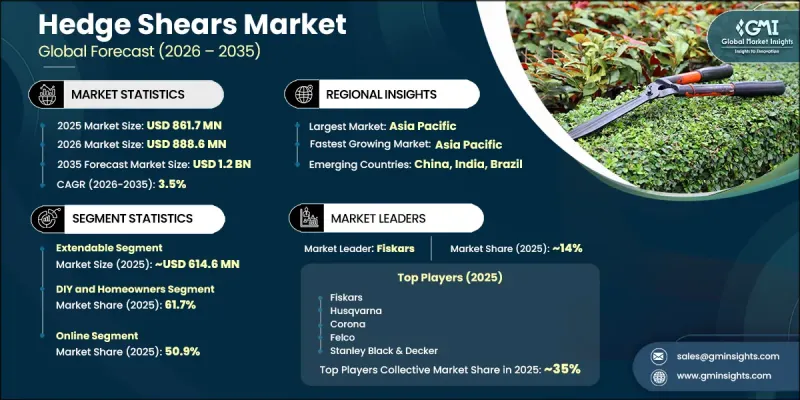
這一成長主要得益於園藝在住宅和專業園林設計師中日益普及。機械化園藝工具的研發、人們對維護良好的戶外生活空間的需求不斷成長,以及線上零售通路的拓展,都進一步推動了市場擴張。人們對環保園藝實踐的日益重視,也促使他們採用手動和節能型工具。產品銷售量顯著成長,尤其得益於生活方式的改變,人們開始轉向DIY園藝。城市發展和美觀綠地設計的日益重視,也推動了對耐用高效綠籬剪的需求。尤其是在可支配收入水準不斷提高的地區,人們越來越傾向於投資能夠提升易用性、性能和整體景觀美感的高品質園藝工具。
| 市場範圍 | |
|---|---|
| 開始年份 | 2025 |
| 預測期 | 2026-2035 |
| 上市時的市場規模 | 8.617億美元 |
| 預測金額 | 12億美元 |
| 複合年成長率 | 3.5% |
隨著戶外住宅環境日益改善,花園、露台和景觀空間正成為住宅設計不可或缺的一部分,這一趨勢也進一步影響市場。這種轉變促使住宅投資購買能夠進行精準修剪和定期維護的工具,以確保戶外空間美觀宜人。專業的園林綠化服務也推動了市場需求的穩定成長。
預計到2025年,伸縮式綠籬剪市場規模將達到6.146億美元,並在2026年至2035年間以3.8%的複合年成長率成長。該細分市場之所以備受關注,是因為它為用戶管理大規模綠籬和高海拔植物提供了更廣闊的工作範圍和更便捷的操作體驗。這些工具旨在提高易用性,同時最大限度地減少體力消耗,適用於專業和住宅用戶。由於修剪過程中無需其他輔助設備,因此提高了安全性和效率,進一步提升了其受歡迎程度。
預計到2025年,DIY和一般家庭用戶細分市場將佔據61.7%的市場佔有率,成為主要的終端用戶類別。這一主導地位源於人們對個人園藝和家庭景觀美化日益成長的興趣。該細分市場的消費者偏好易於使用、輕巧且多功能的工具。此外,隨著越來越多的用戶尋求能夠減少長時間使用疲勞並提高整體園藝效率的產品,節能型綠籬剪的需求也在不斷成長。消費者對經濟實惠且多功能工具的日益成長的偏好,持續推動著該細分市場的擴張。
美國綠籬剪市場預計到2025年將達到2.008億美元,並在2026年至2035年間以3.3%的複合年成長率成長。推動美國市場成長的因素包括:DIY園藝參與度的提高、永續景觀設計理念的普及以及專業景觀美化服務的擴張。消費者對改善戶外空間的濃厚興趣,加上可支配收入的增加,正在推動對先進園藝工具的需求。住宅越來越注重維護美觀的戶外環境,這進一步促進了綠籬剪在住宅的應用。
目錄
第1章:調查方法和範圍
第2章執行摘要
第3章業界考察
- 生態系分析
- 原物料供應商
- 零件製造商
- OEM製造商和組裝
- 經銷商和批發商
- 零售通路
- 最終用戶
- 影響價值鏈的因素
- 利潤率分析(基於初步調查)
- 中斷
- 前景
- 影響產業的因素
- 促進因素
- 重工業對精度和效率日益成長的需求
- 人們對園藝和景觀設計的興趣日益濃厚
- 戶外生活和住宅維修支出日益成長的趨勢
- 都市化及住宅區綠地面積的擴大
- 市集疲軟
- 激烈的競爭和對價格的敏感性
- 園藝需求的季節性和波動
- 機會
- 對優質化和人體工學創新產品的需求
- 在亞太新興市場擴張
- 電子商務通路和D2C(直接面對消費者)模式的成長
- 以永續發展主導導向的產品開發
- 促進因素
- 成長潛力分析
- 未來市場趨勢
- 科技與創新趨勢
- 當前技術趨勢
- 新興技術
- 價格趨勢
- 按地區
- 依產品
- 對過去價格趨勢的分析
- 按業務類型分類的定價策略
- 監理情勢
- 產品安全標準(ISO、ANSI、EN 標準)
- 材料合規性(RoHS、REACH法規)
- 區域進出口關稅結構
- 標籤/包裝要求
- 影響製造業的環境法規
- 關鍵市場趨勢與轉型
- 科技與創新趨勢
- 刀片材料創新
- 符合人體工學設計的車把的進步
- 防鏽塗層技術
- 伸縮機構的設計
- 智慧綠籬剪刀的開發
- 2025年價格分析
- 按地區
- 對過去價格趨勢的分析(基於初步研究)
- 根據業務類型分類的定價策略(高階/價值/成本加成)(基於初步調查)
- 區域價格波動分析
- 原物料成本對價格的影響
- 未來市場趨勢
- 原料分析
- 產品設計分析
- 人體工學設計原則與使用者舒適度指標
- 刀片形狀和切割效率
- 重量最佳化策略
- 美學設計趨勢與消費者偏好
- 波特五力分析
- PESTEL 分析
- 供應鏈分析
- 全球原物料採購趨勢
- 製造地和生產群集
- 物流和配送基礎設施
- 供應鏈脆弱性及風險緩解措施
- 貿易資料分析(基於付費資料庫)(HS編碼:820160)
- 進出口量及進口額趨勢
- 主要貿易路線及關稅的影響
- 主要經濟區域的貿易差額
- 人工智慧和生成式人工智慧對市場的影響
- 利用人工智慧改造現有經營模式
- 針對特定領域的生成式人工智慧應用案例和實施藍圖
- 風險、限制和監管考量
- 按地區和類型(現代貿易與傳統貿易)分類的分銷管道網路(基於初步調查)
- 最後一公里基礎設施差異和分銷管道的變化
- 數位市場電子商務滲透率與發展趨勢
- 專業園藝中心的網路密度
第4章 競爭情勢
- 介紹
- 企業市佔率分析
- 按地區
- 企業矩陣分析
- 主要市場公司的競爭分析
- 競爭定位矩陣
- 主要進展
- 併購
- 夥伴關係與合作
- 新產品發布
- 業務拓展計劃
第5章 市場估算與預測:依產品類型分類,2022-2035年
- 伸縮式綠籬剪
- 不可拉伸的綠籬剪
第6章 市場估計與預測:依葉片尺寸分類,2022-2035年
- 小於5英寸
- 5-7英寸
- 7-9英寸
- 超過9英寸
第7章 市場估計與預測:依葉片類型分類,2022-2035年
- 旁路邊緣
- 直尺
第8章 市場估算與預測:依葉片材質分類,2022-2035年
- 合金鋼
- 鋁
- 碳鋼
- 不銹鋼
- 其他(鈦等)
第9章 市場估計與預測:依價格分類,2022-2035年
- 低的
- 中等的
- 高的
第10章 市場估價與預測:依最終用戶分類,2022-2035年
- DIY和一般家居用品
- 專家
- 園林綠化公司
- 花園管理
- 其他(例如,房地產管理公司)
第11章 市場估價與預測:依通路分類,2022-2035年
- 線上
- 電子商務
- 企業網站
- 離線
- 超級市場
- 專賣店
- 其他(百貨公司等)
第12章 市場估計與預測:依地區分類,2022-2035年
- 北美洲
- 美國
- 加拿大
- 歐洲
- 德國
- 英國
- 法國
- 義大利
- 西班牙
- 亞太地區
- 中國
- 印度
- 日本
- 韓國
- 澳洲
- 拉丁美洲
- 巴西
- 墨西哥
- 阿根廷
- 中東和非洲(MEA)
- 沙烏地阿拉伯
- 阿拉伯聯合大公國
- 南非
第13章:公司簡介
- ARS
- Bahco
- Barnel
- Bosch
- Corona
- Echo
- Felco
- Fiskars
- Husqvarna
- Kanenori
- Makita
- Stanley Black & Decker
- Stihl
- Tata Agrico
- Woodland Tools
The Global Hedge Shears Market was valued at USD 861.7 million in 2025 and is estimated to grow at a CAGR of 3.5% to reach USD 1.2 billion by 2035.
Growth is driven by the expanding popularity of horticultural practices among both residential users and professional landscapers. Increasing development of mechanized gardening tools, growing demand for well-maintained outdoor living spaces, and wider access to online retail channels are further supporting market expansion. Rising awareness of eco-friendly gardening practices is also encouraging consumers to adopt manual and energy-efficient tools. The shift toward DIY gardening, particularly after changes in lifestyle patterns, has significantly strengthened product adoption. Urban development and increasing emphasis on aesthetically designed green spaces are further driving demand for durable and efficient hedge shears. Consumers are increasingly investing in high-quality gardening tools that enhance usability, performance, and overall landscape appearance, particularly in regions where disposable income levels are rising.
| Market Scope | |
|---|---|
| Start Year | 2025 |
| Forecast Year | 2026-2035 |
| Start Value | $861.7 Million |
| Forecast Value | $1.2 Billion |
| CAGR | 3.5% |
The market is further influenced by the growing trend of outdoor home enhancement, where gardens, patios, and landscaped spaces are becoming integral parts of residential design. This shift is encouraging homeowners to invest in tools that support precision trimming and regular maintenance, ensuring visually appealing outdoor environments. Professional landscaping services are also contributing to steady demand growth.
The extendable hedge shears segment generated USD 614.6 million in 2025 and is expected to grow at a CAGR of 3.8% from 2026 to 2035. This segment is gaining traction due to its ability to offer improved reach and operational convenience for users managing larger hedges and elevated plant structures. These tools are designed to enhance accessibility while minimizing physical effort, making them suitable for both professional and residential applications. Their ability to eliminate the need for additional equipment during trimming tasks improves safety and efficiency, further supporting their widespread adoption.
The DIY and homeowners segment held 61.7% share in 2025, establishing itself as the leading end-user category. This dominance is driven by increasing interest in personal gardening and home landscaping activities. Consumers in this segment prefer tools that are easy to use, lightweight, and capable of performing multiple functions. The demand for energy-efficient hedge shears is also rising as users seek products that reduce fatigue during extended use while improving overall gardening efficiency. Growing preference for cost-effective and multifunctional tools continues to support segment expansion.
U.S. Hedge Shears Market accounted for USD 200.8 million in 2025 and is projected to grow at a CAGR of 3.3% from 2026 to 2035. Market growth in the country is supported by rising participation in DIY gardening, increasing adoption of sustainable landscaping practices, and the expansion of professional landscaping services. Strong consumer interest in enhancing outdoor spaces, combined with higher disposable income levels, is driving demand for advanced gardening tools. Homeowners are increasingly focusing on maintaining well-designed outdoor environments, further supporting the adoption of hedge shears across residential applications.
Key companies operating in the Global Hedge Shears Market include Fiskars, Stanley Black & Decker, Bosch, Husqvarna, Makita, Stihl, Echo, Felco, Corona, Bahco, ARS, Barnel, Kanenori, Tata Agrico, and Woodland Tools. Companies in the Hedge Shears Market are focusing on product innovation, ergonomic design improvements, and material advancements to strengthen their market position. They are introducing lightweight and durable tools that enhance user comfort and efficiency during prolonged use. Expansion of product portfolios with energy-efficient and multifunctional gardening tools is helping companies cater to both professional and residential users. Strategic distribution through online and offline retail channels is improving product accessibility and brand reach. Manufacturers are also investing in marketing campaigns that highlight sustainability and ease of use. Additionally, continuous improvements in blade technology and handle design are enhancing performance, while partnerships with landscaping service providers are supporting broader market penetration and customer engagement.
Table of Contents
Chapter 1 Methodology & Scope
- 1.1 Market scope & definitions
- 1.2 Research design
- 1.2.1 Research approach
- 1.2.2 Data collection methods
- 1.3 Base estimates and calculations
- 1.3.1 Base year calculation
- 1.3.2 Market estimates & forecasts parameters
- 1.4 Forecast Model
- 1.4.1 Key trends for market estimates
- 1.4.2 Quantified market impact analysis
- 1.4.2.1 Mathematical impact of growth parameters on forecast
- 1.4.3 Scenario analysis framework
- 1.5 Primary research and validation
- 1.5.1 Some of the primary sources (but not limited to)
- 1.6 Data mining sources
- 1.6.1 Paid Sources
- 1.7 Primary research and validation
- 1.7.1 Primary sources
- 1.8 Research Trail & confidence scoring
- 1.8.1 Research trail components
- 1.8.2 Scoring components
- 1.9 Research transparency addendum
- 1.9.1 Source attribution framework
- 1.9.2 Quality assurance metrics
- 1.9.3 Our commitment to trust
- 1.10 Market Definitions
Chapter 2 Executive Summary
- 2.1 Industry 360° synopsis
- 2.2 Key market trends
- 2.2.1 Regional
- 2.2.2 Product type
- 2.2.3 Blade size
- 2.2.4 Blade type
- 2.2.5 Blade material
- 2.2.6 Price
- 2.2.7 End use
- 2.2.8 Distribution channel
Chapter 3 Industry Insights
- 3.1 Industry ecosystem analysis
- 3.1.1 Raw material suppliers
- 3.1.2 Component manufacturers
- 3.1.3 OEM manufacturers & assembly
- 3.1.4 Distributors & wholesalers
- 3.1.5 Retail channels
- 3.1.6 End users
- 3.1.7 Factor affecting the value chain
- 3.1.8 Profit margin analysis (driven by primary research)
- 3.1.9 Disruptions
- 3.1.10 Future outlook
- 3.2 Industry impact forces
- 3.2.1 Growth drivers
- 3.2.1.1 Growing demand for precision & efficiency in heavy manufacturing
- 3.2.1.2 Increased interest in gardening & landscaping
- 3.2.1.3 Rising outdoor living trends & home improvement spending
- 3.2.1.4 Urbanization & growth in residential green spaces
- 3.2.2 Market pitfalls
- 3.2.2.1 High competition & price sensitivity
- 3.2.2.2 Seasonal nature of gardening & demand fluctuations
- 3.2.3 Opportunities
- 3.2.3.1 Premiumization & ergonomic innovation demand
- 3.2.3.2 Expansion in emerging asia pacific markets
- 3.2.3.3 E-commerce channel growth & direct-to-consumer models
- 3.2.3.4 Sustainability-driven product development
- 3.2.1 Growth drivers
- 3.3 Growth potential analysis
- 3.4 Future market trends
- 3.5 Technology and innovation landscape
- 3.5.1 Current technological trends
- 3.5.2 Emerging technologies
- 3.6 Price trends
- 3.6.1 By region
- 3.6.2 By product
- 3.6.3 Historical price trend analysis
- 3.6.4 Pricing strategy by player type
- 3.7 Regulatory landscape
- 3.7.1 Product Safety Standards (ISO, ANSI, EN Standards)
- 3.7.2 Material Compliance (RoHS, REACH Regulations)
- 3.7.3 Import/Export Tariff Structures by Region
- 3.7.4 Labeling & Packaging Requirements
- 3.7.5 Environmental Regulations Impacting Manufacturing
- 3.8 Major market trends and disruptions
- 3.9 Technological and innovation landscape
- 3.9.1 Blade material innovations
- 3.9.2 Ergonomic handle design advancements
- 3.9.3 Anti-rust coating technologies
- 3.9.4 Telescoping mechanism engineering
- 3.9.5 Smart hedge shears development
- 3.10 Pricing analysis, 2025
- 3.10.1 By region
- 3.10.2 Historical Price Trend Analysis (Driven by Primary Research)
- 3.10.3 Pricing Strategy by Player Type (Premium / Value / Cost-Plus) (Driven by Primary Research)
- 3.10.4 Regional Price Variance Analysis
- 3.10.5 Impact of raw material costs on pricing
- 3.11 Future market trends
- 3.12 Raw material analysis
- 3.13 Product design analysis
- 3.13.1 Ergonomic design principles & user comfort metrics
- 3.13.2 Blade geometry & cutting efficiency
- 3.13.3 Weight optimization strategies
- 3.13.4 Aesthetic design trends & consumer preferences
- 3.14 Porter's analysis
- 3.15 PESTEL analysis
- 3.16 Supply chain analysis
- 3.16.1 Global sourcing landscape for raw materials
- 3.16.2 Manufacturing hubs & production clusters
- 3.16.3 Logistics & distribution infrastructure
- 3.16.4 Supply chain vulnerabilities & risk mitigation
- 3.17 Trade Data Analysis (Driven by paid database) (HS code- 820160)
- 3.17.1 Import/Export Volume & Value Trends
- 3.17.2 Key Trade Corridors & Tariff Impact
- 3.17.3 Trade Balance by Major Economies
- 3.18 Impact of AI & Generative AI on the Market
- 3.18.1 AI-driven disruption of existing business models
- 3.18.2 GenAI use cases & adoption roadmap by segment
- 3.18.3 Risks, limitations & regulatory considerations
- 3.19 Channel coverage by region & format (modern vs. Traditional trade) (driven by primary research)
- 3.19.1 Last-mile infrastructure gaps & emerging channel shifts
- 3.19.2 E-commerce penetration & digital marketplace dynamics
- 3.19.3 Specialty garden center network density
Chapter 4 Competitive Landscape, 2025
- 4.1 Introduction
- 4.2 Company market share analysis
- 4.2.1 By Region
- 4.2.1.1 North America
- 4.2.1.2 Europe
- 4.2.1.3 Asia Pacific
- 4.2.1.4 Latin America
- 4.2.1.5 Middle East & Africa
- 4.2.1 By Region
- 4.3 Company matrix analysis
- 4.4 Competitive analysis of major market players
- 4.5 Competitive positioning matrix
- 4.6 Key developments
- 4.6.1 Mergers & acquisitions
- 4.6.2 Partnerships & collaborations
- 4.6.3 New product launches
- 4.6.4 Expansion plans
Chapter 5 Market Estimates & Forecast, By Product Type, 2022 - 2035, (USD Million) (Thousand Units)
- 5.1 Key trends
- 5.2 Extendable hedge shears
- 5.3 Non-extendable hedge shears
Chapter 6 Market Estimates & Forecast, By Blade Size, 2022 - 2035, (USD Million) (Thousand Units)
- 6.1 Key trends
- 6.2 Below 5 inches
- 6.3 5 to 7 inches
- 6.4 7 to 9 inches
- 6.5 Above 9 inches
Chapter 7 Market Estimates & Forecast, By Blade Type, 2022 - 2035, (USD Million) (Thousand Units)
- 7.1 Key trends
- 7.2 Bypass edge
- 7.3 Straight edge
Chapter 8 Market Estimates & Forecast, By Blade Material, 2022 - 2035, (USD Million) (Thousand Units)
- 8.1 Key trends
- 8.2 Alloy steel
- 8.3 Aluminum
- 8.4 Carbon steel
- 8.5 Stainless steel
- 8.6 Others (titanium etc.)
Chapter 9 Market Estimates & Forecast, By Price, 2022 - 2035, (USD Million) (Thousand Units)
- 9.1 Key trends
- 9.2 Low
- 9.3 Medium
- 9.4 High
Chapter 10 Market Estimates & Forecast, By End User, 2022 - 2035, (USD Million) (Thousand Units)
- 10.1 Key trends
- 10.2 DIY and homeowners
- 10.3 Professionals
- 10.3.1 Landscapers
- 10.3.2 Garden maintenance
- 10.3.3 Others (property management companies etc.)
Chapter 11 Market Estimates & Forecast, By Distribution Channel, 2022 - 2035, (USD Million) (Thousand Units)
- 11.1 Key trends
- 11.2 Online
- 11.2.1 E-commerce
- 11.2.2 Company websites
- 11.3 Offline
- 11.3.1 Supermarkets
- 11.3.2 Specialty stores
- 11.3.3 Others (departmental stores, etc.)
Chapter 12 Market Estimates & Forecast, By Region, 2022 - 2035, (USD Million) (Thousand Units)
- 12.1 Key trends
- 12.2 North America
- 12.2.1 U.S.
- 12.2.2 Canada
- 12.3 Europe
- 12.3.1 Germany
- 12.3.2 UK
- 12.3.3 France
- 12.3.4 Italy
- 12.3.5 Spain
- 12.4 Asia Pacific
- 12.4.1 China
- 12.4.2 India
- 12.4.3 Japan
- 12.4.4 South Korea
- 12.4.5 Australia
- 12.5 Latin America
- 12.5.1 Brazil
- 12.5.2 Mexico
- 12.5.3 Argentina
- 12.6 MEA
- 12.6.1 Saudi Arabia
- 12.6.2 UAE
- 12.6.3 South Africa
Chapter 13 Company Profiles
- 13.1 ARS
- 13.2 Bahco
- 13.3 Barnel
- 13.4 Bosch
- 13.5 Corona
- 13.6 Echo
- 13.7 Felco
- 13.8 Fiskars
- 13.9 Husqvarna
- 13.10 Kanenori
- 13.11 Makita
- 13.12 Stanley Black & Decker
- 13.13 Stihl
- 13.14 Tata Agrico
- 13.15 Woodland Tools

 修枝剪市場:按類型、刀片材質、價格範圍、手柄材質、銷售管道和最終用戶分類-2026-2032年全球預測草坪和綠籬修剪剪市場:按產品類型、刀片材料、通路和最終用戶分類 - 2026-2032 年全球預測電動修枝剪市場:按產品類型、電池類型、分銷管道、應用和最終用戶分類-全球預測,2026-2032年手動修枝剪市場按產品類型、刀片材質、手柄材質、價格範圍、分銷管道和最終用途分類,全球預測(2026-2032年)手持式修枝剪市場按產品類型、機械結構、切割直徑、手柄材質、最終用戶和銷售管道分類-2026-2032年全球預測
 全球電動修枝剪市場
 電動修枝剪市場:全球產業分析,規模,佔有率,成長,趨勢,預測,2024年~2033年
 全球電動修枝剪市場 - 全球產業分析、規模、佔有率、成長、趨勢、預測(2031)- 依產品類型、依最終用途、依銷售管道、依地區