

 |
市場調查報告書
商品編碼
2038792
嬰兒服飾市場機會、成長要素、產業趨勢分析及2026-2035年預測。Toddler Wear Market Opportunity, Growth Drivers, Industry Trend Analysis, and Forecast 2026 - 2035 |
||||||

2025年全球嬰幼兒服飾市場價值1,056億美元,預計2035年將以5.1%的複合年成長率成長至1,734億美元。
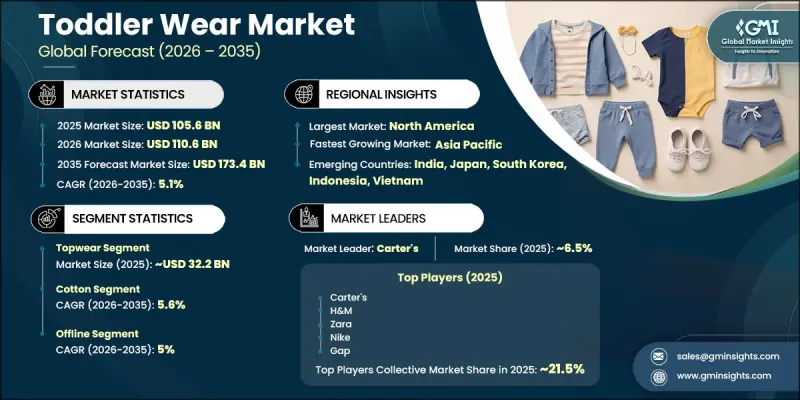
在消費者對優質、舒適、安全的嬰幼兒服裝支出不斷成長的推動下,嬰幼兒服裝市場持續穩定擴張。父母們越來越重視柔軟、透氣、親膚布料製成的服裝,以最大限度地呵護敏感肌膚的寶寶。消費者對布料安全和產品品質的日益關注,顯著影響他們的購買行為,尤其是在都市區家庭中。對有機和天然紡織品的偏好不斷增強,進一步塑造了市場需求趨勢。嬰幼兒快速成長,頻繁更換衣物也是促使消費者重複購買的重要因素。同時,有組織的零售和電商平台的擴張,提升了產品的可近性和種類。線上通路提供豐富的商品選擇,方便消費者比較款式、價格和品牌,而實體店的童裝專區也不斷擴大。促銷活動、季節性新品發布和捆綁銷售策略,進一步刺激了各通路的消費支出。
| 市場範圍 | |
|---|---|
| 開始年份 | 2025 |
| 預測期 | 2026-2035 |
| 上市時的市場規模 | 1056億美元 |
| 預測金額 | 1734億美元 |
| 複合年成長率 | 5.1% |
嬰幼兒服裝涵蓋了專為嬰幼兒早期偏好階段設計的各類服飾,注重舒適性、安全性和耐用性。市場已發生顯著變化,父母越來越重視布料品質和親膚材質。產品創新和設計多樣化是影響消費者購買決策的關鍵因素。製造商不斷推出兼具功能性和美觀性的服裝,滿足從日常穿著到特殊場合服裝的各種需求。人們對嬰幼兒衛生標準和皮膚敏感度的日益關注,並持續推動著全球市場對高品質紡織品的需求。
預計到2025年,外套市場規模將達到322億美元,並在2035年之前以5.6%的複合年成長率成長。由於外套在日常穿搭中扮演著重要角色,且更換週期頻繁,因此該細分市場保持主導地位。外套涵蓋了各種類型的服裝,例如T卹、襯衫、毛衣和夾克,這些服裝幾乎不受季節或場合的限制。家長們偏好上衣,因為它們用途廣泛、易於穿脫,並且款式和布料選擇多樣。嬰幼兒的持續穿著和快速成長也帶來了穩定的更換需求,進一步鞏固了該細分市場在市場上的強勁地位。
預計到2025年,棉製品市佔率將達到36.7%,並在2026年至2035年間以5.6%的複合年成長率成長。棉花因其柔軟、透氣且適合敏感肌膚,仍然是最受歡迎的布料。其天然特性和低致敏性使其成為日常穿著的理想選擇,確保舒適度並最大限度地減少皮膚刺激。人們對親膚、無化學成分纖維的日益關注正在推動棉質服裝的需求。對永續和有機布料的偏好不斷增強,進一步促進了該領域的擴張。耐用性、易護理性和全年穿著性鞏固了棉花在市場上的主導地位。
美國嬰幼兒服飾市場預計到2025年將達到220億美元,並在2026年至2035年間以5.4%的複合年成長率成長。推動美國市場成長的主要因素是消費者對童裝的強勁支出以及對高品質品牌服飾日益成長的偏好。家長們高度重視舒適性、耐用性和安全性,這推動了對優質親膚布料的需求。人們對兒童健康和服裝標準的日益關注,進一步促進了有機和永續服裝的選擇。零售網路和電商平台的擴張提高了全國範圍內的產品供應。儘管時尚潮流和季節性系列持續影響消費者的購買行為,但知名品牌和自有品牌確保了產品的廣泛供應和具有競爭力的價格。
目錄
第1章:調查方法和範圍
第2章執行摘要
第3章業界考察
- 生態系分析
- 供應商情況
- 利潤率
- 每個階段增加的價值
- 影響價值鏈的因素
- 影響產業的因素
- 促進因素
- 人們對舒適性、安全性和親膚材料的興趣日益濃厚。
- 出生率上升和嬰兒人口增加
- 時尚潮流和品牌服裝的影響力日益增強。
- 陷阱與挑戰
- 發展中地區消費者對價格高度敏感
- 由於幼兒快速生長,尺寸會頻繁變化。
- 機會
- 對有機和永續服飾材料的需求日益成長
- 電子商務與D2C品牌擴張
- 促進因素
- 成長潛力分析
- 未來市場趨勢
- 科技與創新趨勢
- 當前技術趨勢
- 新興技術
- 監理情勢
- 標準和合規要求
- 區域法規結構
- 認證標準
- 波特五力分析
- PESTEL 分析
- 價格分析(基於初步調查)
- 對過去價格趨勢的分析
- 按業務類型(高階/平價/快時尚)分類的定價策略
- 按產品類型的價格彈性
- 各地區價格波動
- 原物料成本對零售價格的影響
- 貿易資料分析 - HS編碼:6111(針織或鉤編)(基於付費資料庫)
- 進出口量及進口額趨勢
- 主要貿易路線及關稅的影響
- 主要出口國
- 主要進口國
- HS編碼分類分析
- 分銷基礎設施和通路滲透狀況(基於初步調查)
- 按地區和類型(現代零售與傳統零售)分類的通路覆蓋率(基於初步調查)
- 最後一公里基礎設施差異和新分銷管道的變化(基於初步研究)
- 各地區的電子商務滲透率
- 全通路策略實施現狀
第4章 競爭情勢
- 介紹
- 企業市佔率分析
- 按地區
- 企業矩陣分析
- 主要市場公司的競爭分析
- 競爭定位矩陣
- 主要進展
- 併購
- 夥伴關係與合作
- 新產品發布
- 業務拓展計劃
第5章 市場估價與預測:依產品分類,2022-2035年
- 最高額
- T恤
- 襯衫
- 夾克
- 毛衣
- 其他
- 底部
- 褲子
- 短褲
- 裙子
- 其他
- 睡衣
- 連體衣
- 罩衣
- 其他
- 配件
- 帽子
- 襪子
- 手套
- 其他
- 鞋類
- 其他
第6章 市場估計與預測:依材料分類,2022-2035年
- 棉布
- 尼龍
- 羊毛
- 其他
第7章 市場估計與預測:依價格區間分類,2022-2035年
- 低價位
- 中價位
- 高的
第8章 市場估算與預測:性別,2022-2035年
- 男生
- 女孩
第9章 市場估價與預測:依通路分類,2022-2035年
- 線上
- 電子商務
- 企業網站
- 離線
- 大型零售商店
- 專賣店
- 其他
第10章 市場估價與預測:依地區分類,2022-2035年
- 北美洲
- 美國
- 加拿大
- 歐洲
- 德國
- 英國
- 法國
- 義大利
- 西班牙
- 亞太地區
- 中國
- 印度
- 日本
- 韓國
- 澳洲
- 拉丁美洲
- 巴西
- 墨西哥
- 阿根廷
- 中東和非洲(MEA)
- 沙烏地阿拉伯
- 阿拉伯聯合大公國
- 南非
第11章:公司簡介
- Adidas
- Burberry
- Carter's
- Gap Inc.
- Gerber Childrenswear
- H&M
- Marks & Spencer
- Nike
- Patagonia
- Petit Bateau
- Ralph Lauren
- The Children's Place
- Zara
- Brandix Lanka Limited
- Shenzhou International Group
The Global Toddler Wear Market was valued at USD 105.6 billion in 2025 and is estimated to grow at a CAGR of 5.1% to reach USD 173.4 billion by 2035.
The market is experiencing steady expansion, supported by rising consumer spending on premium, comfortable, and safe clothing for toddlers. Parents are increasingly prioritizing apparel made from soft, breathable, and skin-friendly materials to ensure maximum comfort for children with sensitive skin. Growing awareness regarding fabric safety and product quality has significantly influenced purchasing behavior, especially in urban households. The rising preference for organic and natural textiles is further shaping demand patterns. Frequent wardrobe replacement cycles, driven by rapid growth in toddlers, are also contributing to recurring purchases. In parallel, the expansion of organized retail and digital commerce platforms has enhanced product accessibility and variety. Online channels offer extensive catalog choices, enabling easy comparison of styles, prices, and brands, while offline retail continues to expand dedicated children's apparel sections. Promotional offers, seasonal launches, and bundled pricing strategies are further stimulating consumer spending across distribution channels.
| Market Scope | |
|---|---|
| Start Year | 2025 |
| Forecast Year | 2026-2035 |
| Start Value | $105.6 Billion |
| Forecast Value | $173.4 Billion |
| CAGR | 5.1% |
The toddler wear category includes a wide range of clothing designed specifically for children in early developmental stages, with a strong focus on comfort, safety, and durability. The market has evolved significantly due to changing parental preferences, with greater emphasis placed on fabric quality and non-irritating materials. Product innovation and design diversification have become key factors influencing consumer decisions. Manufacturers are increasingly introducing apparel that balances functionality with aesthetic appeal, catering to both everyday wear and occasion-based requirements. Growing awareness of hygiene standards and skin sensitivity in young children continues to reinforce the demand for high-quality textile solutions across global markets.
The topwear segment accounted for USD 32.2 billion in 2025 and is expected to grow at a CAGR of 5.6% through 2035. This segment maintains a dominant position due to its essential role in daily wardrobe requirements and frequent replacement cycles. It includes a wide range of garments such as t-shirts, shirts, sweaters, and jackets that are widely used across different seasons and occasions. Parents prefer topwear due to its versatility, ease of dressing, and availability in diverse designs and materials. Continuous usage and rapid growth of toddlers drive consistent replacement demand, reinforcing the segment's strong market presence.
The cotton segment held a share of 36.7% in 2025 and is projected to grow at a CAGR of 5.6% during 2026 to 2035. Cotton remains the most preferred fabric due to its softness, breathability, and suitability for sensitive skin. Its natural and hypoallergenic properties make it highly suitable for everyday wear, ensuring comfort and minimizing irritation. Increasing awareness regarding skin-safe and chemical-free textiles has strengthened demand for cotton-based apparel. Rising preference for sustainable and organic fabric options further supports segment expansion. Durability, ease of maintenance, and year-round usability continue to reinforce cotton's leading position in the market.
United States Toddler Wear Market reached USD 22 billion in 2025 and is projected to grow at a CAGR of 5.4% from 2026 to 2035. Market growth in the country is supported by strong consumer spending on children's apparel and increasing preference for high-quality, branded clothing. Parents place significant importance on comfort, durability, and safety, which drives demand for premium and skin-friendly fabrics. Growing awareness of child wellness and clothing standards has further encouraged adoption of organic and sustainable apparel options. The expansion of retail networks and e-commerce platforms has improved product accessibility nationwide. Fashion trends and seasonal collections continue to influence purchasing behavior, while established brands and private labels ensure wide product availability and competitive pricing.
Key companies operating in the Global Toddler Wear Market include Nike, Adidas, Zara, H&M, Gap Inc., Burberry, Ralph Lauren, Carter's, The Children's Place, Marks & Spencer, Gerber Childrenswear, Patagonia, Petit Bateau, Brandix Lanka Limited, and Shenzhou International Group. Companies in the Toddler Wear Market are focusing on product innovation, fabric quality enhancement, and brand differentiation to strengthen their market position. Manufacturers are expanding collections with a strong emphasis on comfort, safety, and skin-friendly materials tailored to toddlers' needs. Increasing investment in sustainable and organic textiles is helping brands align with evolving consumer preferences. Expansion of omnichannel distribution strategies, including both online and offline retail, is improving market reach and accessibility. Companies are also leveraging digital marketing and influencer collaborations to strengthen brand visibility. Seasonal collections, promotional campaigns, and bundled offerings are being used to boost sales volumes. Additionally, firms are focusing on regional expansion and supply chain optimization to ensure cost efficiency and consistent product availability across global markets.
Table of Contents
Chapter 1 Methodology & Scope
- 1.1 Market scope and definition
- 1.2 Research design
- 1.2.1 Research approach
- 1.2.2 Data collection methods
- 1.3 Data mining sources
- 1.3.1 Global
- 1.3.2 Regional/Country
- 1.4 Base estimates and calculations
- 1.4.1 Base year calculation
- 1.4.2 Key trends for market estimation
- 1.5 Primary research and validation
- 1.5.1 Primary sources
- 1.6 Forecast model
- 1.7 Research assumptions and limitations
Chapter 2 Executive Summary
- 2.1 Industry 360° synopsis
- 2.2 Key market trends
- 2.2.1 Regional
- 2.2.2 Product
- 2.2.3 Material
- 2.2.4 Price range
- 2.2.5 Gender
- 2.2.6 Distribution Channel
Chapter 3 Industry Insights
- 3.1 Industry ecosystem analysis
- 3.1.1 Supplier landscape
- 3.1.2 Profit margin
- 3.1.3 Value addition at each stage
- 3.1.4 Factor affecting the value chain
- 3.2 Industry impact forces
- 3.2.1 Growth drivers
- 3.2.1.1 Growing focus on comfort, safety, and skin-friendly materials
- 3.2.1.2 Rising birth rates and increasing toddler population
- 3.2.1.3 Increasing influence of fashion trends and branded apparel
- 3.2.2 Pitfalls & Challenges
- 3.2.2.1 High price sensitivity among consumers in developing regions
- 3.2.2.2 Frequent size changes due to rapid growth of toddlers
- 3.2.3 Opportunities
- 3.2.3.1 Growing demand for organic and sustainable clothing materials
- 3.2.3.2 Expansion of e-commerce and direct-to-consumer brands
- 3.2.1 Growth drivers
- 3.3 Growth potential analysis
- 3.4 Future market trends
- 3.5 Technology and innovation landscape
- 3.5.1 Current technological trends
- 3.5.2 Emerging technologies
- 3.6 Regulatory landscape
- 3.6.1 Standards and compliance requirements
- 3.6.2 Regional regulatory frameworks
- 3.6.3 Certification standards
- 3.7 Porter's analysis
- 3.8 PESTEL analysis
- 3.9 Pricing analysis (driven by primary research)
- 3.9.1 Historical price trend analysis
- 3.9.2 Pricing strategy by player type (premium/value/fast fashion)
- 3.9.3 Price elasticity by product category
- 3.9.4 Regional price variations
- 3.9.5 Impact of material costs on retail pricing
- 3.10 Trade data analysis - HS Code: 6111 (knitted or crocheted) (driven by paid database)
- 3.10.1 Import/export volume & value trends
- 3.10.2 Key trade corridors & tariff impact
- 3.10.3 Major exporting countries
- 3.10.4 Major importing countries
- 3.10.5 HS code classification analysis
- 3.11 Distribution infrastructure & channel penetration landscape (driven by primary research)
- 3.11.1 Channel coverage by region & format (modern vs. traditional trade) (driven by primary research)
- 3.11.2 Last-mile infrastructure gaps & emerging channel shifts (driven by primary research)
- 3.11.3 E-commerce penetration rates by geography
- 3.11.4 Omnichannel strategy adoption
Chapter 4 Competitive Landscape, 2025
- 4.1 Introduction
- 4.2 Company market share analysis
- 4.2.1 By Region
- 4.2.1.1 North America
- 4.2.1.2 Europe
- 4.2.1.3 Asia Pacific
- 4.2.1.4 Latin America
- 4.2.1.5 Middle East & Africa
- 4.2.1 By Region
- 4.3 Company matrix analysis
- 4.4 Competitive analysis of major market players
- 4.5 Competitive positioning matrix
- 4.6 Key developments
- 4.6.1 Mergers & acquisitions
- 4.6.2 Partnerships & collaborations
- 4.6.3 New product launches
- 4.6.4 Expansion plans
Chapter 5 Market Estimates & Forecast, By Product, 2022 - 2035, (USD Billion) (Thousand Units)
- 5.1 Key trends
- 5.2 Topwear
- 5.2.1 T-shirts
- 5.2.2 Shirts
- 5.2.3 Jackets
- 5.2.4 Sweaters
- 5.2.5 Others
- 5.3 Bottomwear
- 5.3.1 Pants
- 5.3.2 Shorts
- 5.3.3 Skirts
- 5.3.4 Others
- 5.4 Sleepwear
- 5.4.1 Onesies
- 5.4.2 Nightgowns
- 5.4.3 Others
- 5.5 Accessories
- 5.5.1 Hats
- 5.5.2 Socks
- 5.5.3 Gloves
- 5.5.4 Others
- 5.6 Footwear
- 5.7 Others
Chapter 6 Market Estimates & Forecast, By Material, 2022 - 2035, (USD Billion) (Thousand Units)
- 6.1 Key trends
- 6.2 Cotton
- 6.3 Nylon
- 6.4 Wool
- 6.5 Others
Chapter 7 Market Estimates & Forecast, By Price range, 2022 - 2035, (USD Billion) (Thousand Units)
- 7.1 Key trends
- 7.2 Low
- 7.3 Medium
- 7.4 High
Chapter 8 Market Estimates & Forecast, By Gender, 2022 - 2035, (USD Billion) (Thousand Units)
- 8.1 Key trends
- 8.2 Boy
- 8.3 Girl
Chapter 9 Market Estimates & Forecast, By Distribution Channel, 2022 - 2035, (USD Billion) (Thousand Units)
- 9.1 Key trends
- 9.2 Online
- 9.2.1 E-commerce
- 9.2.2 Company websites
- 9.3 Offline
- 9.3.1 Mega Retail Stores
- 9.3.2 Specialty stores
- 9.3.3 Others
Chapter 10 Market Estimates & Forecast, By Region, 2022 - 2035, (USD Billion) (Thousand Units)
- 10.1 Key trends
- 10.2 North America
- 10.2.1 U.S.
- 10.2.2 Canada
- 10.3 Europe
- 10.3.1 Germany
- 10.3.2 UK
- 10.3.3 France
- 10.3.4 Italy
- 10.3.5 Spain
- 10.4 Asia Pacific
- 10.4.1 China
- 10.4.2 India
- 10.4.3 Japan
- 10.4.4 South Korea
- 10.4.5 Australia
- 10.5 Latin America
- 10.5.1 Brazil
- 10.5.2 Mexico
- 10.5.3 Argentina
- 10.6 MEA
- 10.6.1 Saudi Arabia
- 10.6.2 UAE
- 10.6.3 South Africa
Chapter 11 Company Profiles
- 11.1 Adidas
- 11.2 Burberry
- 11.3 Carter's
- 11.4 Gap Inc.
- 11.5 Gerber Childrenswear
- 11.6 H&M
- 11.7 Marks & Spencer
- 11.8 Nike
- 11.9 Patagonia
- 11.10 Petit Bateau
- 11.11 Ralph Lauren
- 11.12 The Children's Place
- 11.13 Zara
- 11.14 Brandix Lanka Limited
- 11.15 Shenzhou International Group

 2026-2030年全球線上童裝市場
 童裝市場-2026-2032年全球市場預測
 嬰兒服飾市場規模、佔有率和成長分析:依產品類型、材質、性別、年齡層、價格範圍、銷售管道和地區分類-2026-2033年產業預測嬰兒睡衣市場:按產品類型、材質和年齡分類-2026-2032年全球市場預測嬰兒服飾市場:按產品類型、材料和銷售管道分類的全球市場預測,2026-2032年
 2026-2030年全球嬰幼兒服飾市場嬰兒連身衣市場:依性別、年齡層、布料類型、通路和最終用戶分類-2026-2032年全球預測
 嬰幼兒服飾市場分析及預測(至2035年):依類型、產品類型、材料類型、應用、技術、最終使用者及功能分類童裝市場分析及預測(至2035年):依類型、產品、材料類型、年齡層、性別、銷售管道、技術、最終用戶及功能分類
 兒童服裝市場報告:按產品類型、消費群組、性別、分銷管道和地區分類(2026-2034 年)