


 |
市場調查報告書
商品編碼
2038767
尿量計市場機會、成長要素、產業趨勢分析及2026-2035年預測。Urometer Market Opportunity, Growth Drivers, Industry Trend Analysis, and Forecast 2026 - 2035 |
||||||

全球尿液量分析儀市場預計到 2025 年將達到 5.752 億美元,年複合成長率為 7.9%,到 2035 年將達到 12 億美元。
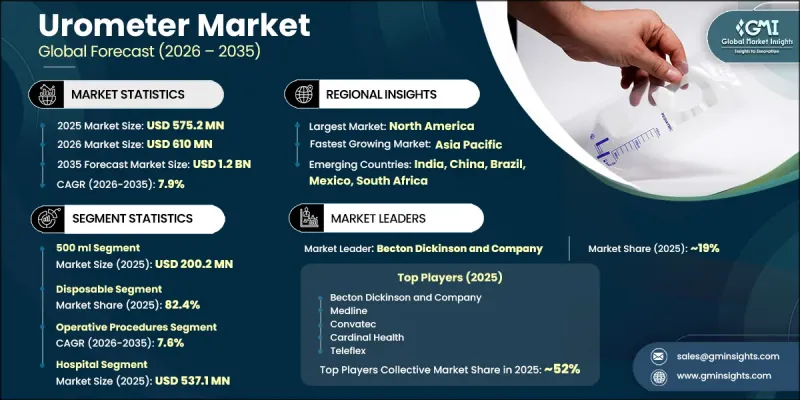
泌尿系統疾病發生率上升、外科手術增多、加護病房入院人數增加,都推動了尿量監測設備的應用。此外,人口老化也顯著增加了需求,因為老年族群更容易患上需要持續監測尿量的疾病。醫療機構嚴格執行感染防治規程也進一步促進了先進監測設備的使用。尿量計是一種專門用於精確測量和追蹤一段時間內尿量的專業醫療設備,通常整合在連接導尿管和收集裝置的封閉式引流系統中。生活方式的改變和慢性病負擔的加重也增加了對高效監測系統的需求,進一步凸顯了尿量計在急診和長期照護機構中的重要性。
| 市場規模 | |
|---|---|
| 開始年份 | 2025 |
| 預測期 | 2026-2035 |
| 上市時的市場規模 | 5.752億美元 |
| 預測金額 | 12億美元 |
| 複合年成長率 | 7.9% |
預計到2025年,500毫升規格的血糖儀銷售額將達到2.02億美元。此規格的強勢地位得益於其在臨床環境中的廣泛應用,尤其是在需要持續、精準監測的場合。其均衡的設計使其能夠進行長時間的有效測量,因此非常適合成人患者的護理。此外,它還能滿足高護理環境下持續監測的需求,這顯著增強了其競爭優勢。
一次性醫療器材憑藉其高效的營運和強大的感染控制優勢,預計到2025年將佔82.4%的市場佔有率。一次性醫療器材無需清洗和消毒,從而減少了時間、人力和資源需求。這些優勢使其非常適合快節奏的醫療環境,在這些環境中,保持衛生標準和最大限度地縮短處理時間至關重要。此外,一次性產品可預測的成本結構也進一步推動了其廣泛應用。
美國尿量監測儀市場預計到2025年將達到2.137億美元。這主要得益於完善的醫療保健生態系統和臨床環境中較高的普及率。全美各地的醫護人員在各種醫療環境中持續使用尿量監測儀來準確監測病患的病情。成熟的臨床規範和日益增強的病人安全意識也推動了市場需求的持續成長。此外,慢性病負擔的加重也增加了對準確、持續監測的需求,從而促進了市場的持續擴張。
目錄
第1章:調查方法
- 研究途徑
- 品質改進計劃
- GMI人工智慧政策和資料完整性計劃
- 資訊來源一致性協議
- GMI人工智慧政策和資料完整性計劃
- 調查過程和可靠性評分
- 調查過程的組成部分
- 評分組成部分
- 數據收集
- 主要來源部分列表
- 資料探勘資訊來源
- 付費資訊來源
- 區域資訊來源
- 付費資訊來源
- 基本估算和計算方法
- 每種方法中基準年的計算
- 預測模型
- 量化市場影響分析
- 生長參數對預測的數學影響
- 量化市場影響分析
- 關於調查透明度的補充信息
- 資訊來源歸屬框架
- 品質保證指標
- 對信任的承諾
第2章執行摘要
第3章業界考察
- 生態系分析
- 影響產業的因素
- 促進因素
- 泌尿系統疾病盛行率增加
- 手術數量及加護病房入院人數增加
- 人口老化及相關慢性疾病
- 加強對感染控制的重視,並採用拋棄式尿量計
- 產業潛在風險與挑戰
- 導尿管相關尿道感染(CAUTI)的風險
- 與醫療塑膠廢棄物相關的環境問題
- 市場機遇
- 居家醫療和遠端患者監護的擴展
- 促進因素
- 成長潛力分析
- 監理情勢(基於初步調查)
- 技術趨勢(基於初步調查)
- 當前技術趨勢
- 新興技術
- 價格分析(2025 年)(基於初步調查)
- 未來市場趨勢
- 人工智慧和生成式人工智慧對市場的影響
- 波特五力分析
- PESTEL 分析
- 價值鏈分析
- 客戶洞察(基於初步研究)
- 創業情境(基於初步研究)
- 差距分析
第4章 競爭情勢
- 介紹
- 企業矩陣分析
- 企業市佔率分析(基於初步研究)
- 世界
- 北美洲
- 歐洲
- 亞太地區
- 競爭定位矩陣
- 主要市場公司的競爭分析
- 主要進展
- 併購
- 夥伴關係與合作
- 新產品發布
- 業務拓展計劃
第5章 市場估價與預測:依產品分類,2022-2035年
- 100 ml
- 200 ml
- 400 ml
- 450 ml
- 500 ml
- 超過500毫升
第6章 市場估計與預測:依使用者性別分類,2022-2035年
- 一次性的
- 可重複使用的
第7章 市場估計與預測:依應用領域分類,2022-2035年
- 外科手術
- 急診創傷
- 安寧療護
- 其他用途
第8章 市場估算與預測:依最終用途分類,2022-2035年
- 醫院
- 診所
- 居家照護設施
- 其他最終用途
第9章 市場估計與預測:依地區分類,2022-2035年
- 北美洲
- 美國
- 加拿大
- 歐洲
- 德國
- 英國
- 法國
- 西班牙
- 義大利
- 荷蘭
- 亞太地區
- 中國
- 日本
- 印度
- 澳洲
- 韓國
- 拉丁美洲
- 巴西
- 墨西哥
- 阿根廷
- 中東和非洲
- 南非
- 沙烏地阿拉伯
- 阿拉伯聯合大公國
第10章:公司簡介
- Advin Health Care
- ANGIPLAST
- B. Braun
- Becton, Dickinson and Company
- Cardinal Health
- Convatec
- Fannin
- Forlong Medical
- Hitec Medical
- Laborie
- Medline
- Observe Medical
- Romsons Group
- Sterimed Group
- Teleflex
The Global Urometer Market was valued at USD 575.2 million in 2025 and is estimated to grow at a CAGR of 7.9% to reach USD 1.2 billion by 2035.
This expansion is supported by the growing incidence of urological conditions, a higher number of surgical procedures, and increasing admissions in critical care settings. In addition, the expanding elderly population is contributing significantly to demand, as aging individuals are more prone to conditions requiring continuous monitoring of urinary output. The adoption of stringent infection prevention protocols across healthcare facilities is further strengthening the use of advanced monitoring devices. A urometer is a specialized medical device used to measure and track urine output accurately over a specified period, typically integrated within a closed drainage system connected to a catheter and collection unit. Changing lifestyles and the growing burden of chronic diseases are also increasing the need for efficient monitoring systems, reinforcing the importance of urometers in both acute and long-term care environments.
| Market Scope | |
|---|---|
| Start Year | 2025 |
| Forecast Year | 2026-2035 |
| Start Value | $575.2 Million |
| Forecast Value | $1.2 Billion |
| CAGR | 7.9% |
The 500 ml segment generated USD 200.2 million in 2025. This segment's strong position is supported by its widespread use in clinical environments where continuous and precise monitoring is required. Its balanced design allows for effective measurement over extended durations, making it suitable for adult patient care. The ability to support consistent monitoring needs in high-dependency settings has contributed significantly to its dominance.
The disposable segment accounted for 82.4% share in 2025, driven by its operational efficiency and strong infection control benefits. Single-use devices eliminate the need for cleaning and sterilization, reducing time, labor, and resource requirements. These advantages make them highly suitable for fast-paced healthcare environments where maintaining hygiene standards and minimizing turnaround time are essential. Additionally, predictable cost structures associated with disposable products further support their widespread adoption.
United States Urometer Market was valued at USD 213.7 million in 2025, supported by a well-developed healthcare ecosystem and strong clinical adoption. Healthcare professionals across the country consistently rely on urometers in various care settings to ensure accurate monitoring of patient conditions. Established clinical protocols and increasing awareness of patient safety are contributing to sustained demand. Furthermore, the growing burden of chronic health conditions is reinforcing the need for precise and continuous monitoring, supporting ongoing market expansion.
Key companies operating in the Global Urometer Market include Becton, Dickinson and Company, B. Braun, Cardinal Health, Teleflex, Convatec, Medline, Laborie, Romsons Group, Sterimed Group, Advin Health Care, ANGIPLAST, Fannin, Forlong Medical, Hitec Medical, and Observe Medical. Companies in the Urometer Market are strengthening their competitive position through product innovation, strategic partnerships, and expansion of distribution networks. They are investing in advanced designs that improve measurement accuracy, ease of use, and patient safety. Many players are focusing on developing cost-effective disposable solutions to meet the rising demand for infection control. Collaborations with healthcare providers and institutions are helping expand market reach and improve product adoption. In addition, companies are enhancing their global presence by entering emerging markets and strengthening supply chain capabilities.
Table of Contents
Chapter 1 Research Methodology
- 1.1 Research approach
- 1.2 Quality commitments
- 1.2.1 GMI AI policy & data integrity commitment
- 1.2.1.1 Source consistency protocol
- 1.2.1 GMI AI policy & data integrity commitment
- 1.3 Research trail & confidence scoring
- 1.3.1 Research trail components
- 1.3.2 Scoring components
- 1.4 Data collection
- 1.4.1 Partial list of primary sources
- 1.5 Data mining sources
- 1.5.1 Paid sources
- 1.5.1.1 Sources, by region
- 1.5.1 Paid sources
- 1.6 Base estimates and calculations
- 1.6.1 Base year calculation for any one approach
- 1.7 Forecast model
- 1.7.1 Quantified market impact analysis
- 1.7.1.1 Mathematical impact of growth parameters on forecast
- 1.7.1 Quantified market impact analysis
- 1.8 Research transparency addendum
- 1.8.1 Source attribution framework
- 1.8.2 Quality assurance metrics
- 1.8.3 Our commitment to trust
Chapter 2 Executive Summary
- 2.1 Industry 3600 synopsis
- 2.2 Key market trends
- 2.2.1 Regional trends
- 2.2.2 Product trends
- 2.2.3 Usability trends
- 2.2.4 Application trends
- 2.2.5 End use trends
- 2.3 CXO perspectives: Strategic imperatives
Chapter 3 Industry Insights
- 3.1 Industry ecosystem analysis
- 3.2 Industry impact forces
- 3.2.1 Growth drivers
- 3.2.1.1 Rising prevalence of urological disorders
- 3.2.1.2 Increasing number of surgical procedures and critical care admissions
- 3.2.1.3 Growing geriatric population and associated chronic conditions
- 3.2.1.4 Increasing focus on infection control and adoption of disposable urometers
- 3.2.2 Industry pitfalls and challenges
- 3.2.2.1 Risk of catheter-associated urinary tract infections (CAUTIs)
- 3.2.2.2 Environmental concerns related to medical plastic waste
- 3.2.3 Market opportunities
- 3.2.3.1 Expansion of home healthcare and remote patient monitoring
- 3.2.1 Growth drivers
- 3.3 Growth potential analysis
- 3.4 Regulatory landscape (Driven by primary research)
- 3.4.1 North America
- 3.4.2 Europe
- 3.4.3 Asia Pacific
- 3.4.4 Latin America
- 3.4.5 MEA
- 3.5 Technology landscape (Driven by primary research)
- 3.5.1 Current technological trends
- 3.5.2 Emerging technologies
- 3.6 Pricing analysis, 2025 (Driven by primary research)
- 3.7 Future market trends
- 3.8 Impact of AI and Generative AI on the market
- 3.9 Porter's analysis
- 3.10 PESTEL analysis
- 3.11 Value chain analysis
- 3.12 Customer insights (Driven by primary research)
- 3.13 Star-up scenario (Driven by primary research)
- 3.14 Gap analysis
Chapter 4 Competitive Landscape, 2025
- 4.1 Introduction
- 4.2 Company matrix analysis
- 4.3 Company market share analysis (Driven by primary research)
- 4.3.1 Global
- 4.3.2 North America
- 4.3.3 Europe
- 4.3.4 Asia Pacific
- 4.4 Competitive positioning matrix
- 4.5 Competitive analysis of major market players
- 4.6 Key developments
- 4.6.1 Mergers & acquisitions
- 4.6.2 Partnerships & collaborations
- 4.6.3 New product launches
- 4.6.4 Expansion plans
Chapter 5 Market Estimates and Forecast, By Product, 2022 - 2035 ($ Mn)
- 5.1 Key trends
- 5.2 100 ml
- 5.3 200 ml
- 5.4 400 ml
- 5.5 450 ml
- 5.6 500 ml
- 5.7 Above 500 ml
Chapter 6 Market Estimates and Forecast, By Usability, 2022 - 2035 ($ Mn)
- 6.1 Key trends
- 6.2 Disposable
- 6.3 Reusable
Chapter 7 Market Estimates and Forecast, By Application, 2022 - 2035 ($ Mn)
- 7.1 Key trends
- 7.2 Operative procedures
- 7.3 Emergency trauma
- 7.4 Palliative care
- 7.5 Other applications
Chapter 8 Market Estimates and Forecast, By End Use, 2022 - 2035 ($ Mn)
- 8.1 Key trends
- 8.2 Hospitals
- 8.3 Clinics
- 8.4 Home care settings
- 8.5 Other end users
Chapter 9 Market Estimates and Forecast, By Region, 2022 - 2035 ($ Mn)
- 9.1 Key trends
- 9.2 North America
- 9.2.1 U.S.
- 9.2.2 Canada
- 9.3 Europe
- 9.3.1 Germany
- 9.3.2 UK
- 9.3.3 France
- 9.3.4 Spain
- 9.3.5 Italy
- 9.3.6 Netherlands
- 9.4 Asia Pacific
- 9.4.1 China
- 9.4.2 Japan
- 9.4.3 India
- 9.4.4 Australia
- 9.4.5 South Korea
- 9.5 Latin America
- 9.5.1 Brazil
- 9.5.2 Mexico
- 9.5.3 Argentina
- 9.6 Middle East and Africa
- 9.6.1 South Africa
- 9.6.2 Saudi Arabia
- 9.6.3 UAE
Chapter 10 Company Profiles
- 10.1 Advin Health Care
- 10.2 ANGIPLAST
- 10.3 B. Braun
- 10.4 Becton, Dickinson and Company
- 10.5 Cardinal Health
- 10.6 Convatec
- 10.7 Fannin
- 10.8 Forlong Medical
- 10.9 Hitec Medical
- 10.10 Laborie
- 10.11 Medline
- 10.12 Observe Medical
- 10.13 Romsons Group
- 10.14 Sterimed Group
- 10.15 Teleflex


