

 |
市場調查報告書
商品編碼
2038753
香薰擴散器市場機會、成長要素、產業趨勢分析及2026-2035年預測Aromatherapy Diffusers Market Opportunity, Growth Drivers, Industry Trend Analysis, and Forecast 2026 - 2035 |
||||||

2025年全球香薰擴散器市場價值為19億美元,預計到2035年將以8%的複合年成長率成長至40億美元。
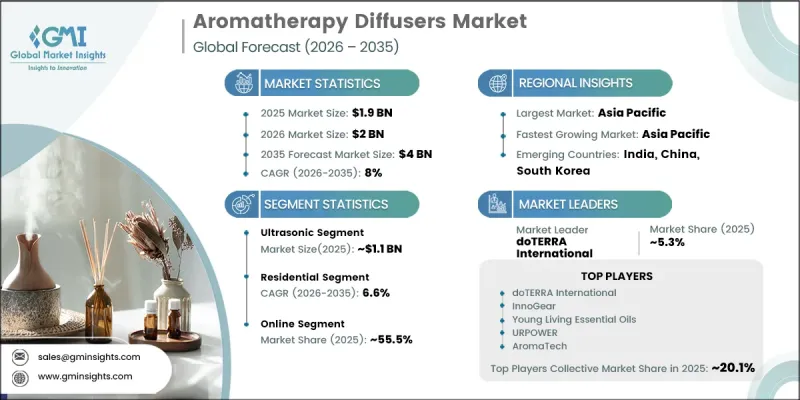
全球生活方式向健康生活方式轉變,推動了市場擴張。消費者越來越重視放鬆、情緒健康和自我護理。人們對精油益處的認知不斷提高,是香薰機在個人和商用環境中廣泛應用的主要因素。數位平台在提升產品認知度和促進消費者互動方面發揮著至關重要的作用,從而推動了不同人群的消費。隨著人們持續投資改善生活環境,香薰機正從小眾產品發展成為居家必備的生活用品。家庭健康領域的優質化趨勢進一步增強了不同收入階層的需求。此外,隨著企業將香氛體驗融入其辦公環境,商業應用也穩定成長。人們對持續改善空間環境的需求不斷成長,推動了高性能香薰系統的需求,而機構投資者也擴大將香薰解決方案納入更廣泛的健康和舒適策略中,從而支持了市場的持續成長。
| 市場範圍 | |
|---|---|
| 開始年份 | 2025 |
| 預測期 | 2026-2035 |
| 上市時的市場規模 | 19億美元 |
| 預計金額 | 40億美元 |
| 複合年成長率 | 8% |
預計到2025年,超音波市場規模將達到11億美元,並在2026年至2035年間以7%的複合年成長率成長。該細分市場憑藉其高效的擴散工藝和保持精油品質的能力而佔據領先地位。超音波技術利用振動機制,無需加熱即可將液體轉化為細霧,保留精油的天然特性。其運作安靜且用途廣泛,使其成為對噪音和性能要求極高的環境的理想選擇,這也促成了其在消費者中的廣泛應用。
預計到2025年,住宅市場規模將達到11億美元,並在2035年之前維持6.6%的複合年成長率。此細分市場佔據最大的市場佔有率,反映出香薰產品在住宅中的滲透率不斷提高。消費者擴大使用香薰機來營造有助於放鬆身心、提升整體幸福感的專屬空間。市場上豐富的價格區間推動了市場滲透,並贏得了從入門級到高階機型等各個消費群體的青睞。
預計到2025年,中國香薰機市場規模將達到2.971億美元,並在2026年至2035年間以7.3%的複合年成長率成長,帶動亞太地區市場的發展。市場成長的促進因素包括消費者健康意識的提高、可支配收入的增加以及數位零售生態系統的快速擴張。國內製造商憑藉具有競爭力的價格和高度擴充性的生產能力不斷鞏固市場地位,同時,追求先進功能和設計感的消費者對高級產品的需求也在不斷成長。持續的創新和不斷變化的消費者偏好正在進一步推動該地區市場的發展。
目錄
第1章:調查方法和範圍
第2章執行摘要
第3章業界考察
- 生態系分析
- 供應商情況
- 利潤率
- 每個階段增加的價值
- 影響價值鏈的因素
- 影響產業的因素
- 促進因素
- 消費者健康意識和自我護理文化的日益增強
- 電子商務與D2C通路的快速擴張
- 在飯店和醫療保健產業擴大商業應用。
- 陷阱與挑戰
- 亞洲低成本製造商之間的競爭異常激烈
- 消費者對產品安全性和精油品質的擔憂。
- 機會
- 智慧技術和物聯網賦能的擴散器技術的整合
- 拓展至中東、非洲和拉丁美洲等新興市場。
- 成長潛力分析
- 未來市場趨勢
- 科技與創新趨勢
- 當前技術趨勢
- 新興技術
- 監理情勢
- 標準和合規要求
- 區域法規結構
- 認證標準
- 波特五力分析
- PESTEL 分析
- 價格分析(基於初步調查)
- 對過去價格趨勢的分析(基於初步研究)
- 根據業務類型分類的定價策略(高階/價值/成本加成)(基於初步調查)
- 按產品類型和分銷管道分類的價格波動
- 區域價格基準
- 貿易資料分析(HS編碼8509.80)(基於付費資料庫)
- 進出口數量和價值的變化趨勢
- 主要貿易走廊及關稅的影響
- 按產品類型分類的分銷趨勢
- 區域貿易趨勢與跨境電子商務
- 人工智慧和生成式人工智慧對市場的影響
- 利用人工智慧改造現有經營模式
- GenAI 各細分市場的應用案例與部署藍圖
- 人工智慧驅動的個人化與消費者體驗
- 預測性維護和智慧家庭整合
- 風險、限制和監管考量
- 分銷基礎設施和通路滲透狀況(基於初步調查)
- 按地區和業態(現代零售與傳統零售)分類的通路覆蓋率(基於初步調查)
- 最後一公里基礎設施缺口和新興管道變化(基於初步研究)
- 電子商務滲透率和全通路策略的演變
第4章 競爭情勢
- 介紹
- 企業市佔率分析
- 按地區
- 企業矩陣分析
- 競爭定位矩陣
- 主要進展
- 併購
- 夥伴關係與合作
- 新產品發布
- 業務拓展計劃
第5章 市場估算與預測:依產品類型分類,2022-2035年
- 超音波擴散器
- 霧化器擴散器
- 加熱擴散器
- 蒸發式擴散器
- 其他
第6章 市場估計與預測:依應用領域分類,2022-2035年
- 住宅
- 商業的
- 水療和健康中心
- 飯店
- 辦公室
- 醫療設施
第7章 市場估計與預測:依價格區間分類,2022-2035年
- 價格低廉(20 美元以下)
- 中價位(20-100美元)
- 高價位(超過100美元)
第8章 市場估算與預測:依通路分類,2022-2035年
- 線上
- 電子商務網站
- 企業網站
- 離線
- 大賣場和超級市場
- 專賣店
- 零售店
- 其他
第9章 市場估計與預測:依地區分類,2022-2035年
- 北美洲
- 美國
- 加拿大
- 歐洲
- 德國
- 英國
- 法國
- 義大利
- 西班牙
- 其他歐洲地區
- 亞太地區
- 中國
- 印度
- 日本
- 韓國
- 澳洲
- 亞太其他地區
- 拉丁美洲
- 巴西
- 墨西哥
- 阿根廷
- 中東和非洲(MEA)
- 沙烏地阿拉伯
- 阿拉伯聯合大公國
- 南非
第10章:公司簡介
- 全球主要公司
- doTERRA International
- Young Living Essential Oils
- AromaTech
- Stadler Form
- InnoGear
- Senovat
- Youluxeo
- 該地區頂尖公司
- Vitruvi
- Ellia(Homedics)
- SpaRoom
- Neom Organics(Neom Wellbeing)
- Saje Wellness
- ESCENTS
- NOW Foods
- Emerging & Specialized Players
- Organic Aromas
- GreenAir(New Green Air Inc.)
- Edens Garden
- Rocky Mountain Oils
- Helias Oils
- URPOWER
- ASAKUKI
The Global Aromatherapy Diffusers Market was valued at USD 1.9 billion in 2025 and is estimated to grow at a CAGR of 8% to reach USD 4 billion by 2035.
Market expansion is fueled by a strong global shift toward wellness-focused lifestyles, with consumers placing greater emphasis on relaxation, emotional balance, and self-care practices. Increasing awareness of the benefits associated with essential oils has significantly contributed to the widespread adoption of diffusers across both personal and professional environments. Digital platforms have played a major role in accelerating product visibility and consumer engagement, encouraging broader acceptance across different demographic groups. As individuals continue to invest in improving their living environments, aromatherapy diffusers have evolved into essential home lifestyle products rather than niche offerings. Premiumization trends within the home wellness segment are further strengthening demand across varied income levels. In addition, commercial adoption is expanding steadily as businesses integrate scent-based experiences into their environments. The need for consistent ambient enhancement is driving demand for high-performance diffusion systems, while institutional buyers are increasingly incorporating aromatherapy solutions into broader wellness and comfort strategies, supporting sustained market growth.
| Market Scope | |
|---|---|
| Start Year | 2025 |
| Forecast Year | 2026-2035 |
| Start Value | $1.9 Billion |
| Forecast Value | $4 Billion |
| CAGR | 8% |
The ultrasonic segment generated USD 1.1 billion in 2025 and is expected to grow at a CAGR of 7% from 2026 to 2035. This segment leads the market due to its efficient diffusion process and ability to maintain the integrity of essential oils. Ultrasonic technology utilizes vibration-based mechanisms to convert liquid into a fine mist without the use of heat, preserving the natural properties of the oils. Its quiet operation and multifunctional capabilities make it highly suitable for environments that require minimal noise and consistent performance, contributing to its widespread adoption among consumers.
The residential segment accounted for USD 1.1 billion in 2025 and is projected to grow at a CAGR of 6.6% through 2035. This segment holds the largest share of the market, reflecting the growing integration of aromatherapy products into daily home routines. Consumers are increasingly using diffusers to create personalized environments that support relaxation and overall well-being. The availability of products across a wide pricing range has enabled strong market penetration, allowing both entry-level and premium offerings to gain traction among different consumer groups.
China Aromatherapy Diffusers Market reached USD 297.1 million in 2025 and is expected to grow at a CAGR of 7.3% from 2026 to 2035, leading the Asia Pacific region. Market growth is supported by increasing consumer awareness of wellness practices, rising disposable income, and the rapid expansion of digital retail ecosystems. Domestic manufacturers continue to strengthen their position through competitive pricing and scalable production capabilities, while premium product offerings are gaining momentum among consumers seeking advanced features and design-oriented solutions. Continuous innovation and evolving consumer preferences are further shaping market development in the region.
Key players operating in the Global Aromatherapy Diffusers Market include Young Living Essential Oils, doTERRA International, AromaTech, Stadler Form, InnoGear, Senovat, Youluxeo, Vitruvi, Ellia (Homedics), SpaRoom, Neom Organics (Neom Wellbeing), Saje Wellness, ESCENTS, NOW Foods, Organic Aromas, GreenAir (New Green Air Inc.), Edens Garden, Rocky Mountain Oils, Helias Oils, URPOWER, and ASAKUKI. Companies in the Aromatherapy Diffusers Market are focusing on product innovation, brand differentiation, and strategic expansion to strengthen their market position. Manufacturers are investing in advanced technologies to enhance product performance, including smart connectivity and customizable features. Businesses are also expanding their product portfolios to cater to diverse consumer preferences across various price segments. Partnerships with retail and e-commerce platforms are helping companies improve product accessibility and reach a broader audience. Branding and marketing strategies are increasingly centered on wellness positioning to align with consumer lifestyle trends.
Table of Contents
Chapter 1 Methodology & Scope
- 1.1 Market scope and definition
- 1.2 Research design
- 1.3 Research approach
- 1.4 Data collection methods
- 1.5 Data mining sources
- 1.5.1 Global
- 1.5.2 Regional/Country
- 1.6 Base estimates and calculations
- 1.6.1 Base year calculation
- 1.6.2 Key trends for market estimation
- 1.7 Primary research and validation
- 1.7.1 Primary sources
- 1.8 Forecast model
- 1.9 Research assumptions and limitations
Chapter 2 Executive Summary
- 2.1 Industry 360 degrees synopsis
- 2.2 Key market trends
- 2.2.1 Regional
- 2.2.2 Product Type
- 2.2.3 Application
- 2.2.4 Price Range
- 2.2.5 Distribution channel
Chapter 3 Industry Insights
- 3.1 Industry ecosystem analysis
- 3.2 Supplier landscape
- 3.3 Profit margin
- 3.4 Value addition at each stage
- 3.5 Factor affecting the value chain
- 3.6 Industry impact forces
- 3.7 Growth drivers
- 3.7.1 Rising consumer wellness awareness and self-care culture
- 3.7.2 Rapid e-commerce and direct-to-consumer channel expansion
- 3.7.3 Increasing commercial adoption in hospitality and healthcare
- 3.8 Pitfalls & Challenges
- 3.8.1 Intense competition from low-cost Asian manufacturers
- 3.8.2 Consumer concerns around product safety and essential oil quality
- 3.9 Opportunities
- 3.9.1 Integration of smart and IoT-enabled diffuser technology
- 3.9.2 Expansion into MEA and Latin America emerging markets
- 3.10 Growth potential analysis
- 3.11 Future market trends
- 3.12 Technology and innovation landscape
- 3.12.1 Current technological trends
- 3.12.2 Emerging technologies
- 3.13 Regulatory landscape
- 3.13.1 Standards and compliance requirements
- 3.13.2 Regional regulatory frameworks
- 3.13.3 Certification standards
- 3.14 Porter's analysis
- 3.15 PESTEL analysis
- 3.16 Pricing analysis (driven by primary research)
- 3.16.1 Historical price trend analysis (driven by primary research)
- 3.16.2 Pricing strategy by player type (premium / value / cost-plus) (driven by primary research)
- 3.16.3 Price variation by product type & distribution channel
- 3.16.4 Regional price benchmarking
- 3.17 Trade data analysis (HS code- 8509.80) (driven by paid database)
- 3.17.1 Import/export volume and value trends
- 3.17.2 Key trade corridors and tariff impact
- 3.17.3 Trade flow by product type
- 3.17.4 Regional trade dynamics and cross-border e-commerce
- 3.18 Impact of AI and generative AI on the market
- 3.18.1 AI-driven disruption of existing business models
- 3.18.2 GenAI use cases and adoption roadmap by segment
- 3.18.3 AI-powered personalization and consumer experience
- 3.18.4 Predictive maintenance and smart home integration
- 3.18.5 Risks, limitations and regulatory considerations
- 3.19 Distribution infrastructure and channel penetration landscape (driven by primary research)
- 3.19.1 Channel coverage by region and format (modern vs. traditional trade) (driven by primary research)
- 3.19.2 Last-mile infrastructure gaps and emerging channel shifts (driven by primary research)
- 3.19.3 E-commerce penetration and omnichannel strategy evolution
Chapter 4 Competitive Landscape, 2025
- 4.1 Introduction
- 4.2 Company market share analysis
- 4.3 By Region
- 4.3.1 North America
- 4.3.2 Europe
- 4.3.3 Asia Pacific
- 4.3.4 Latin America
- 4.3.5 Middle East & Africa
- 4.4 Company matrix analysis
- 4.5 Competitive positioning matrix
- 4.6 Key developments
- 4.6.1 Mergers & acquisitions
- 4.6.2 Partnerships & collaborations
- 4.6.3 New product launches
- 4.6.4 Expansion plans
Chapter 5 Market Estimates & Forecast, By Product Type, 2022 - 2035, (USD Billion)
- 5.1 Key trends
- 5.2 Ultrasonic diffusers
- 5.3 Nebulizing diffusers
- 5.4 Heat diffusers
- 5.5 Evaporative diffusers
- 5.6 Others
Chapter 6 Market Estimates & Forecast, By Application, 2022 - 2035, (USD Billion)
- 6.1 Key trends
- 6.2 Residential
- 6.3 Commercial
- 6.3.1 Spa & wellness centers
- 6.3.2 Hotels
- 6.3.3 Offices
- 6.3.4 Healthcare facilities
Chapter 7 Market Estimates & Forecast, By Price Range, 2022 - 2035, (USD Billion)
- 7.1 Key trends
- 7.2 Low (under USD 20)
- 7.3 Medium (USD 20 - USD 100)
- 7.4 High (above USD 100)
Chapter 8 Market Estimates & Forecast, By Distribution Channel, 2022 - 2035, (USD Billion)
- 8.1 Key trends
- 8.2 Online
- 8.2.1 E-commerce website
- 8.2.2 Company website
- 8.3 Offline
- 8.3.1 Hypermarkets and supermarkets
- 8.3.2 Specialty stores
- 8.3.3 Retail stores
- 8.3.4 Others
Chapter 9 Market Estimates & Forecast, By Region, 2022 - 2035, (USD Billion)
- 9.1 Key trends
- 9.2 North America
- 9.2.1 U.S.
- 9.2.2 Canada
- 9.3 Europe
- 9.3.1 Germany
- 9.3.2 UK
- 9.3.3 France
- 9.3.4 Italy
- 9.3.5 Spain
- 9.3.6 Rest of Europe
- 9.4 Asia Pacific
- 9.4.1 China
- 9.4.2 India
- 9.4.3 Japan
- 9.4.4 South Korea
- 9.4.5 Australia
- 9.4.6 Rest of Asia Pacific
- 9.5 Latin America
- 9.5.1 Brazil
- 9.5.2 Mexico
- 9.5.3 Argentina
- 9.6 MEA
- 9.6.1 Saudi Arabia
- 9.6.2 UAE
- 9.6.3 South Africa
Chapter 10 Company Profiles
- 10.1 Top Global Players
- 10.1.1 doTERRA International
- 10.1.2 Young Living Essential Oils
- 10.1.3 AromaTech
- 10.1.4 Stadler Form
- 10.1.5 InnoGear
- 10.1.6 Senovat
- 10.1.7 Youluxeo
- 10.2 Regional Champions
- 10.2.1 Vitruvi
- 10.2.2 Ellia (Homedics)
- 10.2.3 SpaRoom
- 10.2.4 Neom Organics (Neom Wellbeing)
- 10.2.5 Saje Wellness
- 10.2.6 ESCENTS
- 10.2.7 NOW Foods
- 10.3 Emerging & Specialized Players
- 10.3.1 Organic Aromas
- 10.3.2 GreenAir (New Green Air Inc.)
- 10.3.3 Edens Garden
- 10.3.4 Rocky Mountain Oils
- 10.3.5 Helias Oils
- 10.3.6 URPOWER
- 10.3.7 ASAKUKI

 擴香瓶市場-2026-2032年全球市場預測精油擴香儀市場-2026-2032年全球市場預測香薰機市場:2026-2032年全球市場預測(依產品類型、材質、動力來源、外形規格、應用、最終用戶及通路分類)
 香薰機市場報告:趨勢、預測及競爭分析(至2035年)
 香薰擴散器市場報告:按產品類型、銷售管道、應用和地區分類(2026-2034 年)
 2026 年至 2035 年蠟燭保溫器及相關配件的市場機會、成長要素、產業趨勢分析與預測。
 香薰機市場:依產品類型、銷售管道和地區分類
 香薰擴散器市場分析及預測(至2035年):依類型、產品類型、技術、應用、材質、最終用戶、功能、安裝類型和模式分類
 全球家用香氛擴散器市場規模、佔有率、趨勢及成長分析報告(2026-2034)全球香薰擴散器市場規模、佔有率、趨勢和成長分析報告(2026-2034)