

 |
市場調查報告書
商品編碼
2038737
遠端患者監護設備市場:商業機會、成長要素、產業趨勢分析及2026-2035年預測Remote Patient Monitoring (RPM) Devices Market Opportunity, Growth Drivers, Industry Trend Analysis, and Forecast 2026 - 2035 |
||||||

全球遠端患者監護設備市場預計到 2025 年將達到 262 億美元,預計到 2035 年將以 11.2% 的複合年成長率成長至 743 億美元。
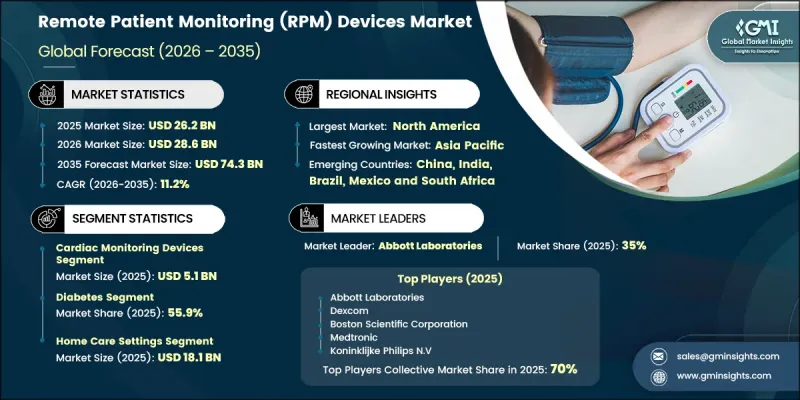
市場成長的促進因素包括慢性病盛行率的上升、醫療保健的快速數位化以及降低再入院率和整體醫療成本的迫切需求。遠端患者監護(RPM) 允許在傳統臨床環境之外持續追蹤患者的生命徵象和健康狀況,使醫生能夠基於數據做出快速決策,並提高患者對治療方案的依從性。智慧型手機、連網醫療設備和雲端平台的普及顯著提高了 RPM 解決方案的易用性、準確性和擴充性。這些技術共同支持了一種更積極主動的預防性醫療模式,減少了急診次數,減輕了醫療基礎設施的負擔。
| 市場範圍 | |
|---|---|
| 開始年份 | 2025 |
| 預測期 | 2026-2035 |
| 上市時的市場規模 | 262億美元 |
| 預測金額 | 743億美元 |
| 複合年成長率 | 11.2% |
全球醫療保健模式轉向價值導向和居家醫療醫療模式的轉變,進一步加速了遠端病患監測(RPM)設備的需求。保險公司和醫療服務提供者日益認知到遠距監測的經濟效益,包括縮短住院時間、降低再入院罰款以及更好地管理高風險患者群體。此外,全球人口老化以及糖尿病、心血管疾病和呼吸系統疾病盛行率的上升,擴大了RPM的目標患者群體。政府的各項舉措,例如推廣數位醫療、報銷遠端醫療以及將遠端監測納入標準治療流程,也在預測期內對擴大市場滲透率發揮重要作用。
預計到2025年,心臟監測設備市場規模將達51億美元。該市場包括心電圖(ECG)設備、植入式心臟監測器、穿戴式式心臟監測器以及用於即時檢測心律不整、心臟衰竭加重和其他心臟異常的事件記錄儀。心血管疾病在全球造成的沉重負擔,以及對高風險心臟病患者進行持續監測的迫切需求,是推動該市場成長要素。遠距心電圖監測減少了患者頻繁的面對面就診需求,能夠及早發現危及生命的事件,並有助於更合理地調整藥物治療。
預計到2025年,居家照護市場規模將達到181億美元,主要得益於醫療服務模式從醫院向患者家中的轉變,旨在提高患者舒適度、降低成本並減少再入院率。該市場利用遠端監測設備,例如生命徵象監測儀、血糖值儀、心臟穿戴設備和連網脈動式血氧監測儀系統,對慢性疾病患者、術後患者和老年人進行持續或定期追蹤。家庭監測使患者能夠在熟悉的環境中接受醫療專業人員的遠端監測,從而提高治療依從性和生活品質。
2024年,北美遠距病患監測(RPM)設備市佔率達到42.3%,成為全球市佔率最大的地區。該地區的主導地位得益於其完善的醫療基礎設施、高額的醫療費用支出以及對數位醫療技術的積極應用。尤其值得一提的是,美國遠距監護服務的優惠報銷政策極大地鼓勵了醫療服務提供者將RPM納入其慢性病管理方案。此外,文明病的高發生率、龐大的老齡人口以及網際網路和智慧型設備的普及,也為遠距監護解決方案的部署創造了理想的環境。
目錄
第1章:調查方法
- 研究途徑
- 品質改進計劃
- GMI人工智慧政策和資料完整性計劃
- 資訊來源一致性協議
- GMI人工智慧政策和資料完整性計劃
- 調查過程和可靠性評分
- 調查過程的組成部分
- 評分組成部分
- 數據收集
- 主要來源部分列表
- 資料探勘資訊來源
- 付費資訊來源
- 區域資訊來源
- 付費資訊來源
- 基本估算和計算方法
- 每種方法中基準年的計算
- 預測模型
- 量化市場影響分析
- 生長參數對預測的數學影響
- 量化市場影響分析
- 關於調查透明度的補充信息
- 資訊來源歸屬框架
- 品質保證指標
- 對信任的承諾
第2章執行摘要
第3章業界考察
- 生態系分析
- 影響產業的因素
- 促進因素
- 全球慢性病發生率上升
- 新興經濟體可支配收入和醫療保健支出不斷成長
- 已開發國家的技術進步
- 遠端患者監護設備的廣泛應用
- 產業潛在風險與挑戰
- 設備高成本
- 嚴格的法規結構
- 市場機遇
- 擴大人工智慧驅動的預測性監測工具的應用
- 穿戴式生物感測器的出現,使得對健康狀況進行連續、即時追蹤成為可能。
- 促進因素
- 成長潛力分析
- 監理情勢(基於初步調查)
- 北美洲
- 歐洲
- 亞太地區
- 技術趨勢(基於初步調查)
- 目前技術
- 聯網生命徵象監測設備
- 支援藍牙和蜂窩網路的RPM設備
- 基於雲端的監測平台和臨床儀表板
- 遠端醫療整合RPM解決方案
- 新興技術
- 人工智慧驅動的預測性監測和臨床決策支持
- 穿戴式生物感測器和貼在皮膚上的監測貼片
- 多參數監測穿戴式裝置
- 具有標準化資料協定的可互通 RPM 生態系統
- 目前技術
- 未來市場趨勢(基於初步研究)
- 專利分析(基於初步研究)
- 人工智慧和生成式人工智慧對市場的影響(基於初步研究)
- 波特五力分析
- PESTEL 分析
第4章 競爭情勢
- 介紹
- 企業市佔率分析
- 企業矩陣分析
- 主要市場公司的競爭分析
- 競爭定位矩陣
- 主要進展
- 併購
- 夥伴關係與合作
- 新產品發布
- 業務拓展計劃
第5章 市場估價與預測:依產品分類,2022-2035年
- 心臟監測設備
- 血壓監測設備
- 神經監測設備
- 呼吸監測設備
- 多參數監測設備
- 血糖監測設備
- 胎兒及新生兒監護設備
- 睡眠監測設備
- 其他產品
第6章 市場估計與預測:依應用領域分類,2022-2035年
- 心血管疾病
- 癌症
- 糖尿病
- 神經系統疾病
- 感染疾病
- 呼吸系統疾病
- 其他用途
第7章 市場估計與預測:依最終用途分類,2022-2035年
- 居家照護環境
- 長期照護
- 其他最終用戶
第8章 市場估計與預測:依地區分類,2022-2035年
- 北美洲
- 美國
- 加拿大
- 歐洲
- 德國
- 英國
- 法國
- 西班牙
- 義大利
- 荷蘭
- 亞太地區
- 中國
- 日本
- 印度
- 澳洲
- 韓國
- 拉丁美洲
- 巴西
- 墨西哥
- 阿根廷
- 中東和非洲
- 南非
- 沙烏地阿拉伯
- 阿拉伯聯合大公國
第9章:公司簡介
- Abbott Laboratories
- Baxter International
- Boston Scientific Corporation
- BIOTRONIK SE &Co. KG
- DexCom
- F. Hoffmann-La Roche
- GE Healthcare
- Johnson &Johnson
- Koninklijke Philips
- Medtronic
- OMRON Corporation
- Sotera Wireless
- VitalConnect
The Global Remote Patient Monitoring Devices Market was valued at USD 26.2 billion in 2025 and is estimated to grow at a CAGR of 11.2% to reach USD 74.3 billion by 2035.
Market growth is driven by the rising prevalence of chronic diseases, rapid digitalization of healthcare, and the growing need to reduce hospital readmissions and overall care costs. Remote patient monitoring (RPM) enables continuous tracking of patients' vital signs and health status outside traditional clinical settings, empowering physicians to make faster, data-driven decisions and improving patient adherence to treatment plans. Rising adoption of smartphones, connected medical devices, and cloud-based platforms has significantly enhanced the usability, accuracy, and scalability of RPM solutions. These technologies collectively support more proactive and preventive care models, reducing emergency visits and easing the burden on healthcare infrastructure.
| Market Scope | |
|---|---|
| Start Year | 2025 |
| Forecast Year | 2026-2035 |
| Start Value | $26.2 Billion |
| Forecast Value | $74.3 Billion |
| CAGR | 11.2% |
The global shift towards value-based care and home-based healthcare is further accelerating the demand for RPM devices. Payers and providers are increasingly recognizing the economic benefits of remote monitoring, such as reduced inpatient days, lower readmission penalties, and better management of high-risk patient cohorts. Additionally, aging populations worldwide and the rising incidence of conditions like diabetes, cardiovascular diseases, and respiratory disorders are expanding the addressable patient pool for RPM. Government initiatives promoting digital health, telehealth reimbursement, and integration of remote monitoring into standard care pathways are also playing a critical role in enhancing market penetration over the forecast period.
The cardiac monitoring devices segment generated USD 5.1 billion in 2025. This segment includes ECG devices, implantable cardiac monitors, wearable heart monitors, and event recorders used to detect arrhythmias, heart failure exacerbations, and other cardiac abnormalities in real time. The high burden of cardiovascular diseases globally, combined with the critical need for continuous surveillance of high-risk cardiac patients, is a core driver for this segment. Remote cardiac monitoring reduces the need for frequent in-person consultations, enables early identification of life-threatening events, and supports better medication titration.
The home care settings segment captured USD 18.1 billion in 2025 as healthcare delivery shifted from hospitals to patients' homes to improve comfort, reduce costs, and minimize hospital readmissions. In this segment, remote monitoring devices such as vital signs monitors, glucose meters, cardiac wearables, and connected oximeters are used to track patients with chronic conditions, post-operative cases, and elderly individuals on a continuous or scheduled basis. Home-based monitoring enables patients to remain in a familiar environment while still being under the virtual supervision of healthcare professionals, which enhances treatment adherence and quality of life.
North America Remote Patient Monitoring Devices Market held 42.3% share in 2024, accounting for the largest regional share. The region's leadership is supported by a well-established healthcare infrastructure, high healthcare expenditure, and strong adoption of digital health technologies. Favorable reimbursement frameworks for remote monitoring services, particularly in the United States, have significantly encouraged providers to incorporate RPM into chronic disease management programs. Additionally, a high prevalence of lifestyle-related disorders, a large elderly population, and widespread access to the internet and smart devices create an ideal environment for the deployment of remote monitoring solutions.
Key players operating in the Global Remote Patient Monitoring Devices Market include Philips Healthcare, Medtronic plc, GE HealthCare, Abbott Laboratories, Boston Scientific Corporation, Nihon Kohden Corporation, ResMed Inc., Dexcom, Inc., and Masimo Corporation. These companies focus on continuous product innovation, integrating advanced sensors, wireless connectivity, and data analytics into their device portfolios. They are also actively involved in strategic partnerships with hospitals, telehealth platforms, and payers to expand their installed base and enhance recurring revenue streams via monitoring services and software subscriptions. Many of these players are investing in AI-enabled platforms that can automatically flag abnormal readings, support predictive risk scoring, and simplify clinical workflows, making remote monitoring more scalable and effective for large patient populations.
Table of Contents
Chapter 1 Research Methodology
- 1.1 Research approach
- 1.2 Quality commitments
- 1.2.1 GMI AI policy & data integrity commitment
- 1.2.1.1 Source consistency protocol
- 1.2.1 GMI AI policy & data integrity commitment
- 1.3 Research trail & confidence scoring
- 1.3.1 Research trail components
- 1.3.2 Scoring components
- 1.4 Data collection
- 1.4.1 Partial list of primary sources
- 1.5 Data mining sources
- 1.5.1 Paid sources
- 1.5.1.1 Sources, by region
- 1.5.1 Paid sources
- 1.6 Base estimates and calculations
- 1.6.1 Base year calculation for any one approach
- 1.7 Forecast model
- 1.7.1 Quantified market impact analysis
- 1.7.1.1 Mathematical impact of growth parameters on forecast
- 1.7.1 Quantified market impact analysis
- 1.8 Research transparency addendum
- 1.8.1 Source attribution framework
- 1.8.2 Quality assurance metrics
- 1.8.3 Our commitment to trust
Chapter 2 Executive Summary
- 2.1 Industry 360° synopsis
- 2.1.1 Key market trends
- 2.1.2 Product trends
- 2.1.3 Application trends
- 2.1.4 End use trends
- 2.1.5 Regional trends
- 2.2 CXO perspectives: Strategic imperatives
Chapter 3 Industry Insights
- 3.1 Industry ecosystem analysis
- 3.2 Industry impact forces
- 3.2.1 Growth drivers
- 3.2.1.1 Rising incidence of chronic diseases across the globe
- 3.2.1.2 Growing disposable income and healthcare expenditure in emerging countries
- 3.2.1.3 Technological advancement in developed nations
- 3.2.1.4 Growing adoption of remote patient monitoring devices
- 3.2.2 Industry pitfalls and challenges
- 3.2.2.1 High cost of devices
- 3.2.2.2 Stringent regulatory framework
- 3.2.3 Market opportunity
- 3.2.3.1 Increasing adoption of AI-powered predictive monitoring tools
- 3.2.3.2 Emergence of wearable biosensors for continuous, real-time health tracking
- 3.2.1 Growth drivers
- 3.3 Growth potential analysis
- 3.4 Regulatory landscape (Driven by Primary Research)
- 3.4.1 North America
- 3.4.2 Europe
- 3.4.3 Asia Pacific
- 3.5 Technological landscape (Driven by Primary Research)
- 3.5.1 Current technologies
- 3.5.1.1 Connected vital signs monitoring devices
- 3.5.1.2 Bluetooth and cellular enabled RPM devices
- 3.5.1.3 Cloud based monitoring platforms and clinical dashboards
- 3.5.1.4 Telehealth integrated rpm solutions
- 3.5.2 Emerging technologies
- 3.5.2.1 AI powered predictive monitoring and clinical decision support
- 3.5.2.2 Wearable biosensors and skin-integrated monitoring patches
- 3.5.2.3 Multi parameter monitoring wearables
- 3.5.2.4 Interoperable RPM ecosystems with standardized data protocols
- 3.5.1 Current technologies
- 3.6 Future market trends (Driven by Primary Research)
- 3.7 Patent analysis (Driven by Primary Research)
- 3.8 Impact of AI and Generative AI on the market (Driven by Primary Research)
- 3.9 Porter's analysis
- 3.10 PESTEL analysis
Chapter 4 Competitive Landscape, 2025
- 4.1 Introduction
- 4.2 Company market share analysis
- 4.3 Company matrix analysis
- 4.4 Competitive analysis of major market players
- 4.5 Competitive positioning matrix
- 4.6 Key developments
- 4.6.1 Merger and acquisition
- 4.6.2 Partnership and collaboration
- 4.6.3 New product launches
- 4.6.4 Expansion plans
Chapter 5 Market Estimates and Forecast, By Product, 2022 - 2035 ($ Mn)
- 5.1 Key trends
- 5.2 Cardiac monitoring devices
- 5.3 Blood pressure monitoring devices
- 5.4 Neurological monitoring devices
- 5.5 Respiratory monitoring devices
- 5.6 Multiparameter monitoring devices
- 5.7 Blood glucose monitoring devices
- 5.8 Fetal and neonatal monitoring devices
- 5.9 Sleep monitoring devices
- 5.10 Other products
Chapter 6 Market Estimates and Forecast, By Application, 2022 - 2035 ($ Mn)
- 6.1 Key trends
- 6.2 Cardiovascular diseases
- 6.3 Cancer
- 6.4 Diabetes
- 6.5 Neurological disorders
- 6.6 Infectious diseases
- 6.7 Respiratory diseases
- 6.8 Other applications
Chapter 7 Market Estimates and Forecast, By End Use, 2022 - 2035 ($ Mn)
- 7.1 Key trends
- 7.2 Home-care settings
- 7.3 Long-term care
- 7.4 Other end users
Chapter 8 Market Estimates and Forecast, By Region, 2022 - 2035 ($ Mn)
- 8.1 Key trends
- 8.2 North America
- 8.2.1 U.S.
- 8.2.2 Canada
- 8.3 Europe
- 8.3.1 Germany
- 8.3.2 UK
- 8.3.3 France
- 8.3.4 Spain
- 8.3.5 Italy
- 8.3.6 Netherlands
- 8.4 Asia Pacific
- 8.4.1 China
- 8.4.2 Japan
- 8.4.3 India
- 8.4.4 Australia
- 8.4.5 South Korea
- 8.5 Latin America
- 8.5.1 Brazil
- 8.5.2 Mexico
- 8.5.3 Argentina
- 8.6 Middle East and Africa
- 8.6.1 South Africa
- 8.6.2 Saudi Arabia
- 8.6.3 UAE
Chapter 9 Company Profiles
- 9.1 Abbott Laboratories
- 9.2 Baxter International
- 9.3 Boston Scientific Corporation
- 9.4 BIOTRONIK SE & Co. KG
- 9.5 DexCom
- 9.6 F. Hoffmann-La Roche
- 9.7 GE Healthcare
- 9.8 Johnson & Johnson
- 9.9 Koninklijke Philips
- 9.10 Medtronic
- 9.11 OMRON Corporation
- 9.12 Sotera Wireless
- 9.13 VitalConnect

 遠端患者監護設備市場規模、佔有率和成長分析:按設備類型、監護功能、最終用戶、技術類型和地區分類-2026-2033年產業預測
 遠端患者監護市場預測至2034年-全球分析(按組件、產品類型、適應症、交付方式、監護方式、傳輸方式、應用、最終用戶和地區分類)
 遠端患者監護市場中的人工智慧:按組件、技術、設備類型、交付方式、服務類型、應用和最終用戶分類——2026-2032年全球市場預測遠端監控設備市場:按產品類型、連接技術、應用和最終用戶分類 - 2026-2032年全球市場預測
 CALM浮標遠端監控設備市場報告:趨勢、預測與競爭分析(至2035年)
 遠端患者監護設備市場規模、佔有率、成長率及全球市場分析:按類型、應用和地區分類,並提供2026-2034年的洞察和預測遠端測試、檢驗和認證市場規模、佔有率、成長率及全球產業分析:按類型、應用和地區的洞察,2026-2034年的預測2026-2034年全球遠端患者監護產品市場規模、佔有率、趨勢和成長分析報告遠端患者監護市場:2026-2032年全球市場預測(按產品類型、交付方式、監護方式、最終用戶和應用領域分類)
 2026年全球腹膜透析遠距監測中心市場報告