


 |
市場調查報告書
商品編碼
2038736
醫療圖像市場商機、成長要素、產業趨勢分析及2026-2035年預測。Medical Imaging Market Opportunity, Growth Drivers, Industry Trend Analysis, and Forecast 2026 - 2035 |
||||||

2025年全球醫療圖像市場價值460億美元,預計2035年將以5.9%的複合年成長率成長至809億美元。
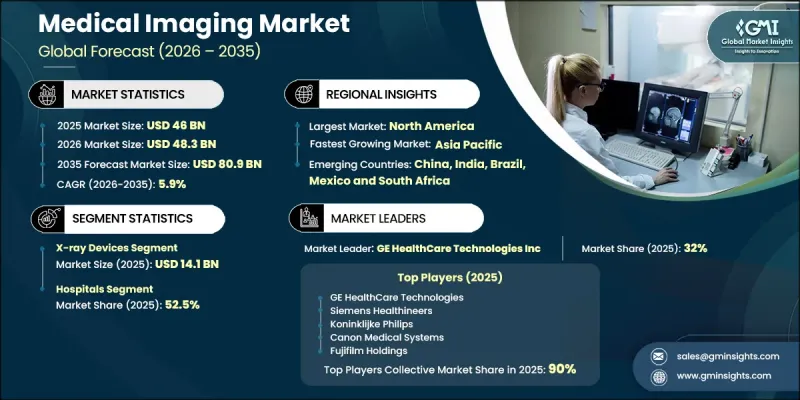
慢性疾病負擔日益加重、人口老化、醫學影像技術的不斷進步以及已開發國家和發展中國家醫療保健成本的不斷上漲,共同推動了這一成長。醫療圖像仍然是臨床診斷和治療計劃的基礎,使醫療專業人員能夠詳細觀察器官、組織和骨骼。這些技術支持疾病的早期發現,指南微創手術,並有助於患者的長期管理。硬體和軟體的創新、影像清晰度的提高以及影像處理速度的加快,進一步增強了臨床決策能力,改善了患者預後,並推動了全球需求的成長。
| 市場範圍 | |
|---|---|
| 開始年份 | 2025 |
| 預測期 | 2026-2035 |
| 上市時的市場規模 | 460億美元 |
| 預測市場規模 | 809億美元 |
| 複合年成長率 | 5.9% |
醫療圖像依賴產生高解析度影像資料的技術,以支援臨床評估和外科手術。這些工具已發展成為診斷的重要組成部分,在醫療保健的各個領域提供精準高效的診斷。磁振造影系統、 X光設備、CT掃描儀和超音波診斷設備等設備廣泛應用於臨床,用於評估內臟損傷、慢性疾病和異常情況。它們的即時成像功能有助於診斷,並簡化工作流程。
預計到2025年, X光設備市場規模將達到141億美元。這主要得益於X光在慢性病早期診斷中應用日益廣泛。 X光技術的不斷升級也推動了該市場的成長。如今,X光設備已包含人工智慧成像解決方案,旨在確保診斷準確性、簡化工作流程並減輕放射科醫生的負擔。這些先進系統已在多中心評估中展現出卓越的有效性,並廣泛應用於臨床實踐。智慧診斷功能的引入顯著提升了醫療服務提供者的信心,並促進了X光系統在現代醫學影像領域的更廣泛應用。
截至2025年,醫院領域將佔據52.5%的市場。這一成長主要得益於快速的都市化、人口成長以及醫療基礎設施投資的增加。先進診斷設備的廣泛應用,以及能夠操作這些設備的專業人員的湧現,使醫院成為該市場的主要終端用戶。此外,醫院維修和新建案的資金投入增加,尤其是在發展中地區,也推動了診斷影像設備的應用。政府和私人對改善醫院基礎設施的投資,也顯著提升了對高效能診斷影像技術的需求。
預計到2025年,美國醫療圖像市場規模將達到158億美元。受環境和生活方式因素的影響,美國癌症發病率不斷上升,這導致人們對高效先進的影像工具的需求日益成長,這些工具可用於癌症的早期檢測和後續觀察。癌症發生率的上升促使醫院和診所投資於具有高診斷價值和患者個體化精準度的影像系統,加速了美國市場的整體成長。
目錄
第1章:調查方法和範圍
第2章執行摘要
第3章業界考察
- 生態系分析
- 影響產業的因素
- 促進因素
- 醫學影像技術的不斷創新與進步
- 醫療費用增加
- 隨著老年人口的快速成長,疾病負擔也不斷加重。
- 人工智慧(AI)在放射學領域的興起
- 政府應採取的舉措
- 產業潛在風險與挑戰
- 醫療影像設備高成本
- 還款政策的變化
- 市場機遇
- 新興市場的擴張
- 促進因素
- 成長潛力分析
- 監理情勢(基於初步調查)
- 北美洲
- 歐洲
- 亞太地區
- 技術趨勢(基於初步調查)
- 目前技術
- 數位X光和平板檢測器系統
- 先進的電腦斷層掃描(CT)和磁振造影(MRI)系統
- PACS和基於雲端的影像資料管理平台
- 新興技術
- 人工智慧影像分析與臨床決策支援系統
- 攜帶式和即時成像技術
- 低劑量、高靈敏度影像診斷技術
- 具有整合數位健康平台的可互通成像生態系統
- 目前技術
- 未來市場趨勢(基於初步研究)
- 專利分析(基於初步研究)
- 價格分析(2025 年)(基於初步調查)
- 人工智慧和生成式人工智慧對市場的影響(基於初步研究)
- 波特五力分析
- PESTEL 分析
第4章 競爭情勢
- 介紹
- 企業市佔率分析
- 企業矩陣分析
- 主要市場公司的競爭分析
- 競爭定位矩陣
- 戰略展望矩陣
- 主要進展
- 併購
- 夥伴關係與合作
- 新產品發布
- 業務拓展計劃
第5章 市場估價與預測:依產品分類,2022-2035年
- X光設備
- 數位的
- 直接成像系統
- 電腦放射成像系統
- 模擬
- 數位的
- MRI
- 超音波
- 2D超音波
- 3D超音波
- 其他超音波
- 電腦斷層掃描
- 核子醫學掃描術診斷
- 乳房X光攝影
第6章 市場估算與預測:依最終用途分類,2022-2035年
- 醫院
- 診斷中心
- 其他最終用戶
第7章 市場估計與預測:依地區分類,2022-2035年
- 北美洲
- 美國
- 加拿大
- 歐洲
- 德國
- 英國
- 法國
- 西班牙
- 義大利
- 荷蘭
- 亞太地區
- 中國
- 日本
- 印度
- 澳洲
- 韓國
- 拉丁美洲
- 巴西
- 墨西哥
- 阿根廷
- 中東和非洲
- 南非
- 沙烏地阿拉伯
- 阿拉伯聯合大公國
第8章:公司簡介
- Agfa-Gevaert Group
- Canon Medical Systems
- Carestream Health
- Esaote
- Fujifilm Holdings
- GE HealthCare Technologies
- Hologic
- Konica Minolta
- Koninklijke Philips
- Orthoscan
- Planmed Oy
- Samsung Medison
- Shimadzu
- Siemens Healthineers
- Trivitron Healthcare
The Global Medical Imaging Market was valued at USD 46 billion in 2025 and is estimated to grow at a CAGR of 5.9% to reach USD 80.9 billion by 2035.
This growth is supported by the increasing burden of chronic diseases, a rising aging population, ongoing advancements in imaging technologies, and greater healthcare spending across both emerging and developed nations. Medical imaging continues to be a cornerstone in clinical diagnostics and treatment planning, as it enables healthcare providers to visualize internal organs, tissues, and bones in detail. These technologies help in early disease detection, guide minimally invasive procedures, and contribute to long-term patient management. Innovations in hardware and software, improved image clarity, and faster image processing are further elevating clinical decision-making, improving patient outcomes, and boosting demand worldwide.
| Market Scope | |
|---|---|
| Start Year | 2025 |
| Forecast Year | 2026-2035 |
| Start Value | $46 Billion |
| Forecast Value | $80.9 Billion |
| CAGR | 5.9% |
Medical imaging relies on technologies that produce high-definition visual data to assist in clinical evaluations and surgical interventions. These tools have evolved into essential components of diagnostics, offering precision and speed across medical disciplines. Devices such as MRI systems, X-rays, CT scanners, and ultrasound machines are deployed across clinical settings to evaluate internal injuries, chronic conditions, and abnormalities. Their real-time imaging capabilities support diagnosis and improve workflow efficiency.
In 2025, the X-ray devices segment reached USD 14.1 billion, primarily due to its increased usage for early diagnosis of chronic illnesses. This segment's growth is supported by the constant upgrades in X-ray technologies that now include AI-powered imaging solutions designed to ensure accuracy, streamline workflows, and reduce the burden on radiologists. These advanced systems have proven their efficacy in multicenter evaluations and are widely adopted across clinical setups. The incorporation of smart diagnostic capabilities is significantly enhancing provider confidence and contributing to the rising utilization of X-ray systems in modern medical imaging practices.
The hospitals segment held a 52.5% share in 2025. Their growing share is influenced by rapid urbanization, population growth, and a rise in healthcare infrastructure investments. The widespread installation of advanced diagnostic equipment, coupled with skilled professionals available to operate them, is positioning hospitals as dominant end-users in this market. Additionally, increased funding for hospital upgrades and new construction especially across developing regions is elevating the adoption of imaging equipment. Government and private investments in improving hospital infrastructure are driving significant demand for high-performance imaging technologies.
United States Medical Imaging Market was valued at USD 15.8 billion in 2025. The rising cancer prevalence across the country, stemming from environmental and lifestyle-related factors, has intensified the need for effective and advanced imaging tools for early cancer detection and monitoring. The growing incidence of such conditions is pushing hospitals and clinics to invest in imaging systems that offer high diagnostic value and patient-specific accuracy, thus accelerating overall market growth in the U.S.
Prominent companies operating in the Global Medical Imaging Market include GE HealthCare Technologies, Shimadzu, Samsung Medison, Carestream Health, Canon Medical Systems, Fujifilm Holdings, Hologic, Konica Minolta, Esaote, Siemens Healthineers, and Koninklijke Philips. Leading medical imaging companies are prioritizing innovation by investing in AI integration, machine learning algorithms, and automation to boost image accuracy and diagnostic speed. They are expanding their digital health platforms to support remote diagnostics, cloud-based image storage, and data interoperability. Global market players are actively pursuing mergers, acquisitions, and collaborations with hospitals and technology firms to broaden their solution portfolios. Expansion into high-growth emerging markets is another critical strategy, supported by localized manufacturing and service centers. To remain competitive, manufacturers are also offering modular imaging systems that reduce maintenance and allow for easier upgrades.
Table of Contents
Chapter 1 Methodology and Scope
- 1.1 Research approach
- 1.2 Quality commitments
- 1.2.1 GMI AI policy & data integrity commitment
- 1.2.1.1 Source consistency protocol
- 1.2.1 GMI AI policy & data integrity commitment
- 1.3 Research trail & confidence scoring
- 1.3.1 Research trail components
- 1.3.2 Scoring components
- 1.4 Data collection
- 1.4.1 Partial list of primary sources
- 1.5 Data mining sources
- 1.5.1 Paid sources
- 1.5.1.1 Sources, by region
- 1.5.1 Paid sources
- 1.6 Base estimates and calculations
- 1.6.1 Base year calculation for any one approach
- 1.7 Forecast model
- 1.7.1 Quantified market impact analysis
- 1.7.1.1 Mathematical impact of growth parameters on forecast
- 1.7.1 Quantified market impact analysis
- 1.8 Research transparency addendum
- 1.8.1 Source attribution framework
- 1.8.2 Quality assurance metrics
- 1.8.3 Our commitment to trust
Chapter 2 Executive Summary
- 2.1 Industry 360° synopsis
- 2.2 Key market trends
- 2.2.1 Product trends
- 2.2.2 End use trends
- 2.2.3 Regional trends
- 2.3 CXO perspectives: Strategic imperatives
Chapter 3 Industry Insights
- 3.1 Industry ecosystem analysis
- 3.2 Industry impact forces
- 3.2.1 Growth drivers
- 3.2.1.1 Incremental innovations and advancements in medical imaging technology
- 3.2.1.2 Rise in healthcare expenditure
- 3.2.1.3 Increasing disease burden along with rapidly growing geriatric population base
- 3.2.1.4 Emergence of artificial intelligence (AI) in radiology
- 3.2.1.5 Favorable government initiatives
- 3.2.2 Industry pitfalls and challenges
- 3.2.2.1 High cost of imaging devices
- 3.2.2.2 Changes in reimbursement policies
- 3.2.3 Market opportunities
- 3.2.3.1 Expansion in emerging markets
- 3.2.1 Growth drivers
- 3.3 Growth potential analysis
- 3.4 Regulatory landscape (Driven by Primary Research)
- 3.4.1 North America
- 3.4.2 Europe
- 3.4.3 Asia Pacific
- 3.5 Technological landscape (Driven by Primary Research)
- 3.5.1 Current technologies
- 3.5.1.1 Digital X ray and flat panel detector systems
- 3.5.1.2 Advanced computed tomography (CT) and magnetic resonance imaging (MRI) systems
- 3.5.1.3 PACS and cloud based imaging data management platforms
- 3.5.2 Emerging technologies
- 3.5.2.1 AI powered image analysis and clinical decision support systems
- 3.5.2.2 Portable and point of care imaging technologies
- 3.5.2.3 Low dose and high sensitivity imaging technologies
- 3.5.2.4 Interoperable imaging ecosystems with integrated digital health platforms
- 3.5.1 Current technologies
- 3.6 Future market trends (Driven by Primary Research)
- 3.7 Patent analysis (Driven by Primary Research)
- 3.8 Pricing analysis, 2025 (Driven by Primary Research)
- 3.9 Impact of AI and Generative AI on the market (Driven by Primary Research)
- 3.10 Porter's analysis
- 3.11 PESTEL analysis
Chapter 4 Competitive Landscape, 2025
- 4.1 Introduction
- 4.2 Company market share analysis
- 4.3 Company matrix analysis
- 4.4 Competitive analysis of major market players
- 4.5 Competitive positioning matrix
- 4.6 Strategy outlook matrix
- 4.7 Key developments
- 4.7.1 Mergers and acquisitions
- 4.7.2 Partnerships and collaborations
- 4.7.3 New product launches
- 4.7.4 Expansion plans
Chapter 5 Market Estimates and Forecast, By Product, 2022 - 2035 ($ Mn)
- 5.1 Key trends
- 5.2 X-ray devices
- 5.2.1 Digital
- 5.2.1.1 Direct radiography systems
- 5.2.1.2 Computed radiography systems
- 5.2.2 Analog
- 5.2.1 Digital
- 5.3 MRI
- 5.4 Ultrasound
- 5.4.1 2D Ultrasound
- 5.4.2 3D Ultrasound
- 5.4.3 Other ultrasounds
- 5.5 Computed tomography
- 5.6 Nuclear imaging
- 5.7 Mammography
Chapter 6 Market Estimates and Forecast, By End Use, 2022 - 2035 ($ Mn)
- 6.1 Key trends
- 6.2 Hospitals
- 6.3 Diagnostic centers
- 6.4 Other end users
Chapter 7 Market Estimates and Forecast, By Region, 2022 - 2035 ($ Mn)
- 7.1 Key trends
- 7.2 North America
- 7.2.1 U.S.
- 7.2.2 Canada
- 7.3 Europe
- 7.3.1 Germany
- 7.3.2 UK
- 7.3.3 France
- 7.3.4 Spain
- 7.3.5 Italy
- 7.3.6 Netherlands
- 7.4 Asia Pacific
- 7.4.1 China
- 7.4.2 Japan
- 7.4.3 India
- 7.4.4 Australia
- 7.4.5 South Korea
- 7.5 Latin America
- 7.5.1 Brazil
- 7.5.2 Mexico
- 7.5.3 Argentina
- 7.6 Middle East and Africa
- 7.6.1 South Africa
- 7.6.2 Saudi Arabia
- 7.6.3 UAE
Chapter 8 Company Profiles
- 8.1 Agfa-Gevaert Group
- 8.2 Canon Medical Systems
- 8.3 Carestream Health
- 8.4 Esaote
- 8.5 Fujifilm Holdings
- 8.6 GE HealthCare Technologies
- 8.7 Hologic
- 8.8 Konica Minolta
- 8.9 Koninklijke Philips
- 8.10 Orthoscan
- 8.11 Planmed Oy
- 8.12 Samsung Medison
- 8.13 Shimadzu
- 8.14 Siemens Healthineers
- 8.15 Trivitron Healthcare

 UrbanSync解決方案市場預測至2034年-按解決方案類型、部署模式、技術、應用、最終用戶和地區分類的全球分析
 醫學影像市場:2026-2032年全球市場預測(依影像方式、組件、應用、最終用戶、解剖部位和部署方式分類)
 醫療影像設備市場規模、佔有率和成長分析:按產品類型、技術、便攜性、應用、最終用戶和地區分類-2026-2033年產業預測
 人工智慧影像診斷工具市場-全球及區域分析:診斷模式、應用、區域、分析及預測(2026-2036年)
 人工智慧驅動的醫療圖像解決方案市場-全球及區域分析:按模式、產品、部署模式、工作流程、應用和地區分類的分析與預測(2026-2036年)
 企業影像解決方案市場規模、佔有率和成長分析:按組件、模式、部署類型、最終用戶和地區分類-2026-2033年產業預測
 醫療影像設備市場:依產品類型、模式、應用、最終用戶和地區分類。
 混合成像市場規模、佔有率和成長分析:按成像方式、應用、最終用戶、系統類型和地區分類-2026-2033年產業預測手持成像設備市場:按設備類型、應用、最終用戶和地區分類
 放射學領域人工智慧市場規模、佔有率和趨勢分析報告:按組件、技術、模式、應用、最終用途、地區和細分市場分類(2026-2033 年)