


 |
市場調查報告書
商品編碼
2038685
休閒遊艇市場機會、成長要素、產業趨勢分析及2026-2035年預測。Leisure Boats Market Opportunity, Growth Drivers, Industry Trend Analysis, and Forecast 2026 - 2035 |
||||||

2025年全球休閒遊艇市場規模預估為189億美元,預估至2035年將達303億美元,年複合成長率為5.1%。
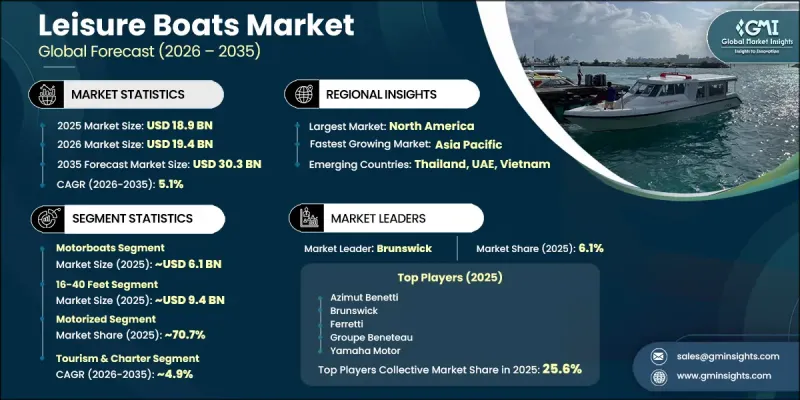
市場成長主要得益於沿海旅遊活動的拓展以及政府加大對濱水區開發案的投資,旨在促進海洋休閒。人們對沿海和內陸水域休閒划船活動的興趣日益濃厚,也推動了市場需求的穩定成長。在一些將釣魚視為休閒休閒的地區,船舶擁有率不斷攀升,進一步促進了市場擴張。技術和設計的進步也在改變整個產業,尤其是在推進系統方面,這些進步提高了效率、功率重量比和維護便利性。模組化船舶設計因其柔軟性而備受青睞,可互換的座椅佈局、可轉換的活動模組以及高度靈活的甲板配置,使得一艘船即可滿足多種休閒用途。這種多功能性尤其吸引重視多功能和個人化休閒體驗的年輕消費者。同時,現代休閒遊艇的設計也越來越注重舒適性、安全性和易用性,融入了多功能空間、完善的船上設施和先進的安全系統等功能。人們越來越偏好適合家庭的划船體驗,這促使製造商專注於能夠容納多種水上活動的靈活佈局,從而進一步增強了全球市場的需求。
| 市場範圍 | |
|---|---|
| 開始年份 | 2025 |
| 預測期 | 2026-2035 |
| 上市時的市場規模 | 189億美元 |
| 預測市場規模 | 303億美元 |
| 複合年成長率 | 5.1% |
預計到2025年,機動艇市佔率將達到32.3%,市場規模將達61億美元。該細分市場憑藉其高度的實用性、操作柔軟性以及對各種休閒的適應性,持續推動著市場成長。機動艇操作簡便,適用於各種水上活動,因此在休閒遊艇行業仍然備受歡迎,適合從初學者到經驗豐富的用戶等各類用戶。
到2025年,16至40英尺船型的市佔率將達到49.7%,市場規模將達到94億美元。由於該尺寸船型在性能、舒適性和實用性方面實現了有效平衡,因此繼續佔據最重要的商業性地位。此尺寸範圍內的小型船艇易於運輸,而大型船型則提供寬敞的內部空間,適合長時間休閒娛樂,因此對各類消費者都極具吸引力。
美國休閒遊艇市場預計到2025年將達到69億美元,並在2026年至2035年間以4%的複合年成長率成長。美國在全球休閒船艇市場佔有主導地位,佔全球市場總額的36.5%,北美市佔率高達87.8%。這一強勁的市場趨勢得益於其廣闊的海岸線、內陸水道以及適當的氣候,使得休閒遊艇活動全年皆可進行。此外,美國擁有大規模的休閒遊艇用戶群,數百萬艘註冊船隻,這進一步鞏固了其在全球休閒遊艇行業的領先地位。
阿茲慕貝內蒂 (Azimut Benetti)、博納多集團 (Groupe Beneteau)、巴伐利亞遊艇 (Bavaria Yachts)、探求者 ( Brunswick)、聖汐 (Sunseeker)、法拉帝 (Ferretti)、馬里布遊艇 (Malibu Boats)、Yamaha Motor Co, Ltd. Motor) 和 Mastercraft 產業領船行業的休閒遊艇公司。休閒遊艇市場的企業正致力於產品創新、客製化和提升船上體驗,以鞏固其市場地位。製造商正加大對模組化船艇設計的投入,以實現靈活的配置和多功能用途,旨在吸引更廣泛的客戶群。推進系統、燃油效率和輕量化材料的技術創新也成為優先事項,以提高性能並降低營運成本。此外,各公司正透過整合以舒適性為中心的功能和先進的安全系統,拓展其在家庭和休閒領域的產品線。與旅遊業者和碼頭開發商建立策略夥伴關係,有助於擴大市場覆蓋範圍。同時,對數位行銷、高階品牌建立和售後服務支援的重視,也使製造商能夠建立客戶忠誠度,並增強其在全球休閒遊艇行業的長期競爭力。
目錄
第1章:調查方法
第2章執行摘要
第3章業界考察
- 生態系分析
- 供應商情況
- 利潤率
- 成本結構
- 每個階段增加的價值
- 影響價值鏈的因素
- 中斷
- 影響產業的因素
- 促進因素
- 可支配所得增加,奢侈品支出增加
- 海洋和沿海旅遊業的發展
- 休閒划船活動的日益普及
- 碼頭和沿海基礎設施的開發
- 產業潛在風險與挑戰
- 休閒遊艇初始購置成本高
- 高昂的維護和營運成本
- 市場機遇
- 擴大電動船和環保船的使用
- 擴大船舶共享和細分所有權模式
- 內河水路旅遊日益普及
- 促進因素
- 科技與創新趨勢
- 目前技術
- 基於GPS的導航系統
- 船用雷達系統
- 柴油和汽油船舶推進系統
- 新興技術
- 電動和混合動力推進系統
- 自動駕駛和人工智慧輔助導航
- 物聯網智慧型船舶系統
- 用於輕型船體的先進複合材料
- 目前技術
- 成長潛力分析
- 價格分析(基於初步調查)
- 對過去價格趨勢的分析
- 按球員類型分類的定價策略(高階/超值/成本加成)
- 監理情勢
- 北美洲
- 美國 -美國海岸警衛隊
- 美國環保署
- 歐洲
- 歐盟委員會
- 英國海事和海岸警衛隊
- 亞太地區
- 澳洲 - 澳洲海事安全局
- 中國 - 中華人民共和國交通運輸部
- 拉丁美洲
- 巴西 - 巴西海軍
- 墨西哥海軍部
- 中東和非洲
- 沙烏地阿拉伯 - 沙烏地阿拉伯港務局
- 阿拉伯聯合大公國 - 杜拜海事局
- 北美洲
- 波特五力分析
- PESTEL 分析
- 專利趨勢(基於初步調查)
- 成本細分分析
- 原料和零件成本
- 人事費用和組裝成本
- 引擎和推進系統的成本
- 分銷、物流和經銷商利潤
- 合規性、測試和認證成本
- 交易數據分析(基於付費資料庫)
- 進出口量及進口額趨勢
- 主要貿易走廊及關稅的影響
- 生產能力和生產趨勢(基於初步調查)
- 按地區和主要生產商分類的已安裝產能
- 設備運轉率和擴建計劃
- 永續性和環境方面
- 永續計劃
- 減少廢棄物策略
- 生產中的能源效率
- 具有環保意識的舉措
- 關於碳足跡的考量
- 人工智慧和生成式人工智慧對市場的影響
- 利用人工智慧改造現有經營模式
- 按細分市場分類的生成式人工智慧用例和部署藍圖
- 風險、限制和監管考量
- 預測假設和情境分析(基於初步研究)
- 基本案例-驅動複合年成長率的關鍵宏觀經濟與產業變量
- 樂觀情境-宏觀經濟與產業的順風
- 悲觀情景-宏觀經濟放緩或產業逆風
第4章 競爭情勢
- 介紹
- 企業市佔率分析
- 北美洲
- 歐洲
- 亞太地區
- 拉丁美洲
- 中東和非洲(MEA)
- 主要市場公司的競爭分析
- 競爭定位矩陣
- 主要進展
- 併購
- 夥伴關係和聯盟
- 新產品發布
- 業務拓展計劃及資金籌措
- 企業級分層基準測試
- 層級分類標準與選擇標準
- 按銷售額、地區和創新能力分類的層級定位矩陣。
第5章 市場估算與預測:依船舶類型分類,2022-2035年
- 汽艇
- 艙式巡航艇
- 弓形騎兵
- 中央控制台
- 浮筒船
- 帆船
- 遊艇
- 豪華遊艇
- 帆船
- 超級遊艇
- 水上摩托車
- 充氣船
- 雙體船
- 船屋
- 獨木舟/皮划艇
- 其他
第6章 市場估計與預測:依促進因素分類,2022-2035年
- 動力
- 汽油車
- 柴油車
- 電
- 混合
- 無動力
第7章 市場規模估算與預測(2022-2035年)
- 不到16英尺
- 16-40英尺
- 超過40英尺
第8章 市場估計與預測:依應用領域分類,2022-2035年
- 休閒
- 體育和水上運動
- 釣魚
- 觀光和包機
- 其他
第9章 市場估計與預測:依地區分類,2022-2035年
- 北美洲
- 美國
- 加拿大
- 歐洲
- 德國
- 英國
- 法國
- 義大利
- 西班牙
- 荷蘭
- 瑞典
- 挪威
- 克羅埃西亞
- 亞太地區
- 中國
- 日本
- 韓國
- 印度
- 澳洲
- 泰國
- 印尼
- 新加坡
- 越南
- 拉丁美洲
- 巴西
- 墨西哥
- 阿根廷
- 智利
- 中東和非洲(MEA)
- 南非
- 沙烏地阿拉伯
- 阿拉伯聯合大公國
第10章:公司簡介
- 世界公司
- Brunswick
- Yamaha Motor
- Groupe Beneteau
- Azimut Benetti
- Ferretti
- Bavaria Yacht
- MasterCraft Boat
- Malibu Boats
- Smoker Craft
- BRP
- 本地球員
- Fairline Yachts
- Princess Yachts
- Sunseeker International
- Absolute Yachts
- Leopard Catamarans
- Pursuit Boats
- Cobalt Boats
- 新興企業
- Arc Boats
- X Shore
- Candela Technology
The Global Leisure Boats Market was valued at USD 18.9 billion in 2025 and is estimated to grow at a CAGR of 5.1% to reach USD 30.3 billion by 2035.
Market growth is supported by the expansion of coastal tourism activities and increasing government investments in waterfront development projects aimed at promoting marine-based recreation. Rising interest in recreational boating activities across coastal and inland water regions is also contributing to steady demand growth. In several regions where fishing is considered both a recreational and leisure activity, boat ownership levels are rising, further supporting market expansion. Technological and design advancements are also reshaping the industry, particularly in propulsion systems that offer improved efficiency, weight-to-power performance, and ease of maintenance. Modular boat designs are gaining strong traction as they provide enhanced flexibility through interchangeable seating arrangements, convertible activity modules, and adaptable deck configurations that allow a single vessel to support multiple recreational uses. This versatility is especially appealing to younger consumers who prioritize multifunctional and customizable leisure experiences. At the same time, modern leisure boats are increasingly designed to enhance comfort, safety, and usability, incorporating features such as convertible spaces, enhanced onboard amenities, and improved safety systems. Growing preference for family-oriented boating experiences is also encouraging manufacturers to focus on adaptable layouts that support multiple water-based activities, further strengthening demand across global markets.
| Market Scope | |
|---|---|
| Start Year | 2025 |
| Forecast Year | 2026-2035 |
| Start Value | $18.9 Billion |
| Forecast Value | $30.3 Billion |
| CAGR | 5.1% |
The motorboats segment held a share of 32.3% in 2025, generating USD 6.1 billion. This segment continues to lead the market due to its strong usability, operational flexibility, and suitability across a wide range of recreational applications. Motorboats remain highly preferred in the leisure boating industry as they offer ease of navigation and adaptability for different water-based activities, making them suitable for both new and experienced users.
The 16-40 feet segment accounted for 49.7% share in 2025, valued at USD 9.4 billion. This size category remains the most commercially significant as it effectively balances performance, comfort, and ownership practicality. Smaller boats within this range offer easy transportability, while larger models provide enhanced onboard space suitable for extended recreational use, making this segment highly attractive for a broad consumer base.
United States Leisure Boats Market reached USD 6.9 billion in 2025 and is projected to grow at a CAGR of 4% from 2026 to 2035. The country holds a leading position globally, accounting for 36.5% of the total market and 87.8% of the North American share. Strong market performance is supported by extensive coastal access, inland waterways, and favorable climatic conditions that enable year-round recreational boating activities. The United States also maintains a large recreational boating base with millions of registered vessels, further reinforcing its dominance in the global leisure boating industry.
Azimut Benetti, Groupe Beneteau, Bavaria Yacht, Brunswick, Sunseeker, Ferretti, Malibu Boats, Yamaha Motor, and MasterCraft Boat are among the leading companies operating in the leisure boats industry. Companies in the Leisure Boats Market are focusing on product innovation, customization, and enhanced onboard experiences to strengthen their market position. Manufacturers are increasingly investing in modular boat designs that allow flexible configurations and multifunctional usage to attract a broader consumer base. Technological advancements in propulsion systems, fuel efficiency, and lightweight materials are being prioritized to improve performance and reduce operational costs. Firms are also expanding their offerings in family-oriented and recreational segments by integrating comfort-focused features and advanced safety systems. Strategic partnerships with tourism operators and marina developers are helping companies expand their market reach. Additionally, strong emphasis on digital marketing, premium branding, and after-sales service support is enabling manufacturers to build customer loyalty and enhance long-term competitiveness in the global leisure boating industry.
Table of Contents
Chapter 1 Methodology
- 1.1 Research approach
- 1.2 Quality Commitments
- 1.2.1 GMI AI policy & data integrity commitment
- 1.3 Research Trail & Confidence Scoring
- 1.3.1 Research Trail Components
- 1.3.2 Scoring Components
- 1.4 Data Collection
- 1.5 Data mining sources
- 1.5.1 Paid sources
- 1.6 Base estimates and calculations
- 1.6.1 Base year calculation for any one approach
- 1.7 Forecast
- 1.7.1 Quantified market impact analysis
- 1.8 Research transparency addendum
- 1.8.1 Source attribution framework
- 1.8.2 Quality assurance metrics
- 1.8.3 Our commitment to trust
Chapter 2 Executive Summary
- 2.1 Industry 360° synopsis
- 2.2 Key market trends
- 2.2.1 Regional
- 2.2.2 Boat
- 2.2.3 Propulsion
- 2.2.4 Size
- 2.2.5 Application
- 2.3 TAM analysis, 2026-2035
- 2.4 CXO perspectives: Strategic imperatives
Chapter 3 Industry Insights
- 3.1 Industry ecosystem analysis
- 3.1.1 Supplier landscape
- 3.1.2 Profit margin
- 3.1.3 Cost structure
- 3.1.4 Value addition at each stage
- 3.1.5 Factor affecting the value chain
- 3.1.6 Disruptions
- 3.2 Industry impact forces
- 3.2.1 Growth drivers
- 3.2.1.1 Rising Disposable Income and Luxury Spending
- 3.2.1.2 Growth in Marine and Coastal Tourism
- 3.2.1.3 Increasing Popularity of Recreational Boating Activities
- 3.2.1.4 Development of Marina and Coastal Infrastructure
- 3.2.2 Industry pitfalls and challenges
- 3.2.2.1 High Initial Purchase Cost of Leisure Boats
- 3.2.2.2 Expensive Maintenance and Operating Costs
- 3.2.3 Market opportunities
- 3.2.3.1 Growing Adoption of Electric and Eco-Friendly Boats
- 3.2.3.2 Expansion of Boat Sharing and Fractional Ownership Models
- 3.2.3.3 Rising Popularity of Inland Water Tourism
- 3.2.1 Growth drivers
- 3.3 Technology and innovation landscape
- 3.3.1 Current technologies
- 3.3.1.1 GPS-Based Navigation Systems
- 3.3.1.2 Marine Radar Systems
- 3.3.1.3 Diesel and Petrol Marine Propulsion Systems
- 3.3.2 Emerging technologies
- 3.3.2.1 Electric and Hybrid Propulsion Systems
- 3.3.2.2 Autonomous and AI-Assisted Navigation
- 3.3.2.3 IoT-Enabled Smart Boat Systems
- 3.3.2.4 Advanced Composite Materials for Lightweight Hulls
- 3.3.1 Current technologies
- 3.4 Growth potential analysis
- 3.5 Pricing analysis (Driven by Primary Research)
- 3.5.1 Historical price trend analysis
- 3.5.2 Pricing strategy by player type (Premium / Value / Cost-plus)
- 3.6 Regulatory landscape
- 3.6.1 North America
- 3.6.1.1 US - U.S. Coast Guard
- 3.6.1.2 US - Environmental Protection Agency
- 3.6.2 Europe
- 3.6.2.1 EU - European Commission
- 3.6.2.2 UK - Maritime and Coastguard Agency
- 3.6.3 Asia Pacific
- 3.6.3.1 Australia - Australian Maritime Safety Authority
- 3.6.3.2 China - Ministry of Transport of the People's Republic of China
- 3.6.4 Latin America
- 3.6.4.1 Brazil - Brazilian Navy
- 3.6.4.2 Mexico - Secretariat of the Navy
- 3.6.5 Middle East & Africa
- 3.6.5.1 Saudi Arabia - Saudi Ports Authority
- 3.6.5.2 UAE - Dubai Maritime Authority
- 3.6.1 North America
- 3.7 Porter's analysis
- 3.8 PESTEL analysis
- 3.9 Patent landscape (Driven by Primary Research)
- 3.10 Cost breakdown analysis
- 3.10.1 Raw materials & components costs
- 3.10.2 Labor & assembly costs
- 3.10.3 Engine & propulsion system costs
- 3.10.4 Distribution, logistics, and dealer margins
- 3.10.5 Compliance, testing & certification costs
- 3.11 Trade Data Analysis (Driven by Paid Database)
- 3.11.1 Import/Export Volume & Value Trends
- 3.11.2 Key Trade Corridors & Tariff Impact
- 3.12 Capacity & Production Landscape (Driven by Primary Research)
- 3.12.1 Installed Capacity by Region & Key Producer
- 3.12.2 Capacity Utilization Rates & Expansion Pipelines
- 3.13 Sustainability and environmental aspects
- 3.13.1 Sustainable Practices
- 3.13.2 Waste Reduction Strategies
- 3.13.3 Energy Efficiency in Production
- 3.13.4 Eco-friendly Initiatives
- 3.13.5 Carbon Footprint Considerations
- 3.14 Impact of AI & Generative AI on the Market
- 3.14.1 AI-driven disruption of existing business models
- 3.14.2 GenAI use cases & adoption roadmap by segment
- 3.14.3 Risks, limitations & regulatory considerations
- 3.15 Forecast assumptions & scenario analysis (Driven by Primary Research)
- 3.15.1 Base Case - key macro & industry variables driving CAGR
- 3.15.2 Optimistic Scenarios - Favorable macro and industry tailwinds
- 3.15.3 Pessimistic Scenario - Macroeconomic slowdown or industry headwinds
Chapter 4 Competitive Landscape, 2025
- 4.1 Introduction
- 4.2 Company market share analysis
- 4.2.1 North America
- 4.2.2 Europe
- 4.2.3 Asia Pacific
- 4.2.4 LATAM
- 4.2.5 MEA
- 4.3 Competitive analysis of major market players
- 4.4 Competitive positioning matrix
- 4.5 Key developments
- 4.5.1 Mergers & acquisitions
- 4.5.2 Partnerships & collaborations
- 4.5.3 New product launches
- 4.5.4 Expansion plans and funding
- 4.6 Company tier benchmarking
- 4.6.1 Tier classification criteria & qualifying thresholds
- 4.6.2 Tier positioning matrix by revenue, geography & innovation
Chapter 5 Market Estimates and Forecast, By Boat, 2022 - 2035 ($ Mn, Units)
- 5.1 Key trends
- 5.2 Motorboats
- 5.2.1 Cabin Cruisers
- 5.2.2 Bowriders
- 5.2.3 Center Consoles
- 5.2.4 Pontoon Boats
- 5.3 Sailboats
- 5.4 Yachts
- 5.4.1 Motor Yachts
- 5.4.2 Sailing Yachts
- 5.4.3 Mega Yachts
- 5.5 Personal watercraft
- 5.6 Inflatable boats
- 5.7 Catamarans
- 5.8 Houseboats
- 5.9 Canoes & Kayaks
- 5.10 Others
Chapter 6 Market Estimates and Forecast, By Propulsion, 2022 - 2035 ($ Mn, Units)
- 6.1 Key trends
- 6.2 Motorized
- 6.2.1 Gasoline-Powered
- 6.2.2 Diesel-Powered
- 6.2.3 Electric
- 6.2.4 Hybrid
- 6.3 Non-Motorized
Chapter 7 Market Estimates and Forecast, By Size, 2022 - 2035 ($ Mn, Units)
- 7.1 Key trends
- 7.2 Under 16 Feet
- 7.3 16-40 Feet
- 7.4 Over 40 Feet
Chapter 8 Market Estimates and Forecast, By Application, 2022 - 2035 ($ Mn, Units)
- 8.1 Key trends
- 8.2 Recreational
- 8.3 Sports & Watersports
- 8.4 Fishing
- 8.5 Tourism & Charter
- 8.6 Others
Chapter 9 Market Estimates & Forecast, By Region, 2022 - 2035 ($Mn, Units)
- 9.1 Key trends
- 9.2 North America
- 9.2.1 US
- 9.2.2 Canada
- 9.3 Europe
- 9.3.1 Germany
- 9.3.2 UK
- 9.3.3 France
- 9.3.4 Italy
- 9.3.5 Spain
- 9.3.6 Netherlands
- 9.3.7 Sweden
- 9.3.8 Norway
- 9.3.9 Croatia
- 9.4 Asia Pacific
- 9.4.1 China
- 9.4.2 Japan
- 9.4.3 South Korea
- 9.4.4 India
- 9.4.5 Australia
- 9.4.6 Thailand
- 9.4.7 Indonesia
- 9.4.8 Singapore
- 9.4.9 Vietnam
- 9.5 Latin America
- 9.5.1 Brazil
- 9.5.2 Mexico
- 9.5.3 Argentina
- 9.5.4 Chile
- 9.6 MEA
- 9.6.1 South Africa
- 9.6.2 Saudi Arabia
- 9.6.3 UAE
Chapter 10 Company Profiles
- 10.1 Global players
- 10.1.1 Brunswick
- 10.1.2 Yamaha Motor
- 10.1.3 Groupe Beneteau
- 10.1.4 Azimut Benetti
- 10.1.5 Ferretti
- 10.1.6 Bavaria Yacht
- 10.1.7 MasterCraft Boat
- 10.1.8 Malibu Boats
- 10.1.9 Smoker Craft
- 10.1.10 BRP
- 10.2 Regional players
- 10.2.1 Fairline Yachts
- 10.2.2 Princess Yachts
- 10.2.3 Sunseeker International
- 10.2.4 Absolute Yachts
- 10.2.5 Leopard Catamarans
- 10.2.6 Pursuit Boats
- 10.2.7 Cobalt Boats
- 10.3 Emerging players
- 10.3.1 Arc Boats
- 10.3.2 X Shore
- 10.3.3 Candela Technology

 休閒遊艇市場-2026-2032年全球市場預測
 船鉤市場分析及預測(至2035年):類型、技術、組件、應用、材質、製造流程、部署現況、最終用戶、功能
 2026-2030年全球休閒遊艇市場
 休閒遊艇市場規模、佔有率和趨勢分析報告:按類型、產品類別、地區和細分市場分類的預測(2026-2033 年)
 2026年全球休閒遊艇市場報告休閒遊艇市場分析及預測(至2035年):依類型、產品類型、服務、技術、零件、應用、材質、最終用戶、安裝類型分類
 全球休閒遊艇市場規模、佔有率、趨勢及成長分析報告(2026-2034)
 船鉤市場 - 全球產業規模、佔有率、趨勢、機會、預測:按材料類型、最終用途、地區和競爭格局分類,2021-2031年
 休閒遊艇市場規模、佔有率和成長分析(按類型、產品、最終用途和地區分類)-2026-2033年產業預測休閒船市場-全球產業規模、佔有率、趨勢、機會和預測(細分、按類型、按推進類型、按動力來源、按地區和競爭,2020-2030 年預測)