

 |
市場調查報告書
商品編碼
2038637
女用貼身內衣市場商機、成長要素、產業趨勢分析及2026-2035年預測。Lingerie Market Opportunity, Growth Drivers, Industry Trend Analysis, and Forecast 2026 - 2035 |
||||||

據估計,2025年全球女用貼身內衣市場價值為660億美元,預計到2035年將以5.7%的複合年成長率成長至1186億美元。
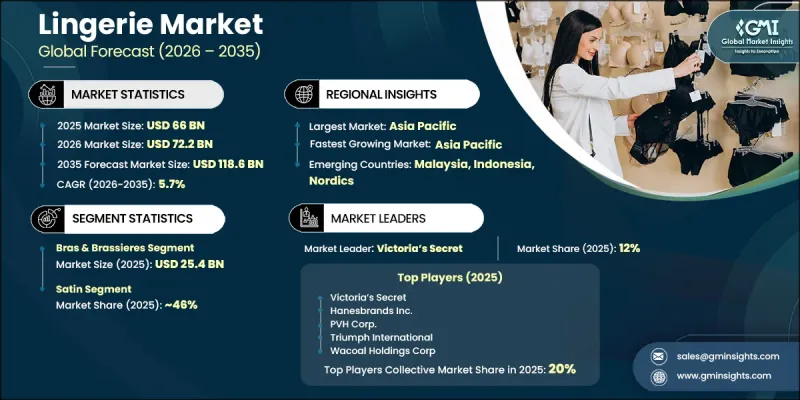
市場擴張主要受消費者對內衣偏好轉變的顯著影響,如今消費者更重視舒適性與功能性。現代消費者不再只關注美觀,而是越來越重視舒適度、透氣性和布料性能。為了順應這項變化,製造商正在重新設計女用貼身內衣系列,採用更柔軟的布料、無縫生產流程以及適合日常穿著的版型。休閒穿著風格的日益流行,以及生活方式的改變和遠距辦公、混合辦公模式的興起,進一步推動了對多功能女用貼身內衣的需求,使其能夠適應各種場合。因此,女用貼身內衣正逐漸被視為衣櫥必備單品,而不僅僅是時尚奢侈品。同時,線上零售通路的快速發展也重塑了消費者的購買行為,提供了豐富的產品選擇、完整的尺寸以及注重隱私的購物體驗。虛擬試穿工具和個人化建議等增強型數位化功能也提升了消費者的購買意願。此外,雖然 D2C(直接面對消費者)模式加強了品牌參與度並提高了盈利,但它也降低了新興企業的進入門檻,加劇了全球市場的競爭。
| 市場範圍 | |
|---|---|
| 開始年份 | 2025 |
| 預測期 | 2026-2035 |
| 上市時的市場規模 | 660億美元 |
| 預計金額 | 1186億美元 |
| 複合年成長率 | 5.7% |
預計到2025年,胸罩及相關產品市場規模將達254億美元。這一主導地位源於其在日常穿著中的重要作用以及各個年齡層的穩定需求。頻繁的更換週期,加上支撐性、舒適度和人體工學設計的持續創新,進一步鞏固了該品類的地位。製造商正加大對先進材料、無縫設計和各種尺寸的投入,以提升整體舒適度。因此,胸罩及相關產品市場依然穩固地佔據「必需品」的地位,在零售消費模式發生廣泛變化的背景下,保持著穩定的需求。
預計到2025年,緞面布料將佔據46%的市場。緞面布料因其兼具視覺上的優雅和穿著的舒適性而備受青睞。其光滑的表面質地、柔軟的垂墜感和微妙的光澤,使其在內衣系列中呈現出奢華布料的形象。在消費者的認知中,緞面與奢華、舒適和精緻的美感緊密相連,這促成了其持續的需求,從日常女用貼身內衣到特殊場合的服飾,緞面布料都廣受歡迎。
預計到2025年,亞太地區女用貼身內衣市佔率將達到44%,並在2035年之前以6%的複合年成長率成長。在亞太地區,中國憑藉其龐大的消費群、快速的都市化以及不斷變化的生活方式偏好,佔據主導地位。由於消費者對國際時尚潮流的偏好不斷加深以及零售生態系統的現代化,他們的購買行為發生了顯著變化。消費者越來越重視內衣的合身度、舒適度和設計品質,這促使品牌拓展產品線,涵蓋多個價格區間和款式類別,以滿足日益多元化的需求。
目錄
第1章:調查方法和範圍
第2章執行摘要
第3章業界考察
- 生態系分析
- 影響價值鏈的因素
- 利潤率分析
- 中斷
- 前景
- 製造商
- 銷售代理
- 零售商
- 影響因素
- 促進因素
- 產業潛在風險與挑戰
- 科技與創新趨勢
- 成長潛力分析
- 法律規範
- 價格分析(基於初步調查)
- 對過去價格趨勢的分析
- 按玩家類型(高階/中階/經濟型)分類的定價策略
- 各國價格波動
- 波特五力分析
- PESTEL 分析
- 消費行為分析
- 貿易資料分析 - HS編碼:6108(三角褲、內褲、睡袍 - 針織品)(基於付費資料庫)
- 進出口量及進口額趨勢
- 主要貿易路線及關稅的影響
- 人工智慧和生成式人工智慧對市場的影響
- 人工智慧正在改變傳統的零售模式。
- 生成式人工智慧的應用案例(虛擬試衣間、個人化建議、設計自動化)
- 風險、限制和監管考量
第4章 競爭情勢
- 介紹
- 企業市佔率分析
- 企業市佔率分析
- 按地區
- 主要市場公司的競爭分析
- 競爭定位矩陣
- 主要進展
- 併購
- 夥伴關係與合作
- 新產品發布
- 業務拓展計劃
第5章 市場估算與預測:依產品類型分類,2022-2035年
- 胸罩和胸罩
- 鋼圈胸罩
- 無鋼圈胸罩
- 運動胸罩
- 哺乳胸罩
- 無鋼圈胸罩
- 女式內褲和三角褲
- 比基尼
- T字背
- 男童短褲
- 潮人
- 高腰三角褲
- 塑身衣
- 連體衣
- 塑形內褲
- 束腰帶
- 大腿塑形器
- 睡衣和家居服
- 娃娃衫和睡裙
- 吊帶背心
- 罩衣
- 長袍和和服
- 連身衣和泰迪熊
- 其他物品(束身衣、胸衣、長筒襪、吊襪帶)
第6章 市場估計與預測:依材料分類,2022-2035年
- 棉布
- 有機棉
- 普通棉花
- 合成纖維
- 尼龍
- 聚酯纖維
- 氨綸和彈性纖維
- 超細纖維
- 種族
- 絲綢
- 緞
- 其他材質(竹纖維、莫代爾、創新混紡織物)
第7章 市場估計與預測:依價格分類,2022-2035年
- 低的
- 中等的
- 高的
第8章 市場估計與預測:依年齡層別分類,2022-2035年
- 18-24歲
- 25-44歲
- 45歲或以上
第9章 市場估價與預測:依通路分類,2022-2035年
- 線上管道
- 電子商務
- 企業網站
- 離線頻道
- 女用貼身內衣專賣店
- 百貨公司
- 旗艦店
- 其他
第10章 市場估價與預測:依地區分類,2022-2035年
- 北美洲
- 美國
- 加拿大
- 歐洲
- 德國
- 英國
- 法國
- 義大利
- 西班牙
- 亞太地區
- 中國
- 日本
- 印度
- 澳洲
- 韓國
- 拉丁美洲
- 巴西
- 墨西哥
- 阿根廷
- 中東和非洲
- 南非
- 沙烏地阿拉伯
- 阿拉伯聯合大公國
第11章:公司簡介
- Adore Me
- Agent Provocateur
- Aubade
- Chantelle Group
- Hanesbrands Inc.
- Hunkemoller
- Intimissimi
- La Perla
- Lise Charmel
- PVH Corp.
- Savage X Fenty
- ThirdLove
- Triumph International
- Victoria's Secret
- Wacoal Holdings Corp.
The Global Lingerie Market was valued at USD 66 billion in 2025 and is estimated to grow at a CAGR of 5.7% to reach USD 118.6 billion by 2035.
Market expansion is strongly influenced by a clear shift in consumer preference toward comfort-led and functional intimate wear. Modern buyers are placing greater importance on comfort, breathability, and fabric performance rather than focusing solely on visual appeal. This shift has prompted manufacturers to redesign lingerie collections with softer textiles, seamless construction techniques, and adaptive fits that support everyday usage. The increasing normalization of casual dressing styles, along with lifestyle changes and remote or hybrid work structures, has further accelerated demand for versatile lingerie solutions that function across multiple settings. As a result, lingerie is increasingly viewed as a core wardrobe essential rather than a discretionary fashion category. At the same time, the rapid expansion of online retail channels is reshaping purchasing behavior by enabling wider product accessibility, inclusive sizing options, and discreet shopping experiences. Digital enhancements such as virtual fitting tools and personalized recommendations are also improving customer confidence. Additionally, direct-to-consumer models are strengthening brand engagement and improving profitability, while simultaneously lowering entry barriers for emerging players and intensifying competition across global markets.
| Market Scope | |
|---|---|
| Start Year | 2025 |
| Forecast Year | 2026-2035 |
| Start Value | $66 Billion |
| Forecast Value | $118.6 Billion |
| CAGR | 5.7% |
In 2025, the bras and brassieres segment accounted for USD 25.4 billion. This leadership position is attributed to their essential role in daily apparel use and consistent demand across diverse age groups. Frequent replacement cycles, combined with continuous innovation in support, comfort, and ergonomic design, further reinforce this category's strength. Manufacturers are increasingly investing in advanced fabrics, seamless designs, and inclusive sizing solutions to enhance overall wearability. As a result, bras and brassieres continue to be considered a necessity-driven segment, maintaining steady demand even during broader shifts in retail consumption patterns.
The satin segment held 46% share in 2025. Satin remains highly preferred due to its blend of visual elegance and comfort-driven appeal. Its smooth surface texture, soft drape, and subtle sheen contribute to its perception as a premium material within intimate wear collections. Consumer perception strongly associates satin with luxury, comfort, and refined aesthetics, which has helped sustain its demand across both everyday lingerie and occasion-focused products.
Asia Pacific Lingerie Market held a 44% share in 2025 and is projected to grow at a CAGR of 6% through 2035. Within this region, China held a dominant position due to its large consumer base, rapid urbanization, and evolving lifestyle preferences. Increasing exposure to international fashion trends and a modernizing retail ecosystem have significantly reshaped purchasing behavior. Consumers are becoming more attentive to fit, comfort, and design quality, which is encouraging brands to expand their offerings across multiple price tiers and style categories to meet diversified demand.
Major players operating in the Global Lingerie Industry include Victoria's Secret, Triumph International, Hanesbrands Inc., Savage X Fenty, La Perla, Chantelle Group, Hunkemoller, Wacoal Holdings Corp., ThirdLove, Intimissimi, Aubade, Lise Charmel, PVH Corp., Adore Me, and Agent Provocateur. Key strategies adopted by companies in the Lingerie Market include expanding inclusive sizing portfolios to reach broader consumer segments, investing in advanced fabric innovation focused on comfort and breathability, and strengthening omnichannel retail presence to integrate online and offline shopping experiences. Brands are increasingly leveraging direct-to-consumer models to improve margins and enhance customer relationships. Personalization through AI-based fitting tools and recommendation systems is also gaining traction to improve conversion rates. Additionally, companies are focusing on sustainable material sourcing and eco-friendly production processes to align with evolving consumer values.
Table of Contents
Chapter 1 Methodology and Scope
- 1.1 Research approach
- 1.2 Quality Commitments
- 1.2.1 GMI AI policy & data integrity commitment
- 1.2.1.1 Source consistency protocol
- 1.2.1 GMI AI policy & data integrity commitment
- 1.3 Research Trail & Confidence Scoring
- 1.3.1 Research Trail Components
- 1.3.2 Scoring Components
- 1.4 Data Collection
- 1.4.1 Partial list of primary sources
- 1.5 Data mining sources
- 1.5.1 Paid sources
- 1.5.1.1 Sources, by region
- 1.5.1 Paid sources
- 1.6 Base estimates and calculations
- 1.6.1 Base year calculation for any one approach
- 1.7 Forecast model
- 1.7.1 Quantified market impact analysis
- 1.7.1.1 Mathematical impact of growth parameters on forecast
- 1.7.1 Quantified market impact analysis
- 1.8 Research transparency addendum
- 1.8.1 Source attribution framework
- 1.8.2 Quality assurance metrics
- 1.8.3 Our commitment to trust
Chapter 2 Executive Summary
- 2.1 Industry 360° synopsis
- 2.2 Key market trends
- 2.2.1 Regional
- 2.2.2 Product type
- 2.2.3 Material
- 2.2.4 Price
- 2.2.5 Age group
- 2.2.6 Distribution channel
Chapter 3 Industry Insights
- 3.1 Industry ecosystem analysis
- 3.1.1 Factors affecting the value chain
- 3.1.2 Profit margin analysis
- 3.1.3 Disruptions
- 3.1.4 Future outlook
- 3.1.5 Manufacturers
- 3.1.6 Distributors
- 3.1.7 Retailers
- 3.2 Impact forces
- 3.2.1 Growth drivers
- 3.2.2 Industry pitfalls & challenges
- 3.3 Technology & innovation landscape
- 3.4 Growth potential analysis
- 3.5 Regulatory framework
- 3.6 Pricing analysis (driven by primary research)
- 3.6.1 Historical price trend analysis
- 3.6.2 Pricing strategy by player type (premium vs mid-range vs economy)
- 3.6.3 Price variation by country
- 3.7 Porter's analysis
- 3.8 PESTEL analysis
- 3.9 Consumer behavior analysis
- 3.10 Trade data analysis - HS Code: 6108 (briefs, panties, robes - knitted) (driven by paid database)
- 3.10.1 Import & export volume & value trends
- 3.10.2 Key trade corridors & tariff impact
- 3.11 Impact of AI & generative AI on the market
- 3.11.1 AI-driven disruption of traditional retail models
- 3.11.2 GenAI use cases (virtual fitting rooms, personalized recommendations, design automation)
- 3.11.3 Risks, limitations & regulatory considerations
Chapter 4 Competitive Landscape, 2025
- 4.1 Introduction
- 4.2 Company market share analysis
- 4.3 Company market share analysis
- 4.3.1 By region
- 4.3.1.1 North America
- 4.3.1.2 Europe
- 4.3.1.3 Asia Pacific
- 4.3.1.4 Latin America
- 4.3.1.5 Middle East and Africa
- 4.3.1 By region
- 4.4 Competitive analysis of major market players
- 4.5 Competitive positioning matrix
- 4.6 Key developments
- 4.6.1 Mergers & acquisitions
- 4.6.2 Partnerships & collaborations
- 4.6.3 New product launches
- 4.6.4 Expansion plans
Chapter 5 Market Estimates and Forecast, By Product Type, 2022 - 2035 (USD Billion) (Thousand Units)
- 5.1 Key trends
- 5.2 Bras & Brassieres
- 5.2.1 Wired Bras
- 5.2.2 Wireless Bras
- 5.2.3 Sports Bras
- 5.2.4 Nursing Bras
- 5.2.5 Bralettes
- 5.3 Panties & Briefs
- 5.3.1 Bikini
- 5.3.2 Thong
- 5.3.3 Boyshort
- 5.3.4 Hipster
- 5.3.5 High-Waisted Briefs
- 5.4 Shapewear
- 5.4.1 Bodysuits
- 5.4.2 Control Briefs
- 5.4.3 Waist Cinchers
- 5.4.4 Thigh Shapers
- 5.5 Sleepwear & Loungewear
- 5.5.1 Babydolls & chemises
- 5.5.2 Camisoles
- 5.5.3 Nightgowns
- 5.5.4 Robes & Kimonos
- 5.6 Bodysuits & Teddies
- 5.7 Others (corsets, bustiers, hosiery, garters)
Chapter 6 Market Estimates and Forecast, By Material, 2022 - 2035 (USD Billion) (Thousand Units)
- 6.1 Key trends
- 6.2 Cotton
- 6.2.1 Organic Cotton
- 6.2.2 Conventional Cotton
- 6.3 Synthetic Fabrics
- 6.3.1 Nylon
- 6.3.2 Polyester
- 6.3.3 Spandex & Elastane
- 6.3.4 Microfiber
- 6.4 Lace
- 6.5 Silk
- 6.6 Satin
- 6.7 Others (bamboo, modal, innovative blends)
Chapter 7 Market Estimates and Forecast, By Price, 2022 - 2035 (USD Billion) (Thousand Units)
- 7.1 Key trends
- 7.2 Low
- 7.3 Medium
- 7.4 High
Chapter 8 Market Estimates and Forecast, By Age Group, 2022 - 2035 (USD Billion) (Thousand Units)
- 8.1 Key trends
- 8.2 18-24 Years
- 8.3 25-44 Years
- 8.4 45+ Years
Chapter 9 Market Estimates and Forecast, By Distribution Channel, 2022 - 2035 (USD Billion) (Thousand Units)
- 9.1 Key trends
- 9.2 Online channels
- 9.2.1 E-commerce
- 9.2.2 Company websites
- 9.3 Offline channels
- 9.3.1 Specialty lingerie stores
- 9.3.2 Department stores
- 9.3.3 Flagship stores
- 9.3.4 Others
Chapter 10 Market Estimates and Forecast, By Region, 2022 - 2035 (USD Billion) (Thousand Units)
- 10.1 Key trends
- 10.2 North America
- 10.2.1 U.S.
- 10.2.2 Canada
- 10.3 Europe
- 10.3.1 Germany
- 10.3.2 UK
- 10.3.3 France
- 10.3.4 Italy
- 10.3.5 Spain
- 10.4 Asia Pacific
- 10.4.1 China
- 10.4.2 Japan
- 10.4.3 India
- 10.4.4 Australia
- 10.4.5 South Korea
- 10.5 Latin America
- 10.5.1 Brazil
- 10.5.2 Mexico
- 10.5.3 Argentina
- 10.6 Middle East and Africa
- 10.6.1 South Africa
- 10.6.2 Saudi Arabia
- 10.6.3 UAE
Chapter 11 Company Profiles
- 11.1 Adore Me
- 11.2 Agent Provocateur
- 11.3 Aubade
- 11.4 Chantelle Group
- 11.5 Hanesbrands Inc.
- 11.6 Hunkemoller
- 11.7 Intimissimi
- 11.8 La Perla
- 11.9 Lise Charmel
- 11.10 PVH Corp.
- 11.11 Savage X Fenty
- 11.12 ThirdLove
- 11.13 Triumph International
- 11.14 Victoria's Secret
- 11.15 Wacoal Holdings Corp.

 女用貼身內衣市場-2026-2032年全球市場預測女性用女用貼身內衣市場:依產品類型、材料類型、功能及通路分類-2026-2032年全球市場預測哺乳及孕婦胸罩市場:2026-2032年全球市場預測(依產品類型、材質、價格範圍、使用階段及通路分類)
 2026-2030年全球線上女用貼身內衣市場
 2026-2030年全球女用貼身內衣市場
 情趣女用貼身內衣市場-全球產業規模、佔有率、趨勢、機會及預測:依產品類型、材質、通路、地區及競爭格局分類,2021-2031年
 女用貼身內衣市場規模、佔有率和成長分析:按產品類型、材料、通路、消費者和地區分類-2026-2033年產業預測
 情趣女用貼身內衣市場報告:趨勢、預測及競爭分析(至2035年)
 女用貼身內衣市場分析及預測(至2035年):依類型、產品類型、材料類型、應用、最終用戶、功能、技術、製程及解決方案分類
 全球貼身女用貼身內衣市場規模、佔有率、趨勢和成長分析報告(2026-2034年)