


 |
市場調查報告書
商品編碼
2038468
工業發電機市場機會、成長要素、產業趨勢分析及2026-2035年預測Industrial Generator Market Opportunity, Growth Drivers, Industry Trend Analysis, and Forecast 2026 - 2035 |
||||||

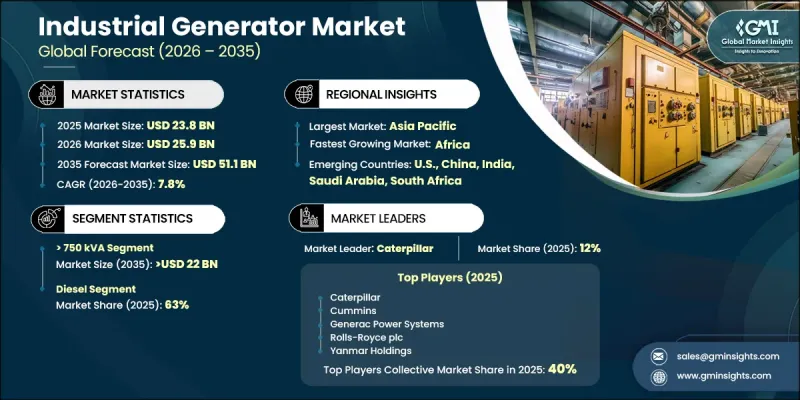
2025年全球工業發電機市場價值為238億美元,預計到2035年將以7.8%的複合年成長率成長至511億美元。
新興經濟體強勁的工業擴張和大規模基礎設施建設正在推動對可靠備用電源和不間斷供電系統的需求。製造業、建築業、石油天然氣和採礦業對不間斷供電的需求不斷成長,進一步促進了市場成長。快速的都市化和工業產能投資的增加也為持續的需求做出了貢獻。同時,技術進步使得更節能、低排放的發電系統得以實現,並符合不斷變化的環境標準。這些發展正在加速現代工業發電解決方案在各個終端用戶領域的應用。對業務永續營運、能源安全和減少停機時間的日益關注也在影響採購決策。此外,更嚴格的法規結構以及向更清潔、更有效率的能源解決方案的逐步轉變,正在影響整個市場的產品創新和部署策略。
| 市場範圍 | |
|---|---|
| 開始年份 | 2025 |
| 預測期 | 2026-2035 |
| 上市時的市場規模 | 238億美元 |
| 預測金額 | 511億美元 |
| 複合年成長率 | 7.8% |
工業發電機是高度耐用的工程化電力系統,旨在電網中斷或需要持續穩定供電時提供電力。它們在確保工業設施和關鍵基礎設施的業務連續性方面發揮著至關重要的作用。這些系統設計用於處理高負載能力,並在日常和緊急運行環境中保持穩定的效能。
工業投資的增加,尤其是對加強供應鏈基礎設施的投入,以及政府政策的調整,都在支持製造業擴張,從而推動對可靠緊急電源系統的需求。對能源效率和綠能解決方案的日益重視,也塑造著產業的發展方向。包括建築、採礦、石油天然氣和製造業在內的各個行業對不間斷電力供應的依賴性不斷增強,進一步促進了市場成長。旨在提高能源效率和減少停電的監管壓力,也正在加速各終端用戶產業對相關技術的應用。
到2025年,柴油工業發電機組將佔據63%的市場。這些系統因其運作可靠性、適應性和不受外部天氣條件影響的運作能力而廣泛應用。其成本效益和可靠的電力供應持續支撐整體工業應用領域的強勁需求。不斷擴大的工業活動進一步加劇了對可靠電力供應解決方案的需求。
預計到2035年,額定輸出功率超過750千伏安的工業發電機市場規模將達220億美元。採礦業和大型基礎設施項目需求的成長是推動該細分市場成長的主要動力。這些大容量發電機廣泛用於為挖土機、起重機和輸送機系統等重型機械提供動力。在偏遠和無電網地區的應用不斷擴大也促進了市場成長。
美國工業發電機市場預計到2025年將達到39億美元。製造業需求的成長主要源自於防止營運中斷和減少因意外停電造成的生產損失。高耐用性、卓越性能、穩定性以及適用於連續工業用途是推動產品普及的關鍵因素。工業生產規模的擴大和生產設施的現代化改造進一步提升了市場滲透率。
目錄
第1章:調查方法和範圍
第2章執行摘要
第3章業界考察
- 生態系分析
- 原物料供應及採購分析
- 生產能力評估
- 供應鏈韌性與風險因素
- 配電網路分析
- 影響產業的因素
- 促進因素
- 產業潛在風險與挑戰
- 監理情勢
- 成長潛力分析
- 波特五力分析
- PESTEL 分析
- 工業發電機成本結構分析
- 新機會與趨勢
- 數位化和物聯網整合
- 未開發市場和應用領域的成長
- 投資分析及未來展望
- 價格趨勢分析(美元/單位)(基於初步調查)
- 按地區分類(基於初步調查)
- 按產量(基於初步調查)
- 貿易數據分析(基於初步調查)
- 進出口額趨勢(基於初步調查)
- 主要貿易路線及關稅的影響(基於初步調查)
- 生產能力和生產趨勢(基於初步調查)
- 按地區和主要生產商分類的產能(基於初步調查)
- 運轉率和擴張計劃(基於初步調查)
- 人工智慧和生成式人工智慧對市場的影響(基於初步研究)
- 人工智慧驅動的生產最佳化(基於初步調查)
- 預測性維護和故障檢測(基於初步調查)
第4章 競爭情勢
- 介紹
- 企業市佔率分析:按地區分類
- 北美洲
- 歐洲
- 亞太地區
- 中東
- 非洲
- 拉丁美洲
- 競爭定位矩陣
- 主要進展
- 併購
- 夥伴關係與合作
- 新產品發布
- 業務拓展計劃及資金籌措
- 企業級分層基準測試
- 排名分類標準與遴選標準
- 按收入、地區和創新能力分類的層級定位矩陣。
第5章 市場規模及預測:依產量分類,2022-2035年
- 75千伏安或以下
- >75 kVA-375 kVA
- >375 kVA-750 kVA
- >750 kVA
第6章 市場規模與預測:依最終用途分類,2022-2035年
- 石油和天然氣
- 製造業
- 建造
- 電力業務
- 礦業
- 運輸/物流
- 其他
第7章 市場規模及預測:依應用領域分類,2022-2035年
- 支援
- 抑低尖峰負載
- 主/連續
第8章 市場規模及預測:依燃料類型分類,2022-2035年
- 柴油引擎
- 氣體
- 其他
第9章 市場規模及預測:依地區分類,2022-2035年
- 北美洲
- 美國
- 加拿大
- 歐洲
- 俄羅斯
- 英國
- 德國
- 法國
- 西班牙
- 奧地利
- 義大利
- 亞太地區
- 中國
- 澳洲
- 印度
- 日本
- 韓國
- 印尼
- 馬來西亞
- 泰國
- 越南
- 菲律賓
- 緬甸
- 中東
- 沙烏地阿拉伯
- 阿拉伯聯合大公國
- 卡達
- 土耳其
- 伊朗
- 阿曼
- 非洲
- 埃及
- 奈及利亞
- 阿爾及利亞
- 南非
- 安哥拉
- 肯亞
- 拉丁美洲
- 巴西
- 墨西哥
- 阿根廷
- 智利
第10章:公司簡介
- Ashok Leyland
- Atlas Copco
- Caterpillar
- Cummins
- Deere &Company
- FG Wilson
- Generac Power Systems
- Greaves Cotton
- HIMOINSA
- JC Bamford Excavators Ltd.
- Kirloskar
- MAHINDRA POWEROL
- Mitsubishi Heavy Industries
- Powerica
- Rehlko
- Rolls Royce plc
- Sudhir Power
- Supernova Genset
- Wartsila
- Yanmar Holdings
The Global Industrial Generator Market was valued at USD 23.8 billion in 2025 and is estimated to grow at a CAGR of 7.8% to reach USD 51.1 billion by 2035.
Strong industrial expansion and large-scale infrastructure development across emerging economies are reinforcing the demand for reliable backup and continuous power systems. The increasing requirement for uninterrupted electricity across manufacturing, construction, oil and gas, and mining operations is further strengthening market growth. Rapid urbanization and rising investments in industrial capacity are also contributing to sustained demand. At the same time, technological advancements are enabling more fuel-efficient, lower-emission generator systems that comply with evolving environmental standards. These developments are encouraging broader adoption of modern industrial generator solutions across diverse end-use sectors. Growing focus on operational resilience, energy security, and reduced downtime is also shaping purchasing decisions. In addition, stricter regulatory frameworks and a gradual shift toward cleaner and more efficient energy solutions are influencing product innovation and deployment strategies across the market landscape.
| Market Scope | |
|---|---|
| Start Year | 2025 |
| Forecast Year | 2026-2035 |
| Start Value | $23.8 Billion |
| Forecast Value | $51.1 Billion |
| CAGR | 7.8% |
An industrial generator is a heavy-duty, engineered power system designed to supply electricity during grid disruptions or when continuous and stable power is required. It plays a critical role in ensuring operational continuity across industrial facilities and essential infrastructure. These systems are built to handle high load capacities and maintain stable performance under both routine and emergency operating conditions.
Rising industrial investments and evolving government policies focused on strengthening supply chain infrastructure are supporting manufacturing expansion, which in turn is driving demand for reliable backup power systems. The growing emphasis on energy efficiency and cleaner power solutions is also shaping industry direction. Increased reliance on uninterrupted electricity across multiple sectors, including construction, mining, oil and gas, and manufacturing, is further supporting market expansion. Regulatory pressures aimed at improving energy performance and reducing outages are reinforcing adoption across end-use industries.
The diesel industrial generator segment accounted for 63% share in 2025. These systems remain widely used due to their operational reliability, adaptability, and ability to function independently of external weather conditions. Their cost-effectiveness and consistent power delivery continue to support strong demand across industrial applications. Expanding industrial activity is further reinforcing the need for dependable electricity supply solutions.
The > 750 kVA rated industrial generator market is expected to reach USD 22 billion by 2035. Increasing demand from mining operations and large-scale infrastructure projects is significantly contributing to segment growth. These high-capacity generators are extensively used to power heavy machinery such as excavators, cranes, and conveyor systems. Their growing deployment in remote, off-grid locations is also strengthening market expansion.
U.S. Industrial Generator Market was valued at USD 3.9 billion in 2025. Rising demand from manufacturing sectors is driven by the need for uninterrupted operations and reduced production losses caused by unexpected outages. High durability, strong performance, stability, and suitability for continuous industrial use are key factors supporting product adoption. Expanding industrial output and modernization of production facilities are further strengthening market penetration.
Key industry participants operating in the Industrial Generator Market include Cummins, Caterpillar, Generac Power Systems, Atlas Copco, Mitsubishi Heavy Industries, Wartsila, Rolls-Royce, FG Wilson, HIMOINSA, Yanmar Holdings, JC Bamford Excavators, Kirloskar, Ashok Leyland, MAHINDRA POWEROL, Powerica, Deere & Company, Greaves Cotton, Rehlko, Supernova Genset, and Sudhir Power. Companies in the Industrial Generator Market are focusing on expanding product efficiency through advanced engine technologies and fuel optimization systems. Strategic investments in low-emission and hybrid power solutions are helping firms align with tightening environmental regulations. Manufacturers are also strengthening global distribution networks and establishing regional service hubs to improve after-sales support and operational reliability. Partnerships with industrial end users are being used to secure long-term supply contracts and enhance market stability.
Table of Contents
Chapter 1 Methodology & Scope
- 1.1 Research approach
- 1.2 Quality commitments
- 1.2.1 GMI AI policy & data integrity commitment
- 1.2.1.1 Source consistency protocol
- 1.2.1 GMI AI policy & data integrity commitment
- 1.3 Research trail & confidence scoring
- 1.3.1 Research trail components
- 1.3.2 Scoring components
- 1.4 Data collection
- 1.4.1 Partial list of primary sources
- 1.5 Data mining sources
- 1.5.1 Paid sources
- 1.5.1.1 Sources, by region
- 1.5.1 Paid sources
- 1.6 Base estimates and calculations
- 1.6.1 Base year calculation for any one approach
- 1.7 Market estimates & forecasts parameters
- 1.8 Forecast model
- 1.8.1 Quantified market impact analysis
- 1.8.1.1 Mathematical impact of growth parameters on forecast
- 1.8.1 Quantified market impact analysis
- 1.9 Research transparency addendum
- 1.9.1 Source attribution framework
- 1.9.2 Quality assurance metrics
- 1.9.3 Our commitment to trust
- 1.10 Market definitions
Chapter 2 Executive Summary
- 2.1 Industry synopsis, 2022 - 2035
- 2.1.1 Business trends
- 2.1.2 Power rating trends
- 2.1.3 End use trends
- 2.1.4 Fuel trends
- 2.1.5 Application trends
- 2.1.6 Regional trends
Chapter 3 Industry Insights
- 3.1 Industry ecosystem analysis
- 3.1.1 Raw material availability & sourcing analysis
- 3.1.2 Manufacturing capacity assessment
- 3.1.3 Supply chain resilience & risk factors
- 3.1.4 Distribution network analysis
- 3.2 Industry impact forces
- 3.2.1 Growth drivers
- 3.2.2 Industry pitfalls & challenges
- 3.3 Regulatory landscape
- 3.4 Growth potential analysis
- 3.5 Porter's analysis
- 3.5.1 Bargaining power of suppliers
- 3.5.2 Bargaining power of buyers
- 3.5.3 Threat of new entrants
- 3.5.4 Threat of substitutes
- 3.6 PESTEL analysis
- 3.6.1 Political factors
- 3.6.2 Economic factors
- 3.6.3 Social factors
- 3.6.4 Technological factors
- 3.6.5 Legal factors
- 3.6.6 Environmental factors
- 3.7 Cost structure analysis of industrial generator
- 3.8 Emerging opportunities & trends
- 3.9 Digitalization & IoT integration
- 3.9.1 Growth in untapped markets & applications
- 3.10 Investment analysis & future prospects
- 3.11 Price trend analysis (USD/Unit) (Driven by Primary Research)
- 3.11.1 By region (Driven by Primary Research)
- 3.11.2 By power rating (Driven by Primary Research)
- 3.12 Trade data analysis (Driven by Primary Research)
- 3.12.1 Import/export value trends (Driven by Primary Research)
- 3.12.2 Key trade corridors & tariff impact (Driven by Primary Research)
- 3.13 Capacity & production landscape (Driven by Primary Research)
- 3.13.1 Capacity by region & key producer (Driven by Primary Research)
- 3.13.2 Capacity utilization rates & expansion pipelines (Driven by Primary Research)
- 3.14 Impact of AI & Generative AI on the market (Driven by Primary Research)
- 3.14.1 AI-Driven production optimization (Driven by Primary Research)
- 3.14.2 Predictive maintenance & fault detection (Driven by Primary Research)
Chapter 4 Competitive Landscape, 2026
- 4.1 Introduction
- 4.2 Company market share analysis, by region, 2025
- 4.2.1 North America
- 4.2.2 Europe
- 4.2.3 Asia Pacific
- 4.2.4 Middle East
- 4.2.5 Africa
- 4.2.6 Latin America
- 4.3 Competitive positioning matrix
- 4.4 Key developments
- 4.4.1 Mergers & acquisitions
- 4.4.2 Partnerships & collaborations
- 4.4.3 New product launches
- 4.4.4 Expansion plans & funding
- 4.5 Company tier benchmarking
- 4.5.1 Tier classification criteria & qualifying thresholds
- 4.5.2 Tier positioning matrix by revenue, geography & innovation
Chapter 5 Market Size and Forecast, By Power Rating, 2022 - 2035 (USD Million & ‘000 Units)
- 5.1 Key trends
- 5.2 ≤ 75 kVA
- 5.3 > 75 kVA - 375 kVA
- 5.4 > 375 KVA - 750 kVA
- 5.5 > 750 kVA
Chapter 6 Market Size and Forecast, By End Use, 2022 - 2035 (USD Million & ‘000 Units)
- 6.1 Key trends
- 6.2 Oil & gas
- 6.3 Manufacturing
- 6.4 Construction
- 6.5 Electric utilities
- 6.6 Mining
- 6.7 Transport & logistics
- 6.8 Others
Chapter 7 Market Size and Forecast, By Application, 2022 - 2035 (USD Million & ‘000 Units)
- 7.1 Key trends
- 7.2 Standby
- 7.3 Peak shaving
- 7.4 Prime/continuous
Chapter 8 Market Size and Forecast, By Fuel, 2022 - 2035 (USD Million & ‘000 Units)
- 8.1 Key trends
- 8.2 Diesel
- 8.3 Gas
- 8.4 Others
Chapter 9 Market Size and Forecast, By Region, 2022 - 2035 (USD Million & ‘000 Units)
- 9.1 Key trends
- 9.2 North America
- 9.2.1 U.S.
- 9.2.2 Canada
- 9.3 Europe
- 9.3.1 Russia
- 9.3.2 UK
- 9.3.3 Germany
- 9.3.4 France
- 9.3.5 Spain
- 9.3.6 Austria
- 9.3.7 Italy
- 9.4 Asia Pacific
- 9.4.1 China
- 9.4.2 Australia
- 9.4.3 India
- 9.4.4 Japan
- 9.4.5 South Korea
- 9.4.6 Indonesia
- 9.4.7 Malaysia
- 9.4.8 Thailand
- 9.4.9 Vietnam
- 9.4.10 Philippines
- 9.4.11 Myanmar
- 9.5 Middle East
- 9.5.1 Saudi Arabia
- 9.5.2 UAE
- 9.5.3 Qatar
- 9.5.4 Turkey
- 9.5.5 Iran
- 9.5.6 Oman
- 9.6 Africa
- 9.6.1 Egypt
- 9.6.2 Nigeria
- 9.6.3 Algeria
- 9.6.4 South Africa
- 9.6.5 Angola
- 9.6.6 Kenya
- 9.7 Latin America
- 9.7.1 Brazil
- 9.7.2 Mexico
- 9.7.3 Argentina
- 9.7.4 Chile
Chapter 10 Company Profiles
- 10.1 Ashok Leyland
- 10.2 Atlas Copco
- 10.3 Caterpillar
- 10.4 Cummins
- 10.5 Deere & Company
- 10.6 FG Wilson
- 10.7 Generac Power Systems
- 10.8 Greaves Cotton
- 10.9 HIMOINSA
- 10.10 JC Bamford Excavators Ltd.
- 10.11 Kirloskar
- 10.12 MAHINDRA POWEROL
- 10.13 Mitsubishi Heavy Industries
- 10.14 Powerica
- 10.15 Rehlko
- 10.16 Rolls Royce plc
- 10.17 Sudhir Power
- 10.18 Supernova Genset
- 10.19 Wartsila
- 10.20 Yanmar Holdings

 雙燃料發電機市場-2026-2032年全球市場預測發電機市場:2026-2032年全球市場預測(依發電機類型、技術、輸出功率、便攜性、相數、冷卻系統、銷售管道和最終用戶分類)
 2026年全球微電網黑啟動市場報告
 黑啟動發電機市場規模、佔有率和成長分析:按燃料類型、額定功率、應用、最終用戶和地區分類-2026-2033年產業預測
 發電機控制面板市場 - 全球產業規模、佔有率、趨勢、機會和預測:按功率類型、額定輸出、燃料、配件、地區和競爭格局分類,2021-2031年
 商用備用發電機組市場規模、佔有率和成長分析:按輸出功率、燃料類型、冷卻系統、相數、便攜性、應用、最終用戶和地區分類-2026-2033年產業預測
 發電機市場預測至2034年—按類型、額定功率、燃料類型、安裝配置、應用、最終用戶和地區分類的全球分析
 工業發電機市場規模、佔有率和成長分析:按產品類型、額定功率、應用、便攜性、最終用戶產業和地區分類-2026-2033年產業預測
 射頻發生器市場:按射頻發生器類型、頻寬、最終用戶和地區分類
 發電機銷售市場報告:按燃料類型、額定功率、應用、最終用戶和地區分類,2026-2034年